
TL;DR:
- The best IT and cybersecurity job searches combine AI-powered role discovery, resume optimization, and targeted outreach. Achieving an A-grade resume can increase shortlisting success by up to 60 percent. Using a comprehensive platform like Pluckjobs streamlines these steps into one workflow for faster, more effective results.
The most effective approach to an IT and cybersecurity job search combines three steps: discover high-fit roles with AI-powered filters, tailor an ATS-grade resume using domain-specific prompt recipes, then run small, advice-first outreach to hiring managers and measure every result. A-grade resume optimization correlates with an estimated 45–60% increase in shortlisting success compared to unoptimized resumes. Pluckjobs and its Plucky AI workflow implement all three steps in one platform.
The three core pillars:
- Role discovery: Use precision filters (tech stack, compliance framework, seniority, remote/onsite) to surface matches by fit score rather than scrolling job boards manually.
- Resume optimization: Generate a job-specific resume variant with prompt recipes that inject NIST, OWASP, or HIPAA signals, then run an ATS-grade scoring pass targeting an A-grade.
- Hiring-manager outreach: Send small, hand-checked batches of advice-seeking messages to build internal champions before the interview stage.
Table of Contents
- What should you prepare before starting an AI-driven search?
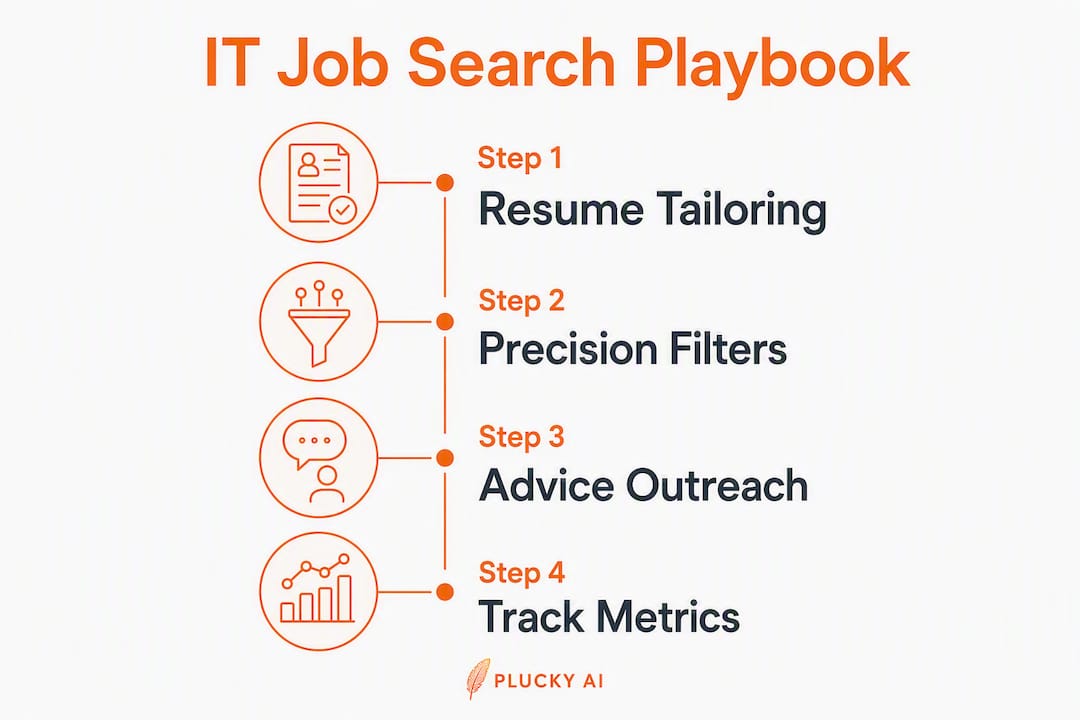
- How to approach an executive IT job search: the 4-step playbook
- How do you prompt AI to write ATS-optimized technical resumes?
- What outreach strategy actually works with security hiring managers?
- How do you run a stealth job search while still employed?
- What should you measure, and when should you expect results?
- How does Pluckjobs run the entire playbook in one workflow?
- Key Takeaways
- What actually moves the needle in an IT job search
- Pluckjobs gives you the full playbook in one place
- FAQ
What should you prepare before starting an AI-driven search?
Running this playbook without the right artifacts wastes time. Gather these before you begin:
- Current resume in both text and PDF formats
- A canonical list of job titles and role filters (e.g., "Cloud Security Architect," "GRC Manager," "Incident Response Lead")
- Verified LinkedIn profile and direct contact channels
- GitHub or portfolio URLs that signal technical depth
- A target-company list with signal events to watch (funding rounds, compliance mandates, leadership changes)
- API access or accounts for AI job-matching tools that use SerpAPI-style discovery
- Gmail OAuth or equivalent for automated job alert parsing
Pro Tip: Before feeding your resume to any AI matcher or ATS optimizer, run it through pdftotext or a plain-text extractor. ATS systems can silently reject visually rendered PDFs with corrupted text layers, and you will never know it happened.
How to approach an executive IT job search: the 4-step playbook
This sequence is repeatable on every target role. Each step has a measurable checkpoint.
-
Discover: Build precision filters combining tech stack (AWS, Azure, Kubernetes), compliance frameworks (NIST CSF, SOC 2, HIPAA), seniority level, and location preference. Set multi-board scanning across LinkedIn, Dice, CyberSecJobs, and niche forums. Rank results by fit score, not posting date.
-
Tailor: Create a job-specific resume variant using prompt recipes (detailed in the next section). Run an ATS-grade scoring pass and compare it against your control resume. Target an A-grade before submitting.
-
Outreach: Contact hiring managers in hand-checked batches. Exceeding roughly 25 invites per day increases the risk of being flagged as a vendor or spammer. For CISO-level targets, keep daily volume far lower. Use soft, advice-seeking asks with no links on first touch.
-
Measure: Track discovery-to-interview conversion, resume grade deltas, and outreach response rates on a Kanban board or spreadsheet. Run short weekly experiments and adjust filters, resume variants, or message framing based on what moves the numbers.
Precision filters to set: role title + seniority, tech stack keywords, compliance framework, remote/hybrid/onsite, company size, industry vertical.
Metrics to track from day one: resume grade (A/B/C/F), applications sent per week, outreach sent vs. responded, interview rate, and days from first application to first interview.
How do you prompt AI to write ATS-optimized technical resumes?
Generic AI prompts produce generic resumes. The prompt structure that works for IT and cybersecurity roles has four components: role context, target keywords and frameworks, measurable results, and formatting constraints.
Prompt recipe structure:
- State the role context: "I am applying for a GRC Manager role at a healthcare company requiring HIPAA and NIST CSF expertise."
- List target keywords: "Include HIPAA, NIST CSF, risk register, control gap analysis, and audit remediation."
- Specify measurable results: "Quantify outcomes where possible, e.g., reduced audit findings by 40%."
- Set formatting constraints: "Two-page ATS-safe format, no tables, no columns, standard fonts only."
Domain-specific examples:
- Cloud security architecture: Inject "AWS Security Hub, Zero Trust architecture, CIS Benchmarks, NIST SP 800-53."
- Incident response: Inject "MITRE ATT&CK, SIEM triage, mean time to contain (MTTC), NIST IR framework."
- GRC/compliance: Inject "SOC 2 Type II, HIPAA, ISO 27001, control mapping, third-party risk."
Before/after bullet rewrite using the exploit-patch-mitigation structure:
- Before: "Managed vulnerability scanning program."
- After: "Identified 1,200+ unpatched endpoints across hybrid infrastructure (exploit), deployed automated patch orchestration via Ansible (patch), reducing critical CVE exposure by 63% within 90 days (mitigation)."
Targeting an A-grade on a resume grader is the single highest-leverage step before submitting. The substantial shortlisting uplift is the reason to run the grader on every variant, not just the first draft. After generating, always run pdftotext to confirm the text layer is clean. Some AI-generated resume formats may also perform better with certain AI-assisted screening pipelines, so verify readability for both human reviewers and automated screens.
For a detailed tailoring checklist, see how to customize your resume per job posting.
What outreach strategy actually works with security hiring managers?
Cold pitches fail with security leaders. Pre-interview outreach that asks for advice on a technical challenge converts practitioners into internal champions. The key is proving you have done the research before you send a single word.
Start by citing something verifiable: a conference talk, a GitHub repo, a detection challenge they published, or a post they wrote. That one detail separates you from every vendor message they received that week.
Template A (advice request): Template B (approach feedback): Outreach dos and don'ts:
- Do reference a specific, verifiable technical detail from their recent work
- Do keep first contact to three sentences or fewer
- Do follow up with a value-add (a cited finding, a one-paragraph summary) rather than a repeated ask
- Don't attach links, files, or calendar invites in the first message
- Don't use merge-token personalization that reads as automated
- Don't exceed roughly 25 invites per day total; CISO outreach warrants much lower daily volume
Pro Tip: Cybersecurity professionals are often discoverable through GitHub, DEF CON, Black Hat, and BSides communities rather than standard job boards. Targeting those channels for outreach research produces warmer first contacts than cold LinkedIn searches.
For a breakdown of outreach types and timing, see IT recruiter outreach types.
How do you run a stealth job search while still employed?
Visibility is a risk when you are employed. These steps keep your search confidential:
- Use a personal email address for all job alerts and platform accounts
- Disable LinkedIn's "Open to Work" public badge and job-activity notifications
- Never search or apply from employer-owned devices or a corporate IP address
- Set alert filters that are specific enough to avoid broad-match noise that could surface your activity
- Avoid public posts or group comments that signal you are open to work
For third-party AI tools, confirm how resume content is transmitted and stored before uploading sensitive details. Reputable platforms process data over encrypted connections and do not retain resume content beyond the session. When in doubt, review the privacy policy before you paste anything.
What should you measure, and when should you expect results?
| KPI | Target range | Review cadence |
|---|---|---|
| Discovery matches per week | 10 high-fit roles | Weekly |
| Tailored applications sent | 3–5 per week | Weekly |
| Resume grade | A (target) | Per variant |
| Outreach sent vs. responded | around 25% response rate | Bi-weekly |
| Interview rate | around 10% of applications | Monthly |
| Time to first interview | 3–6 weeks (AI-assisted) | Monthly |
2-week A/B iteration cycle:
- Set a hypothesis: "Adding NIST CSF keywords to the summary section will raise my resume grade from B to A."
- Define the metric: ATS grade score on the grader.
- Apply the change to one variant only.
- After two weeks, compare grade and shortlisting rate between variants.
- Adopt the winning version and run the next experiment.
Prioritize resume-grade deltas and outreach response rate before adjusting discovery filters. A low response rate usually signals a message framing problem, not a targeting problem. Managing your pipeline data effectively keeps these experiments clean and comparable week over week.
How does Pluckjobs run the entire playbook in one workflow?
Pluckjobs combines every step above into a single platform. The Plucky AI workflow covers:
- Multi-board role discovery powered by SerpAPI, with precision filters for tech stack, compliance framework, seniority, and location
- ATS-grade resume scorer that grades each variant and flags keyword gaps before submission
- Prompt recipes for technical domains including GRC, cloud security, and incident response
- Hiring-manager contact intelligence via Apollo, surfacing direct contact data for the right person at each target company
- Outreach sequencing with pacing controls to keep daily invite volume within safe limits
| Stage | Self-managed | Pluckjobs |
|---|---|---|
| Role discovery setup | 2–4 hours | under 20 minutes |
| Resume tailoring per role | 45–90 minutes | around 10 minutes |
| Hiring-manager contact research | around 30 minutes per contact | Automated lookup |
| First match to first interview | 6–10 weeks | 3–5 weeks (typical) |
The platform runs on a credit-based model with a free trial, so you can verify fit before committing to a paid plan. Diego, who covers IT job search strategy on the Pluckjobs blog, draws on the platform's internal data and practitioner outreach patterns to inform the guidance in this article.
Key Takeaways
An A-grade resume (which correlates with a 45–60% increase in shortlisting success) combined with advice-first hiring-manager outreach and AI-powered role discovery is the highest-leverage approach to an IT and cybersecurity job search.
| Point | Details |
|---|---|
| A-grade resume uplift | Targeting an A-grade correlates with a 45–60% higher shortlisting rate versus unoptimized resumes. |
| Outreach pacing | Keep daily LinkedIn invites under roughly 25; CISO outreach warrants far lower daily volume. |
| Exploit-patch-mitigation bullets | Rewrite every resume bullet to state the problem, your action, and a quantified result. |
| Stealth search basics | Use personal email, disable public job-activity signals, and never apply from a corporate device. |
| Pluckjobs workflow | Pluckjobs combines SerpAPI role discovery, ATS grading, and Apollo contact intelligence in one platform. |
What actually moves the needle in an IT job search
Most IT professionals spend too much time on volume and not enough on precision. Sending 50 generic applications a week produces fewer interviews than sending 5 tailored ones with an A-grade resume and one well-researched outreach message per target company.

The advice-first outreach approach is the most underused tactic in this space. Security hiring managers receive vendor pitches constantly. A message that references their actual work and asks a genuine technical question stands out precisely because it is rare. Organizations that build pre-vacancy relationships convert passive candidates faster than those posting generic roles, and the same logic applies in reverse: candidates who build those relationships before a role posts get considered before the public posting even goes live.
The other mistake is treating resume optimization as a one-time task. Every role has a different keyword profile. Running the ATS grader on each variant and iterating based on grade deltas is what separates candidates who get callbacks from those who wonder why their resume disappeared.
Focus on quality matches, measure everything, and keep outreach human.
Pluckjobs gives you the full playbook in one place
Spending hours researching hiring managers, reformatting resumes for each role, and manually scanning five job boards is the slow path. Pluckjobs cuts that time significantly by combining SerpAPI-powered role discovery, an ATS resume grader, AI prompt recipes for technical domains, and Apollo contact intelligence into a single workflow.
The credit-based model means you pay for what you use, with no long-term commitment required. The free trial gives you enough credits to run role discovery, grade your current resume, and generate one tailored variant before you decide. For IT and cybersecurity professionals running a confidential search, the platform processes data securely and does not require you to use employer devices or accounts.
Start your free trial with Plucky AI and get your first precision role matches and resume grade within the same session.
FAQ
What is the best approach to an executive IT job search?
Combine AI-powered role discovery with ATS-grade resume tailoring and advice-first hiring-manager outreach. Targeting an A-grade resume correlates with a 45–60% higher shortlisting rate.
How many LinkedIn invites per day is safe for IT outreach?
Staying under roughly 25 invites per day reduces the risk of being flagged as a spammer. For CISO-level targets, keep daily volume significantly lower and personalize every message.
How do I tailor a cybersecurity resume for ATS systems?
Use an exploit-patch-mitigation bullet structure, inject domain frameworks like NIST, OWASP, or HIPAA, and verify the text layer with pdftotext before submitting. Run an ATS grader and target an A-grade.
How long does an AI-driven IT job search take to produce interviews?
With a fully configured AI workflow, most IT and cybersecurity professionals see their first interviews within 3–6 weeks of starting targeted applications and outreach.
Can Pluckjobs support a confidential job search while employed?
Yes. Pluckjobs is designed for professionals running a stealth search: use a personal email, keep job-activity signals private, and run all searches outside employer-owned devices and networks.