
TL;DR:
- AI job matching uses machine learning to connect candidates with roles based on skills and experience, not just keywords. Nearly half of organizations now use AI in HR, filtering or ranking applications before human review. Optimizing resumes with specific skills and certifications improves AI fit scores and expands visibility to relevant roles.
AI job matching is defined as the use of artificial intelligence algorithms to connect job seekers with roles based on a deep analysis of skills, experience, and career context, not just keywords or job titles. For IT and cybersecurity professionals, this distinction matters enormously. 43% of organizations now use AI in HR, nearly doubling from 26% a year earlier. That means nearly half of the roles you apply for are already filtered or ranked by an AI engine before a human recruiter ever sees your name. Understanding what AI job matching is, and how to work with it, is no longer optional.
What is AI job matching and how does it work?
AI job matching is the industry term for automated candidate-to-role alignment using machine learning. It goes far beyond the Boolean keyword filters that dominated recruiting in the 2010s. The core mechanism converts both your resume and a job description into mathematical vectors, numerical representations of meaning that allow the system to measure semantic similarity rather than exact word overlap.
Here is what that process looks like in practice:
- Resume parsing: The AI extracts structured data from your resume, including job titles, skills, certifications, and tenure.
- Skills ontology mapping: The system maps your skills onto a graph of related technical terms. Skills ontologies allow the AI to recognize that "PostgreSQL" and "Postgres" are the same skill, and that a "penetration tester" likely knows "Kali Linux" and "Metasploit."
- Semantic comparison: Transformer language models compare your profile vector to the job description vector, measuring conceptual closeness rather than literal matches.
- Weighted scoring: The system scores candidates by skills, experience recency, seniority level, and career trajectory. Must-have criteria carry more weight than nice-to-haves.
- Ranked shortlist with rationale: AI matching produces ranked shortlists with explanations, so recruiters can see why you ranked where you did and override the result if needed.
This is fundamentally different from a recruiter searching a database for "CISSP AND firewall AND 5 years." The AI reads the narrative of your career, not just its labels.
Pro Tip: Use full skill names and recognized certifications on your resume, such as "Certified Information Systems Security Professional (CISSP)" rather than just the acronym. Skills ontologies recognize both forms, and the full name improves your semantic match score.

What are the benefits of AI job matching for IT and cybersecurity professionals?
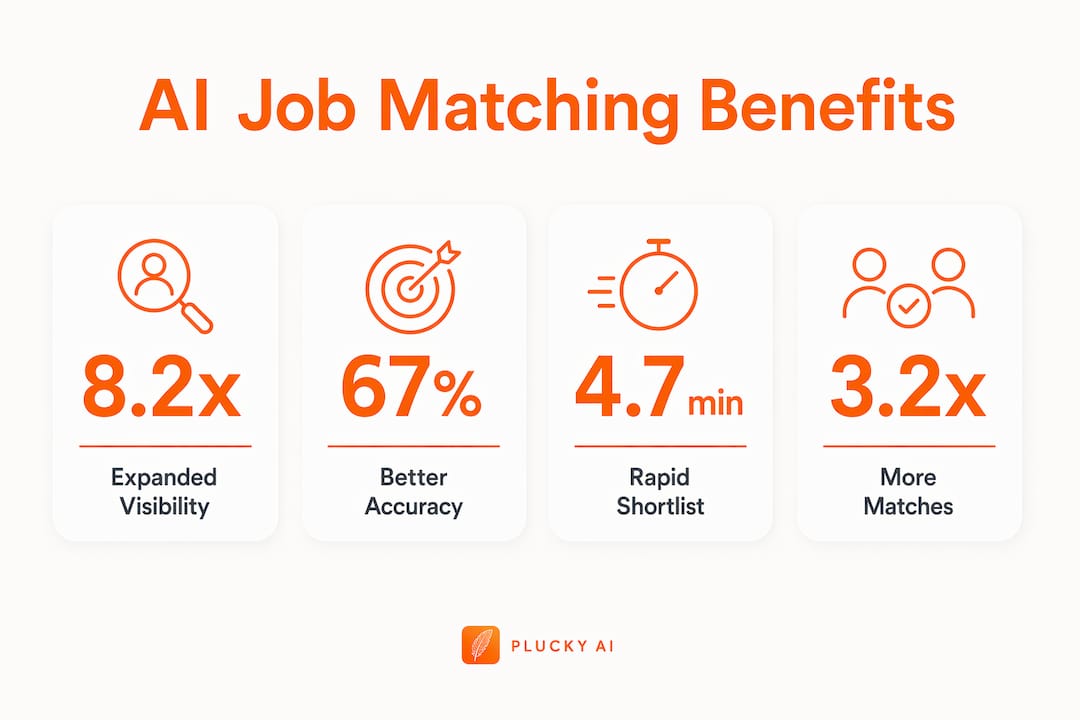
The benefits of AI job matching for tech professionals are measurable and significant. Skills-based AI matching expands candidate pools by 6x generally, and by 8.2x for AI-specific roles, compared to title-based searches. That expansion cuts both ways: you become visible for roles you would never have found by searching job titles alone.
Speed: from hours to minutes
AI-driven matching reduces the time to build a qualified shortlist to 4.7 minutes, compared to 3.2 hours for manual methods. Average time-to-fill drops from 42 days to 14 days. For you as a job seeker, that means faster callbacks, faster interview cycles, and a shorter gap between application and offer.
Accuracy: better fit, fewer wasted applications
Skills-based AI improves candidate-to-job fit by 67% over title-based approaches. That improvement translates directly into fewer rejections for roles you are genuinely qualified for, and fewer interviews where the job turns out to be nothing like the description.
Hidden skill discovery
AI job matching identifies transferable and hidden skills that traditional searches miss entirely. A cybersecurity analyst who spent two years in a cloud infrastructure role may not have "cloud security" in their job title, but the AI reads the experience and maps it correctly. AI highlights candidates with transferable skills that would never surface in a keyword search.
The practical benefits for IT and cybersecurity job seekers include:
- Visibility for roles outside your exact title history
- Faster shortlisting and interview scheduling
- More accurate job recommendations based on actual skill depth
- Reduced time spent on applications that were never a real fit
- Better targeting of applications toward roles where you rank highly
How does AI job matching compare to traditional job search methods?
AI and traditional recruiting each have a distinct role. Understanding where each method excels helps you use both more effectively.
AI excels at speed, scale, and pattern recognition across large volumes of data. Semantic AI search identifies 3.2x more qualified candidates than keyword filtering. It processes thousands of applications in the time a recruiter spends reviewing ten. For IT and cybersecurity roles, where skill sets are highly specific and certifications matter, that depth of analysis is a genuine advantage.
Traditional recruiting excels where AI struggles. Cultural fit, communication style, leadership potential, and the nuanced judgment calls that define a great hire still require human assessment. AI also carries real limitations around transparency and bias. Training data reflects historical hiring patterns, which can disadvantage candidates from non-traditional backgrounds. By 2026, 87% of companies use AI recruiting, but only 52% report satisfaction with results. That gap points directly to the limitations of AI when used without human oversight.
The most effective hiring workflows combine both. AI handles the initial screening and ranking. Recruiters then apply judgment to the shortlist, focusing their time on substantive conversations rather than resume sorting. AI candidate matching shifts repetitive screening from recruiters so they can focus on the interactions that actually predict job performance.
Pro Tip: Do not treat AI matching as the finish line. Use it to get shortlisted, then invest in direct outreach to the hiring manager. A warm introduction still outperforms a cold application, even a highly ranked one.
How can IT and cybersecurity professionals get better results from AI matching tools?
Getting the most from AI job placement tools requires deliberate preparation. The AI reads your resume as data, so the quality of that data determines your ranking.
-
Write skills-forward resumes. List specific technologies, frameworks, and certifications explicitly. "Managed network security" is vague. "Deployed Palo Alto Networks NGFW and managed Splunk SIEM for a 2,000-node enterprise network" gives the AI concrete, mappable data. Learn how AI writes job-specific resumes to understand exactly what the system looks for.
-
Use AI tools for role discovery, not just applications. AI career matching services surface roles you would not find by browsing job boards manually. Platforms that combine role discovery with contact intelligence let you find the role and the hiring manager in one step.
-
Align your resume language to each role. AI matching scores semantic similarity, so a resume tailored to a specific job description will rank higher than a generic one. Review the job posting and mirror its terminology where it accurately reflects your experience.
-
Combine AI screening with direct outreach. Getting ranked highly by an AI system is the start, not the end. Pair your AI-matched applications with direct contact to hiring managers. Platforms like Pluckjobs provide hiring manager contact data alongside job matches, which closes the gap between a strong AI ranking and an actual conversation.
-
Track your match scores and adjust. If you are applying to roles where your AI match score is consistently low, the problem is usually a skills gap or a terminology mismatch on your resume. Use that feedback to refine your profile rather than applying more broadly.
Common pitfalls to avoid:
- Relying entirely on AI recommendations without reviewing job criteria yourself
- Using generic resume language that the AI cannot map to specific skills
- Ignoring roles outside your exact title history where your skills transfer well
- Skipping interview preparation because the AI ranked you highly
Understanding how to use AI tools for job search in IT gives you a practical framework for combining these steps into a repeatable process.
Key Takeaways
AI job matching gives IT and cybersecurity professionals a measurable advantage by surfacing more relevant roles faster, improving match accuracy by 67%, and expanding candidate visibility by up to 8.2x compared to title-based searches.
| Point | Details |
|---|---|
| AI reads skills, not just titles | Skills-based matching surfaces roles your title history alone would never reveal. |
| Speed is a real advantage | AI shortlisting takes 4.7 minutes versus 3.2 hours manually, cutting time-to-fill from 42 to 14 days. |
| Candidate pools expand dramatically | AI matching expands pools by 6x generally and 8.2x for AI-specific roles over keyword searches. |
| Human judgment still matters | AI handles screening; recruiters and direct outreach handle the decisions that determine final hires. |
| Resume quality drives AI ranking | Specific skills, full certification names, and role-aligned language directly improve your match score. |
Why I think most IT job seekers are using AI matching backwards
Most professionals I see treat AI job matching as a passive filter. They upload a resume, wait for recommendations, and apply to whatever the system surfaces. That approach misses the point entirely.
The real power of automated job matching is not that it finds jobs for you. It is that it tells you, implicitly, how the market reads your profile. When your match scores are low for roles you know you can do, that is diagnostic information. Your resume is not communicating your skills in the language the AI understands. That is fixable in an afternoon.
The professionals who get the most from AI career matching services are the ones who treat the system as a feedback loop. They adjust their resume language, watch their scores change, and use that signal to sharpen their positioning before they ever send an application. Pair that with direct hiring manager outreach and you have a job search strategy that actually compounds over time. AI handles the volume. You handle the relationship. Neither works as well without the other.
— Diego
Pluckjobs: AI job matching built for IT and cybersecurity professionals
Pluckjobs combines SerpAPI-powered role discovery with Apollo contact intelligence to deliver precision job matches, hiring manager outreach data, and tailored resumes in one place.
For IT and cybersecurity professionals, that means you find the right role, identify the right person to contact, and send a targeted application, all without cold applying into a void. Pluckjobs maps your technical skills against live job postings, surfaces roles that match your actual experience depth, and gives you the contact data to act on every match directly. Start your AI-powered job search and see how precision matching changes the speed and quality of your results.
FAQ
What is AI job matching in simple terms?
AI job matching uses machine learning algorithms to compare a candidate's skills and experience to job requirements at a semantic level, not just by keyword overlap. The result is a ranked list of roles or candidates based on actual fit.
How does AI job matching work for cybersecurity roles?
The AI parses your resume into structured data, maps your certifications and technical skills onto a skills ontology, and scores your profile against job descriptions using semantic similarity. Skills like "penetration testing" and related tools are recognized as a cluster, not isolated keywords.
What are the main benefits of AI job matching for IT professionals?
AI job matching expands your visibility to relevant roles by up to 8.2x, improves match accuracy by 67% over title-based searches, and reduces the time from application to shortlist from hours to minutes.
Does AI job matching replace recruiters?
AI handles initial screening and ranking, but recruiters retain final judgment on cultural fit, soft skills, and hiring decisions. The most effective hiring processes combine AI screening with human assessment.
How can I improve my AI match score?
Use specific technology names, full certification titles, and role-aligned language on your resume. Skills ontologies recognize exact terms, so precise language directly raises your semantic similarity score against target job descriptions.