
Why tailoring your resume per job posting changes everything
Generic resumes fail before a human ever reads them. Tailored resumes achieve significantly higher keyword match rates against job descriptions compared to generic ones, increasing the chance to pass ATS filters. That gap is the difference between an ATS filter passing your application and discarding it silently. Customizing your resume per job posting means adapting your existing content to mirror each job description's specific language, priorities, and required skills. You are not fabricating experience. You are translating your real background into the words the employer already uses.
The payoff is measurable. Resumes with strong keyword alignment advance to interviews at a substantially higher rate than generic submissions. Three sections drive nearly all of the improvement: professional summary, skills section, and top bullet points. Tailoring these achieves most of the ATS score improvement. Full rewrites add almost nothing beyond that.
How to customize your resume per job posting in 10–15 minutes
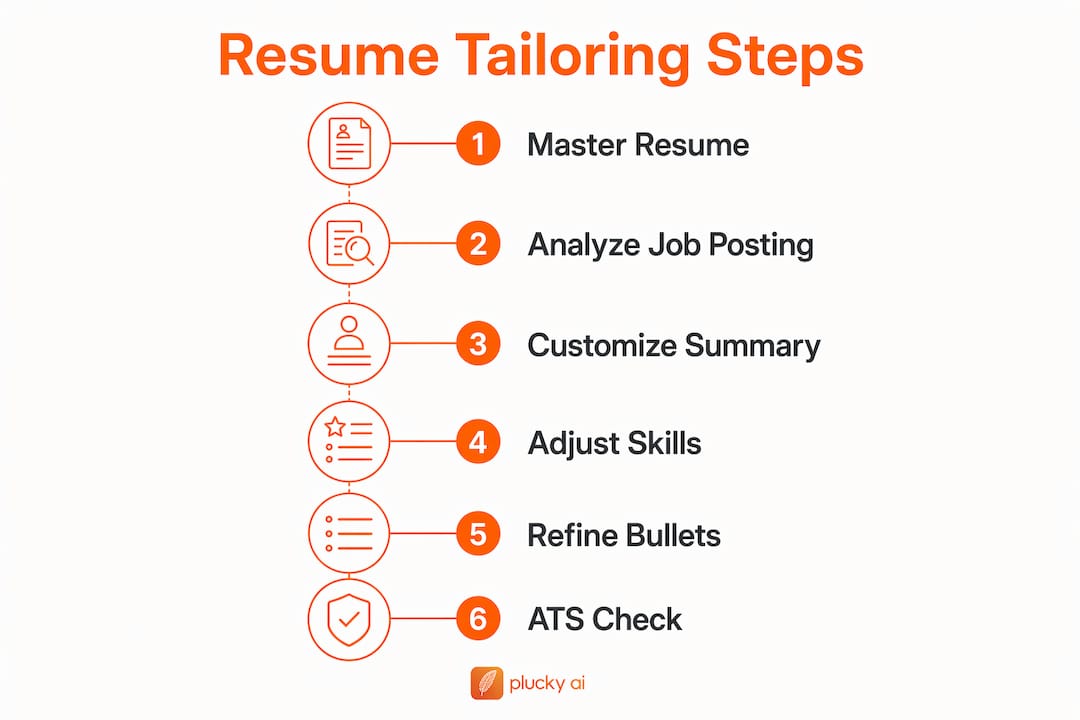
A repeatable 4-step method keeps each application under 15 minutes once you have practiced it a few times.
- Step 1 (3 minutes): Read the job description and extract three keyword categories: hard skills and tools, day-to-day responsibilities, and success outcomes. Keywords that appear multiple times signal the employer's top priorities.
- Step 2 (2 minutes): Update your skills section. Lead with the role's top tools, drop anything irrelevant to this posting, and add specific platforms or frameworks the job description names.
- Step 3 (5 minutes): Rewrite 3–5 bullets using the STAR method (Situation, Task, Action, Result) to weave in JD keywords alongside quantified outcomes.
- Step 4 (1 minute): Update your summary or headline to mirror the exact job title from the posting. ATS systems match titles literally, so "Senior Frontend Engineer" and "UI Engineer" are not interchangeable.
Pro Tip: Build a master resume first. This is a 4–5 page document containing every bullet, project, and skill you have ever used. For each application, copy it and cut down to a targeted one-page version. You never lose strong bullets, and you never rewrite from scratch.
Career expert Robin Ryan warns against over-customization: if you are spending 45 minutes per application, you are rewriting, not tailoring. Strategic refinement of the highest-impact sections beats exhaustive overhauls every time.
How ATS systems score your resume and what that means for you
Applicant Tracking Systems scan for specific keywords, formatting patterns, and structural signals before any recruiter sees your file. Understanding how they score helps you target your effort precisely.
- ATS systems weight the first 5–8 skills listed more heavily than items buried lower. Reordering your skills section to lead with the job's top tools boosts your ranking without adding a single new word.
- Keyword placement matters across sections. A tool mentioned only in your bullets but absent from your skills section may not register as a confirmed qualification.
- An 80% match score is considered strong. Scores below 65% are likely to be filtered out before a human review.
Common ATS pitfalls to avoid:
- Keyword stuffing: listing every term from the JD without context. ATS systems are increasingly sophisticated, and recruiters notice padding immediately.
- Inconsistent job titles: your held title stays accurate in the experience section. Use the summary or headline to mirror the target role's title.
- Irrelevant skills: they dilute your keyword match for this specific role. Cut them for each tailored version, even if they stay in your master resume.
Before submitting, run your tailored resume through an ATS scoring tool alongside the job description. A score above 80 means your keyword coverage is solid. Anything below that warrants another pass at the skills section and top bullets.
What a tailored resume actually looks like versus a generic one
The difference between a generic and a tailored resume is visible in three places: the summary, the skills list, and the top bullet points.
| Element | Generic resume | Tailored resume |
|---|---|---|
| Summary | "Results-driven professional with 5 years of experience" | "Senior Frontend Engineer with 5 years building React and TypeScript applications at scale" |
| Skills section | Python, JavaScript, AWS, SQL, communication | React, TypeScript, Next.js, PostgreSQL, GraphQL, AWS (ECS, S3) |
| Top bullet | "Improved application performance" | "Reduced page load time by 40% by migrating legacy jQuery to React 18 with lazy loading" |
| Keyword match | a low percentage of JD keywords | a high percentage of JD keywords |
| ATS outcome | Likely filtered | Passes to recruiter review |
A few patterns that make tailored resumes work:
- Lead the summary with your most relevant achievement for this role, not years of experience or buzzwords like "detail-oriented."
- Mirror the employer's exact phrasing. If the posting says "cross-functional collaboration," do not write "worked with other teams." Same skill, different keyword match.
- Quantify bullets wherever possible. "Increased quarterly enterprise sales by 34%" is concrete. "Improved sales" tells a recruiter nothing.
How to organize and submit tailored resumes without losing track
Managing multiple tailored versions requires a simple system. Without one, you will submit the wrong file or lose a strong bullet you wrote for a previous application.
- Maintain your master resume as a living document. Add new bullets after every project or role change. This is your source, never something you send directly.
- Name files clearly: use a format like
resume-google-swe-2026.pdfso you can reference each version later without opening every file. - Create an application folder for each role containing the job description, your tailored resume, and any notes on the company or hiring manager.
- Run an ATS check before submitting. Paste your resume and the job description into a scoring tool. Fix any gaps before the file leaves your hands.
- Submission checklist: confirm your summary references the role, your skills section leads with the JD's top tools, your top bullets use JD language, and the file is saved as a PDF.
For IT and cybersecurity roles specifically, managing job search data across multiple applications adds another layer of complexity. A consistent naming and folder system prevents the version-control problems that cost candidates interviews.
How AI tools accelerate resume tailoring without sacrificing accuracy
AI tools handle the time-consuming parts of tailoring: scanning job descriptions, extracting keywords, and suggesting bullet rewrites. Done right, they cut the manual effort significantly while keeping your resume truthful.
What AI does well in this workflow:
- Extracts hard skills, responsibilities, and outcome keywords from a job description in seconds
- Suggests rewritten bullets that incorporate JD language while preserving your underlying experience
- Flags keyword gaps between your current resume and the posting
What AI cannot do for you:
- Verify that suggested skills actually match your real background
- Guarantee that rewritten bullets accurately represent what you did
- Replace your judgment on which experiences are most relevant
Pro Tip: Use AI output as a first draft, not a final product. Review every suggested change against your actual experience. The ethical boundary is clear: AI adjusts language and framing; it never invents skills or alters job titles, company names, or dates.
Plucky AI, Pluckjobs's built-in tailoring tool, applies this approach directly to IT and cybersecurity roles. It scans job descriptions, surfaces the keywords your resume is missing, and suggests targeted rewrites, all without fabricating qualifications. For professionals applying to AI-matched IT roles, that combination of role discovery and resume tailoring in one platform removes the back-and-forth between separate tools.

How to analyze a job posting to identify key skills and qualifications
Reading a job description strategically takes about three minutes and shapes every tailoring decision that follows. Start with the required qualifications section. These are non-negotiable: if the posting says "5 years of project management experience," your resume needs to show that clearly. Preferred qualifications are bonus points. Matching even a few of them puts you ahead of candidates who only hit the minimums.

Next, read the narrative paragraphs, not just the bullet lists. Employers often reveal their actual priorities in the description of the role's context and goals. Repeated terms signal priority. If "cross-functional" appears three times, it belongs in your summary and at least one bullet. Finally, note the action verbs the posting uses ("drive," "lead," "implement") and mirror them in your bullets. Keyword matching on SEO-adjacent principles applies here too: exact phrasing outperforms synonyms in automated scoring.
How to tailor your cover letter alongside your resume
A tailored cover letter reinforces the same keyword signals your resume sends. Open with the specific role title and the single most relevant achievement you bring to it. Do not restate your resume chronologically. Instead, address the employer's top two or three stated priorities directly and explain how your background maps to each one.
Keep the language consistent with your resume. If your resume says "cross-functional collaboration," your cover letter should use the same phrase. Inconsistency between the two documents signals a copy-paste job. Close with a concrete next step: a request for a conversation about the role, not a generic "I look forward to hearing from you."
Common mistakes to avoid when customizing resumes
Most tailoring errors fall into a few predictable patterns. Knowing them in advance saves time and prevents rejections that have nothing to do with your actual qualifications.
- Changing your held job titles: your experience section must reflect the title you actually held. Misrepresenting titles is a background-check failure waiting to happen.
- Only tailoring the skills section: a mismatched summary with a tailored skills list signals you did not read the posting carefully. All three core sections need to align.
- Ignoring the narrative paragraphs in the job description. The bullet list of requirements is not the whole picture. The paragraphs often contain the most revealing language about what the employer values.
- Over-customizing: spending 45 minutes per application produces diminishing returns and leads to burnout. The common IT job search mistakes that cost candidates the most are often about effort misallocation, not effort volume.
- Listing skills you cannot discuss: if an interviewer asks about a tool you added to hit a keyword, you will lose credibility immediately.
How to measure and improve recruiter appeal through tailored resumes
Recruiter appeal is measurable before you submit. The top-half test is the fastest check: if a recruiter reads only the top half of your resume, do they immediately know what role you are applying for and why you are qualified? If not, your summary and top bullets need work.
For a more precise read, run your resume through an ATS scoring tool with the job description. A score above 80 indicates strong keyword coverage. Below 65 means the resume will likely be filtered before a recruiter sees it. Track your response rate across applications. If you are sending tailored resumes and still not getting callbacks, the issue is usually title match or specificity in the top bullets, not volume. Job search metrics like response rate per tailored application give you the data to adjust your approach rather than guess.
Pluckjobs gives IT and cybersecurity pros a faster path to tailored applications
Tailoring resumes manually works. It also takes time that compounds across dozens of applications. Pluckjobs is built for IT and cybersecurity professionals who want precision job matches and tailored resumes without the back-and-forth between separate tools.
Plucky AI, Pluckjobs's AI-powered engine, combines Apollo contact intelligence with SerpAPI-powered role discovery to surface the right roles and the right hiring managers simultaneously. It scans each job description, identifies keyword gaps in your resume, and generates targeted rewrites that reflect your actual experience. No fabricated skills. No generic templates. The result is a tailored resume aligned to a specific posting, paired with direct outreach data for the person making the hiring decision. For IT and cybersecurity professionals tired of cold applying to roles that never respond, start with Plucky AI and apply with a resume that was built for the role, not just sent to it.
Key Takeaways
Tailoring your resume to each job posting is the single highest-impact change you can make to your job search, and it takes 10–15 minutes per application with a repeatable method.
| Point | Details |
|---|---|
| Keyword match gap | Generic resumes capture fewer than half the keywords in job descriptions, while tailored resumes can reach 75–90% match and clear most ATS filters. |
| Three sections drive results | Summary, skills, and top 3–5 bullets account for 94% of ATS scoring impact; full rewrites add little extra value. |
| Interview rate impact | Tailored resumes advance to interviews at 3.8x the rate of generic submissions. |
| Master resume system | Maintain a single source document and copy it for each application to avoid rewriting from scratch. |
| Pluckjobs for IT pros | Plucky AI scans job descriptions, flags keyword gaps, and generates tailored resumes with hiring manager outreach data in one platform. |
FAQ
How long does it take to customize a resume per job posting?
With a master resume and a repeatable process, tailoring takes 10–15 minutes per application. If you are spending 45 minutes, you are rewriting rather than tailoring.
Which sections should I tailor for every job?
Tailor your professional summary, skills section, and top 3–5 bullet points every time. These three areas carry 94% of ATS scoring impact; full rewrites add little extra value.
What ATS score should I aim for before submitting?
An 80% match score is considered strong. Scores below 65% are likely to be filtered before a recruiter sees the application.
Can AI tools help me tailor my resume without misrepresenting my experience?
Yes, when used correctly. AI tools extract keywords and suggest rewrites but must be reviewed against your actual background. They adjust language and framing; they should never invent skills or alter factual details like job titles or dates.
What is a master resume and why does it matter?
A master resume is a comprehensive 4–5 page document containing every bullet, project, and skill you might use across applications. You copy it for each role and cut it down to a targeted one-page version, preserving strong content without starting from scratch each time.