
TL;DR:
- Direct outreach to hiring managers gives IT professionals a response rate 10 to 100 times higher than applying through portals. Contacting the person who owns the hiring decision greatly increases the chance of being hired, especially when using verified contact information. Personalized, concise messages with specific achievements and relevant knowledge are essential for successful outreach.
Direct outreach to hiring managers is defined as contacting the person who owns the hiring decision, bypassing applicant tracking systems and recruiter gatekeepers entirely. For IT professionals, this approach is not optional. Cold outreach yields 10–100x more responses than submitting through online portals. Candidates who reach hiring managers directly are 5 times more likely to be hired than those who apply through job boards alone. This guide covers how to identify the right person, find their contact details, write a message that gets a reply, and avoid the mistakes that kill most outreach attempts before they start.
How to reach hiring managers directly: finding the right person first
The first step is identifying who actually makes the hiring decision. That person is rarely the recruiter or the HR coordinator. At most companies, the hiring manager is the team lead, engineering manager, or department head whose budget funds the role.
Start with the job posting itself. Many postings list a team name or reporting structure. Search that team name on LinkedIn using the "People" filter, then narrow by title. Look for titles like "Engineering Manager," "Director of IT," or "Head of Security." At smaller companies, the CTO or VP of Engineering often interviews candidates directly.
- Search the company's LinkedIn page and filter employees by department and seniority level.
- Check the company's "About" or "Team" page for named leaders in the relevant function.
- Look at press releases and conference speaker bios. IT leaders who speak publicly are easy to identify by name and title.
- Ask alumni from your university or former colleagues who work at the target company for a warm introduction.
Candidates with a connection at a company are 9 times more likely to get hired. A warm introduction from a mutual contact is the single fastest path to a conversation. When no connection exists, cold outreach is the next best option, but you must still target the right person.
Pro Tip: At large enterprises with 1,000+ employees, avoid reaching out to the general recruiter listed on the job post. That person screens hundreds of applications daily. The engineering manager who needs the role filled is far more motivated to respond.

For smaller companies, the hiring manager and the founder are sometimes the same person. A brief, direct message on LinkedIn or a well-crafted email to the company domain can land directly in front of the decision-maker with no intermediary at all.
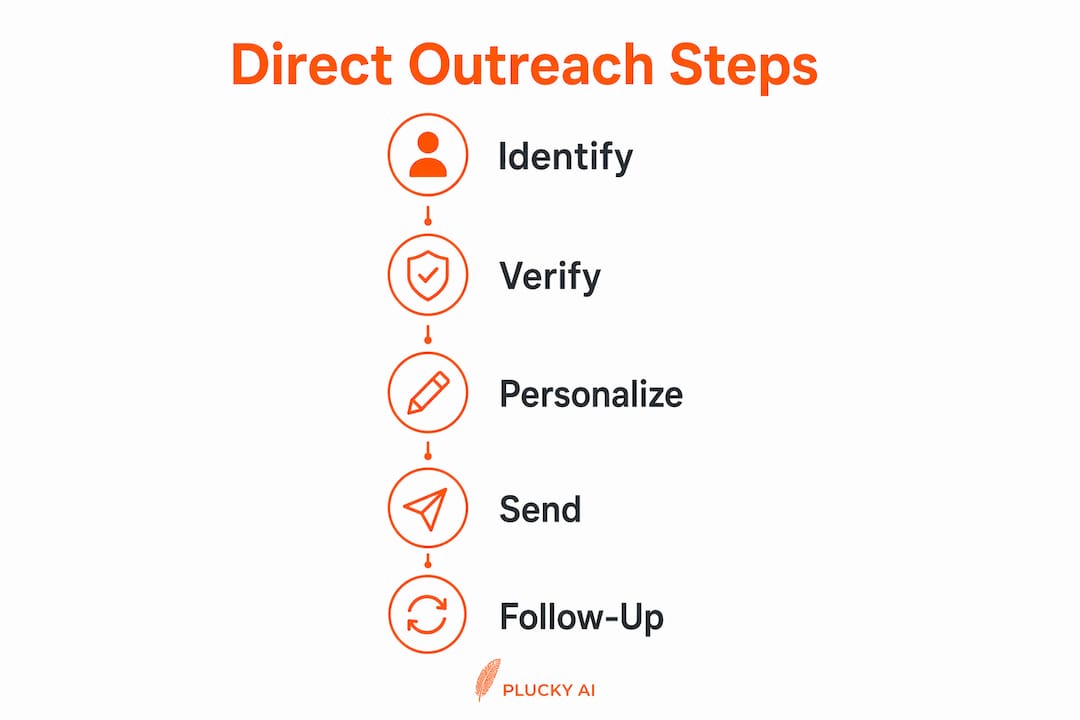
How do you find a hiring manager's email address?
Finding a verified email address is the most concrete step in the outreach process. Several methods work reliably for IT professionals.
- Use an email finder tool. Tools like Hunter.io, Apollo, and Snov.io search public web data to surface professional email addresses. Apollo, which powers Pluckjobs' contact intelligence layer, cross-references multiple data sources to improve accuracy. Always run the result through a verification step before sending.
- Identify the company's email format. Most companies use one consistent pattern: firstname.lastname@company.com or f.lastname@company.com. Press releases and employee bios often contain publicly listed emails that reveal the format. Once you know the pattern, constructing the hiring manager's address is straightforward.
- Check LinkedIn for direct contact details. Some professionals list their work email in their LinkedIn contact section. Others have a personal website linked from their profile that includes contact information.
- Use LinkedIn direct messages as a fallback. LinkedIn messages and phone calls serve as reliable alternatives when a direct email address is not available. A concise LinkedIn message that mirrors the structure of a good cold email performs nearly as well.
The table below summarizes the main contact discovery methods and their best use cases.
| Method | Best use case |
|---|---|
| Hunter.io / Apollo / Snov.io | Finding verified emails at mid-to-large companies |
| Email format inference | When one public email from the company is already known |
| LinkedIn contact section | When the professional lists their email publicly |
| LinkedIn direct message | Fallback when no email address can be verified |
| Warm introduction | Highest conversion; use when a mutual connection exists |
Pro Tip: Before sending, paste the email address into an email verification tool like NeverBounce or ZeroBounce. A hard bounce on your first message can damage your sender reputation and flag your domain as spam.
For a deeper breakdown of finding a hiring manager's email, the process of cross-referencing public sources is covered in detail with worked examples.
What makes an outreach email actually work?
Effective outreach avoids cover letter style entirely. A cover letter recaps your resume. A good outreach email does one thing: it connects a specific achievement you have to a specific problem the team is facing.
Keep the email under 100 words. Hiring managers read dozens of messages daily. A long email signals that you do not respect their time. The structure that works is simple: one sentence on who you are, one sentence on a concrete result you delivered, one sentence connecting that result to their team's likely need, and a single low-friction ask.
- Subject line: Be specific. "Senior Network Engineer with AWS experience" outperforms "Exploring opportunities at [Company]" every time.
- Opening line: Name the role or team directly. "I saw your team is hiring a cloud security engineer" is better than any generic opener.
- Core claim: State one measurable achievement. "I reduced incident response time by 40% at [Previous Company] by rebuilding the SIEM pipeline" is the kind of sentence that earns a reply.
- Call to action: Ask for a 15-minute call, not a full interview. Low-friction asks get higher response rates.
- No attachments: First emails should include a LinkedIn or portfolio link instead of attached files. Attachments trigger spam filters and security flags at many corporate email systems.
Outreach messages work best as conversation starters with clear relevance to the team's current needs. Research the company's recent product launches, engineering blog posts, or open roles to find that relevance before you write a single word.
Follow up once, five to seven business days after the first email. Keep the follow-up to two sentences. If there is no reply after the second message, move on. Persistence is professional. Repeated messages after two attempts is not.
Common mistakes that kill IT outreach before it starts
Most outreach fails not because the candidate is unqualified, but because the message reaches the wrong person or says the wrong thing.
- Targeting recruiters at major tech firms. Outreach to recruiters at top tech companies is often counterproductive. Recruiters at large firms manage pipeline volume. The hiring manager owns the decision and is far more motivated to respond to a relevant candidate.
- Using generic salutations. "Dear Hiring Manager" signals that you did not research the company. Use the person's actual name. If you cannot find it, do more research before sending.
- Reaching out before applying. At companies with a formal application process, contacting the hiring manager before submitting an application can create friction. Apply first, then follow up with a direct message referencing your application.
- Ignoring the company's preferred process. Some organizations explicitly state that candidates should not contact employees directly. Respecting that boundary is not weakness. Violating it removes you from consideration immediately.
- Sending the same message to multiple people at the same company. Hiring teams talk. If two people receive the same generic email from you on the same day, the conversation about you will not be positive.
Company career pages, LinkedIn, and professional networks should be your first research stops before any outreach. Understanding the company's culture and hiring process shapes every decision that follows. For IT professionals who want a structured approach, the IT job application workflow covers how direct outreach fits into a complete job search system.
Key Takeaways
Direct outreach to hiring managers, backed by verified contact data and a concise, achievement-focused message, is the most effective method for IT professionals to bypass applicant tracking systems and get hired faster.
| Point | Details |
|---|---|
| Target the decision-maker | Contact the engineering manager or team lead, not the recruiter or HR coordinator. |
| Verify contact data | Use tools like Hunter.io or Apollo, then confirm the address before sending. |
| Write under 100 words | Lead with one concrete achievement tied directly to the team's known need. |
| Skip attachments | Include a LinkedIn or portfolio link instead to avoid spam filters. |
| Follow up once | Send one follow-up after five to seven business days, then move on. |
Why most IT professionals are one email away from a conversation
I have reviewed hundreds of outreach attempts from IT professionals, and the pattern is consistent. The candidates who get replies are not always the most qualified. They are the ones who did the research. They know the team's stack. They reference a recent product launch or a specific engineering challenge the company has written about publicly. That specificity is what separates a reply from a delete.
The biggest mistake I see is treating direct outreach as a numbers game. Sending 50 generic emails produces worse results than sending 5 highly personalized ones. The research phase, finding the right person, understanding their team's context, and connecting your background to their actual problem, takes longer than writing the email itself. That is the point. The research is the work.
LinkedIn alone is not enough for IT professionals in a competitive market. Direct email outreach, backed by verified contact data and a message that demonstrates genuine knowledge of the company, is what moves the needle. The professionals who combine both consistently outperform those who rely on either channel alone.
Persistence matters, but it has a hard limit. One follow-up is professional. Two is the maximum. Beyond that, you are not demonstrating interest. You are demonstrating that you do not read social signals, which is not a quality any hiring manager wants on their team.
— Diego
Pluckjobs makes hiring manager outreach faster for IT professionals
Finding the right hiring manager, verifying their contact details, and writing a personalized message takes hours when done manually. Pluckjobs cuts that time significantly for IT and cybersecurity professionals.
Pluckjobs combines Apollo contact intelligence with AI-powered role discovery to surface the hiring manager behind each open role, not just the job listing. The platform delivers verified contact data, tailored resume suggestions, and outreach support in one place. IT professionals who use Plucky AI spend less time researching and more time in actual conversations with the people who make hiring decisions. No more cold applying to black-hole portals. Find the role, find the person, get hired.
FAQ
What is direct outreach to a hiring manager?
Direct outreach means contacting the person who owns the hiring decision, typically an engineering manager or team lead, rather than submitting through a job portal or recruiter.
How effective is contacting hiring managers directly?
Cold outreach to hiring managers yields 10–100x more responses than applying through online portals, and directly sourced candidates are 5 times more likely to be hired.
What should I include in a cold email to a hiring manager?
Keep the email under 100 words. Include one concrete achievement, a clear connection to the team's need, and a low-friction ask such as a 15-minute call.
Should I attach my resume to the first outreach email?
No. Attachments trigger spam filters at many corporate email systems. Include a link to your LinkedIn profile or online portfolio instead.
How do I find a hiring manager's email address?
Use email finder tools like Hunter.io, Apollo, or Snov.io, then verify the address before sending. Cross-referencing press releases and employee bios also reveals the company's standard email format.