
TL;DR:
- IT managers face challenges in job searching due to ATS filters, outdated skills, and a focus on tasks over outcomes. Tailored applications, networking, and demonstrating business impact are key strategies to succeed in the modern IT job market.
IT manager job search challenges are defined by a collision of automation, skill obsolescence, and a hiring market that has fundamentally changed its expectations. The core problem is not a lack of qualified candidates. ATS filters reject roughly 97% of applications before a human ever reads them, and 78% of IT roles now require demonstrated AI proficiency. IT managers who built careers on infrastructure, uptime, and legacy systems find themselves filtered out by algorithms designed for a different era. Understanding why this happens is the first step toward fixing it.
Why IT managers struggle job searching: the ATS problem
Applicant Tracking Systems are the first and most brutal barrier in the modern IT job search. 98% of Fortune 500 companies use ATS platforms that screen resumes in 0.3 seconds, producing an interview rate of just 3%. That means for every 180 applications submitted, roughly five result in interviews. The math alone explains why mass applying fails.
ATS platforms do not read resumes the way humans do. They parse for exact phrase matches from the job description, which means synonyms and generic language trigger automatic rejections. An IT manager who writes "oversaw infrastructure" when the job description says "managed on-premises network architecture" may never reach a recruiter's inbox. The system is not evaluating competence. It is matching strings.
Common formatting errors compound the problem further. Multi-column layouts, graphics, headers embedded in text boxes, and non-standard fonts all cause ATS parsers to misread or skip content entirely. A resume that looks polished in PDF form can appear as a blank document to an ATS.
Common ATS failure points for IT managers:
- Using tables or columns to organize skills sections
- Listing certifications without spelling out the full name (e.g., "CISSP" without "Certified Information Systems Security Professional")
- Omitting keywords that appear verbatim in the job posting
- Submitting a PDF when the system requires a .docx file
- Writing a summary paragraph that uses no role-specific language
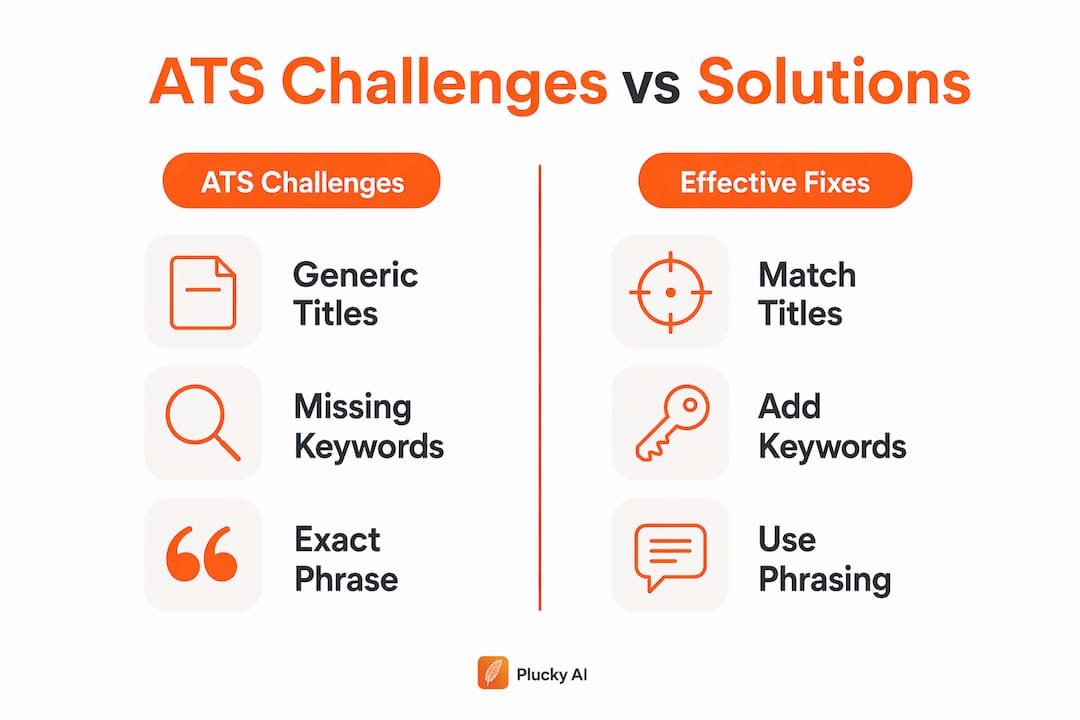
| ATS Issue | Fix |
|---|---|
| Generic job titles | Match the exact title from the job description |
| Missing keywords | Copy key phrases directly from the posting |
| Complex formatting | Use a single-column, plain-text-friendly layout |
| Vague skill labels | Spell out tools, platforms, and certifications in full |
Pro Tip: Run your resume through a free ATS simulator before submitting. Tools that parse your document and flag missing keywords will show you exactly where the system drops your application.
Hiring managers are also growing skeptical of ATS-screened resumes. Many report a disconnect between resume quality and actual interview performance, partly because AI-generated and heavily optimized resumes have flooded inbound pipelines. This creates a trust crisis that makes the human review stage harder to reach, not easier.
How outdated skills block IT managers from getting hired
The technical skill half-life has shortened to 2.5 years. That figure is not abstract. It means a skill set built between 2021 and 2023 is already approaching obsolescence in 2026. For IT managers who spent those years maintaining legacy systems or managing teams without hands-on cloud or AI work, the gap is real and visible to recruiters.

The demand shift is specific. Roles that once required network administration and server management now list AWS, Azure, Terraform, and AI governance as baseline requirements. An IT manager without documented experience in at least one of these areas faces an immediate disadvantage in keyword matching and recruiter screening alike.
Skills that are losing hiring weight in 2026:
- On-premises Active Directory administration without hybrid cloud experience
- Legacy ITSM tools without ServiceNow or Jira Service Management equivalents
- Hardware-focused infrastructure roles without virtualization or container knowledge
- Security roles without cloud security or zero-trust architecture exposure
The fix is not a complete career reinvention. 85% of employers now prioritize skills-based hiring, which means certifications and real project experience carry more weight than degrees. An IT manager who completes an AWS Solutions Architect certification and documents one cloud migration project has a concrete, verifiable credential to show. That is more persuasive than ten years of general management experience listed without context.
Portfolio development matters here. IT managers rarely think of themselves as portfolio workers, but a GitHub repository documenting an automation script, a case study of a cost-saving infrastructure change, or a write-up of a security incident response all serve as proof of applied skill. Recruiters and hiring managers can verify these. A resume bullet point cannot be verified at all.
Why soft skills and business outcomes now outrank technical credentials
Soft skill gaps cause 89% of hiring failures. That statistic reframes the entire hiring conversation. Technical competence is the entry ticket, not the differentiator. A LinkedIn survey found that 57% of senior leaders prioritize soft skills over hard skills when making hiring decisions. IT managers who present themselves purely as technical operators miss the criteria that actually drive selection.
The specific soft skills in demand are not vague. Communication, adaptability during organizational change, and the ability to lead cross-functional teams top the list. An IT manager who can describe how they translated a complex security incident into a board-level briefing demonstrates all three in one example.
Pro Tip: Replace every resume bullet that starts with "Responsible for" with a sentence that starts with a strong verb and ends with a measurable result. "Managed firewall" becomes "Reduced unauthorized access attempts by 40% by redesigning firewall rule sets across three data centers."
Hiring managers measure candidates against business outcomes, not task lists. Resumes that quantify results generate significantly more interview callbacks than those listing responsibilities. The difference between "managed a team of eight engineers" and "led a team of eight engineers to deliver a $2.1M network modernization project six weeks ahead of schedule" is the difference between being screened out and being called.
IT managers are often measured internally on legacy metrics like uptime, but modern hiring focuses on business value delivery. The translation work falls on the candidate. You must reframe your experience in the language of outcomes, cost savings, risk reduction, and revenue enablement before a recruiter ever sees your name.
Effective job search strategies for IT managers
Targeted applications outperform mass applying by a significant margin. Candidates who spend roughly 45 minutes per tailored application find relevant roles within 1–3 months. Those who mass apply with generic resumes average six months or longer. The time investment per application pays back in speed and quality of outcomes.
The most effective job search strategy for IT managers follows a clear sequence:
- Identify 10–15 target companies where your experience matches the business model, not just the job title.
- Map the job description and extract every technical term, certification, and soft skill listed. Mirror that language in your resume and cover letter.
- Build or update your LinkedIn profile to reflect the role you are targeting, not the role you currently hold. Recruiters search by keywords, and your headline and about section must match.
- Activate your network before you apply. A warm introduction from a current employee converts to an interview at 8 times the rate of a cold application. Referrals frequently bypass ATS entirely.
- Apply to roles where you meet 70–80% of requirements. Meeting every requirement is not the threshold. Clearing 70–80% of listed criteria while demonstrating strong outcomes is sufficient to advance.
Networking is not optional for IT managers in 2026. Recruiters increasingly distrust inbound job board applications because of the volume of AI-generated and embellished submissions. A referral from a trusted contact carries credibility that no resume can replicate. Attending industry events, contributing to professional communities, and maintaining relationships with former colleagues are not soft suggestions. They are the primary channel through which IT managers get hired.
Understanding how automated screening works from the hiring manager's side also gives you a real advantage. When you know what signals ATS platforms flag as positive, you can engineer your application to pass the filter and impress the human reviewer. That dual optimization is what separates candidates who get callbacks from those who do not.
Pro Tip: Track your job search metrics weekly. Application count, response rate, and interview conversion rate tell you exactly where your process is breaking down, so you can fix the right variable.
Job seekers who communicate clearly and demonstrate impact consistently outperform those with stronger technical credentials but weaker presentation. Visibility and clarity are skills. Treat them as such.
Key Takeaways
IT managers fail job searches most often because ATS filters, outdated skills, and a focus on tasks over outcomes block them before a human ever evaluates their application.
| Point | Details |
|---|---|
| ATS filters dominate screening | 98% of Fortune 500 companies use ATS; only 3% of applications reach an interview. |
| Skill half-life is 2.5 years | IT managers without AI or cloud credentials are increasingly filtered out at the keyword stage. |
| Soft skills drive hiring decisions | 89% of hiring failures trace to soft skill gaps, not technical shortfalls. |
| Referrals multiply interview odds | Referred candidates are 8 times more likely to be hired and often bypass ATS entirely. |
| Targeted applications save time | Spending 45 minutes per tailored application cuts job search time from 6 months to 1–3 months. |
The part of IT job searching no one talks about honestly
The IT job market is not broken. The rules changed, and most IT managers are still playing by the old ones.
I have watched technically excellent managers spend months applying to roles they were genuinely qualified for and hearing nothing back. The pattern is almost always the same. Their resume reads like an internal performance review. It lists what they managed, not what they changed. It uses the language of their last employer, not the language of the job they want. And they apply to 40 roles in a week instead of five roles with real preparation behind each one.
The hardest mental shift is accepting that job searching is a skill, not a status. Senior IT managers often feel that their track record should speak for itself. It does not. A recruiter spending six seconds on a resume cannot see your track record. They see formatting, keywords, and one or two numbers. If those elements do not signal fit immediately, the resume moves on.
What actually works is treating your job search the way you would treat a project. Define the target. Research the stakeholders. Build the right deliverable for the right audience. Measure the results and adjust. IT managers are good at this kind of structured execution. The problem is most never apply it to their own search.
The other underrated factor is community. The IT managers I have seen find roles fastest are not the ones with the best resumes. They are the ones who stayed visible, kept their network warm, and had someone willing to make a call on their behalf. That relationship capital compounds over years. You cannot build it in a week when you need it.
— Diego
How Pluckjobs helps IT managers get seen and get hired
IT managers who are serious about fixing their job search need more than resume advice. They need a system that connects the right role with the right contact and puts a tailored application in front of a real decision-maker.
Pluckjobs is built specifically for IT and cybersecurity professionals. The platform combines AI-powered role discovery with Apollo contact intelligence to surface hiring manager outreach data alongside every matched role. You find the job and the person who fills it. Pluckjobs also generates tailored resumes aligned to each job description, so your application clears ATS filters and reads well to the human reviewer. No cold applying. No generic submissions. Start your search at Pluckjobs and run a targeted search today.
FAQ
Why do IT managers get rejected before a human sees their resume?
ATS platforms screen resumes in 0.3 seconds using exact keyword matching. Resumes that miss phrases from the job description are rejected automatically, regardless of the candidate's actual qualifications.
What skills do IT managers need to stay competitive in 2026?
Roles now require demonstrated AI proficiency, cloud platform experience (AWS, Azure), and certifications in areas like zero-trust security or DevOps. Legacy infrastructure skills alone are no longer sufficient to clear keyword filters.
How much does networking actually improve IT manager hiring odds?
Referred candidates are 8 times more likely to be hired than cold applicants. Referrals also frequently bypass ATS screening entirely, reaching hiring managers directly.
Should IT managers apply to roles where they meet all requirements?
No. Clearing 70–80% of listed requirements while demonstrating strong, quantified outcomes is the effective threshold. Waiting for a perfect match extends job searches significantly.
How long does a targeted IT job search take compared to mass applying?
Candidates who tailor each application spend roughly 45 minutes per submission and typically find a role within 1–3 months. Mass applying with generic resumes averages six months or longer.