
A proactive job search means reaching out to employers before roles are posted; a reactive search means responding to listings after they go live. For most active job seekers, proactive tactics produce better outcomes because they access opportunities before competition peaks.
- Reactive: You wait for a posting, then compete against hundreds of applicants filtered by an ATS before a human ever sees your name.
- Proactive: You identify target employers, find the hiring manager, and make contact while the role is still forming or before it exists publicly.
The practical recommendation: keep a reactive baseline for fresh postings, but allocate the majority of your effort to proactive outreach. Roughly 70% of roles are filled through networking or internal referrals before they are ever posted on a job board.
Table of Contents
- What is a reactive job search, and why does it limit you?
- What does a proactive job search look like in practice?
- Why proactive methods often produce better outcomes
- How to move from reactive to proactive: a step-by-step plan
- When reactive searching still makes sense
- An IT professional's proactive search: before and after
- 10 proactive tactics you can start this week
- Key Takeaways
- The part most proactive job search guides skip
- Pluckjobs makes the proactive loop faster for IT and cybersecurity pros
- Further reading and sources
- FAQ
What is a reactive job search, and why does it limit you?
A reactive job search is exactly what most people default to: you open LinkedIn Jobs, Indeed, or a company's careers page, scan what's posted, and apply. The entire process is driven by what employers choose to make public, on their timeline, not yours.
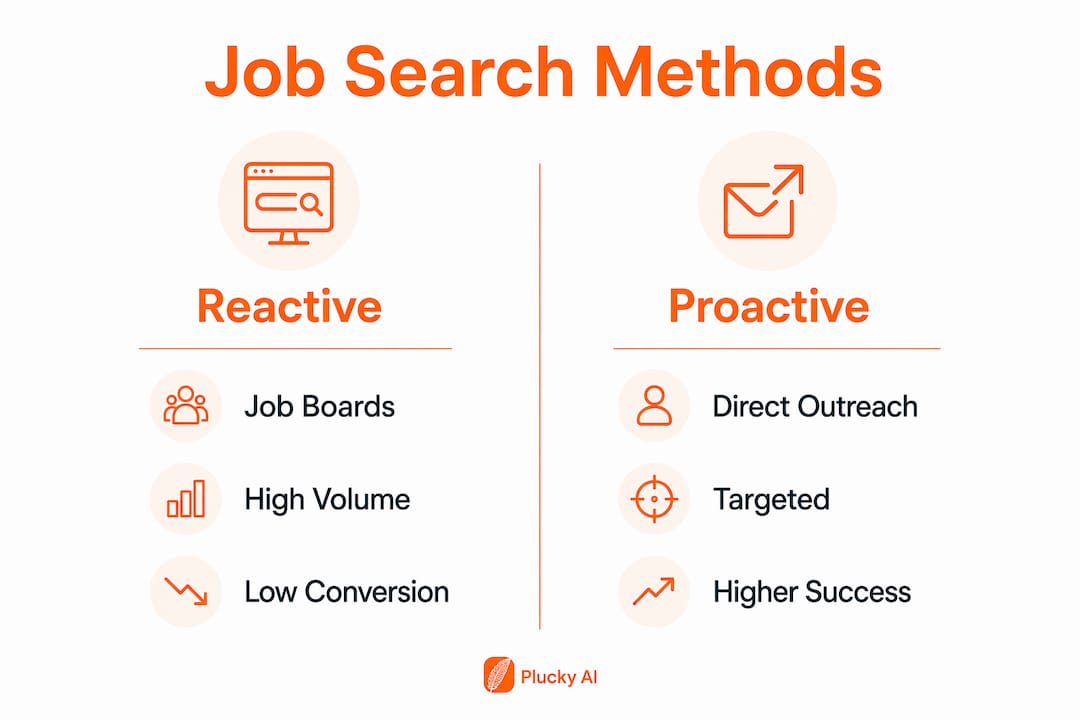
Typical reactive tactics include submitting applications through job boards, setting up email alerts for new postings, uploading a resume to recruiter portals, and applying through company career pages. For high-volume entry-level hiring in fields like retail, customer service, or certain IT support roles, reactive methods can work efficiently because employers genuinely need volume and process applicants quickly.
The structural problem is competition. By the time a role appears on a major job board, you are often one of hundreds of applicants. Career analysts consistently flag purely reactive searching as a common pitfall because it limits candidates to one or two channels and leaves them dependent on ATS filters to surface their resume. There is also a freshness problem: many job-board APIs return the date a posting was indexed rather than the original publish date, so a listing labeled "posted today" may have been live for a week and already have a shortlist.
Pro Tip: Set your job-board filters to "past 24 hours" and cross-check the actual posting date on the company's own careers page before investing time in a full application.
What does a proactive job search look like in practice?
A proactive job search means you initiate contact with employers before a role is posted, or sometimes before it even exists. The goal is to move from being an anonymous applicant to being a known quantity when a hiring decision gets made.
Core proactive tactics include:
- Targeted networking: Identifying people at companies you want to work for and building genuine relationships over weeks, not hours before you apply.
- Informational interviews: Requesting 20-minute conversations with practitioners or managers to learn about team needs and get your name into their memory.
- Referrals: Asking a mutual contact to introduce you, which converts you from a cold name to a trusted recommendation.
- Direct outreach to hiring managers: Sending a short, specific message that references a real business problem and positions you as someone who can solve it.
- Tailored project proposals: Sharing a brief analysis or solution sketch that demonstrates your thinking before any formal process begins.
Job seekers who approach companies the way IT consultants approach clients — identifying a specific problem and proposing a solution — shift from "applicant" to "potential partner" in the hiring manager's mind. That framing change alone materially increases response rates.
Why proactive methods often produce better outcomes

The performance gap between proactive and reactive searching comes down to one concept: anchored versus floating data. When you apply through a job board, you are floating data inside an ATS. The hiring manager has no prior context for you, no trust signal, and no reason to prioritize your resume over the next one. A referral or a problem-solution outreach anchors your application to a person and a specific context, which lowers the perceived risk of hiring you.
The numbers reflect this gap. Direct outreach and referred candidates show materially higher success rates compared to generic online applications. That spread exists because referrals carry social proof and because a direct message to a hiring manager bypasses the ATS entirely.
| Method | Typical success rate | Primary advantage |
|---|---|---|
| Generic job board application | ~2% | High volume, low effort per application |
| Recruiter portal submission | Low–moderate | Broader reach, some screening support |
| Referral from a known contact | ~33% | Trust transfer, ATS bypass |
| Direct outreach to hiring manager | ~33% | Personal context, problem-solution framing |
There are cases where reactive tactics hold up well. Entry-level roles with structured hiring pipelines, government positions with mandatory public postings, and companies running high-volume cohort hiring all process reactive applicants efficiently. Speed matters in those contexts, and applying early to a fresh posting can offset some of the competition disadvantage.
How to move from reactive to proactive: a step-by-step plan
The shift does not require abandoning job boards. It requires adding a structured outreach loop that runs alongside your reactive applications.

Step 1: Define your target employer list. Pick 15–25 companies where you genuinely want to work. Research their tech stack, recent hires, open team structures, and any public signals of growth or hiring intent. A focused list makes every subsequent step faster.
Step 2: Find the right contact. For each target company, identify the hiring manager or team lead for the role you want, not just the HR generalist. LinkedIn, the company's website staff page, and tools like Apollo surface this data quickly. Cross-reference with your existing network to find a mutual connection.
Step 3: Craft a specific outreach message. Keep it under 100 words. Reference something real about the company or team, state one concrete thing you can contribute, and ask for a 15-minute conversation, not a job. A template that works:
Step 4: Follow up once, then move on. Send a follow-up message 5–7 days after the first if you get no reply. One follow-up is professional; more than that crosses into pressure. If there is still no response, move the contact to a "revisit in 30 days" queue and focus energy elsewhere.
Step 5: Track everything. Log each outreach attempt, the date, the response, and the next action. Managing your search data in a simple spreadsheet or a purpose-built tracker keeps your pipeline visible and prevents leads from going cold unnoticed.
Metrics to track: outreach sent per week, response rate, meetings booked, interview conversion rate, and time from first contact to first conversation. Expect to see initial response signals within 2–3 weeks of consistent outreach at a volume of 10–15 targeted messages per week.
Pro Tip: Use a repeatable loop: discover → rank by "can I win × do I want it" → tailor message → send → track → follow up. A systemized job-search loop keeps your materials improving over time and prevents the scattered effort that kills most proactive campaigns.
When reactive searching still makes sense
Reactive and proactive methods are not mutually exclusive. The right blend depends on your seniority, timeline, and the hiring patterns of your target market.
Reactive tactics make sense when: you are targeting entry-level or associate roles where employers genuinely process large applicant pools; you have a short timeline and need volume quickly; or you are applying to government, regulated, or publicly funded positions that require open postings by policy.
A practical weekly split for most mid-career job seekers: allocate roughly 60–70% of your job-search time to proactive activities (outreach, networking, informational interviews, referral cultivation) and 30–40% to reactive applications on fresh postings. Career coaches consistently recommend this blended strategy rather than abandoning either approach entirely.
The decision rule is straightforward: when you have time and a clear target, go proactive. When you need speed or are targeting a company with a structured pipeline, reactive applications on day-one postings are worth the effort. Watch for IT job search red flags in any reactive listing — vague role descriptions, salary ranges missing, or postings that reappear every few weeks often signal low-quality opportunities.
An IT professional's proactive search: before and after
A mid-level cybersecurity analyst spent six weeks applying exclusively through job boards with no responses beyond automated rejections. The roles were real, the resume was solid, and the applications were going nowhere. The problem was structural: every application entered an ATS queue alongside dozens of others, with no differentiating signal.
The shift to a proactive approach involved three changes: building a target list of 20 security-focused companies, using contact intelligence data to identify the security engineering leads at each, and sending tailored outreach messages that referenced each company's recent public security disclosures or blog posts.
| Metric | Reactive phase (6 weeks) | Proactive phase (4 weeks) |
|---|---|---|
| Applications sent | — | 10–15 targeted messages per week |
| Responses received | 2 (4%) | 7 |
| Meetings booked | — | 4 |
| Interviews reached | — | 2 |
The volume dropped sharply, but the conversion rate at every stage improved. One of the four meetings came through a mutual LinkedIn connection who made a warm introduction after seeing the analyst's targeted message. That role was never posted publicly. Verifying that job-board postings were genuinely fresh (within 24–72 hours) also eliminated wasted effort on stale listings that already had internal candidates in process.
10 proactive tactics you can start this week
- Build your target employer list (30 min, free) — List 15–25 companies by industry, size, and tech stack fit.
- Identify the hiring manager for each target role (15 min per company, free with LinkedIn) — Find the team lead, not just HR.
- Optimize your LinkedIn profile for inbound discovery (60 min, free) — Use role-specific keywords, a clear headline, and a summary that states what you solve. LinkedIn profile tips from recruiters can sharpen this quickly.
- Send three tailored outreach messages (20 min each, free) — Use the template from Step 3 above; personalize every line.
- Request one informational interview (10 min, free) — Ask a practitioner at a target company for 15 minutes to learn about their team.
- Tailor your resume for one specific role (30 min, free) — Mirror the job description's language; use the IT job application checklist as a quality gate.
- Follow up on outstanding outreach (10 min, free) — Check your tracker; send one follow-up to any message older than 7 days with no reply.
- Engage with a hiring manager's LinkedIn post (5 min, free) — Leave a substantive comment that shows domain knowledge, not just "great post."
- Apply to two fresh reactive postings (20 min each, free) — Filter for postings under 24 hours old; verify the date on the company's own careers page.
- Set up a contact-intelligence tool for your top 5 targets (30–60 min, paid or freemium) — Tools that surface direct contact data for hiring managers, such as Apollo, save hours of manual research and are worth the cost for a focused search.
Key Takeaways
A proactive job search consistently outperforms a purely reactive one because it accesses the hidden job market, converts you from anonymous data to a known quantity, and produces response rates many times higher than cold board applications.
| Point | Details |
|---|---|
| Proactive wins on conversion | Direct outreach and referrals show success rates around 33% vs. roughly 2% for generic board applications. |
| The hidden job market is large | Roughly 70% of roles fill through networking or referrals before public posting. |
| Blend both methods | Allocate 60–70% of search time to proactive outreach and 30–40% to fresh reactive postings. |
| Track a short metric set | Monitor outreach sent, response rate, meetings booked, and interview conversion weekly. |
| Pluckjobs accelerates the proactive loop | Pluckjobs combines contact intelligence and role discovery to help IT and cybersecurity professionals find hiring managers and send targeted outreach faster. |
The part most proactive job search guides skip
Most articles on proactive searching make it sound like a motivation problem: just be more intentional, reach out more, network harder. The real obstacle is usually operational. Candidates start strong, send 10 outreach messages in week one, get two responses, then let the follow-up cadence collapse because there is no system holding it together.
The other common mistake is treating outreach as a numbers game and blasting generic messages at scale. Hiring managers in IT and cybersecurity receive enough of those to recognize them instantly. A message that references a specific CVE disclosure, a recent product launch, or a team's public GitHub activity takes five extra minutes to write and produces a response rate that generic messages never will.
Realistic timeline: expect 3–4 weeks before a proactive campaign produces consistent meeting volume, assuming 10–15 targeted messages per week. The first two weeks often feel slow. That is normal. The pipeline builds with compounding interest, not a straight line. Candidates who quit at week two never see the return on the work they already did.
One more thing worth saying plainly: automation helps, but it requires a human review gate. Automated discovery and outreach tools can save hours per week on research and drafting, but every message that goes out should pass a human eye before it sends. A hallucinated detail in an outreach message to a CISO is not a recoverable error.
Pluckjobs makes the proactive loop faster for IT and cybersecurity pros
The hardest part of a proactive search is not the strategy. It is finding the right person at the right company and getting a message in front of them before the role goes public. That research step alone can consume hours per week when done manually.
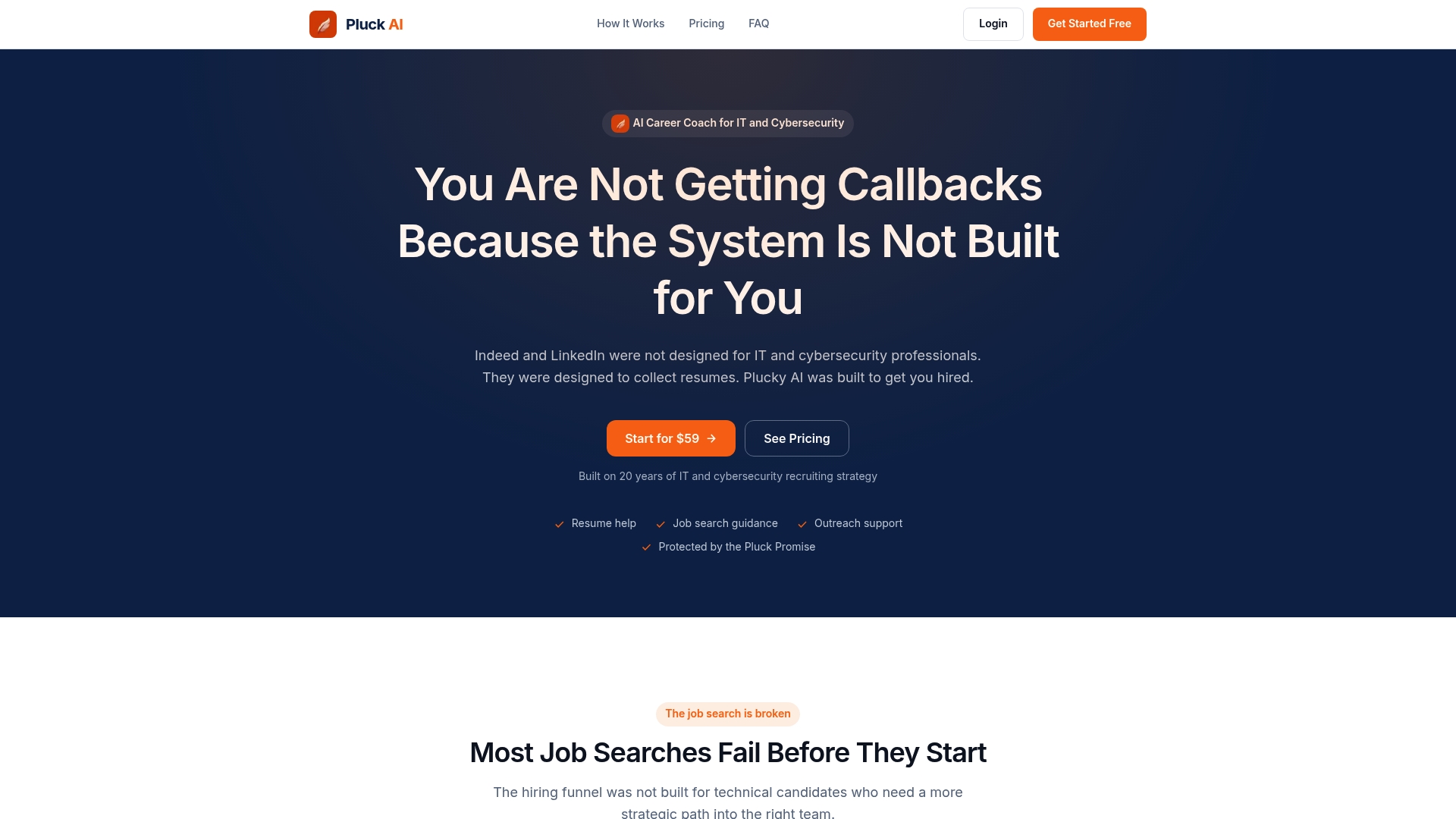
Pluckjobs is built specifically for IT and cybersecurity professionals who want to run a proactive search without spending half their week on contact research. The platform combines Apollo contact intelligence with SerpAPI-powered role discovery to surface hiring manager data, match roles to your profile, and generate tailored resumes, all in one place. You get the hiring manager's name, the fresh role, and a starting point for your outreach message before most candidates even know the job exists.
If you are ready to move beyond cold board applications, start your search on Pluckjobs and put the proactive framework from this article into practice immediately.
Further reading and sources
The claims and frameworks in this article draw from the following sources. Each is worth reading directly if you want to go deeper on a specific tactic.
- Proactive Job Search Approaches (JCU) — Practical breakdown of networking, cold outreach, and referral tactics with guidance on how to approach contacts and follow up effectively.
- Proactive vs. Reactive Job Search (AskCruit) — Source for the anchored vs. floating data framework and the 33% vs. 2% success rate comparison between direct outreach and board applications.
- The Pulse #02: Reactive vs. Proactive Job Searching (Reed Resumes) — Covers the blended strategy recommendation and the case against purely reactive searching.
- Proactive Job Search (Job-Hunt.org) — Four-step framework for targeting employers, building internal contacts, and following up consistently.
- Reactive vs. Proactive Job Search (University of Phoenix) — Covers self-reflection and goal alignment as a foundation for proactive searching.
- I Replaced My Entire Job Search With One Claude Skill (Abhijay Vuyyuru) — Practitioner account of using automation for discovery, including the posting-date freshness problem with job-board APIs.
FAQ
What is the difference between a proactive and reactive job search?
A reactive job search responds to posted listings on job boards; a proactive search initiates contact with target employers before roles are advertised, using networking, referrals, and direct outreach to access opportunities earlier in the hiring process.
Is it better to be proactive or reactive in a job search?
Proactive tactics generally produce better conversion rates. Direct outreach and referred candidates show success rates around 33% compared to roughly 2% for generic board applications, and roughly 70% of roles fill before public posting.
What is the 70/30 rule in hiring?
The figure refers to the estimate that roughly 70% of positions are filled through networking or internal referrals before they are publicly posted, leaving only about 30% accessible through traditional job board applications.
What are the biggest pitfalls of a purely reactive job search?
Relying only on job boards limits you to high-competition postings filtered by ATS software, exposes you to stale listings mislabeled as recent, and leaves you dependent on employer timing rather than your own outreach. Career advisors consistently flag purely reactive searching as one of the most common and correctable job-search mistakes.
How does Pluckjobs support a proactive job search for IT professionals?
Pluckjobs combines Apollo contact intelligence with SerpAPI-powered role discovery to surface hiring manager data and fresh role matches for IT and cybersecurity professionals, reducing the manual research time that typically slows down a proactive outreach campaign.