
TL;DR:
- A targeted, data-driven job search strategy reduces search time for IT and cybersecurity professionals. Focusing on 15-25 companies, leveraging networking, and tracking metrics increases interview chances and improves offers. Consistent execution and positioning are essential for fast, successful career transitions.
A job search strategy is a structured, multi-activity plan that targets specific roles and companies, combines tailored applications with purposeful networking, and uses data tracking to cut your time to hire. Without one, most IT and cybersecurity professionals spend 3–5 months searching. With one, search duration drops to 6–12 weeks using consistent, targeted applications. The difference is not luck. It is planning. This guide covers what a job search strategy actually involves, why targeted approaches outperform mass applications in technical fields, and how tools like LinkedIn, CRM trackers, and AI resume checkers fit into a complete job search plan.
What is a job search strategy for IT professionals?
A job search strategy is the professional term for a deliberate, data-driven campaign to land your next role. It is not a checklist. It is a repeatable system with defined targets, weekly activity goals, and measurable checkpoints. For IT and cybersecurity professionals, the stakes are higher than in most fields. Roles like Security Operations Center analyst, cloud security architect, or DevSecOps engineer require precise positioning. Generic applications rarely land interviews for these positions.
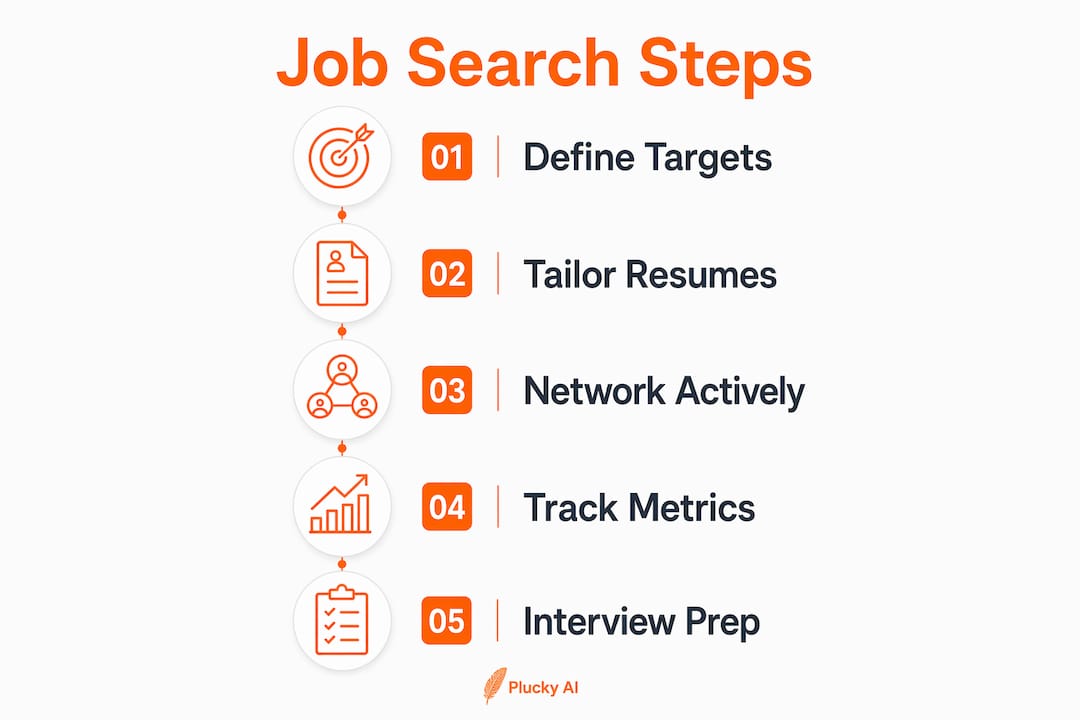
The core components of any solid job search strategy are: a target company list, a tailored resume for each role family, a networking plan, a tracking system, and an interview preparation framework. Each component feeds the next. Your target list informs your resume. Your networking plan surfaces contacts at those companies. Your tracking system tells you what is working and what is not.
Combining targeted research, purposeful networking, and personal branding maximizes opportunities specifically in IT and cybersecurity. That combination is what separates a structured job search from a passive one.

Does targeting fewer companies actually work?
The answer is yes, and the data is clear. Focusing on 15–25 specific companies yields more interviews, better offers, and faster hires than broad mass applications. Candidates who target fewer companies spend more time researching each one, understanding the team structure, and tailoring their outreach. That specificity shows up in every touchpoint, from the cover letter to the LinkedIn message to the interview.
For cybersecurity professionals, this matters even more. A SOC team at a financial services firm has different priorities than one at a healthcare provider. Referencing those specifics in your application signals domain awareness. Hiring managers notice. Candidates who do not tailor their materials blend into the noise.
Pro Tip: Build your target list using role families, not just job titles. Use the cybersecurity job titles guide to map related roles across companies, so you can apply to multiple positions within the same organization without duplicating effort.
Targeted vs. mass application: a direct comparison
| Factor | Targeted Approach | Mass Application |
|---|---|---|
| Weekly applications | 10–15 tailored | 50–100+ generic |
| Interview conversion | High | Low |
| Time to first offer | 6–12 weeks | 3–5 months |
| Offer quality | Above market average | At or below market |
| Candidate burnout risk | Moderate | High |
The table above reflects a consistent pattern in job search planning research. High volume with low specificity significantly lowers success rates and extends search duration. Fewer, better applications win.
How does networking unlock the hidden job market?
Networking is not optional. The hidden job market is the dominant channel for offers above $80,000 in knowledge work, including IT and cybersecurity. Roles at this level fill through internal referrals, warm introductions, and recruiter relationships before they ever reach a job board. If your strategy relies entirely on public postings, you are competing for the visible minority of available positions.
Networking accounts for approximately 50% of recommended job search time due to higher conversion rates from personal connections versus cold applications. That allocation reflects reality. A warm introduction to a hiring manager at Palo Alto Networks or CrowdStrike converts at a far higher rate than an ATS submission. Time spent building those connections pays off faster than time spent on job boards.
Here is how to build a networking plan that actually works for IT and cybersecurity professionals:
- Map your existing network first. Former colleagues, classmates from CompTIA or SANS training, and GitHub collaborators are all warm contacts. Start there before reaching out cold.
- Engage on LinkedIn with substance. Comment on posts from security leaders at your target companies. Share your own analysis of recent CVEs or cloud misconfigurations. Visibility builds credibility before you ever send a message.
- Reach out to recruiters who specialize in your field. Technical recruiters at firms like CyberSN or Heidrick and Struggles focus exclusively on security roles. They know which companies are hiring before postings go live.
- Attend DEF CON, Black Hat, or BSides events. In-person conversations at security conferences convert to referrals at a higher rate than any digital outreach.
Pro Tip: Pair every online application with a networking touchpoint. Find someone at the company on LinkedIn and send a brief, specific message referencing the role. This doubles your visibility with the hiring team. LinkedIn alone is not enough, but LinkedIn plus a direct message is a different story.
What is a job search data strategy and why does it matter?
A job search data strategy is the practice of tracking every application, response, and interview outcome to identify where your funnel breaks down. Most candidates apply and wait. High-performing candidates apply, track, analyze, and adjust. The difference in outcomes is significant.
CRM or spreadsheet tracking helps candidates achieve better funnel conversion by identifying weak points and adjusting efforts accordingly. The key metrics to track are:
- Application-to-callback ratio. If this falls below 10%, your resume or targeting is the problem. Adjust your resume for ATS compatibility using tools like Jobscan or review the ATS optimization guide to diagnose the issue.
- Callback-to-interview ratio. If recruiters call but do not advance you, your phone screen performance needs work. Practice your 90-second value statement.
- Interview-to-offer ratio. If you reach final rounds but do not get offers, your technical interview prep or compensation discussion needs attention.
- Time per stage. Tracking how long each stage takes helps you prioritize follow-up and avoid letting warm leads go cold.
Sample job search tracking metrics
| Metric | Healthy Range | Action if Below Range |
|---|---|---|
| Application-to-callback | 10–20% | Revise resume, tighten targeting |
| Callback-to-interview | 50–70% | Improve phone screen delivery |
| Interview-to-offer | 20–40% | Strengthen technical prep |
| Average days per stage | Under 14 days | Follow up proactively |
AI tools add another layer to this process. Grammarly catches tone and clarity issues in cover letters. Hemingway Editor flags sentences that are too complex for a quick recruiter scan. ATS checkers like Jobscan compare your resume against a specific job description and score the match. The 2026 job market demands a marketing mindset that treats candidates like products and uses AI and CRM tools for smart tracking and iterative improvement.
How to execute your job search strategy week by week
Execution is where most job search plans fail. Professionals build a strategy, apply for two weeks, get discouraged, and stop. A structured weekly cadence prevents that collapse.
- Set a weekly application target of 10–15 tailored applications. This volume, maintained consistently, compresses search time to 6–12 weeks. More than 15 per week usually means quality drops. Fewer than 10 slows momentum.
- Prepare your 90-second value statement before your first interview. Hiring managers form a meaningful opinion in the first seven minutes of an interview. Your opening statement needs to cover your role, your most relevant achievement, and what you are looking for. Practice it until it sounds natural, not rehearsed.
- Tailor your resume for each role family. A resume for a cloud security engineer role should emphasize AWS Security Hub, GuardDuty, and IAM policy experience. A resume for a penetration tester should lead with Metasploit, Burp Suite, and red team engagements. One generic resume does not serve both.
- Follow up on every application within seven days. A brief LinkedIn message to the hiring manager or a recruiter at the company keeps your name visible without being aggressive.
- Negotiate only after receiving a written offer. Waiting for a written offer before countering and anchoring your proposal to documented market data from sources like Levels.fyi or the SANS Salary Survey produces better outcomes. Negotiating verbally before an offer is in writing gives away leverage.
Pro Tip: Build a long-game search cadence into your plan from day one. Treat your search like a sprint followed by a recovery week, not a continuous grind. Planned breaks protect decision quality.
Common pitfalls that derail IT and cybersecurity job searches
Even well-intentioned job search plans break down. These are the most common failure points specific to technical professionals:
- Spray-and-pray applications. Sending 50 generic applications per week feels productive. It is not. High-volume, low-specificity strategies lower success rates and extend search duration. Each application that does not match your target profile wastes time you could spend networking.
- Skipping networking entirely. Many IT professionals are introverted by preference and avoid outreach. This is the single most costly mistake in a technical job search. Even two meaningful conversations per week compound into referrals over a month.
- Failing to track performance data. Without metrics, you cannot tell whether your resume, your targeting, or your interview performance is the bottleneck. Guessing wastes weeks.
- Ignoring burnout signals. Planned mental reset intervals of about two weeks after intense search campaigns protect decision quality. A burned-out candidate accepts the wrong offer or performs poorly in final rounds.
- Treating certifications as a substitute for positioning. Earning a CISSP or AWS Security Specialty mid-search is valuable long-term. It rarely accelerates an active search. Focus on positioning the credentials you already have before adding new ones.
Key takeaways
A structured job search strategy built on targeted company lists, consistent networking, and data tracking is the fastest path to a quality IT or cybersecurity offer.
| Point | Details |
|---|---|
| Define your target list | Focus on 15–25 specific companies to generate more interviews than mass applications. |
| Allocate time to networking | Spend roughly 50% of search time on networking to access the hidden job market. |
| Track your funnel metrics | Monitor application-to-callback ratios to identify and fix weak points quickly. |
| Prepare your value statement | Craft a 90-second opening before interviews since hiring managers decide fast. |
| Negotiate from a written offer | Always anchor counter-proposals to market data after receiving a written offer. |
The marketing mindset most IT professionals resist
I have watched technically brilliant engineers spend six months searching while less-experienced candidates land roles in eight weeks. The difference is almost never skill. It is positioning. The professionals who search fastest treat themselves like a product with a clear value proposition, a defined target market, and a distribution strategy. That framing feels uncomfortable to most engineers. It should not.
The tools available in 2026 make this easier than it has ever been. AI resume checkers, Apollo-style contact databases, and CRM tracking sheets remove most of the manual friction from job search planning. The candidates who use these tools consistently outperform those who rely on job boards alone. I have seen this pattern repeat across every seniority level in IT and cybersecurity.
The hardest part is not the strategy. It is maintaining the discipline to execute it when responses are slow. Build your weekly cadence, track your numbers, take your reset weeks, and trust the process. If you are searching confidentially while employed, the stealth job search playbook covers how to run a full campaign without alerting your current employer. The structure is the same. The execution just requires more care.
— Diego
How Pluckjobs puts this strategy into practice
Pluckjobs is built specifically for IT and cybersecurity professionals who want to run a data-driven job search without managing five separate tools.
Pluckjobs combines Apollo contact intelligence with SerpAPI-powered role discovery to surface precision job matches and the hiring manager contact data you need to skip cold applications entirely. The platform generates tailored resumes for each role and tracks your outreach in one place, giving you the CRM-style visibility that separates strategic searches from passive ones. If you are ready to move from reactive applying to a structured campaign, start your search on Pluckjobs and see how targeted outreach changes your results.
FAQ
What is a job search strategy in simple terms?
A job search strategy is a structured plan that defines your target companies, application volume, networking activities, and tracking methods. It replaces random applying with a repeatable system designed to produce faster, better offers.
How many companies should i target in my IT job search?
Research supports targeting 15–25 specific companies for the best results. Candidates who focus on fewer, well-researched targets generate more interviews and better offers than those who apply broadly.
How does networking fit into a job search strategy?
Networking should account for roughly 50% of your active search time. Most high-value IT and cybersecurity roles fill through referrals and recruiter relationships before they appear on public job boards.
What metrics should i track during my job search?
Track your application-to-callback ratio, callback-to-interview ratio, and interview-to-offer ratio. An application-to-callback rate below 10% signals a resume or targeting problem that needs fixing before you send more applications.
When should i negotiate a job offer?
Negotiate only after receiving a written offer. Anchor your counter-proposal to documented market data from sources like Levels.fyi or the SANS Salary Survey to produce the strongest outcome.