
TL;DR:
- IT job boards fall into five categories: general-purpose, niche tech, remote-first, freelance marketplaces, and community forums, each suited to different career stages. Using targeted platforms enhances response rates and reduces application noise, with niche boards and community forums providing higher quality connections for senior roles. Matching your experience level and job type to the appropriate platform maximizes efficiency and success in your IT job search.
IT job boards are defined as digital platforms that aggregate and publish technology-focused employment listings, connecting IT and cybersecurity professionals with employers seeking specialized technical talent. The five core types of IT job boards are general-purpose boards, niche tech boards, remote-first platforms, freelance marketplaces, and community-driven forums. Each category serves a distinct career stage and role type. Choosing the wrong platform wastes time and produces low response rates. The right match between board type and your specific goals is what separates a productive search from months of silence.
1. Types of IT job boards: the five main categories

IT job board categories fall into five distinct groups, each built around a different hiring model and audience. General-purpose boards like Indeed, LinkedIn, and Glassdoor cast the widest net. Niche boards like Dice and CyberCoders target specific technical disciplines. Remote-first platforms like RemoteOK and We Work Remotely serve distributed teams. Freelance marketplaces like Toptal and Upwork handle contract and project-based work. Community forums like Hacker News "Who is Hiring" connect senior specialists directly with decision-makers.
Understanding these five categories before you start applying is the single most efficient move you can make. One size fits all is a misconception. Matching the board to your career stage dramatically improves your response rate and overall experience. The sections below break down each category in full.
2. General-purpose boards: high volume, high competition
General-purpose boards are the most widely recognized IT recruitment websites, offering listings across every industry and experience level. Indeed, LinkedIn, Glassdoor, and ZipRecruiter each host millions of active postings at any given time. For IT professionals, this volume is both an advantage and a liability.
The advantage is reach. You can find entry-level help desk roles and senior cloud architect positions on the same platform. The liability is noise. Indeed and LinkedIn have lower response rates than specialized sites like Google Jobs and GovernmentJobs.com for tech roles. That data comes from an analysis of 600,000+ applications by 60,000 candidates, and it means your application competes with hundreds of unqualified submissions on every general posting.
ZipRecruiter partially addresses this with AI-driven matching. ZipRecruiter connects candidates to 4 out of 5 employers within 24 hours using its matching algorithm. That speed matters when hiring windows are short. Still, general boards work best for entry to mid-level roles where volume and visibility outweigh precision.
Pro Tip: Set up daily email alerts with specific Boolean search strings on Indeed and LinkedIn. Searching for "cybersecurity analyst AND (SIEM OR SOC)" returns far more relevant results than a simple keyword search.
3. Niche and specialized IT job boards
Niche IT job boards are purpose-built for technology disciplines, attracting candidates who are already qualified and actively seeking roles in software engineering, cybersecurity, data science, and AI. Dice is the most established specialized IT job site in the United States, with a candidate pool that skews toward experienced developers and infrastructure professionals. CyberCoders focuses on technology and engineering placements with recruiter-driven outreach. Stack Overflow Jobs historically served software engineers looking for developer-specific roles.
The quality difference between niche and general boards is measurable. Niche IT job boards often yield lower cost per qualified applicant due to targeted audiences, despite smaller applicant volumes. For cybersecurity professionals, reviewing the full range of cybersecurity job titles before searching on Dice or CyberCoders helps you match your exact specialization to the right listing.
Here is a direct comparison of niche versus general boards across three dimensions:
| Dimension | General boards (Indeed, LinkedIn) | Niche boards (Dice, CyberCoders) |
|---|---|---|
| Application quality | Mixed, high volume of unqualified applicants | Pre-filtered, technically qualified pool |
| Listing relevance | Broad, many non-IT roles mixed in | Focused exclusively on tech and IT roles |
| Response rate | Lower for specialized roles | Higher for mid-to-senior IT positions |
| User experience | Familiar, easy to use | Role-specific filters and terminology |
Pro Tip: Check niche boards every 48 hours rather than weekly. Specialized listings fill faster because the qualified applicant pool is smaller and employers move quickly when they find a fit.
4. Remote-first IT job platforms
Remote-first job boards have matured into a distinct category, offering extensive remote and flexible technology roles with salary transparency built into the listing format. RemoteOK, We Work Remotely, and JustRemote each focus exclusively on distributed work arrangements, which makes them fundamentally different from general boards that simply filter for "remote" as an option.
These platforms serve two audiences well: IT professionals who want location independence and employers building globally distributed engineering teams. The listings on remote-first boards typically include time zone requirements, async communication expectations, and compensation ranges upfront. That transparency saves significant time compared to discovering a role is remote-optional only after three interview rounds.
Key features to look for when evaluating remote IT job boards:
- Salary ranges listed by default, not hidden behind application walls
- Time zone and location restrictions clearly stated in the job description
- Scam detection tools or employer verification badges
- Role category filters specific to IT, such as DevOps, security, or backend engineering
- Contract versus full-time clarity so you know the employment model before applying
AI integration is accelerating match quality on these platforms. Boards that use machine learning to rank listings by your stated preferences and past application behavior surface better fits faster. For IT professionals pursuing a long-game job search strategy, remote-first boards expand your addressable market to global employers without requiring relocation.
5. Community-driven forums for senior IT professionals
Community-driven job forums are not traditional job boards. They operate as threaded discussions or monthly posts where employers and candidates interact directly, bypassing applicant tracking systems entirely. Hacker News "Who is Hiring" is the most cited example. Posted on the first of each month, it attracts startups and growth-stage technology companies posting roles directly to a technically literate audience.
Senior IT roles benefit from community forums like Hacker News "Who is Hiring" due to the higher signal-to-noise ratio compared to mass-application platforms. When a staff engineer or principal security architect responds to a Hacker News post, they are often speaking directly with a founder or engineering lead, not a recruiter screening resumes by keyword. That direct connection compresses the hiring timeline and improves offer quality.
These forums work best for professionals with 8 or more years of experience who can articulate their value concisely in a text post. They are not the right channel for entry-level candidates, who benefit more from volume-based platforms. The tradeoff is clear: less reach, but far higher conversion when the fit is right.
6. Freelance marketplaces vs. permanent IT job boards
Freelance marketplaces are a separate category from traditional job boards, and conflating the two leads to mismatched expectations. Freelance marketplaces differ fundamentally from job boards by facilitating project-based contract work with vetting, escrow, and payment infrastructure built in. Toptal, Upwork, and Fiverr each operate this model, though they serve different tiers of the market.
Toptal positions itself as the top 3% of freelance talent, with a rigorous screening process that includes live coding challenges and communication assessments. Upwork serves a broader range of contract roles, from short-term bug fixes to multi-month platform builds. Fiverr is best suited for discrete, deliverable-based tasks rather than ongoing IT engagements.
The distinction matters for your career strategy. If you want a permanent W-2 role with benefits and organizational stability, freelance platforms are the wrong channel. If you want project variety, rate control, and the ability to work with multiple clients simultaneously, they are the right one. Many senior IT professionals use both channels in parallel, maintaining a freelance presence on Upwork while monitoring Dice for full-time opportunities.
Pro Tip: Use community forums like Hacker News for networking and relationship-building with technical founders. Use freelance platforms for project-based income while you pursue permanent roles through niche boards.
7. How to choose the right IT job board for your career stage
Selecting the best IT job board depends on three variables: your experience level, your target role, and whether you want permanent or contract work. Matching these variables to the right platform type is more important than applying to every board simultaneously.
Here is a practical framework by career stage:
- Early career (0 to 3 years): Start with Indeed and LinkedIn for volume, and add ZipRecruiter for AI-assisted matching. Handshake yields better returns for early-career professionals but loses effectiveness at mid-to-senior levels, so use it while it works.
- Mid-level (4 to 8 years): Shift primary effort to Dice for IT-specific roles and remote-first boards if location flexibility is a goal. General boards become secondary at this stage.
- Senior and specialized (8+ years): Prioritize community forums and niche boards. Hacker News, specialized cybersecurity forums, and direct recruiter outreach through platforms like Pluckjobs produce better results than mass applications.
- Contract and freelance: Use Toptal for high-value engagements and Upwork for ongoing project pipelines. These replace, not supplement, traditional boards when contract work is your primary model.
- Cybersecurity specialists: Use CyberCoders and niche cybersecurity-specific boards alongside general boards. The applicant pool on specialized sites is smaller, but the role fit is significantly higher.
For professionals managing a confidential search, the stealth job search playbook covers how to use multiple board types without alerting your current employer.
Key takeaways
The most effective IT job search combines niche boards for role quality, remote-first platforms for flexibility, and community forums for senior-level access, with board selection matched precisely to career stage.
| Point | Details |
|---|---|
| Match board to career stage | Early-career professionals gain from general boards; senior specialists convert better on niche and community platforms. |
| Niche boards outperform on quality | Specialized sites like Dice and CyberCoders yield lower cost per qualified applicant and higher response rates for IT roles. |
| Remote-first boards offer transparency | Platforms like RemoteOK and We Work Remotely list salary ranges and time zone requirements upfront, saving application time. |
| Freelance platforms are a separate category | Toptal and Upwork handle vetting, escrow, and payments, making them distinct from traditional permanent job boards. |
| Community forums reach decision-makers | Hacker News "Who is Hiring" connects senior IT professionals directly with founders and engineering leads, bypassing ATS filters. |
What I've learned after watching thousands of IT job searches
After observing how IT professionals approach their searches across every experience level, one pattern stands out: most people default to LinkedIn and Indeed out of habit, not strategy. They apply to 50 roles on general boards and wonder why they hear back from two. The data is not ambiguous. Google Jobs shows nearly 3x higher response rates than LinkedIn for active IT job seekers, based on an analysis of 600,000+ applications. That gap is not a rounding error.
The professionals who move fastest are the ones who treat board selection as a deliberate decision, not a default. A mid-level cloud engineer who spends 80% of their search time on Dice and We Work Remotely will outperform someone spending the same hours on LinkedIn, assuming both have equivalent skills. Platform fit matters as much as resume quality.
My honest observation on AI integration: it is improving match quality on platforms that have invested in it, but it has not eliminated the need for direct outreach. The best outcomes I have seen combine AI-assisted discovery with personalized contact to hiring managers. Boards that surface the role are step one. Reaching the right person at that company is step two. Most job seekers stop at step one.
The emerging platforms worth watching in 2026 are those combining role discovery with contact intelligence, moving beyond simple listing aggregation. That convergence is where the next generation of IT job search automation is heading, and the professionals who adopt these tools early will have a measurable advantage.
— Diego
How Pluckjobs gives you an edge across every board type
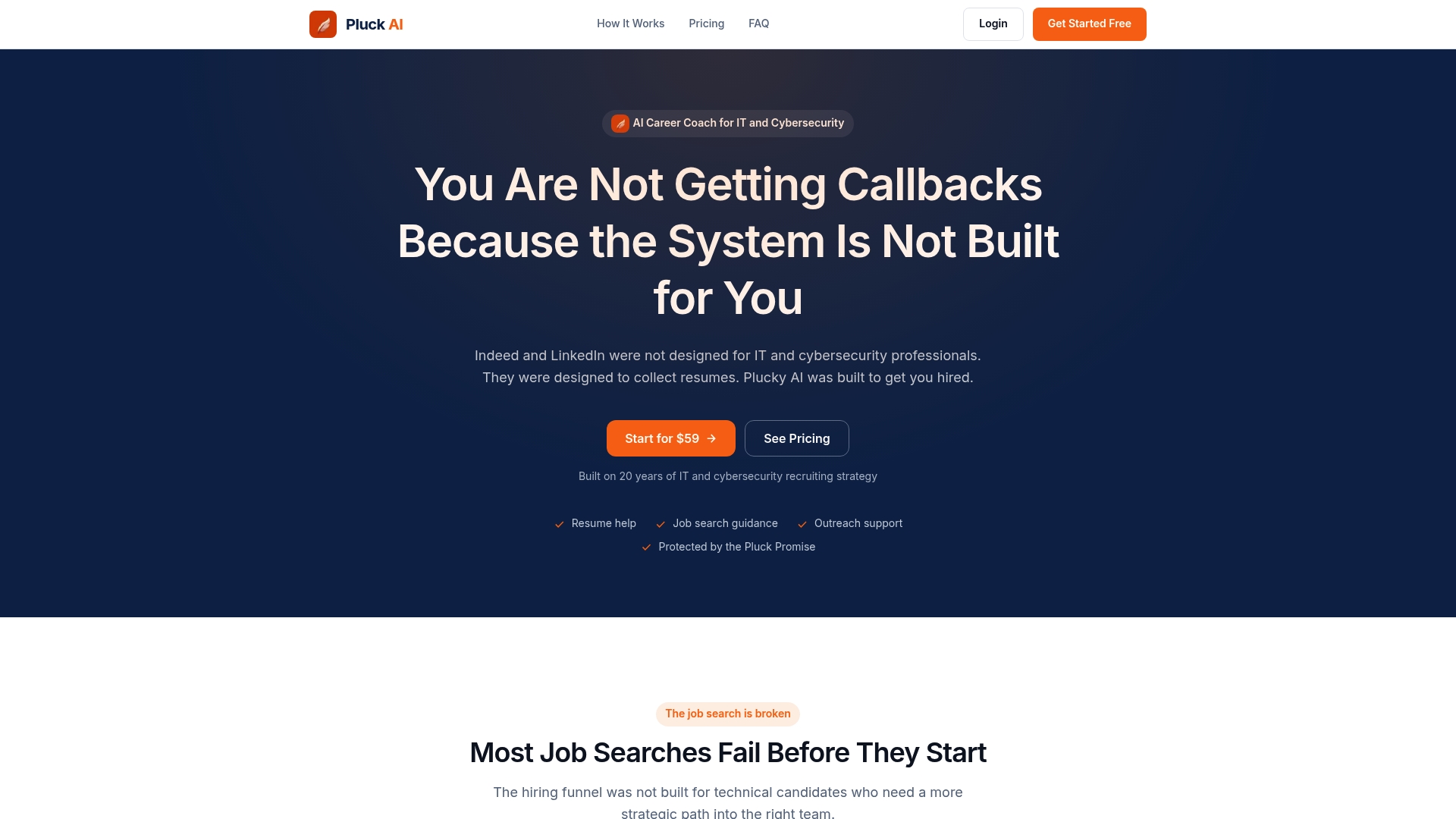
Pluckjobs is an AI-powered job search platform built specifically for IT and cybersecurity professionals. Rather than replacing individual job boards, Pluckjobs works across board types by combining SerpAPI-powered role discovery with Apollo contact intelligence. You find the role on Dice, RemoteOK, or a niche cybersecurity board, and Pluckjobs surfaces the hiring manager's direct contact data alongside a tailored resume for that specific posting. No more cold applying to an ATS and waiting. The Pluckjobs platform connects role discovery to direct outreach in one workflow, giving you the precision that general boards cannot provide on their own.
FAQ
What are the main types of IT job boards?
The five main types of IT job boards are general-purpose boards (Indeed, LinkedIn), niche tech boards (Dice, CyberCoders), remote-first platforms (RemoteOK, We Work Remotely), freelance marketplaces (Toptal, Upwork), and community-driven forums (Hacker News "Who is Hiring"). Each serves a different career stage and hiring model.
Which IT job board has the best response rate?
Google Jobs shows nearly 3x higher response rates than LinkedIn for active IT job seekers, based on an analysis of 600,000+ applications. Niche boards like Dice also outperform general platforms for mid-to-senior IT roles due to pre-filtered, technically qualified applicant pools.
Are freelance platforms the same as IT job boards?
No. Freelance marketplaces like Toptal and Upwork facilitate project-based contract work with built-in vetting, escrow, and payment systems. Traditional IT job boards focus on permanent or direct-hire roles and do not manage the financial or contractual side of the engagement.
When should I use a remote-first IT job board?
Use remote-first boards like RemoteOK or We Work Remotely when location independence is a primary requirement. These platforms list salary ranges and time zone restrictions upfront, which saves time compared to filtering for remote options on general boards where that information is often missing.
How do I choose the best IT job board for my experience level?
Early-career professionals should prioritize general boards for volume. Mid-level professionals should shift to niche boards like Dice for role quality. Senior and specialized IT professionals convert best on community forums and niche cybersecurity platforms, where the applicant pool is smaller and direct access to decision-makers is higher.