
TL;DR:
- Applying early in a job search gives IT and cybersecurity professionals a structural advantage because recruiters prioritize initial batches of applications. To maximize this, candidates should monitor company career pages directly and customize resumes in advance, applying within 24 hours of direct postings. Building a system to track and tailor applications consistently increases the likelihood of securing interviews before others apply.
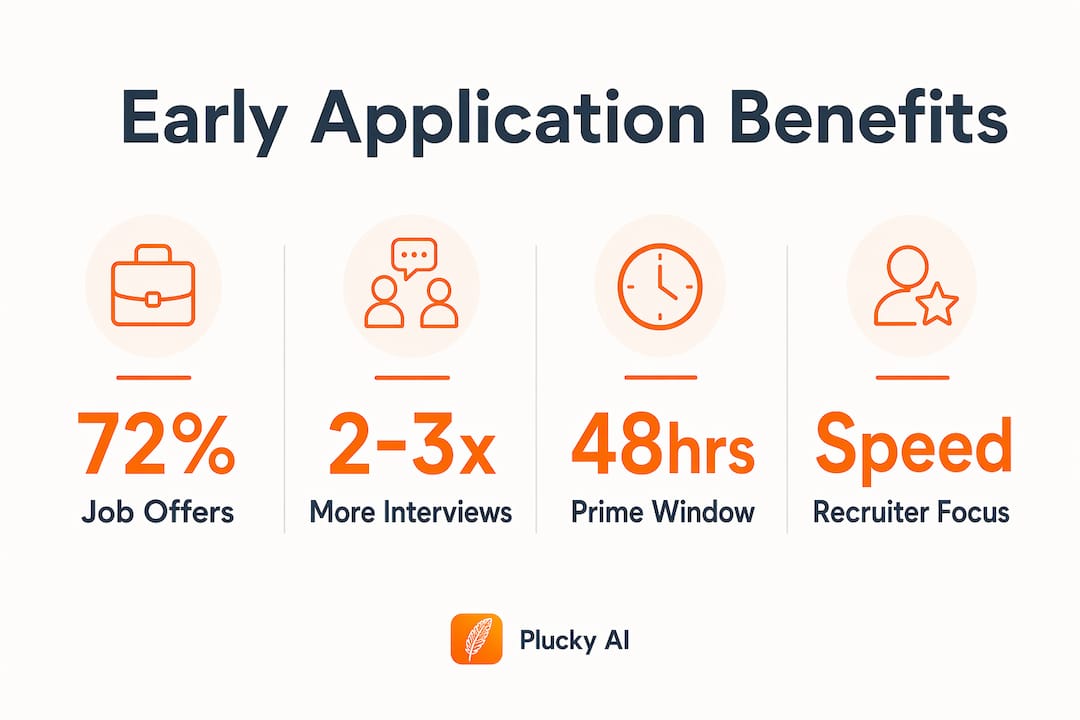
Applying early in a job search is the single most controllable timing advantage available to IT and cybersecurity professionals. 72% of job offers go to candidates who apply within the first five days of a posting. Candidates who submit within 24–48 hours see 2–3 times more interview opportunities than those who apply later. The reason is structural, not preferential. Recruiters process applications in batches, and the first batch always receives the most attention. Understanding why applying early matters in your job search, and how to act on it, separates candidates who get calls from those who get silence.
Why applying early matters in your job search: the recruiter pipeline advantage
Recruiters do not read every application with equal attention. They review resumes in controlled batches to manage workload, and early batch applications are prioritized by default. This is not a conscious bias. It is a structural reality driven by time constraints.
When a role goes live, the first 10–30 applications arrive before the inbox floods. Recruiters are fresh, focused, and actively building a shortlist. They spend more time on each resume. They are more likely to give a borderline candidate the benefit of the doubt. As the application count climbs into the hundreds, attention per resume drops sharply.
"Recruiters don't consciously prefer early applicants. They simply process manageable batches first. By the time later applications arrive, the shortlist is often already forming. The structural advantage belongs to whoever gets in front of a recruiter when the pool is still small and attention is still high."
The timing effect compounds further. Candidates who apply within the first 48 hours set the benchmark recruiters use to evaluate everyone who follows. If an early applicant has strong cloud security credentials, every subsequent candidate gets measured against that bar. Late applicants with identical qualifications often look weaker by comparison, not because they are, but because the frame of reference has already been set.
This is the core mechanic behind early application advantages. Speed gets you in front of a recruiter when attention is highest and the comparison pool is smallest.

What "applying early" actually means for IT and cybersecurity roles in 2026
The phrase "applying early" sounds simple. The execution is more specific than most job seekers realize. For IT and cybersecurity professionals, the real early window is narrower than the job board timestamps suggest.
Job aggregators lag company career pages by up to 72 hours. A role posted on a company's careers portal on Monday morning may not appear on LinkedIn or other boards until Wednesday. By the time you see it labeled "Just Posted," dozens of applications may already be in the recruiter's inbox.
The practical implications for your job search application timeline:
- Monitor company career pages directly. Set bookmarks for the careers sections of your top 20 target employers. Check them every morning before opening any job board.
- Treat "Just Posted" labels with skepticism. On aggregators, this label reflects when the scraper picked up the listing, not when the company published it.
- Apply within 24 hours of the direct company posting. That is the real early window. Anything beyond 48 hours puts you in the mid-to-late batch.
- Filter for ghost jobs and expired listings. Aggregators frequently surface roles that are already filled or on hold. A direct career page visit confirms whether a role is genuinely active.
- Use company career page monitoring as your primary signal. Aggregators are useful for discovery, but they should never be your only source.
Pro Tip: Set up Google Alerts for "[Company Name] careers" or "[Company Name] is hiring" to catch announcements before they hit the major job boards.
The cybersecurity sector moves especially fast. Roles in threat intelligence, cloud security, and penetration testing often attract qualified candidates within hours of posting. The 24-hour window is not a guideline. It is a hard competitive boundary.
Why tailored resumes determine whether early applications actually work
Speed without relevance wastes your timing advantage entirely. Generic resumes submitted early still get overlooked by applicant tracking systems and recruiters alike. Being first in the inbox only matters if the resume earns attention once it is opened.
The solution is preparation before the application, not during it. IT and cybersecurity professionals who build role-specific resume templates in advance can apply quickly without sacrificing quality. Here is a practical system:
- Identify your three to five core role types. For cybersecurity, these might include SOC analyst, penetration tester, cloud security engineer, GRC specialist, and incident response lead. Build a tailored resume base for each.
- Map keywords from the job description to your resume. ATS systems filter on exact terminology. A role asking for "SIEM administration" and "MITRE ATT&CK framework" needs those phrases in your resume, not synonyms.
- Customize the summary and top skills section per application. These two sections take five minutes to adjust and carry the most weight with recruiters who skim before reading.
- Use AI tools to accelerate customization. AI-powered resume tools can align your existing experience to a specific job description in minutes, preserving accuracy while improving relevance.
- Keep a master resume with every role, certification, and project documented. Pull from it selectively for each application rather than starting from scratch.
Pro Tip: Store your role-specific resume templates in a cloud folder labeled by role type. When a relevant posting appears, open the matching template, update the summary and keywords, and submit. Total time: under 20 minutes.
The early application advantage is real, but it is conditional. Preparation is what converts timing into interviews.
Practical strategies for applying early without burning out
Applying early consistently requires a system, not just intention. Without structure, the process becomes reactive and exhausting. These strategies keep you fast, focused, and sustainable.
- Set job alerts on company career portals, not just aggregators. Most enterprise employers, including major tech firms and government contractors, offer email alerts directly from their careers page. These arrive before any aggregator picks up the listing.
- Schedule a daily 30-minute application block. Early morning works best. Applying on Monday or early in the workweek increases recruiter visibility because hiring managers are fresh and actively filling roles at the start of the week.
- Prepare your materials before you need them. Your LinkedIn profile, resume templates, and cover letter frameworks should be ready before you start monitoring. Scrambling to write from scratch kills your timing advantage.
- Track every application in a simple spreadsheet. Log the company, role title, date applied, and follow-up date. This prevents duplicate applications, missed follow-ups, and the mental drain of losing track of where you stand.
- Limit daily applications to roles you genuinely qualify for. Applying to 30 roles a day with a generic resume produces worse results than applying to five roles with tailored documents. Quality and speed together win. Quality alone is slow. Speed alone is noise.
Pro Tip: Use your IT job application checklist to verify each application before submitting. A two-minute review catches keyword gaps and formatting errors that cost you the interview.
The goal is a repeatable process you can run every morning without decision fatigue. When the system is built, applying early becomes a habit rather than a sprint.
Key Takeaways
Early applications succeed because recruiters process initial batches with the most attention, and the first 48 hours set the benchmark every later candidate is measured against.
| Point | Details |
|---|---|
| Apply within 24–48 hours | Candidates in this window see 2–3 times more interview opportunities than late applicants. |
| Monitor company career pages directly | Aggregators lag postings by up to 72 hours, so direct monitoring is the only reliable early signal. |
| Tailor every resume before submitting | Generic early applications still fail ATS filters; role-specific keywords are non-negotiable. |
| Apply early in the workweek | Monday and Tuesday submissions reach recruiters when attention and hiring urgency are highest. |
| Build a system, not a sprint | Pre-built templates and daily application blocks make consistent early applications sustainable. |
Timing is a skill, not luck
Most job seekers treat application timing as something that just happens. I disagree. Timing is a skill you build deliberately, and in IT and cybersecurity hiring, it is one of the few variables entirely within your control.
The recruiter behavior data is clear. Early applicants set the standard. Late applicants get compared to it. That dynamic does not change based on how strong your background is. A senior penetration tester applying two weeks after a posting competes against the benchmark set by whoever applied on day one. That is a structural disadvantage no resume can fully overcome.
What I have seen consistently is that the professionals who get the most traction are not necessarily the most qualified. They are the most prepared. They have their templates ready. They check career pages before job boards. They apply Tuesday morning, not Friday afternoon. They treat the application process as a repeatable operation, not a one-off effort.
The common mistake is treating early application as a volume play. Submitting 50 applications in the first 24 hours with a generic resume is not an early application strategy. It is noise. The real approach combines speed with specificity. That combination is rare, which is exactly why it works.
If you take one thing from this: build your system before you need it. The best time to prepare your role-specific resume templates and set up career page alerts is before a role you want appears. Once it does, you have hours, not days.
— Diego
How Pluckjobs helps you apply first and apply right
IT and cybersecurity roles fill fast. Pluckjobs is built for professionals who cannot afford to be late.
Pluckjobs combines AI-powered role discovery with instant resume customization, so you can find a role on a company's career page and submit a tailored application within minutes. The platform pulls hiring manager contact data through Apollo intelligence and surfaces active roles through SerpAPI before they saturate the major boards. No more cold applying to listings that are already half-filled. Find the role early, reach the right person, and submit a resume built for that specific job. That is the early application advantage, built into one tool.
FAQ
How much does applying early improve your chances?
Candidates who apply within the first five days receive 72% of all job offers. Those who apply within 24–48 hours see 2–3 times more interview opportunities than later applicants.
Why do recruiters favor early applicants?
Recruiters process applications in batches and give the most attention to the first batch, when the pool is small and their energy is highest. The preference is structural, not intentional.
What is the best day to submit a job application?
Applying on Monday or early in the workweek gives your application the best chance of landing in front of a recruiter when they are fresh and actively filling roles.
Does applying early matter if my resume is not tailored?
No. Generic resumes submitted early still get filtered out by ATS systems and overlooked by recruiters. Speed and relevance must work together.
How do I find IT job postings before they hit LinkedIn?
Monitor company career pages directly and set up email alerts from employer portals. Job aggregators lag company postings by up to 72 hours, so direct monitoring is the only reliable way to catch roles in the true early window.