
TL;DR:
- Job search burnout is emotional exhaustion caused by prolonged effort without meaningful feedback. It results from systemic issues like ghost jobs, ATS filtering, and social pressure, not personal failure. Recovery requires balancing rest with strategic adjustments, emphasizing targeted outreach over mass applying.
Job search burnout is defined as a state of emotional, mental, and physical exhaustion caused by prolonged, high-effort job seeking with little or no meaningful feedback. It is not a character flaw or a sign of weakness. 72% of job seekers report mental health impacts from job search stress, including PTSD-like symptoms. That number reflects a systemic problem, not a personal one. The process itself creates the conditions for burnout: constant output with almost no return signal, repeated rejection without explanation, and financial pressure that never lets up. Recognizing what job search burnout is marks the first step toward doing something about it.
What is job search burnout and why does it feel different?
Job search burnout is not the same as ordinary fatigue. Ordinary fatigue resolves after rest. Burnout is a deeper state: loss of meaning and disengagement caused by ongoing ambiguity and unresolved effort. You keep sending applications into silence, and your nervous system stays on alert waiting for a response that never comes.
The clinical term most researchers use is "occupational burnout," adapted here to the job search context. The World Health Organization defines occupational burnout by three dimensions: exhaustion, cynicism, and reduced sense of efficacy. All three appear in prolonged job searches, which is why the informal phrase "job search burnout" maps cleanly onto a recognized psychological state.
What makes the 2026 job market especially draining is the signal-feedback imbalance: candidates send far more signals (applications) than they receive feedback. That chronic vigilance prevents the nervous system from resetting between attempts. The result is not just tiredness. It is a sustained state of cognitive overload.
What causes job search fatigue in 2026?
Several structural forces drive job search fatigue, and most of them have nothing to do with how hard you are trying.
- Ghost jobs. 27.2% of long-term job listings flagged as open for three or more months are ghost jobs with no active hiring intent. Applying to these listings wastes real effort on a process that was never going to result in an offer.
- ATS filtering. Automated screening systems reject resumes before a human ever reads them. Many IT and cybersecurity candidates lose out not because they are unqualified, but because their resume fails a keyword or formatting check. This is a core reason why jobs posted do not equate to jobs filled.
- Ghosting. Most applications disappear into silence. Rejection accumulates without closure, making the process more psychologically depleting than typical work stress.
- Social and financial pressure. The longer a search runs, the more external pressure compounds internal exhaustion. Explaining your situation to family, watching savings shrink, and comparing yourself to peers who landed roles all add cognitive weight.
Pro Tip: Filter job listings by post date and avoid any role posted more than 30 days ago unless you can verify it is actively being filled. This one habit cuts ghost job exposure significantly.
The difference between job search burnout and standard work burnout is the absence of a clear feedback loop. At work, you complete tasks and see results. In a job search, you complete tasks and hear nothing. That ambiguity is what makes the exhaustion accumulate faster.
What are the signs of job search burnout?
Recognizing burnout early prevents it from deepening. The signs fall into three categories: emotional, behavioral, and cognitive.
- Emotional markers. Apathy toward roles you would have been excited about six weeks ago. A creeping sense of hopelessness that the search will never end. Irritability that spills into personal relationships and daily life.
- Behavioral signs. You start submitting fewer applications, not because you are being more selective, but because you cannot bring yourself to start. Procrastination replaces your morning routine. You disengage from networking conversations you used to find energizing.
- Cognitive symptoms. Decision fatigue makes even small choices feel hard. Negative self-talk replaces realistic self-assessment. You begin to believe the problem is you, not the process.
The critical distinction here is between an energy problem and a strategy problem. An energy problem means you are depleted and need rest. A strategy problem means your approach is not working, and rest alone will not fix it. Confusing the two leads to the most common mistake in job search burnout recovery: taking a break and then returning to the exact same ineffective strategy.
Pro Tip: Keep a one-line daily log of your emotional state during the search. After two weeks, patterns become visible. You will see whether your energy is declining steadily (energy problem) or spiking after certain activities (strategy problem).

Subtle signs are just as telling as the obvious ones. Spending 45 minutes on a cover letter you used to write in 15 minutes is a sign. Refreshing your inbox compulsively instead of working on applications is a sign. Both indicate that the search has taken over your mental bandwidth in an unproductive way.
How to cope with job search stress and recover from burnout
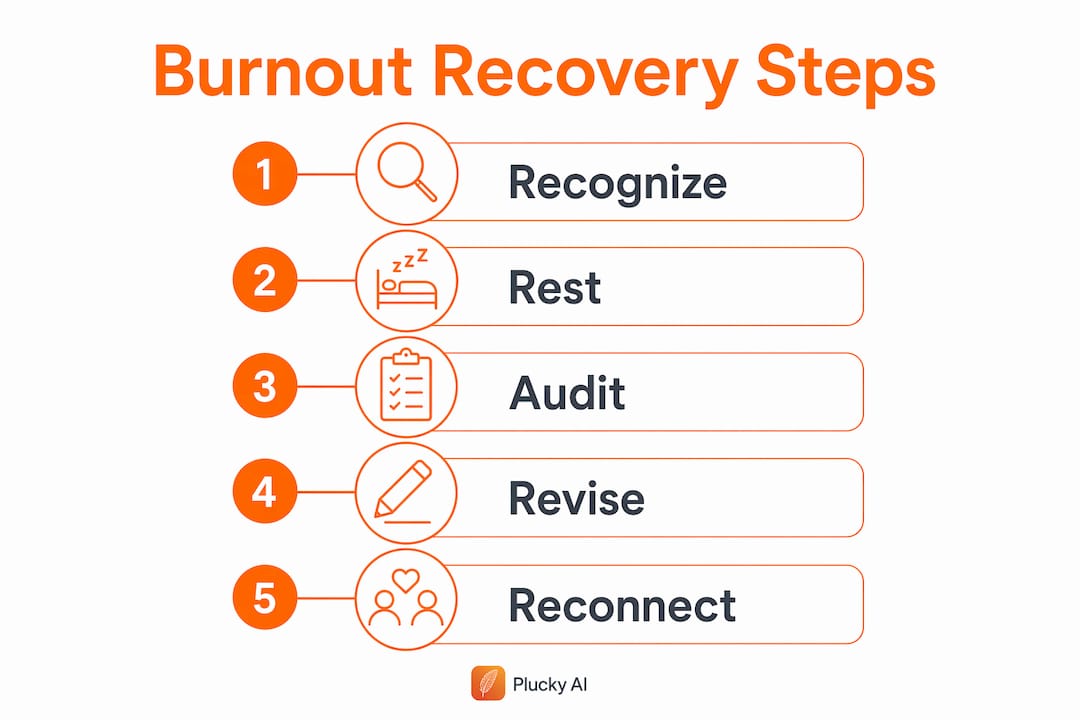
Recovery from job search burnout requires two parallel tracks: restoring your energy and auditing your strategy. Neither track works without the other.
- Cap your daily application volume. 3–5 tailored applications per day outperforms mass applying. Volume thinking reduces quality and accelerates burnout. Fewer, better applications produce more responses.
- Take real breaks. Two full days away from job search activity can restore cognitive and emotional resources more effectively than pushing through at a depleted level. Schedule these breaks without guilt.
- Switch to process metrics. Measuring progress by outcomes like responses or offers crashes morale when those outcomes are outside your control. Track what you can control: applications sent, networking conversations started, skills updated.
- Rebuild identity outside the search. Volunteer work, freelance projects, open-source contributions, and professional communities all reinforce your sense of competence and worth independent of whether a recruiter responds.
- Audit your materials before adding volume. Check your resume for ATS compatibility, keyword alignment, and formatting. Review your IT job application strategy before sending another batch of applications.
Pro Tip: Set a hard stop time for job search activity each day, such as 12:00 PM. Treat the afternoon as protected time for skill-building or rest. This boundary prevents the search from consuming your entire day and draining the energy you need to apply well.
The goal is not to search less. The goal is to search in a way that does not destroy your capacity to keep going.
Why pushing harder often makes burnout worse
The instinct when nothing is working is to do more. Send more applications. Spend more hours searching. That instinct is wrong, and the data supports why.
Pushing through burnout by increasing application volume creates a cycle: weaker applications lead to more rejection, more rejection deepens burnout, and burnout produces even weaker applications. The cycle accelerates until the job seeker either stops entirely or lands a role despite the process, not because of it.
Applying to 30–40 jobs within 8 weeks without any acknowledgment is a signal of strategy failure, not effort failure. At that point, the problem is almost certainly ATS filtering, poor role targeting, or a resume that does not match the roles being applied to. More applications will not fix any of those problems.
| Problem type | What it looks like | What actually helps |
|---|---|---|
| Energy problem | Exhaustion, apathy, inability to start tasks | Rest, breaks, activities outside the search |
| Strategy problem | High volume, zero responses, no interview invites | Resume audit, ATS check, role targeting review |
| Both combined | Depleted and stuck with no results | Rest first, then strategy audit before resuming |
The distinction matters because the solutions are different. Treating a strategy problem with rest leaves the broken strategy in place. Treating an energy problem with a strategy audit while depleted produces poor decisions. Sequence matters: restore energy first, then fix the approach.
How modern hiring processes contribute to burnout
The 2026 hiring environment has structural features that make burnout more likely for every candidate, regardless of qualifications.
Automated screening systems filter resumes before a recruiter reads them. A cybersecurity engineer with ten years of experience can be rejected in seconds by an algorithm that did not find the right keyword combination. Understanding why IT applications get rejected is not optional knowledge. It is the foundation of a working search strategy.
Ghost jobs compound the problem. When a significant share of open listings carry no real hiring intent, candidates invest time and emotional energy into applications that were never going to produce results. Filtering by recency and verifying active roles through LinkedIn or direct outreach reduces this waste.
Networking and referrals remain the most reliable path through automated filters. A referral from an internal employee bypasses ATS screening in most organizations. Direct outreach to hiring managers, backed by real contact data, converts at a higher rate than cold applications. Candidates who shift from mass applying to targeted outreach consistently report better results and lower stress.
| Search method | ATS exposure | Feedback likelihood | Burnout risk |
|---|---|---|---|
| Mass job board applying | High | Low | High |
| Targeted applications with tailored resumes | Medium | Medium | Medium |
| Referral or direct hiring manager outreach | Low | High | Low |
Avoiding common IT job search mistakes like applying to stale listings or submitting generic resumes reduces the rejection volume that feeds burnout in the first place.
Key Takeaways
Job search burnout is a recognized state of exhaustion driven by systemic factors, and recovery requires both rest and a strategy audit, not just more effort.
| Point | Details |
|---|---|
| Burnout has a clear definition | It is emotional and cognitive exhaustion from prolonged job seeking with little feedback, not personal failure. |
| Ghost jobs waste real effort | 27.2% of long-term listings have no hiring intent, making role verification a necessary first step. |
| Energy and strategy are different problems | Depleted candidates need rest first; broken strategies need an audit before more applications go out. |
| Process metrics protect morale | Tracking applications sent instead of responses received keeps motivation stable during a long search. |
| Targeted outreach beats volume | 3–5 tailored applications per day with direct hiring manager contact produces better results than mass applying. |
The part no one tells you about job search burnout
The most damaging belief I see in burned-out job seekers is that the exhaustion proves something is wrong with them. It does not. It proves they have been operating in a system designed to produce exactly this outcome: high effort, low feedback, and no clear signal of progress.
What I have observed consistently is that the job seekers who recover fastest are not the ones who push through. They are the ones who stop, assess honestly, and change one specific thing before resuming. Not everything. One thing. A resume rewrite. A shift from job boards to direct outreach. A decision to apply only to roles posted in the last two weeks.
The mental health dimension of this is real and should not be minimized. Prolonged job search stress affects sleep, relationships, and self-perception in ways that outlast the search itself. Taking breaks is not giving up. It is protecting the cognitive capacity you need to make good decisions when the right opportunity appears.
Redefine what success looks like during the search. A conversation with a hiring manager is a win. A referral from a former colleague is a win. A resume that gets past ATS for the first time is a win. Measuring only offers and responses makes every day feel like failure. Measuring process and connection makes progress visible.
— Diego
A smarter way to search without burning out
Job search burnout often intensifies when the process feels random and uncontrollable. Pluckjobs addresses that directly. The platform combines AI-powered role discovery with Apollo contact intelligence, so IT and cybersecurity professionals find the right roles and reach the right people without mass applying.
Plucky AI builds tailored resumes, surfaces hiring manager contact data, and matches candidates to roles that fit their actual profile. That means fewer wasted applications, more direct conversations, and a search process that does not grind you down over weeks of silence. Pluckjobs is built for professionals who want to work precisely, not endlessly.
FAQ
What is job search burnout exactly?
Job search burnout is emotional and cognitive exhaustion caused by prolonged job seeking with little feedback. It differs from ordinary fatigue because rest alone does not resolve it without also addressing the underlying strategy.
How do I know if I have job search burnout or just normal stress?
Normal stress eases after a break or a positive event. Burnout persists even when conditions improve and includes apathy, loss of motivation, and negative self-talk that does not respond to short-term relief.
How many applications before burnout becomes a strategy problem?
Applying to 30–40 jobs over 8 weeks without any response typically signals a strategy failure, such as ATS filtering or poor role targeting, rather than insufficient effort.
What is the fastest way to recover from job search burnout?
Take two full days completely away from job search activity, then audit your resume and targeting before resuming. Returning to the same strategy without changes will restart the burnout cycle.
Does networking actually reduce job search burnout?
Networking reduces burnout because it replaces silent rejection with real human feedback. Referrals also bypass ATS filters, which cuts the volume of unanswered applications that drives exhaustion in the first place.