
TL;DR:
- Applying generic resumes to multiple jobs results in low interview rates, while targeted resumes significantly improve chances. Failing to optimize ATS formatting and neglecting impact-driven accomplishments can disqualify candidates early in the process. Focusing on quality applications, active follow-up, and a strategic long-term approach increases the likelihood of success in IT job searches.
The most damaging common job search mistakes IT professionals make is mass-applying generic resumes to every open role. Generic applications achieve only an 8% interview rate, while targeted, keyword-matched resumes push that number above 35%. That is a difference of over 300%. Applicant Tracking Systems (ATS) filter out unpersonalized submissions before a human ever reads them. Tools like Grammarly can improve resume quality, but no grammar fix compensates for a resume that ignores the job description entirely.
1. common IT job search mistakes start with mass applying

Mass applying is the single most widespread IT job application mistake in 2026. Fewer than 1 in 10 applications on public job boards result in interviews, with the real average sitting around 2%. That number reflects how brutally ATS filters punish generic submissions.
The "spray-and-pray" method feels productive. Sending 50 applications in a week creates the illusion of momentum. The reality is that each untailored resume reinforces the same rejection pattern. Recruiters and ATS platforms both reward specificity, not volume.
The mental cost is real too. 72% of job seekers report significant negative mental health impact from volume-based job searches, often beginning to doubt their own skills. That self-doubt compounds the problem by pushing candidates toward even more frantic, untargeted applications.
- Send fewer applications, not more
- Spend at least 30 minutes customizing each resume to the specific role
- Track your application-to-interview ratio using a job search metrics tracker
- Cut any role where you match fewer than 60% of the listed requirements
Pro Tip: Target 10 to 15 high-fit roles per week instead of 50 low-fit ones. Your interview rate will rise faster than your application count.
2. ATS formatting errors that instantly disqualify your resume
ATS incompatibility is one of the most preventable resume mistakes in the tech job search. Approximately 23% of resume rejections happen because ATS software cannot parse complex formatting like tables, columns, or embedded graphics. Your resume never reaches a human reviewer.
Creative resume layouts built in Canva or Microsoft Word's design templates look impressive on screen. ATS software reads them as garbled text or blank fields. A resume with a two-column layout may have its skills section read before the job title, producing nonsensical output that triggers automatic rejection.
The fix is straightforward. Use a single-column format, standard fonts like Arial or Calibri, and plain text section headers. Keywords from the job description must appear in the body of the resume, not inside a graphic or text box.
| Formatting Element | ATS-Safe Version | ATS Risk Version |
|---|---|---|
| Layout | Single column | Two columns or sidebars |
| Fonts | Arial, Calibri, Georgia | Decorative or script fonts |
| Graphics | None | Icons, logos, charts |
| File type | .docx or plain .pdf | Image-based PDF |
| Section headers | Standard labels (Experience, Skills) | Custom or stylized headers |
Pro Tip: Spend 10–15 minutes per application swapping in exact keywords from the job posting. Copy the job title verbatim if you have held that role. ATS systems match strings, not concepts.
For a deeper breakdown of ATS resume optimization, the technical requirements have evolved significantly heading into 2026.
3. stacking certifications without proving what you built
Certification stacking is a misstep in tech job searches that many IT professionals do not recognize until they are deep into a fruitless search. Holding CompTIA Security+, AWS Solutions Architect, and Certified Kubernetes Administrator looks impressive on paper. Recruiters prioritize measurable achievements over certification lists every time.
The "show, don't tell" principle applies directly here. A resume that lists eight certifications but describes job responsibilities in vague terms like "managed infrastructure" or "supported security operations" tells a recruiter nothing about your actual impact. A resume that says "reduced cloud infrastructure costs by 34% over two quarters by consolidating EC2 instances" tells them everything.
Effective accomplishment statements for IT roles include:
- Quantified outcomes: "Automated patch management for 400 endpoints, reducing remediation time from 5 days to 6 hours"
- Team and scope context: "Led a 4-person DevOps team through a zero-downtime migration to AWS GovCloud"
- Business impact: "Identified and closed 3 critical vulnerabilities before a SOC 2 audit, avoiding a potential compliance failure"
- Tool specificity: "Built CI/CD pipelines using Jenkins and GitHub Actions, cutting deployment cycles by 60%"
Certifications belong on your resume. They just cannot carry the whole weight. Pair every major certification with a project or outcome that proves you applied it.
4. wasting time on ghost jobs in IT listings
Ghost jobs are a specific and costly job search error for IT professionals. Around 27% of LinkedIn IT job listings are ghost jobs, meaning the company has no real intent to hire from that posting. They may be collecting resumes for future roles, testing the talent market, or simply forgot to take down an old listing.
Identifying ghost jobs before you invest time in a tailored application saves hours every week. The warning signs are consistent:
- The posting has been live for more than 60 days without any updates
- The salary range is unusually wide, such as $80,000 to $160,000 for the same role
- The job description is vague about team size, tech stack, or reporting structure
- The company has announced layoffs or a hiring freeze in recent months
- The same listing has been reposted multiple times with minor wording changes
Cross-reference any suspicious listing against the company's LinkedIn page. If their headcount has dropped recently and the role has been open for three months, treat it as a ghost job and move on. Prioritize listings posted within the last 14 days with specific technical requirements and named hiring managers.
5. skipping follow-up after applications and interviews
Neglecting follow-up is one of the most common interview pitfalls in IT hiring processes. Most candidates apply and wait. The ones who get callbacks often do one extra thing: they follow up. Following up within 5–7 business days after an application deadline can revive a stalled candidacy.
A follow-up email does not need to be elaborate. Two to three sentences confirming your interest, referencing a specific aspect of the role, and asking about next steps is enough. The goal is to reappear in the recruiter's inbox at a moment when your application may have been buried.
After interviews, a thank-you note sent within 24 hours serves a different purpose. It signals professionalism and gives you one more opportunity to reinforce a key point from the conversation. Reference something specific the interviewer said. Generic thank-you notes read as templates and get ignored.
Pro Tip: Connect with the hiring manager on LinkedIn the same day you apply. A brief, professional message referencing the role puts a face to your application before the recruiter even opens your resume.
6. neglecting your digital presence and LinkedIn profile
A weak or misaligned LinkedIn profile is a consistent IT job application mistake that undermines otherwise strong candidates. Recruiters spend only 6–10 seconds on an initial resume scan, and many check LinkedIn immediately after. If your profile contradicts your resume or looks abandoned, it raises flags.
Your LinkedIn headline should not say "Open to Work." It should state your specialty and value: "Cloud Security Engineer | AWS | Zero Trust Architecture | Available for Senior Roles." That headline is searchable and specific. It tells a recruiter exactly what you do before they click your profile.
Portfolio links matter more in IT than in most fields. GitHub repositories, published write-ups on Medium, or a personal site showing lab work and projects give recruiters evidence beyond the resume. A cybersecurity professional with a documented home lab on GitHub signals hands-on competence that no certification alone can match.
LinkedIn alone is not enough for a complete IT job search strategy. Supplement it with direct outreach, niche job boards, and community presence in forums like Reddit's r/netsec or specialized Slack groups.
7. ignoring the long game in IT job searching
Short-term thinking is a structural job search error that extends the average IT job search by months. Candidates who apply only when unemployed or urgently need a new role start from zero every time. Candidates who maintain a long-game job search strategy build relationships, visibility, and pipeline continuously.
Networking is not about asking for jobs. It is about being known before a role opens. Commenting thoughtfully on posts from engineering managers at target companies, contributing to open-source projects, or speaking at local tech meetups puts your name in front of decision-makers organically. When a role opens, you are already a familiar face rather than a cold application.
Soft skills presentation is also underestimated in IT job searches. Technical depth gets you to the interview. Communication, collaboration, and problem-solving framing get you the offer. Candidates who can explain a complex infrastructure decision in plain language consistently outperform peers with equivalent technical skills in final-round interviews.
Key takeaways
Targeted, ATS-compatible resumes combined with focused applications and active follow-up are the three factors that most directly determine interview rates for IT professionals.
| Point | Details |
|---|---|
| Target over volume | Tailored resumes achieve 35%+ interview rates versus 8% for generic ones. |
| Fix ATS formatting first | 23% of rejections come from formatting errors ATS cannot parse. |
| Prove impact, not credentials | Quantified project outcomes outperform certification lists with recruiters. |
| Screen out ghost jobs | 27% of LinkedIn IT listings have no real hiring intent; check posting age and company news. |
| Follow up consistently | A professional follow-up within 5–7 business days can revive stalled applications. |
What i've learned after watching hundreds of IT job searches fail
Most IT professionals I have observed do not fail because they lack skills. They fail because they treat the job search as a numbers game when it is actually a precision game. The instinct to apply to more roles when rejections pile up is understandable. It is also the wrong move almost every time.
The ATS problem is worse than most candidates realize. You can have exactly the right experience and still never reach a human reviewer because your resume used a two-column layout or buried keywords inside a text box. That is not a skills gap. That is a formatting gap, and it is entirely fixable in an afternoon.
Certification stacking concerns me the most. I see IT professionals spending thousands of dollars and hundreds of hours on credentials, then writing resumes that describe responsibilities instead of results. A CISSP next to "responsible for security operations" is a missed opportunity. That same CISSP next to "redesigned incident response playbooks that cut mean time to contain by 40%" is a conversation starter.
The mental health dimension is real and underreported. Sending 200 applications and hearing nothing back does not mean you are unqualified. It usually means your targeting is off. Fixing the process fixes the feedback loop, and that alone changes how the search feels.
My honest recommendation: treat your job search like a product launch. Define your target audience, craft a specific message, and measure what works. Adjust based on data, not anxiety.
— Diego
Stop applying blind. let Pluckjobs do the targeting.
The mistakes covered in this article share one root cause: applying without enough information. You do not know if the role is a ghost job. You do not know who the hiring manager is. You do not know if your resume will survive ATS parsing.
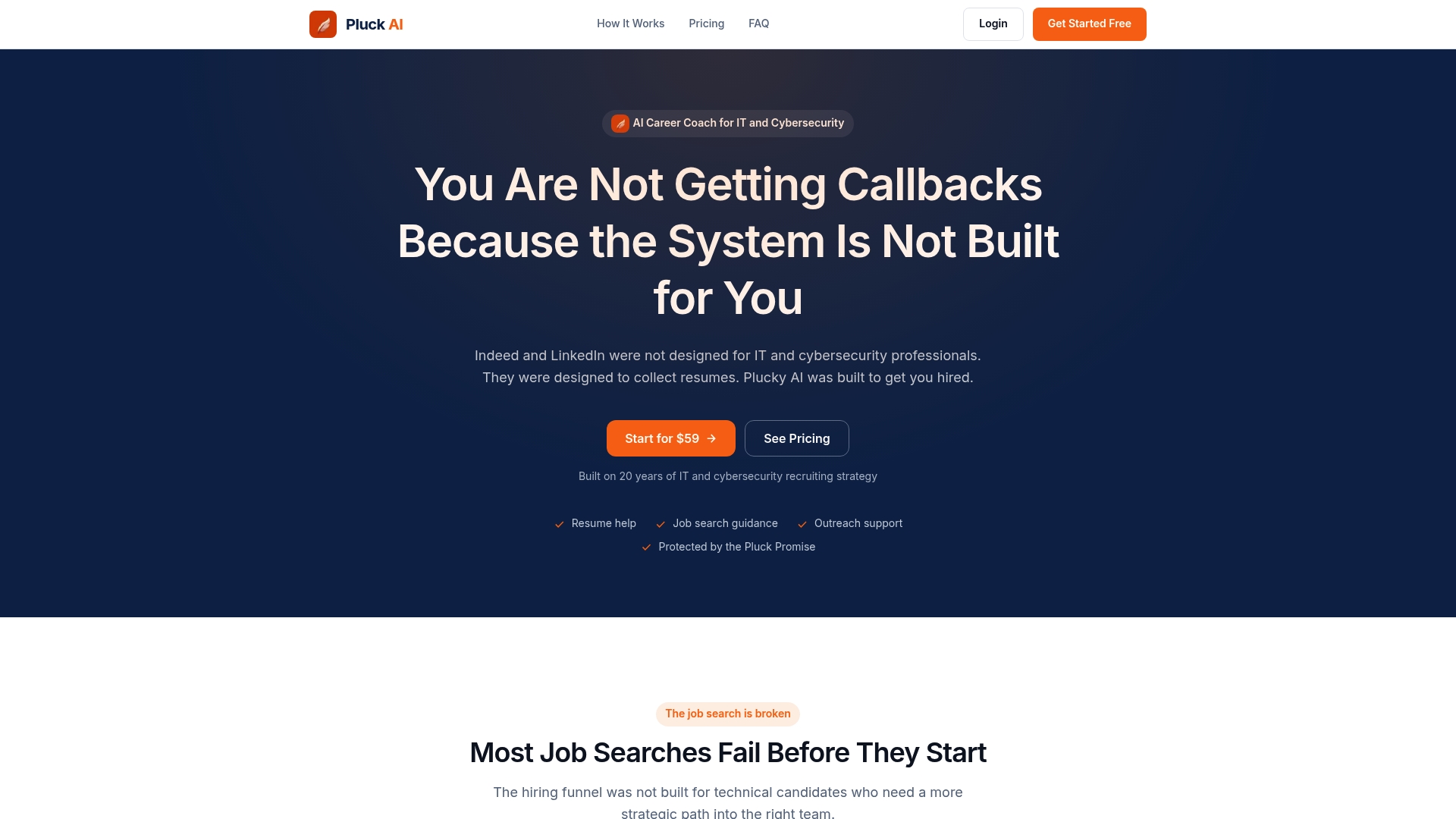
Pluckjobs solves exactly that. The platform combines Apollo contact intelligence with SerpAPI-powered role discovery to surface real, active IT and cybersecurity roles, identify the hiring manager behind each one, and generate tailored resumes matched to the job description. No more guessing. No more cold applying. Start your targeted IT job search with Pluckjobs and apply with the kind of precision that actually produces interviews.
FAQ
What is the interview rate for generic IT resumes?
Generic, mass-applied resumes achieve roughly an 8% interview rate. Targeted, keyword-matched resumes reach above 35%, according to research on IT hiring outcomes.
How do i know if a job listing is a ghost job?
Look for postings older than 60 days, unusually wide salary ranges, vague job descriptions, and repeated repostings. Cross-check against the company's recent hiring activity on LinkedIn.
Why does ATS reject my resume before a human sees it?
ATS software cannot parse tables, columns, graphics, or non-standard fonts. Approximately 23% of resume rejections occur because of formatting errors, not a lack of qualifications.
How soon should i follow up after a job application?
Follow up within 5–7 business days after the application deadline. Keep the message brief, confirm your interest, and ask about next steps.
Do certifications help or hurt my IT job search?
Certifications help when paired with measurable project outcomes. Listing certifications without demonstrating how you applied them signals theoretical knowledge rather than proven capability, which recruiters consistently deprioritize.