
TL;DR:
- Most IT resumes are rejected before a human reviews them due to ATS filtering failures and formatting mistakes. Keyword mismatches, poor formatting, and typos significantly lower the chances of passing initial screening and impressing recruiters. Tailoring applications and fixing technical resume issues greatly improve interview opportunities.
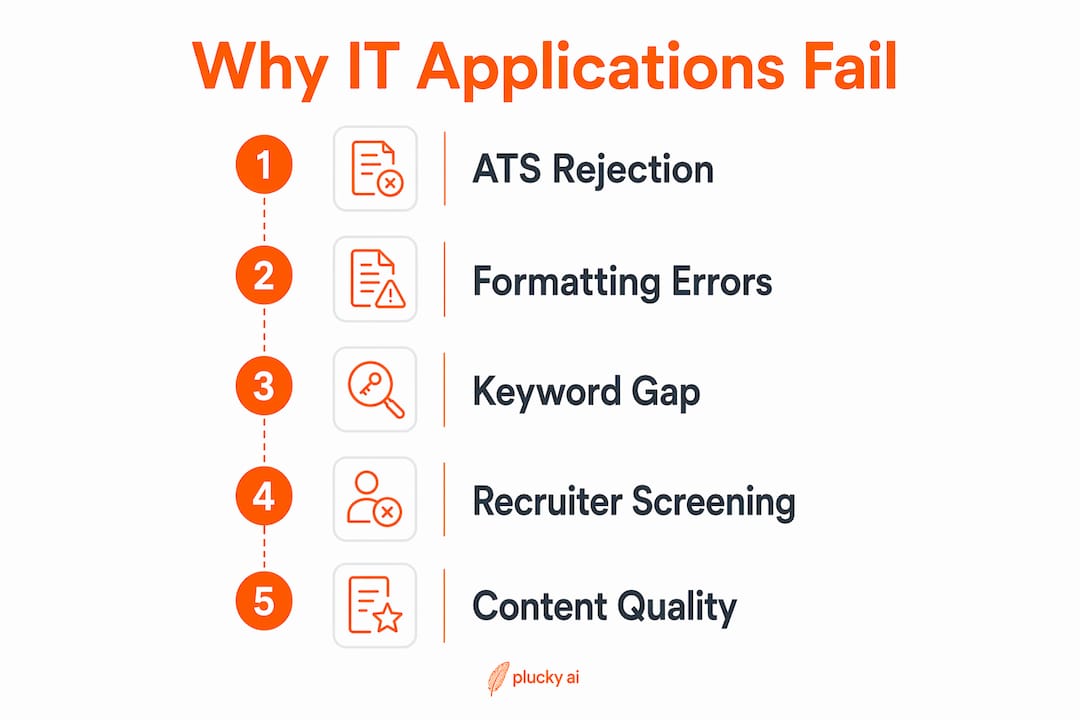
IT job applications get rejected primarily because Applicant Tracking Systems discard resumes before a human ever reads them. The ATS rejection rate for IT roles sits at 71.4%, driven mostly by keyword mismatches and formatting errors rather than a lack of qualifications. Only 3% of IT applications lead to an interview. That means roughly 5 out of every 180 submissions reach a recruiter's desk. Understanding why it job applications get rejected, and what to do about it, is the fastest way to change that ratio. This article covers the full rejection pipeline: ATS mechanics, formatting failures, keyword gaps, and recruiter biases.
Why IT job applications get rejected by ATS systems
Applicant Tracking Systems are the first filter every IT application hits. 98% of Fortune 500 companies use ATS software to screen candidates, which means your resume almost certainly passes through one before a recruiter sees it. The system reads your resume like a text file, parsing it line by line and scoring it against a list of required keywords pulled from the job description.

The problem is that ATS parsers are not intelligent readers. They follow rigid rules. A resume formatted with columns, tables, or graphics will confuse the parser, causing it to scramble text or skip entire sections. When the parser cannot read your contact information or work history correctly, the system scores your application low and moves on. The recruiter never knows you applied.
Common ATS parsing failures in IT applications include:
- Multi-column layouts that cause the parser to read across columns instead of down, merging unrelated text
- Tables used to display skills or job history, which ATS systems frequently skip entirely
- Headers and footers containing contact details, which many parsers ignore completely
- Text boxes and graphics that render as blank space in the parsed output
- Scanned PDF images of resumes, which ATS systems cannot read at all
Tailored applications are three times more likely to lead to interviews than generic ones. That single data point explains why mass applying with one resume rarely works in IT hiring.
Pro Tip: Before submitting any application, paste your resume text into a plain text editor like Notepad. If the content reads out of order or loses structure, your ATS parsing will fail. Fix the layout before you apply.
What formatting mistakes cause automatic rejection?
Formatting is the most underestimated factor in IT application failure. 34% of rejected resumes had formatting failures including multi-column layouts, tables, or contact information placed in the header or footer. These are not minor cosmetic issues. They cause the ATS to discard the resume before any human reviews it.
The most damaging formatting choices follow a predictable pattern:
- Two-column layouts. Two-column layouts scramble parsed text, merging unrelated data from separate columns into a single garbled line. A skills section placed next to a job title can end up reading as one nonsensical string.
- Decorative fonts and icons. Non-standard fonts and icon-based skill ratings look polished in a PDF but convert to unreadable characters in plain-text parsing.
- Contact info in the header. Many ATS systems skip document headers entirely. Your phone number and email address disappear from the parsed output.
- Saving files with vague names. A file named "Resume_Final_v3.pdf" signals disorganization. Name your file "FirstName_LastName_Role.pdf" so recruiters can find it after downloading.
The table below shows the most common formatting errors and their direct consequences:
| Formatting Error | ATS Consequence |
|---|---|
| Multi-column layout | Text scrambled or merged across columns |
| Tables for skills/history | Entire section skipped by parser |
| Contact info in header/footer | Phone and email lost from parsed output |
| Scanned PDF image | Resume reads as blank document |
| Decorative or icon fonts | Characters render as symbols or question marks |
Pro Tip: Use a single-column Word document or a plain PDF exported from Google Docs. Avoid resume builder templates that default to two columns. Simple formatting passes every ATS parser.
How does the keyword translation gap cause IT rejections?
The keyword translation gap is the most common reason IT professionals get rejected despite having the right experience. 82% of rejected resumes contained less than 50% of the target job's required keywords, even when candidates had directly relevant skills. ATS systems look for exact matches, not synonyms or paraphrased descriptions.
This is where IT applicants consistently lose ground. You may have managed cross-functional teams, but if the job description says "stakeholder management" and your resume says "worked with leaders across departments," the ATS scores that as a miss. The experience is identical. The language is not. Mirroring the job description's exact terms fixes most automated screening failures without changing the substance of your resume.
Common keyword gaps in IT resumes include:
- Writing "used agile methods" instead of "Agile" or "Scrum"
- Listing a tool by its full name when the job description uses an abbreviation, or vice versa
- Describing cloud work without naming the specific platform (AWS, Azure, GCP)
- Omitting certifications that appear verbatim in the job posting (CISSP, CompTIA Security+)
- Using "collaborated with teams" instead of "cross-functional collaboration"
The fix is straightforward. Copy the job description into a text document. Highlight every skill, tool, methodology, and certification mentioned. Compare that list against your resume word for word. Add missing terms where they accurately reflect your experience. This audit takes 15 minutes and directly improves your ATS score.
Pro Tip: Focus on the top third of the job description. Hiring managers front-load the most critical requirements. Keywords appearing in the first five bullet points carry the most weight in ATS scoring algorithms.
For a broader look at AI-powered keyword matching in IT roles, the approach extends well beyond simple word swaps.
What content quality issues cause recruiter rejection after ATS?
Passing the ATS is only half the problem. Once a recruiter opens your resume, you have approximately 7.4 seconds before they decide whether to keep reading. Recruiters spend an average of 7.4 seconds on an initial scan, looking for role level, tools, and evidence of results. A resume that passes ATS but reads as a list of job duties will still get rejected.
77% of hiring managers reject resumes for even a single typo or grammatical error. They interpret it as a signal of poor attention to detail, which is a disqualifying trait in most IT roles. A single spelling mistake in a cybersecurity resume, for example, can override an otherwise strong application.
The content issues that cause recruiter rejection fall into four categories:
- Duty-based bullet points. "Responsible for managing network infrastructure" tells a recruiter nothing about your impact. Outcome-focused language demonstrating real-world results is what technical hiring managers prioritize.
- Vague buzzwords. Phrases like "team player," "results-driven," and "passionate about technology" consume space without providing evidence.
- AI-generated phrasing. 80% of hiring managers can detect AI-written resumes, and 49% automatically dismiss them. Unnatural sentence structures and generic language are the primary signals.
- Resume length mismatches. A 4-page resume for a mid-level IT role signals poor prioritization. A 1-page resume for a senior architect role signals incomplete experience.
"A 100% rejection rate often signals resume structural issues or lack of results-oriented language rather than candidate talent. The resume is the problem, not the person."
Replace duty-based bullets with achievement statements. "Managed firewall configurations" becomes "Reduced unauthorized access incidents by auditing and reconfiguring firewall rules across 12 enterprise endpoints." The second version gives a recruiter something to act on. The first gives them nothing to remember.
For a deeper look at how recruiter screening works in tech hiring, the filtering logic extends well beyond the resume itself.
How can IT applicants improve their chances of passing ATS and impressing recruiters?
The factors leading to IT application failure are fixable. Each one has a direct countermeasure that does not require starting from scratch.
- Use a single-column, plain-text layout. Remove all tables, columns, and graphics. Export as a standard PDF or .docx file.
- Audit keywords before every application. Match your resume language to the exact terms in the job description. Do not paraphrase certifications, tools, or methodologies.
- Rewrite bullets as achievement statements. Lead each bullet with a strong verb and end with a measurable result. "Deployed" beats "responsible for deploying." A number beats no number.
- Proofread twice, then use a grammar checker. Tools like Grammarly catch errors that spell-check misses. Read your resume aloud to catch awkward phrasing that signals AI generation.
- Apply to well-matched roles, not every role. Mass-applying with generic resumes lowers your chances because AI-powered screening tools rank tailored applications higher. Thirty targeted applications outperform 300 generic ones.
- Place contact information in the body of the document. Name, phone, email, LinkedIn URL, and city should appear in the main text, not in a header or footer.
Reviewing a solid IT job application checklist before each submission catches the errors that cost candidates interviews.
Pro Tip: Save a master resume with all your experience, then create a tailored version for each application. You only need to adjust the summary, keywords, and top bullet points. The rest stays the same.
Key Takeaways
IT job applications fail at the ATS stage due to formatting errors and keyword gaps, then fail at the recruiter stage due to duty-based content and typos. Both failure points are preventable with targeted fixes.
| Point | Details |
|---|---|
| ATS rejects most IT applications | 71.4% of IT resumes are rejected by ATS before a recruiter reads them. |
| Formatting causes automatic rejection | 34% of rejected resumes fail due to multi-column layouts, tables, or misplaced contact info. |
| Keyword gaps eliminate qualified candidates | 82% of rejected resumes lacked 50% of the job's required keywords despite relevant experience. |
| Typos disqualify strong resumes | 77% of hiring managers reject resumes with even one grammatical error. |
| Tailored applications win interviews | Targeted resumes are three times more likely to lead to interviews than generic submissions. |
The real reason most IT applicants keep getting rejected
Most IT professionals I speak with assume rejection means they are underqualified. That assumption is almost always wrong. The data points to process failures, not talent deficits. A 100% rejection rate is a structural problem with the resume, not a verdict on the candidate's ability.
What I find consistently is that IT applicants spend too much time applying and too little time preparing. Sending 50 applications in a week feels productive. Spending two hours rewriting one resume for one role feels slow. But the math favors the second approach every time. Three well-targeted applications with tailored keywords and achievement-based bullets will outperform 50 generic submissions.
The other pattern I see is a reluctance to treat the resume as a marketing document. Technical professionals often resist quantifying their work because the numbers feel imprecise. But technical hiring managers prioritize proof of skills with measurable outcomes over technical knowledge alone. "Reduced mean time to resolution by 30%" is more persuasive than any certification list.
The most effective shift an IT applicant can make is to stop optimizing for volume and start optimizing for fit. Read the job description carefully. Mirror its language. Show results that match its priorities. That approach does not require more time. It requires more intention.
— Diego
Pluckjobs: built for IT applicants who want precision, not volume
Sending more applications is not the answer. Sending better ones is. Pluckjobs is an AI-powered job search platform built specifically for IT and cybersecurity professionals who want to stop cold applying and start getting responses.
Plucky AI combines role discovery with hiring manager outreach data and tailored resume generation in one tool. It identifies exact keyword gaps between your resume and a target job description, then helps you close them without rewriting from scratch. You find the right role, reach the right person, and submit an application that is built to pass ATS and impress recruiters. For IT professionals serious about cutting through the noise, Pluckjobs removes the guesswork from every step of the process.
FAQ
Why do most IT job applications get rejected automatically?
Most IT applications are rejected by ATS software before a recruiter reviews them. The 71.4% ATS rejection rate for IT roles is driven primarily by keyword mismatches and formatting errors.
What formatting errors cause ATS rejection?
Multi-column layouts, tables, and contact information placed in headers or footers are the most common causes. These formatting choices prevent ATS parsers from reading resume content correctly.
How many keywords does my IT resume need to pass ATS?
Your resume should match at least 50% of the keywords in the job description. Resumes with less than 50% keyword coverage are rejected at a significantly higher rate, even when candidates have relevant experience.
Do typos really cause recruiters to reject IT resumes?
Yes. 77% of hiring managers reject resumes with even a single typo or grammatical error. In IT roles, attention to detail is a core competency, and errors signal the opposite.
Does applying to more IT jobs improve your chances?
No. Mass-applying with generic resumes lowers your chances because AI-powered screening tools rank tailored applications higher. A smaller number of targeted, customized applications produces better results than high-volume generic submissions.