
TL;DR:
- A job search funnel is a structured system that guides candidates through awareness, engagement, and conversion stages. It emphasizes targeted sourcing, personalized outreach, and consistent tracking to improve response and offer rates. Most failures stem from leak points that require diagnostic fixes rather than increased effort.
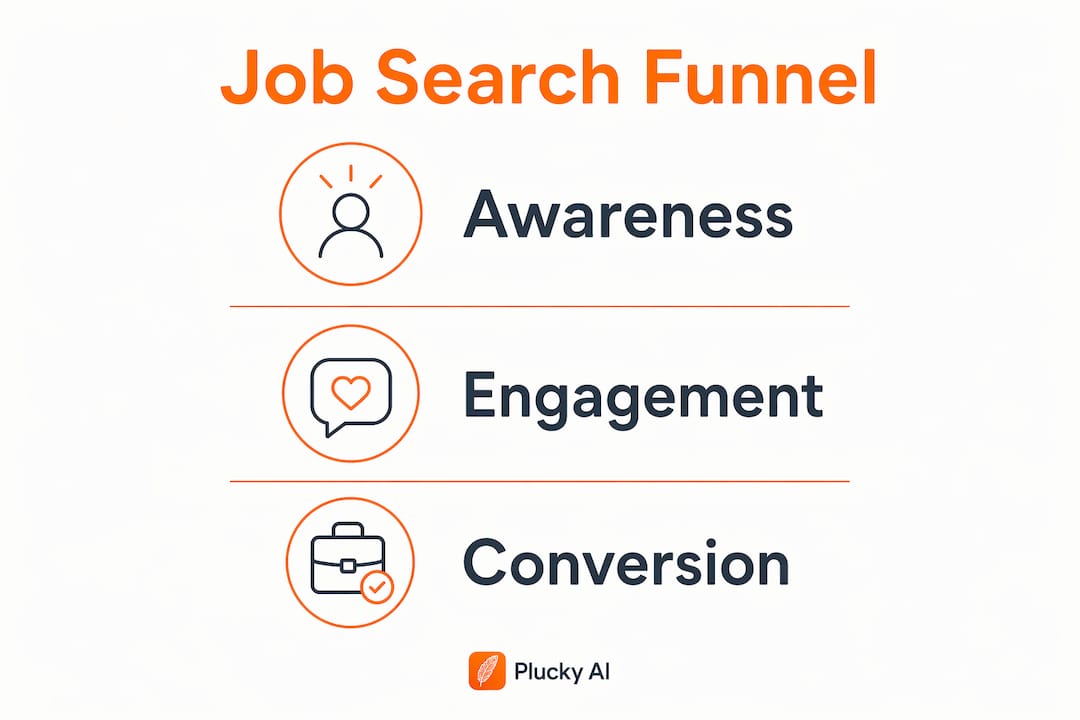
A job search funnel is a structured framework that moves candidates through three sequential stages: Awareness, Engagement, and Conversion. Each stage has specific goals, measurable outputs, and a defined set of actions. Without this structure, most job seekers apply randomly, track nothing, and wonder why months pass without an offer. The funnel model borrows directly from sales and marketing. You are the product. Every employer is a potential buyer. Your job is to move them from "never heard of you" to "you're hired" through a deliberate, repeatable process.
What is a job search funnel and how does it work?
A job search funnel organizes your entire search into three stages, each narrowing toward a single outcome: a signed offer letter. The three stages are Awareness, Engagement, and Conversion. Understanding what happens at each stage is the foundation of any effective job search strategy.
Stage 1: Awareness (visibility)
The Awareness stage is where you identify opportunities and get your name in front of the right people. This means sourcing job leads from LinkedIn, niche IT job boards, company career pages, and professional communities. The goal is volume with direction. Experts recommend identifying 10–15 leads per week at this stage. That number gives you enough pipeline to sustain momentum through the later stages.

The biggest threat at this stage is invisibility. 97.4% of Fortune 500 companies use Applicant Tracking Systems that filter out most candidates before a human ever sees the resume. Cold online applications convert at roughly 0.1–2%. That number should change how you think about sourcing. Visibility is not just about applying. It is about being findable, referable, and positioned before a job is even posted.
Stage 2: Engagement (application and networking)
The Engagement stage is where you turn leads into active conversations. This includes submitting tailored applications, reaching out to hiring managers, and activating your network. Tailored applications with customized resumes increase response rates from around 2% to 20–30%. That is a tenfold improvement from one change: specificity. Generic applications fail because they signal low intent to the reader.
Networking belongs here too. Every informational interview, LinkedIn message, and alumni connection is an Engagement activity. The goal is to move from a name on a screen to a person someone vouches for.
Stage 3: Conversion (interviews and offers)
The Conversion stage covers everything from the first interview to the signed offer. This includes interview preparation, follow-up emails, and salary negotiation. The target at this stage is 1–2 interviews per week, sustained over time. Most job seekers treat each interview as a one-off event. The funnel model treats it as a conversion rate problem. If you interview often but rarely get offers, the issue is closing technique, not luck.
| Stage | Goal | Weekly target | Key actions |
|---|---|---|---|
| Awareness | Identify opportunities | 10–15 leads | Job boards, LinkedIn, referrals |
| Engagement | Generate responses | 5–7 applications | Tailored resumes, outreach, networking |
| Conversion | Secure offers | 1–2 interviews | Prep, follow-up, negotiation |
Pro Tip: Track each lead in a spreadsheet or tool like Notion or Airtable. Assign a stage to every opportunity. This turns a chaotic search into a managed pipeline you can review and adjust weekly.
How can you diagnose drop-offs in your job search funnel?
Every job search funnel leaks somewhere. The skill is knowing where. Career strategist Shay Bricker frames this as a diagnostic exercise, not a personal failure. Each drop-off point tells you something specific about what needs to change.
The three most common leak points are:
- No responses to applications. This signals a targeting or visibility problem. Your resume may not pass ATS filters, or you are applying to roles that do not match your profile closely enough. The fix is to optimize your resume for ATS and narrow your targeting to roles where your background is a strong match.
- Responses but no interviews. This signals a resume or positioning problem. Recruiters are reading your application but not finding enough reason to call. Review your resume for specificity. Quantify results. Align your language with the job description.
- Interviews but no offers. This signals a conversion problem. You are getting in the room but not closing. Record mock interviews, review your answers against the STAR method, and follow up after every interview with a specific, personalized note.
Tracking these metrics weekly is what separates a managed search from a passive one. Measuring conversion rates at each stage and adjusting your approach improves success rates over time. Without data, you are guessing. With data, you are iterating.
One underused diagnostic tool is the informational interview. When you cannot get a formal interview, an informational conversation with someone inside the company tells you whether your targeting is right. It also plants a referral seed for future openings.
Pro Tip: Log every rejection with a one-line note on why you think it happened. After two weeks, patterns emerge. Those patterns are your improvement roadmap.
What role do networking and referrals play in funnel conversion?
Networking is the single highest-leverage activity in the entire job search process. 70–80% of jobs are filled through networking, not job board applications. That figure means the majority of open roles are decided before most candidates even know the position exists.
Referrals work because they bypass the ATS entirely. A referred candidate skips the automated filter and lands directly in front of a hiring manager. Cold applications convert at 0.1–2%. Referrals convert at around 30%. That difference is not marginal. It is structural.
Here is how to build referral activity into your funnel:
- Reconnect before you need anything. Message former colleagues, classmates, and managers with genuine updates. Share an article. Congratulate a promotion. Build the relationship before making an ask.
- Be specific in your outreach. "I'm exploring roles in cloud security at mid-size financial firms. Do you know anyone at [Company]?" is more effective than "Let me know if you hear of anything."
- Request informational interviews. A 20-minute call with someone inside your target company is worth more than 20 cold applications. It generates insider knowledge and a potential referral in one conversation.
- Use LinkedIn strategically. LinkedIn for IT job search works best when you treat it as a relationship platform, not a job board. Post, comment, and connect with intent.
Networking also compresses the funnel. A referred candidate often skips early screening rounds entirely. That means fewer stages, faster timelines, and better offer rates.
How to build and maintain an effective job search funnel system
Building a job search funnel system means creating a repeatable weekly routine that covers all three stages simultaneously. Most job seekers focus entirely on one stage at a time. They apply in bulk for two weeks, then wait. Then they interview. Then they start over. This creates gaps and extends the search by months.
A functioning funnel runs all three stages in parallel every week. Here is a practical weekly structure:
- Monday: Sourcing (Awareness). Identify 10–15 new leads from job boards, LinkedIn, and company career pages. Add them to your tracking system with source, role, and company noted.
- Tuesday and Wednesday: Applications (Engagement). Select 5–7 of the strongest leads. Customize each resume and cover letter. Send targeted outreach to a hiring manager or internal contact at each company.
- Thursday: Networking (Engagement). Send 3–5 networking messages. Follow up on any unanswered outreach from the prior week. Schedule informational interviews where possible.
- Friday: Interview prep and review (Conversion). Prepare for any scheduled interviews. Review your funnel metrics. Note where leads are stalling and adjust your approach for the following week.
The tools you use matter less than the consistency of the system. A simple Google Sheets tracker works. So does a dedicated job search metrics platform. What matters is that every lead has a stage, a status, and a next action assigned to it.
Weekly funnel management that classifies activities by stage optimizes consistent productivity and focus. The job seekers who land fastest are not the ones who apply the most. They are the ones who apply with the most precision and follow up with the most consistency.
| Metric to track | What it tells you |
|---|---|
| Leads identified per week | Whether your sourcing is active enough |
| Application response rate | Whether your resume and targeting are aligned |
| Interview-to-offer ratio | Whether your closing and negotiation skills are strong |
| Time per stage | Where your funnel is slowing down |
Key takeaways
A job search funnel works because it converts a chaotic, emotional process into a measurable system with defined stages, weekly targets, and clear diagnostic signals.
| Point | Details |
|---|---|
| Three core stages | Awareness, Engagement, and Conversion each require distinct weekly actions and targets. |
| ATS is a real barrier | 97.4% of Fortune 500 companies use ATS, making cold applications convert at just 0.1–2%. |
| Networking drives results | Referrals convert at around 30% versus 2% for cold applications, making networking the highest-ROI activity. |
| Diagnose drop-offs by stage | No responses signal targeting issues; no offers signal closing gaps. Each problem has a specific fix. |
| Consistency beats volume | Running all three funnel stages in parallel every week shortens the search more than bulk applying. |
Why I think most job seekers are solving the wrong problem
Most people treat a stalled job search as a motivation problem. They push harder, apply more, and refresh their inbox more often. The actual problem is almost always structural. The funnel is leaking at a specific stage, and no amount of effort fixes a structural leak.
Job coach Joseph Ortenzi puts it plainly: you are the product, and every touchpoint is a positioning decision. That reframe changes everything. A marketer does not respond to low conversion rates by running more ads with the same broken message. They diagnose the funnel, fix the message, and test again.
The job seekers I have seen succeed fastest are the ones who track obsessively and feel nothing about individual rejections. They treat a rejection as a data point. They ask: was this a targeting miss, a resume miss, or an interview miss? Then they adjust one variable and test again. The University of St. Thomas calls this "celebrating action, not just results." That mindset is not just motivational advice. It is a practical strategy for staying in the game long enough to win.
The other mistake I see constantly is treating LinkedIn as the whole strategy. LinkedIn is one channel in the Awareness stage. It is not a funnel. It is not a strategy. LinkedIn alone is not enough for IT professionals, and the same is true across industries. A real funnel uses multiple sourcing channels, active outreach, and a tracking system that tells you exactly where your search stands at any moment.
Build the system. Run it weekly. Treat every data point as information. The offer comes from the process, not from luck.
— Diego
How Pluckjobs powers your job search funnel
For IT and cybersecurity professionals, managing a job search funnel manually is time-consuming. Pluckjobs changes that. The platform combines Apollo contact intelligence with SerpAPI-powered role discovery to surface precision job matches and direct hiring manager contact data in one place.
Every stage of the funnel gets support. Awareness becomes faster with AI-driven role discovery that surfaces relevant openings before they go cold. Engagement gets sharper with AI-tailored resumes built to match specific job descriptions. Conversion improves when you know exactly who to follow up with and how to reach them. Pluckjobs removes the guesswork from cold applying and replaces it with targeted, data-backed outreach. If you are in IT or cybersecurity and want a funnel that actually moves, Pluckjobs is built for that.
FAQ
What is a job search funnel in simple terms?
A job search funnel is a three-stage system that moves you from finding opportunities to receiving an offer. The stages are Awareness, Engagement, and Conversion, each with specific weekly targets and actions.
How many applications should I send per week?
Experts recommend submitting 5–7 quality, tailored applications per week rather than sending high volumes of generic ones. Tailored applications generate response rates of 20–30% compared to roughly 2% for generic submissions.
Why do most job applications get no response?
Most applications fail at the Awareness stage because ATS filters screen out resumes before a human reviews them. Optimizing your resume for ATS keywords and pursuing referrals dramatically improves your visibility.
How is a job search funnel different from a recruitment funnel?
A recruitment funnel is managed by employers to evaluate candidates. A job search funnel is managed by the candidate to track and optimize their own progress through the hiring process from the applicant's perspective.
How long does a typical job search funnel take?
Timeline varies by industry and role level, but a well-managed funnel running all three stages in parallel typically produces interviews within two to four weeks of consistent weekly activity.