
A long-game job search strategy is a structured, paced approach that replaces high-volume applications with targeted outreach, deliberate networking, and continuous skill development over a period of several months. For IT and cybersecurity professionals, this method is the difference between landing a role that fits your career trajectory and accepting the first offer that appears after months of exhausting, unfocused effort. The average mid-career search takes 4 to 7 months, while senior roles extend to 6 to 10 months. That timeline demands a system, not a sprint. Tools like LinkedIn, AI-powered resume platforms, and contact intelligence tools such as Pluckjobs make this structured approach more executable than ever before.
What is a long-game job search strategy and how does it differ from traditional approaches?
A strategic job search, the industry term for what many call the long-game approach, is defined by quality over quantity, warm channels over cold applications, and weekly systems over reactive bursts of activity. Traditional job hunting relies on what practitioners call "spray and pray": submitting dozens of generic applications to job boards and waiting. The long-game strategy replaces that with 8 to 15 tailored applications per week, each customized to the company's specific challenges and the role's actual requirements.
The conversion rate difference is significant. Warm channels yield 3x higher offer conversion rates compared to mass cold applications. Warm channels include internal mobility opportunities, referrals from strong professional ties, introductions through weaker network connections, inbound recruiter outreach, and direct contact with hiring managers. Each of these paths produces better outcomes than refreshing a job board.
| Approach | Volume | Channel | Burnout risk | Conversion rate |
|---|---|---|---|---|
| Spray and pray | 40+ generic apps/week | Cold job boards | Very high | Low |
| Long-game strategy | 8 to 15 tailored apps/week | Warm referrals, direct outreach | Managed | Up to 3x higher |
The traditional approach also produces a well-documented psychological cost. 62% of job seekers experience clinical burnout during a typical search. That statistic reflects what happens when effort is high but feedback is low. A paced strategy distributes effort across multiple activities, which keeps motivation intact over the full duration of the search.
Pro Tip: If you have been applying to more than 20 roles per week with no customization, stop. Cut your volume in half, double the research per application, and track your response rate over the next two weeks. The data will confirm the shift.
What are the core pillars and weekly activities that sustain a long-game search?
The four pillars of a strategic job search are tailored applications, networking and informational interviews, skill development, and weekly performance review. These are not optional categories. They are the load-bearing structure of a search that lasts months without collapsing under its own weight. Research recommends dedicating 16 to 20 hours per week across these four areas, distributed deliberately rather than concentrated in reactive bursts.
A practical weekly structure for IT professionals looks like this:
- Monday and Tuesday: Research and submit 3 to 5 tailored applications. Each application includes a customized resume section and a brief note on why this specific company and role align with your background.
- Wednesday: Conduct one to two informational interviews or LinkedIn outreach messages. Focus on people in roles you want or at companies on your target list.
- Thursday: Dedicate two to three hours to skill development. For IT and cybersecurity professionals, this means certifications like CompTIA Security+, AWS Solutions Architect, or hands-on labs through platforms like TryHackMe or Hack The Box.
- Friday: Review the week's metrics. Track application response rates, networking replies, and interview conversion. Adjust next week's plan based on what the data shows.
Rest is not a reward for productivity. Maintaining non-work activities during a prolonged search is a documented factor in preventing burnout and preserving the mental clarity needed to make good decisions about offers. Build at least one full day off into every week.
Pro Tip: Track every application in a simple spreadsheet with columns for company, role, date applied, contact name, follow-up date, and current status. After four weeks, patterns emerge. You will see which types of roles respond and which channels produce conversations.
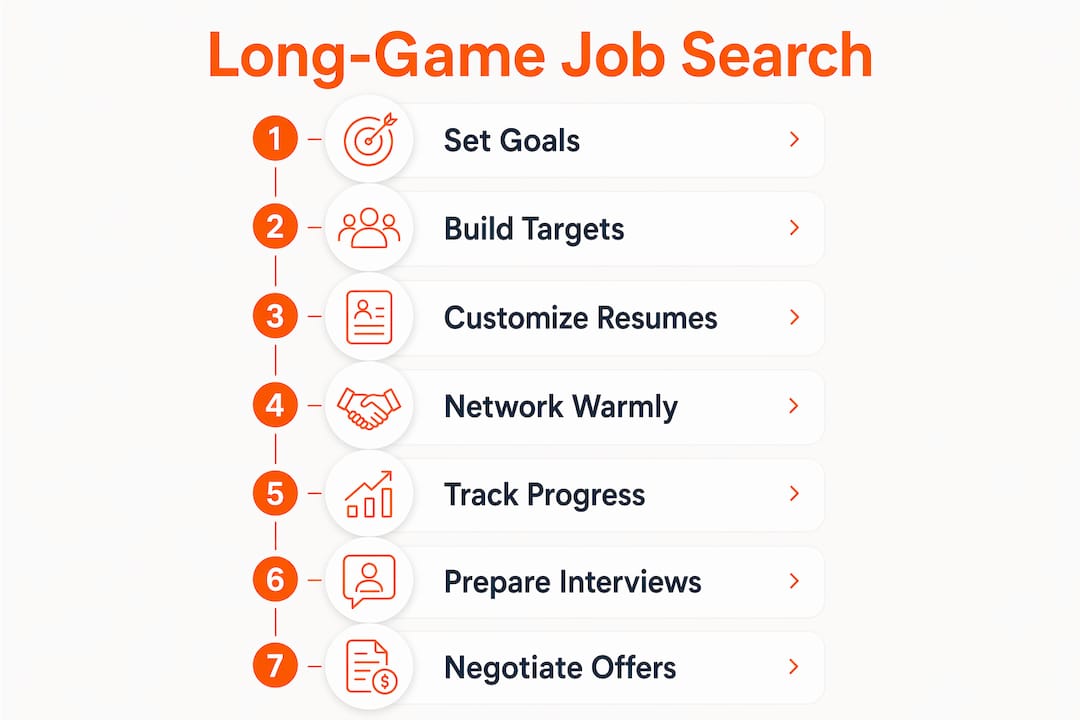
How to build your target list and leverage warm channels for higher success rates
Building a target company list is the foundation of effective job search planning. The goal is to identify 15 to 20 preferred companies where your skills, experience level, and career goals align with the company's current direction. For IT professionals, this means going beyond company size and industry. You need to know which teams are growing, which technologies they use, and ideally, who manages the function you want to join.

Specificity is what separates a target list from a wish list. Each company entry should include the role family you are targeting, the likely team structure, the technology stack in use, and the name of at least one relevant hiring manager or team lead. This level of detail prevents the drift back into volume mode, where you apply broadly and lose the quality advantage the strategy depends on.
Warm channel sequencing, ordered by conversion probability, works as follows:
- Internal mobility: If you are currently employed, internal transfers are the highest-conversion path. Decision-makers already know your work.
- Strong ties: Direct connections who can refer you or make an introduction. These are former managers, colleagues, and mentors who will advocate for you.
- Weak ties: Acquaintances and second-degree connections. Research consistently shows that weak ties surface opportunities strong ties cannot, because they operate in different networks.
- Inbound recruiters: Recruiters who reach out to you based on your profile. This is a signal that your LinkedIn presence is working.
- Outbound hiring managers: Direct, personalized outreach to the person who owns the role. This requires research but produces results when done correctly.
LinkedIn profile optimization directly affects how many inbound opportunities reach you. Targeting your LinkedIn headline with role-family keywords, key technical skills, and a professional photo significantly increases recruiter discovery. For a cybersecurity professional, a headline like "Cloud Security Engineer | AWS | Zero Trust | SOC2" outperforms "Experienced IT Professional" in every recruiter search.
Personalized outreach messages follow a simple structure: one sentence on why you are reaching out to this specific person, one sentence connecting your background to their work, and one clear ask. "Would you have 20 minutes for a brief conversation?" is more effective than a vague request to "connect."
Pro Tip: Applying to 8 to 10 tailored roles with company research and resume customization outperforms 40 generic applications, even with the same time investment. The math favors precision.
What interview and offer conversion tactics maximize your long-game payoff?
The interview is where months of strategic preparation either pay off or stall. The first 7 minutes of any interview form the hiring decision more than any other window. A focused 90-second narrative that connects your background directly to the company's stated challenges is the single highest-leverage move you can make in that window. Generic "tell me about yourself" answers waste it.
Treat every interview as a two-way evaluation. You are assessing whether this role, team, and company match your career goals. Candidates who ask sharp, specific questions about team structure, current technical challenges, and success metrics in the first 90 days consistently perform better in hiring decisions. It signals preparation and confidence, both of which are valued in IT and cybersecurity roles where judgment under uncertainty is part of the job.
On the offer side, timing and anchoring determine outcomes. Negotiate only after receiving a written offer, and anchor your counter on documented market data from sources like Levels.fyi, Glassdoor, or the Bureau of Labor Statistics. Anchoring on personal financial need produces worse outcomes than anchoring on market benchmarks. The hiring manager responds to data, not circumstance.
Common mistakes that waste the long-game advantage at the offer stage include accepting verbally before reviewing the full package, failing to negotiate non-salary components like remote work flexibility, equity, or professional development budgets, and moving too quickly out of relief that the search is ending. A search that took six months deserves a week of careful offer review.
Key takeaways
A long-game job search strategy succeeds because it replaces reactive, high-volume effort with a disciplined weekly system built on warm channels, targeted applications, and consistent skill development.
| Point | Details |
|---|---|
| Paced application volume | Submit 8 to 15 tailored applications per week rather than dozens of generic ones. |
| Warm channel priority | Referrals and direct outreach yield up to 3x higher conversion than cold job board applications. |
| Weekly structure matters | Allocate 16 to 20 hours per week across applications, networking, skill development, and review. |
| Target list specificity | Build a list of 15 to 20 companies with role, team, and hiring manager detail to stay focused. |
| Negotiate with data | Counter offers anchored on market benchmarks produce better compensation outcomes than need-based requests. |
Why endurance is the skill most IT job seekers underestimate
I have watched technically strong IT professionals lose searches not to less-qualified candidates, but to their own inconsistency. They apply heavily for two weeks, hear nothing, and pull back. Then they apply again in a panic. That cycle produces worse outcomes than a steady, lower-volume effort maintained across four months.
Endurance in a long search is not a personality trait. It is a design problem. The professionals who succeed build a weekly system that functions on low-energy Wednesdays just as well as it does on motivated Monday mornings. The system does the work when motivation does not show up.
There is also an emotional dimension that rarely gets discussed in job search guides. A prolonged search can trigger a real sense of grief over lost professional identity, particularly for senior IT professionals who define themselves through their work. Intentional self-care during the process produces clarity and confidence that directly affects how you show up in interviews and networking conversations. Candidates who are visibly desperate make poor decisions about offers and read poorly in interviews.
The mindset shift that produces results is moving from "I need a job" to "I am building toward a specific career outcome." That shift changes how you write outreach messages, how you evaluate opportunities, and how you handle rejection. In IT and cybersecurity, where the talent market is competitive but the demand for skilled professionals is real, a strategic, patient approach is not just advisable. It is the method that works.
— Diego
How Pluckjobs accelerates your long-game search in tech
Pluckjobs is built specifically for IT and cybersecurity professionals who are done cold-applying and ready to search with precision. The platform combines Apollo contact intelligence with SerpAPI-powered role discovery to surface relevant openings and the hiring manager contact data that makes warm outreach possible. Tailored resumes, direct outreach data, and role matching are all in one place. If your long-game strategy depends on targeting the right companies and reaching the right people, Pluckjobs removes the manual research that slows most searches down. Find the role. Find the person. Get hired.
FAQ
How long does a long-game job search typically take?
The average mid-career search takes 4 to 7 months, while senior-level roles in IT and cybersecurity typically require 6 to 10 months. A paced strategy accounts for this timeline from the start rather than treating it as a failure.
How many applications should I submit per week in a strategic search?
Research supports submitting 8 to 15 highly tailored applications per week. Each application should include company-specific resume customization and role-relevant framing rather than a generic submission.
What is the most effective channel for finding a job in IT?
Warm channels, specifically referrals from strong professional ties and direct outreach to hiring managers, produce the highest conversion rates. Sequenced warm outreach converts at up to 3x the rate of cold job board applications.
How do I avoid burnout during a long job search?
Limit active search time to 16 to 20 hours per week, distribute effort across applications, networking, and skill development, and protect at least one full rest day per week. Burnout affects 62% of job seekers who do not manage this structure deliberately.
When should I negotiate a job offer?
Negotiate only after you have a written offer in hand. Anchor your counter on documented market data from sources like Levels.fyi or Glassdoor rather than on personal financial need, which produces stronger compensation outcomes.