
Send a concise, personalized thank-you email to every interviewer within 24 hours of your interview, same day if possible. Keep it under 200 words, reference one specific detail from the conversation, and send each panel member a separate note rather than one group message. That combination of speed, brevity, and specificity is what actually influences hiring decisions.
TL;DR:
- Sending a thank-you email within 24 hours of the interview is crucial because hiring teams often decide quickly, sometimes within hours.
- Personalizing the message with a specific detail from the conversation and linking it to your skills significantly increases your chances of standing out.
- Avoid generic messages, and send individual notes to each panel member instead of one group email to demonstrate genuine engagement and attention.
- If delayed, a thank-you email is still better than none, but avoiding apology for lateness is recommended; timing with government agencies may require digital follow-up due to delays.
- A well-structured email referencing a role-specific detail and your ability to solve a problem can influence minor perceptions that impact final hiring decisions.
Table of Contents
- Why Your Interview Thank You Email Actually Matters
- When to Send: Timing Rules and Special Cases
- What to Include: Structure, Subject Line, and Tone
- Interview Thank You Email Templates for Every Scenario
- Mistakes That Undercut a Good Thank You Email
- What to Do If You Don't Hear Back
- Does a Thank You Email Actually Affect Hiring Decisions?
- A Publisher's Take on Follow-Up Strategy
- Speed Up Your Follow-Up With Pluckjobs
- Where This Guidance Comes From
- Sources
- FAQ
Why Your Interview Thank You Email Actually Matters
Hiring moves fast once interviews wrap up. Teams often make a decision within days, sometimes hours, and a well-timed follow-up keeps your name in front of the people deciding your fate. A generic "thanks for your time" gets skimmed and forgotten. A sharp one gets forwarded to the hiring manager with a note attached.
The strongest interview thank you email doesn't just say thanks. It performs what career strategists at Swarthmore's Career Center call a "fit check": you take one skill you have and tie it directly to a problem the interviewer mentioned. That single move separates a memorable candidate from a forgettable one, and it costs you nothing but two extra minutes of thought before you hit send.
When to Send: Timing Rules and Special Cases
The window is 24 hours, and Harvard Law School's career office treats that as the standard for a reason: any longer, and your follow-up reads like an afterthought rather than genuine enthusiasm.
If your interview happens in the morning, send your note that same afternoon. If it runs late in the day, send it that evening or first thing the next morning. Either way, same day beats next day.
Missed the window entirely? Send it anyway. A thank-you email sent 48 or 72 hours late is still better than none at all. Skip the apology for lateness. It draws attention to the delay instead of your message. Just send a clean, concise note and move forward.
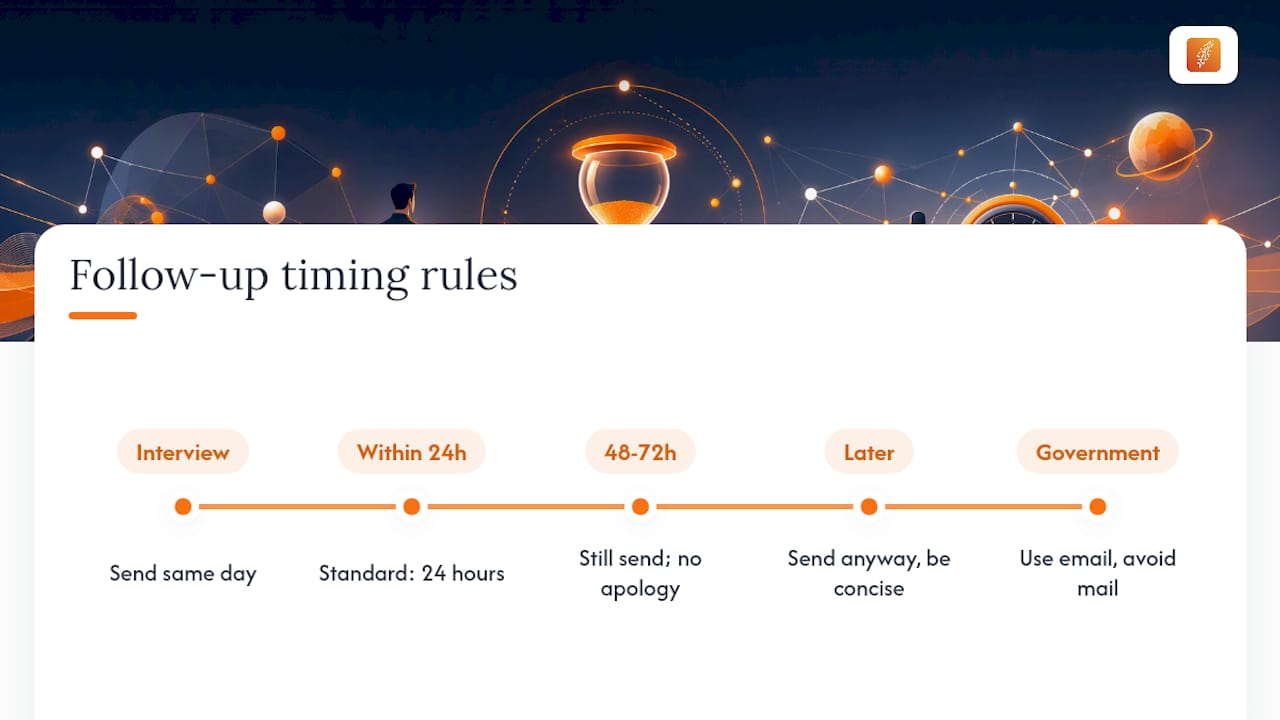
One exception worth knowing: if you're interviewing with a government employer, don't count on a mailed note to arrive in time. Internal mail routing at government agencies can cause serious delays, so collect email addresses or business cards during the interview and follow up digitally instead.
What to Include: Structure, Subject Line, and Tone
A strong post-interview thank you email follows a predictable shape. You don't need to reinvent it every time. You need to fill it in correctly.
Subject line should be scannable in an inbox full of other messages. Three that work well:
- "Thank You, [Interviewer Name], Cybersecurity Analyst Role"
- "Great Speaking With You Today, [First Name]"
- "[Your Name], Following Up on Our Interview"
Opening line: Thank the interviewer by name and reference the specific role. Skip "I hope this email finds you well." It's filler that delays the point.
The specific reference: Name one detail from the conversation, a project they mentioned, a technical challenge they're facing, a timeline they shared, a book or tool they brought up. This is the single most important sentence in the email because it proves you were actually listening, not just waiting for your turn to talk.
The fit reminder: One sentence connecting a skill you have to a need they described. Not a résumé recap. A direct line between their problem and your capability.
Closing: Offer to provide anything else they need (references, work samples, a portfolio link) and sign off with your name, phone number, and a link to your LinkedIn or portfolio.
Keep the whole message under 200 words and formatted for mobile: short paragraphs, no walls of text, nothing that requires pinch-zooming on a phone screen.
Pro Tip: Draft your fit-reminder sentence before you even leave the building. The detail you'll want to reference is freshest in your memory in the first ten minutes after the interview ends, not two hours later when you finally sit down to write.
Interview Thank You Email Templates for Every Scenario
Different interview formats call for slightly different notes. Here's how to adapt the same core structure across five common situations.
-
Recruiter or phone screen. Keep it brief since this contact is often just the gatekeeper. Subject: "Thank You for the Call Today." Body: "Hi [Name], thank you for the time today discussing the [Role] position. I enjoyed learning more about [specific detail, e.g., the team's move to zero-trust architecture]. I'm excited about the next steps and happy to provide anything else you need." Three lines, done.
-
Hiring manager one-on-one. This is where the fit check matters most. Open with thanks and the specific reference. Middle paragraph ties your background to their stated need ("Since your team is migrating legacy systems to AWS, my three years automating that exact process with Terraform could shorten that timeline"). Close with availability for next steps.
-
Panel interviews. Never send one email to the whole group. Send each panelist an individualized note referencing something they specifically said, not a copy-pasted paragraph with swapped names. If you only caught one contact email, ask that person to forward brief thanks to the others, or note in your message that you'd appreciate their help passing along your thanks.
-
Technical follow-up. If a technical interview left a question partially answered, use the thank-you as a chance to close the gap. Add one clarifying sentence, or better, a link to a relevant GitHub repo or Gist showing the solution you were describing. This works especially well for engineering and security roles where a demonstrated artifact beats a verbal explanation.
-
Correcting a missed answer. If you fumbled a question, don't over-explain in the follow-up. One line does it: "One thing I wanted to add on the incident-response question, we also implemented automated rollback triggers, which cut our mean recovery time by half." Then move on to the rest of the note.
Mistakes That Undercut a Good Thank You Email
Even a well-intentioned follow-up can backfire. The most common mistakes:
- Sending a template that's obviously generic, no company name, no role, no specific detail from the conversation.
- Misspelling the interviewer's name or title, which is instantly noticeable and hard to recover from.
- Writing a message so long it reads like a cover letter rather than a quick, genuine note.
- CC-ing every interviewer on one email instead of sending individual notes.
Run a 30-second check before you hit send: confirm the person's name and title, the company name, the role title, any links you've included, your subject line, and a quick read for typos. Proofreading matters more than most candidates assume; a single misspelled name can undo an otherwise sharp message.
Handwritten notes still have a place, mainly in very formal or relationship-driven industries, but they're the exception now. Most hiring contexts favor a fast, mobile-friendly email that respects the interviewer's time over a note that might sit in a mailroom for days.
What to Do If You Don't Hear Back
Silence after your thank-you email doesn't necessarily mean bad news. Hiring timelines slip constantly, especially when multiple stakeholders need to sign off.
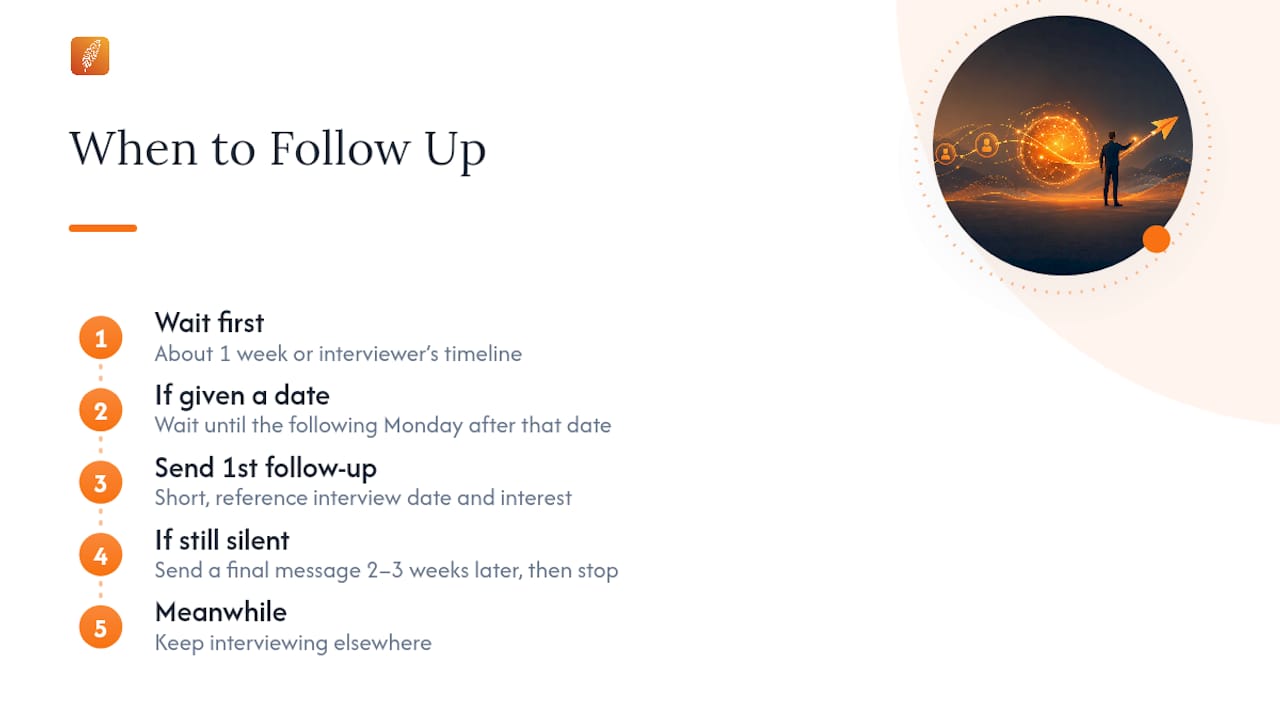
Give it about a week after your thank-you email, or whatever timeline the interviewer gave you during the conversation, before following up again. If they said "we'll have a decision by Friday," wait until the following Monday, not Friday afternoon.
Your follow-up should be short and low-pressure. Reference your original interview date, restate your interest in the role, and ask for a status update. Something like: "Hi [Name], I wanted to check in on the [Role] position I interviewed for on [date]. I remain very interested in the opportunity and wanted to see if there's an update on timeline."
If you still hear nothing after a second follow-up, it's reasonable to send one more message two to three weeks later, then let it go. Continuing to email beyond that point risks looking less like enthusiasm and more like pressure. In the meantime, keep interviewing elsewhere. A thank-you email and a polite follow-up are professional moves, not a substitute for a real answer, and the strongest candidates rarely wait on one opportunity alone.
Does a Thank You Email Actually Affect Hiring Decisions?
Hiring managers rarely reject a strong candidate solely because they skipped a thank-you note, but the note does shape perception in ways that matter at the margins. In competitive processes where two or three finalists are close, the follow-up becomes a tiebreaker.
A sharp thank-you email signals two things hiring teams actually weigh: communication skill and genuine interest. If your note references a specific technical challenge the team is facing and connects it to something you've solved before, you're no longer just "the candidate who interviewed Tuesday." You're the candidate who's already thinking about their problems.
The reverse is also true. A missing or careless follow-up doesn't disqualify you outright, but a sloppy one, wrong company name, generic phrasing, obvious typos, does register as a small red flag about attention to detail. For roles in IT and cybersecurity, where precision is part of the job description, that detail carries extra weight. The email itself is rarely the deciding factor, but it's one of the few parts of the process you fully control after the interview ends.
A Publisher's Take on Follow-Up Strategy
Most advice on this topic treats the thank-you email as a formality. It's not. It's the last piece of evidence a hiring team sees before they decide, and most candidates waste it on generic phrasing that says nothing about them.
At Pluckjobs, we built tools to find hiring manager contact information specifically because the biggest obstacle to a good follow-up usually isn't writing skill, it's not having the right email address in the first place. Pair that with a bit of research on what to reference from the interview itself, and even a five-minute template becomes a genuine differentiator. Use the templates above as a starting frame, but never send one without swapping in a real detail from your actual conversation.
— Diego
Speed Up Your Follow-Up With Pluckjobs
Finding the right contact information is often the hardest part of sending a personalized thank-you email, especially when a recruiter never shares direct emails for the hiring manager or panel. Pluckjobs was built for IT and cybersecurity job seekers who need that contact data fast, combining role discovery with hiring manager outreach information so you're not guessing at name spellings or job titles.
Beyond contact lookup, Pluckjobs helps you tailor your outreach and application materials to the specific role you interviewed for, the same personalization principle that makes a thank-you email land well applies to your resume and cover messages too. If you're actively interviewing and want to stop cold-guessing your way through follow-ups, start a trial with Pluckjobs and see how much faster the process moves when you have the right contact details and tailored materials in hand from the start.
Where This Guidance Comes From
This guide draws on Harvard Law School's career office guidance on timing rules and panel etiquette, Grammarly's breakdown of structure and length, and Forbes coverage of modern tone expectations. College career centers consistently echo the same core rules: fast, short, specific.
Sources
- Interview Follow-Up: Thank-You Notes - Harvard Law School
- Thank-You Email After an Interview: Steps and Templates - Grammarly
- How to Write a Great Thank-You Email After An Interview - Forbes
- How to Write a Thank-You Email After an Interview in 2026 (With Examples) - Swarthmore Career Center
FAQ
How Long After an Interview Should I Send a Thank You Email?
Send it within 24 hours, ideally the same day. If your interview was in the morning, send it that afternoon; if it was in the afternoon, send it that evening or the next morning at the latest.
What's a Good Short Thank You Message?
A strong short message thanks the interviewer by name, references one specific detail from the conversation, ties one of your skills to a problem they mentioned, and closes with an offer to provide more information.
How Do You Professionally Thank Someone for an Interview?
Address them by name, keep the message under 200 words, mention something specific from your conversation, and close with your contact details and a clear, polite sign-off. Send a separate note to each interviewer if you met with more than one.
How Do I Express Gratitude for the Opportunity to Interview?
Say thank you directly in the first line, name the specific role and company, and follow with one genuine detail about the conversation that shows you were engaged, not just reciting a template.
Should I Send the Same Thank You Email to Every Interviewer on a Panel?
No. Send each panelist an individualized note referencing something specific that person said, since a copy-pasted group email reads as impersonal and undercuts the effort of following up at all.