
Before you walk into any interview, you should be able to state the company's one-line business, explain how it makes money, name the role's immediate purpose, and ask one question that proves you've done the work. That's the baseline for demonstrating business acumen, according to career prep guidance. Everything else builds on it.
Your pre-interview checklist:
- One-sentence company summary: What the company does and who it serves (e.g., "Acme Security sells cloud-based endpoint detection to mid-market enterprises on a subscription model."
- Revenue model: Subscription, enterprise sales, transaction fees, or ad-supported — know which one and what it implies about growth pressure.
- Role purpose: Is this a backfill, a new headcount for a product expansion, or a net-new initiative? Each signals different urgency and expectations.
- Two to three competitors and the company's differentiator: Name them. State what sets this company apart in one clause.
- One recent signal: A product launch, funding round, acquisition, or leadership change from the last 90 days that you can reference naturally.
- One personalized question: Something that shows you've interpreted the company's priorities, not just read their homepage.
If asked "Why do you want this job?" your first sentence should name the company's specific problem or opportunity and connect it directly to what you bring.
Key Takeaways
Thorough pre-interview company research means knowing the business model, the role's purpose, and one recent signal you can reference — then converting those facts into tailored answers and questions.
| Point | Details |
|---|---|
| 5-minute minimum | Know the one-sentence company pitch, one recent signal, and one question to ask before any interview. |
| 30-minute depth | Add LinkedIn org scan, Glassdoor pattern review, and job description mapping to build 2–3 STAR stories. |
| 3-hour full prep | For public companies, read SEC EDGAR Item 1 and Item 7; add a competitor scan and a drafted 30-60-90 plan. |
| Interpret, don't recite | Connecting a company signal to your own experience is what demonstrates business acumen to hiring teams. |
| Pluckjobs accelerates prep | Plucky AI surfaces role context, hiring manager data, and tailored STAR frameworks for IT and cybersecurity candidates. |
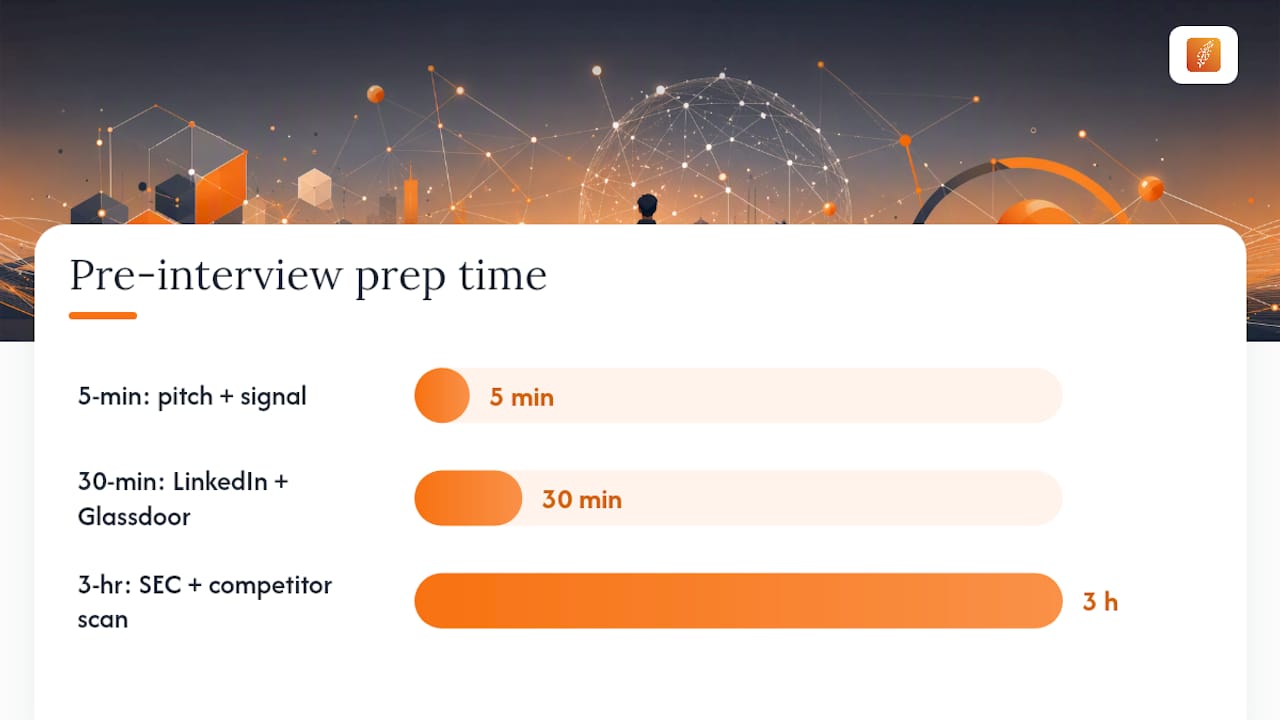
Table of Contents
- What should you research about a company before your interview?
- Where can you find reliable company information fast?
- How do you evaluate sources using a Who/Why/When/How check?
- How do you turn company research into strong interview answers?
- Copy-ready scripts: summaries, STAR snippets, and questions to ask
- What's the right pre-interview research timeline?
- What research red flags should make you reconsider?
- What most candidates get wrong about interview research
- Plucky AI speeds up the research you just read about
- Sources
- FAQ
What should you research about a company before your interview?
Research is most valuable when you interpret it — not just collect facts, but explain what problem the organization is trying to solve right now and position your experience to address it. Here's what to cover, in order of impact.
-
Company overview: mission, product, and customers. Read the About page and the homepage headline. Synthesize them into one sentence. A strong summary names the product category, the buyer, and the delivery model: "Cloudflare secures and accelerates internet traffic for businesses of all sizes via a global edge network." If you can't do that after five minutes on their site, keep reading.
-
Business model. How does revenue actually flow? A B2B SaaS company with annual contracts behaves very differently from a marketplace that earns transaction fees. Knowing the model tells you what the company optimizes for — retention, volume, or deal size — and lets you frame your experience in terms that resonate with the hiring team.
-
Role context: why this job exists now. Check the job posting date, look at LinkedIn for recent team hires, and scan for press about new products or expansions. A role posted after a Series B funding round is almost certainly a growth hire. A role that's been reposted multiple times may signal retention problems or shifting requirements. Strong candidates interpret these signals to explain why the role exists and what competency will make the hire successful.
-
Products, road map signals, and recent launches. Check the company's blog, press releases, and product changelog if one exists. A recent partnership or a new feature announcement. tells you where the team is focused. Reference it specifically — "I saw you launched X last month" lands far better than a generic compliment.
-
Organizational structure and key leadership. Know the name and background of your hiring manager before you walk in. Check their LinkedIn for tenure, prior companies, and any public posts about team priorities. For senior roles, know the relevant VP or C-suite executive and their stated strategic focus.
-
Culture and values: cross-check what they say with what employees report. The careers page will always sound good. Cross-reference it with Glassdoor themes, Blind posts, and LinkedIn tenure data. If the company claims "work-life balance" but employee reviews mention short tenures and constant on-call rotations, that gap is worth probing.
-
Competitors and market position. Candidates should be able to name 2–3 competitors and articulate the company's differentiator. Don't just list names — state the contrast: "Unlike CrowdStrike, which targets enterprise, this company focuses on mid-market with a lower-friction deployment model."
-
Financial health for public companies. Pull the most recent 10-K or 10-Q from SEC EDGAR. Item 1 gives the business description; Item 7 (Management's Discussion and Analysis) gives revenue trends, margin commentary, and risk factors. Fifteen minutes here tells you more than an hour of blog reading.
-
Private-company strategies. When SEC filings don't exist, reverse-engineer priorities from competitor activity, funding announcements, customer case studies, and leadership interviews. A Series A startup that just hired a VP of Enterprise Sales is clearly pivoting upmarket — that's a signal worth referencing.
-
Role-specific requirements from the job description. Map every required skill and deliverable to a concrete example from your own background. If the JD asks for "experience leading incident response in cloud environments," you need a STAR story ready that matches that exact language.
Where can you find reliable company information fast?
The sources below are ranked by speed-to-value for U.S. job seekers. Career-center guidance consistently points to LinkedIn for org and hiring signals, Glassdoor for culture patterns and interview reports, and Google News for recent announcements — each platform serves a distinct research purpose.
| Source | Best for | Time to scan |
|---|---|---|
| Company website (About, Blog, Newsroom) | Mission, product, customers, recent launches | 10–15 minutes |
| LinkedIn (company page + employee profiles) | Org structure, hiring patterns, team tenure, hiring manager background | 15 minutes |
| Glassdoor / Blind | Culture patterns, interview question reports, compensation ranges | 10 minutes |
| Google News / press releases | Announcements, funding, partnerships, leadership changes (last 90 days) | 5–10 minutes |
| SEC EDGAR (10-K, 10-Q) | Revenue trends, strategy commentary, risk factors (public companies only) | 15 minutes |
| Investor relations (IR) page | Official financials, earnings call transcripts, strategic priorities | 10–15 minutes |
| Industry databases (Hoover's, Mergent, OneSource) | Deep firm profiles, market share, industry context | 30 minutes |
| Social channels (Twitter/X, Instagram, YouTube) | Brand voice, product demos, community engagement, recent campaigns | 5–10 minutes |
Quick triage:
- Read now: Company website, LinkedIn company page, one Google News search for the company name + last 90 days.
- Read if you have 30+ minutes: Glassdoor (look for patterns across at least 10 reviews, not single outliers), hiring manager's LinkedIn profile, job description line by line.
- Read if you have 3+ hours: SEC EDGAR 10-K Item 1 and Item 7, earnings call transcript, competitor comparison using a framework like the one outlined in this competitor analysis guide.
Subscription databases like Hoover's, OneSource, and Mergent offer deeper firm-level profiles, but free tools — EDGAR, Google News, LinkedIn — are usually sufficient for interview-level preparation. Escalate to paid databases only when you're preparing for a senior role or a company with limited public coverage.
How do you evaluate sources using a Who/Why/When/How check?
Not every source deserves equal weight. Before you quote a finding in an interview, run it through a four-question credibility check drawn from university research guidance:
- Who produced it? A regulatory filing (SEC, FTC) or an institutional source (earnings call, official press release) carries far more weight than an anonymous blog post or a single Glassdoor review.
- Why did they produce it? A company's own press release is promotional by design. An analyst report from a firm with no advisory relationship is more objective. Know the incentive behind the source.
- When was it published? A 2021 Glassdoor review about culture is less reliable than a pattern of 15 reviews from the past six months. For financials, use the most recent filing period.
- How was it collected? Verified employee reviews with specific details are more credible than vague, unverifiable claims. SEC filings are audited; blog posts are not.
Red flags for unreliable sources:
- A single anonymous review with extreme sentiment (either glowing or damning) and no corroborating pattern.
- A "company profile" article with no byline, no date, and no linked primary source.
- Outdated data presented as current (a 2019 revenue figure cited as the company's current performance).
- Paid promotional placements disguised as editorial coverage (look for "sponsored" labels or affiliate disclosures).
Cross-check examples:
- If a company's careers page claims "flat hierarchy," verify it against LinkedIn org data. If there are seven layers between the CEO and individual contributors, the claim doesn't hold.
- If a press release announces record growth, check the most recent 10-Q for actual revenue figures before repeating the claim in an interview.
Pro Tip: If you're uncertain about a finding, turn it into a question rather than a statement. "I read that the team recently shifted focus toward enterprise accounts — is that still the direction?" signals research and intellectual honesty at the same time.
How do you turn company research into strong interview answers?
Facts don't win interviews. Interpretation does. The goal is to show the hiring team that you understand their current problem and have relevant experience addressing it.
One-sentence company pitch templates:
- "[Company] provides [product/service] to [customer segment] via [delivery model], competing primarily against [competitor A] and [competitor B]."
- For a "Why this company?" question: "I'm drawn to [Company] because [specific recent signal] tells me the team is focused on [problem/opportunity], and that's exactly where my background in [relevant skill] applies."
Mapping STAR stories to role needs:
The job description is your script. Pull the top three required competencies and build one STAR story for each. The Situation and Task should reference the scale or context that matches the company's stage — a startup story for a startup role, an enterprise example for an enterprise employer. The Result should use a metric that the company would recognize as meaningful (uptime percentage for an infrastructure role, detection rate for a security role).

The 30-60-90 plan template:
Tie each timeframe to a company priority you identified in research:
- First 30 days: "Based on what I've read about the current incident response backlog, I'd spend the first month auditing existing playbooks and building relationships with the SOC team."
- Days 31–60: "Once I understand the environment, I'd focus on [specific gap or initiative from your research] — the product launch / migration / compliance deadline you mentioned."
- Days 61–90: "By day 90, I'd aim to have [measurable outcome] in place, which aligns with the Q3 priority I saw referenced in your last earnings call / blog post."
Phrases that signal business acumen without overreaching:
- "Based on what I've read about your recent expansion into..."
- "The shift toward [product area] that I noticed in your Q4 commentary suggests..."
- "I'd want to validate this in the interview, but my read is that the team is prioritizing..."
That last phrase is especially useful. The best interview questions invite the hiring team to validate or refine your interpretation — which turns a question into a two-way conversation rather than a quiz.
Copy-ready scripts: summaries, STAR snippets, and questions to ask
These examples are models to adapt, not scripts to recite verbatim. Adjust the specifics to match the actual company and role.
One-sentence company summaries by business model:
- B2B SaaS: "Acme Security sells cloud-native endpoint detection to mid-market companies on an annual subscription, competing primarily against legacy AV vendors on deployment speed and alert fidelity."
- Marketplace: "TalentBridge connects freelance cybersecurity consultants with project-based enterprise buyers, earning a transaction fee on each engagement."
- Product company: "Fortinet designs and manufactures network security hardware and software, serving large enterprises and service providers through a direct and channel sales model."
- Services business: "SecureOps provides managed detection and response to healthcare organizations, differentiating on HIPAA compliance expertise and 24/7 U.S.-based SOC coverage."
Short STAR snippets mapped to common IT competencies:
- Incident response under pressure: "When a ransomware event hit our production environment on a Friday night, I led the containment effort, coordinating across three teams and restoring service within four hours — well inside our SLA."
- Cross-functional communication: "I translated a complex vulnerability disclosure into a one-page executive brief that got immediate budget approval for a remediation sprint, cutting our exposure window by three weeks."
- Process improvement: "I rebuilt our patch management workflow from a manual spreadsheet to an automated pipeline, reducing mean time to patch from 21 days to 6."
Three high-impact questions to ask the hiring team:
- "How has the focus of this team shifted over the past year, and what's driving that change?" (This question, recommended by practitioner guidance, invites the interviewer to confirm or correct your research interpretation.)
- "Why does this role exist right now — is it a backfill, a new headcount, or something else?" (Direct, respectful, and signals strategic thinking.)
- "What would make someone hired into this role feel like a clear success at the 90-day mark?" (Ties directly to your 30-60-90 plan and shows you're thinking about delivery, not just getting the offer.)
One-paragraph 30-60-90 example (product launch context):
"In the first 30 days, I'd focus on understanding the existing detection stack and the gaps the team has already identified. Between days 31 and 60, I'd align my work to the cloud migration initiative I read about in your Q1 update — specifically, extending coverage to the new AWS environment. By day 90, I'd aim to have a documented coverage map and at least one automated response playbook deployed, which I understand is a near-term priority based on the compliance timeline you mentioned."
A note on tone by interview level: For individual contributor roles, lead with execution specifics and concrete metrics. For manager or director roles, shift toward team outcomes, cross-functional influence, and strategic framing. The research stays the same; the emphasis changes.
What's the right pre-interview research timeline?
A focused 60–90 minute research window usually yields enough interview-ready material. Beyond that, diminishing returns set in and your time is better spent practicing answers. Here's how to allocate it.
| Time block | Tasks | Output |
|---|---|---|
| 48 hours before | Company website, LinkedIn, Google News (last 90 days), Glassdoor pattern scan | One-sentence pitch, 2–3 culture themes, one recent signal |
| 24 hours before | Job description line-by-line, STAR story mapping, 30-60-90 draft, SEC EDGAR if public | 3 tailored STAR stories, 3 questions to ask |
| 1 hour before | Review your notes, rehearse your one-sentence pitch and "Why this company?" answer out loud | Confident delivery, not new information |
| 15–30 minutes before | Reread the job title and hiring manager's name, confirm logistics | Calm, focused, no last-minute surprises |
Numbered checklist for the 48 hours before:
- Run a Google News search: "[Company name]" + last 3 months. Save one finding to reference.
- Read the company's About page and synthesize a one-sentence summary.
- Check LinkedIn: company page for recent posts, hiring manager profile for background and tenure.
- Scan Glassdoor: read at least 10 recent reviews and identify one recurring theme (positive or negative).
- Pull the job description and highlight every required skill. Map each to a STAR story.
- For public companies: open SEC EDGAR, pull the most recent 10-K, and read Item 1 and Item 7.
- Draft three questions to ask. Make at least one reference something specific from your research.
- Practice your "Why this company?" answer out loud. Time it. Keep it under 90 seconds.
When to stop: once you can answer "What does this company do, how does it make money, why does this role exist, and what would make me successful in it?" — you're ready. More research beyond that point rarely changes interview outcomes.
What research red flags should make you reconsider?
Company research occasionally surfaces signals that should change your interview strategy or, in some cases, your decision to proceed. Here's what to watch for and how to respond.
- Frequent leadership turnover. If the CISO, CTO, or VP of Engineering has changed three times in two years, ask directly: "How would you describe the leadership stability on this team?" Don't accuse — probe.
- Contradictory messaging. A company that claims "security-first culture" in its careers page but has a public breach history with no disclosed remediation steps is worth questioning. Ask about their incident response maturity and post-incident process.
- Reposted roles. A job posting that has been relisted multiple times, especially with identical language, may indicate the role is hard to fill due to unrealistic expectations, budget constraints, or internal conflict. Ask why the last person in the role moved on.
- Glassdoor patterns, not outliers. A single negative review means little. Ten reviews over 18 months that all mention the same manager behavior or the same structural problem is a pattern. Ask a neutral version: "How does the team handle disagreements about technical direction?"
- Pending litigation or regulatory action. A quick search of "[Company name] + lawsuit" or "[Company name] + FTC" can surface material risks. For IT and cybersecurity roles specifically, check for any public breach disclosures or FTC consent orders — these directly affect your future work environment.
- Funding gaps or financial distress signals. For private companies, a long gap since the last funding round combined with layoff announcements is a real signal. Ask about runway and hiring plans without being confrontational: "How is the company positioned heading into the next 12 months?"
For a deeper look at warning signs specific to IT job searches, the IT job search red flags guide covers 12 patterns worth knowing before you accept an offer.
What most candidates get wrong about interview research
Most candidates treat company research as a test to pass — memorize enough facts to avoid looking uninformed. That framing misses the actual opportunity.
The real purpose of pre-interview company analysis is positioning. When you walk in knowing why a role exists, what problem the team is actively trying to solve, and what a successful hire looks like from the hiring manager's perspective, you're not answering questions anymore. You're having a strategic conversation. That shift is what separates candidates who get offers from candidates who get polite rejections.
There's a specific mistake worth calling out: candidates who research deeply but then recite facts instead of interpreting them. Saying "I saw you raised a Series C in March" is fine. Saying "I saw you raised a Series C in March, which tells me you're likely scaling the sales team and moving upmarket — and that's exactly the environment where my enterprise security background applies" is what actually moves the needle. The interpretation is the signal.
One practical test: after you've done your research, ask yourself two questions. "Why does this role exist right now?" and "What would make this hire feel successful in 90 days?" If you can answer both with specifics, you're ready. If you're still speaking in generalities, you need another pass at the sources.
The other underrated move is using your research to ask a question that invites the interviewer to correct you. "My read from your recent product announcements is that the team is prioritizing cloud-native detection — is that still the main focus?" That question does three things at once: it proves you've done the work, it shows intellectual humility, and it opens a real conversation. Most candidates never get there because they're too focused on having the right answers to ask the right questions.
Plucky AI speeds up the research you just read about
Doing all of this manually takes time — time that most IT and cybersecurity job seekers don't have between active roles, certifications, and competing applications. Plucky AI compresses the research-to-ready-answer pipeline by combining role discovery, hiring manager contact data, and tailored resume and interview prep into one platform.
Where manual research gives you raw signals, Plucky AI surfaces the role context, company priorities, and hiring manager background that make your answers specific. It generates tailored STAR story frameworks aligned to the job description, so you're not starting from a blank page. And because it's built specifically for IT and cybersecurity professionals, the output speaks the right technical language from the start.
Manual cross-checking still matters — no tool replaces reading an actual 10-K or spotting a Glassdoor pattern yourself. Plucky AI complements that work by handling the time-consuming aggregation so you can focus on interpretation and practice. Start your free trial and see how much faster you can move from job posting to interview-ready.
Sources
- How to Research a Company Before Your Interview
- How to Research a Company Before an Interview (And Actually Show You Belong There) • The Resilient Recruiter
- Company Research
- Doing Company Research: A Resource Guide - Research Guides at Library of Congress
- How to Research a Company Before Your Interview
- Company research - University of Florida Business Library
FAQ
Why should you research a company before an interview?
Research lets you connect your experience to the company's current priorities rather than giving generic answers. Candidates who can articulate the business model, name competitors, and reference a recent company signal consistently demonstrate stronger business acumen to hiring teams.
What should you research about a company before your interview?
Cover the company's core product and revenue model, the role's purpose (backfill vs. growth hire), 2–3 competitors and the company's differentiator, one recent news signal, and the hiring manager's background. For public companies, scan SEC EDGAR Item 1 and Item 7 of the most recent 10-K.
What is the 30-60-90 rule in an interview?
A 30-60-90 plan outlines what you'll focus on in your first 30, 60, and 90 days in the role. The strongest versions tie each timeframe to a specific company priority you identified in research — a product launch, a compliance deadline, or a stated strategic initiative.
What kind of research should you do before an IT or cybersecurity interview?
Beyond the standard company overview, IT and cybersecurity candidates should check for recent breach disclosures, FTC actions, or compliance deadlines that directly affect the role. Review the tech stack mentioned in the job description, map your STAR stories to the specific tools and environments listed, and check the hiring manager's LinkedIn for their technical background and team priorities.
How much time should you spend researching before an interview?
A focused 60–90 minute research session typically yields enough interview-ready material. Spend the first block on the company website, LinkedIn, and Google News; use remaining time on Glassdoor patterns and job description mapping. Beyond 90 minutes, shift time toward practicing answers out loud.