
Prepare several STAR-L stories that map to the core competencies often tested, such as conflict, failure, ambiguity, collaboration, and delivery under pressure. Practice each one until it lands in two to three minutes flat. This article gives you the exact question bank grouped by competency, the answer structure interviewers are scoring you against, and a rehearsal routine that turns a handful of work stories into coverage for almost any behavioral prompt an IT interview throws at you.
TL;DR:
- Candidates should focus on telling specific, measurable stories that clearly demonstrate their decisions and actions relevant to core competencies.
- Rehearsing six to eight stories, mapped to multiple competencies, enables versatile responses to most behavioral questions without memorizing dozens of scripts.
- Tailoring stories for junior, senior, or managerial roles by emphasizing different details helps candidates meet interviewers' expectations at each level.
- Practicing with timed, recorded, and peer-led drills enhances delivery clarity, pacing, and ability to handle follow-up questions confidently.
- Emphasizing ownership, quantifiable impact, and reflection on lessons learned makes responses stand out and aligns with how interviewers score behavioral answers.
Table of Contents
- Behavioral Interview Questions IT Candidates Actually Get Asked
- Answering With STAR-L: Structure, Timing, and What Gets Scored
- Adjusting Your Answers for Junior, Senior, and Manager Interviewers
- How to Build a Story Bank You Can Actually Reuse
- The Mistakes That Quietly Cost Offers
- The Research Behind This Approach
- Practice Methods That Actually Move the Needle
- How IT Interviewers Score Behavioral Answers
- Addressing Gaps or Weak Spots in Your Answers
- Cultural Fit and Fairness in IT Behavioral Interviews
- Behavioral Interview Tips for Virtual and Remote IT Interviews
- What Actually Separates a Good Story From a Great One
- Let Pluckjobs Sharpen Your Story Bank Before the Interview
- Sources
- FAQ
Behavioral Interview Questions IT Candidates Actually Get Asked
Most IT interview loops recycle the same seven competency buckets, just with different wording. Instead of memorizing dozens of isolated questions, group them, and you will see that one well-built story often answers three or four variations.
IT employers lean hard on behavioral prompts to gauge collaboration, troubleshooting instinct, and how you talk to people outside engineering, according to career coaching guidance from Arizona State University. Here is the bank, organized by what each question is actually testing.
Ambiguity and problem solving
- "Tell me about a time you had to make a decision without complete information."
- "Describe a project where the requirements changed midway through."
- "Walk me through a bug that had no obvious root cause." (High-signal for senior candidates: interviewers want your diagnostic reasoning, not just the fix.)
Conflict and disagreement
- "Tell me about a time you disagreed with a technical decision made by a teammate or manager."
- "Describe a conflict with a peer over code review feedback or design direction."
- "How did you handle a disagreement with someone more senior than you?" (Junior candidates get more credit for showing respect and curiosity here than for winning the argument.)
Failure and learning
- "Tell me about a project that failed or fell short."
- "Describe a mistake that made it to production."
- "What is something you had to unlearn?"
Collaboration and influence
- "Tell me about a time you had to influence someone without formal authority."
- "Describe a cross-team project where priorities clashed."
- "How have you mentored or onboarded a teammate?" (This one is often reserved for candidates being evaluated for a senior or lead track.)
Delivery under pressure
- "Tell me about a deadline you almost missed."
- "Describe an incident you had to resolve under a service-level agreement."
- "How do you decide what to cut when a deadline is fixed and scope is not?"
Prioritization and time management
- "How do you decide what to work on when everything feels urgent?"
- "Tell me about a time you had to reprioritize mid-sprint."
Communicating technical work to non-technical stakeholders
- "Describe a time you had to explain a technical delay to a non-technical stakeholder."
- "Tell me about a time you translated a customer complaint into an engineering fix."
Role-specific variants sharpen the picture further. Help desk and IT support candidates should expect prompts like "Walk me through how you de-escalated an angry user" or "Describe a ticket you misdiagnosed at first." SRE and ops candidates hear "Tell me about an incident you owned end to end, including the post-mortem." IT interview guides increasingly frame these around layered troubleshooting, de-escalation, and SLA-driven prioritization, according to Interviewchamp. Software engineers should be ready for "Tell me about a design decision you'd make differently now" alongside the standard conflict and failure prompts.
Answering With STAR-L: Structure, Timing, and What Gets Scored
STAR-L extends the classic framework with one more beat: Situation, Task, Action, Result, and Learning. That last piece matters more than most candidates think. Adding a short reflection on what you took away from the experience signals a growth mindset, and tech interviewers reward it consistently, per PracHub's tech interview guide.
Here is how to split your airtime across a two-to-three-minute answer:
- Situation (about 10%): One or two sentences of context. Skip company history; get to the stakes.
- Task (about 10%): What specifically was your responsibility or goal.
- Action (about 50%): The bulk of your answer. This is where you name the technical choices you made, the trade-offs you weighed, and the debugging or decision steps you took.
- Result (about 15%): A traceable outcome, ideally with a number attached, latency reduced, tickets closed per week, incidents avoided.
- Learning (about 15%): What you would do differently, or what you now do because of that experience.
Pro Tip: Record yourself answering a story out loud and time it. Most candidates run 4 to 5 minutes on their first attempt and don't realize it until they hear the playback.
Interviewers are listening for first-person language ("I decided," not "we decided"), a measurable result, and a clean line from action to outcome. Structured behavioral interviews carry meaningfully higher predictive validity than unstructured chats, which is why hiring teams increasingly build competency frameworks around STAR evaluation instead of freeform conversation. Expect a follow-up probe: "What would you have done if that fix hadn't worked?" or "How did the team react?" Practice answering those cold, because they usually reveal more than the rehearsed story itself.
Adjusting Your Answers for Junior, Senior, and Manager Interviewers
The same story can serve a junior technical screen and a staff-level loop, but only if you reframe which details you emphasize. Interviewers calibrate what counts as a strong answer based on your target level, expecting different evidence types entirely from a junior candidate versus a senior one.
- Junior interviewers focus on process: did you follow a logical troubleshooting sequence, did you ask for help at the right time, did you de-escalate a frustrated user calmly.
- Senior interviewers evaluate judgment: did you weigh trade-offs across systems, did you influence people outside your reporting line, did you think about the long-term cost of a quick fix.
- Manager-track interviewers often want a layer on top of both: how did you develop the people involved, and how did you communicate risk upward.
Take one incident story and practice three versions. For a junior audience, walk through your diagnostic steps in detail. For a senior audience, spend more time on the architectural trade-off you accepted and why. For a manager-track loop, add a sentence on how you coached a teammate through the same incident afterward. The facts stay identical. The emphasis moves.
How to Build a Story Bank You Can Actually Reuse
Six to eight stories, chosen well, will cover the vast majority of behavioral prompts you encounter. Trying to have a unique story for every question is what makes candidates freeze mid-interview.
- Pick stories with measurable outcomes. A story where you can name a number, reduced downtime, cut onboarding time, resolved a backlog, is worth more than a well-told anecdote with no result attached.
- Map each story to two or three competencies. A production incident story might cover "delivery under pressure," "collaboration," and "failure and learning" all at once, depending on which beat you emphasize.
- Write a one-line index card for each story. Situation in one clause, result in one number, learning in one sentence. This becomes your mental lookup table mid-interview.
- Rehearse on a schedule, not randomly. Timed solo drills early in the week, a recorded run midweek so you can hear your own pacing, and a peer mock closer to the interview date.
Practice techniques that combine timed drills, recorded playback, and mock interviews with real follow-up probing produce noticeably sharper answers than passive review, according to PracHub's prep guidance. If you have a company research routine for the role, cross-reference it against your story bank so the examples you lead with match what that specific team seems to value.
The Mistakes That Quietly Cost Offers
A technically strong answer can still fall flat because of how it is delivered, not what happened.
- Overusing "we." Interviewers can't score a team's contribution. Say "I" for the decisions and actions that were yours.
- No measurable result. A story that ends in "and it worked out" instead of a number reads as unfinished. Quantifying impact is consistently what separates strong answers from forgettable ones, per PhantomCodeAI's engineering interview guide.
- Rambling setup. If your Situation and Task eat past 20% of your airtime, you've already lost the interviewer's attention before the Action even starts.
- No learning takeaway. Skipping the "L" makes you sound like someone who hasn't reflected on the experience at all.
- Red flags to avoid entirely: blame-shifting toward a teammate, a composite or hypothetical story dressed up as real, and pushback when an interviewer offers feedback on your answer.
The Research Behind This Approach
Structured, competency-based interviews aren't a fad. Decades of personnel-selection research point to STAR-style evaluation as one of the more reliable predictors of on-the-job performance available to hiring teams, a finding NextMantra's 2026 engineering interview guide echoes for tech-specific hiring. Pluckjobs builds its interview coaching around that same competency-mapping logic: instead of generic prep, the platform helps IT and cybersecurity candidates connect their existing story bank to the specific role and hiring manager they're targeting, so rehearsal time goes toward the questions most likely to come up.
Practice Methods That Actually Move the Needle
Reading a list of behavioral questions does almost nothing for your delivery. What moves the needle is friction, the kind that forces you to hear your own pacing and gaps in real time.
Start with solo timed drills. Set a timer for three minutes, answer out loud, and stop the moment it beeps, even mid-sentence. That discomfort teaches you where your story runs long before an interviewer has to cut you off. Move next to recorded practice. Play it back and count filler words, "um," "so basically," "kind of." You will hear things you never notice while speaking.
Peer mocks are where the real gains show up, because a human can push back the way an interviewer will. Ask your mock partner to fire a genuine follow-up after each answer: "What would you have done if that hadn't worked?" or "How did your manager react?" Rehearsing the follow-up, not just the scripted story, is what separates candidates who freeze under a probe from those who handle it smoothly.
A short warm-up question before diving into harder prompts also helps performance later in the loop, since it reduces cognitive load before the tougher technical or behavioral rounds. If you're building a rotation of practice partners, pair this drilling with a broader technical interview prep routine so behavioral and technical readiness develop together instead of in isolation.
How IT Interviewers Score Behavioral Answers
Most interviewers aren't grading you on a gut feeling. They're working from a rubric, even an informal one, built around a handful of repeatable criteria: specificity, ownership, measurable impact, and communication clarity.
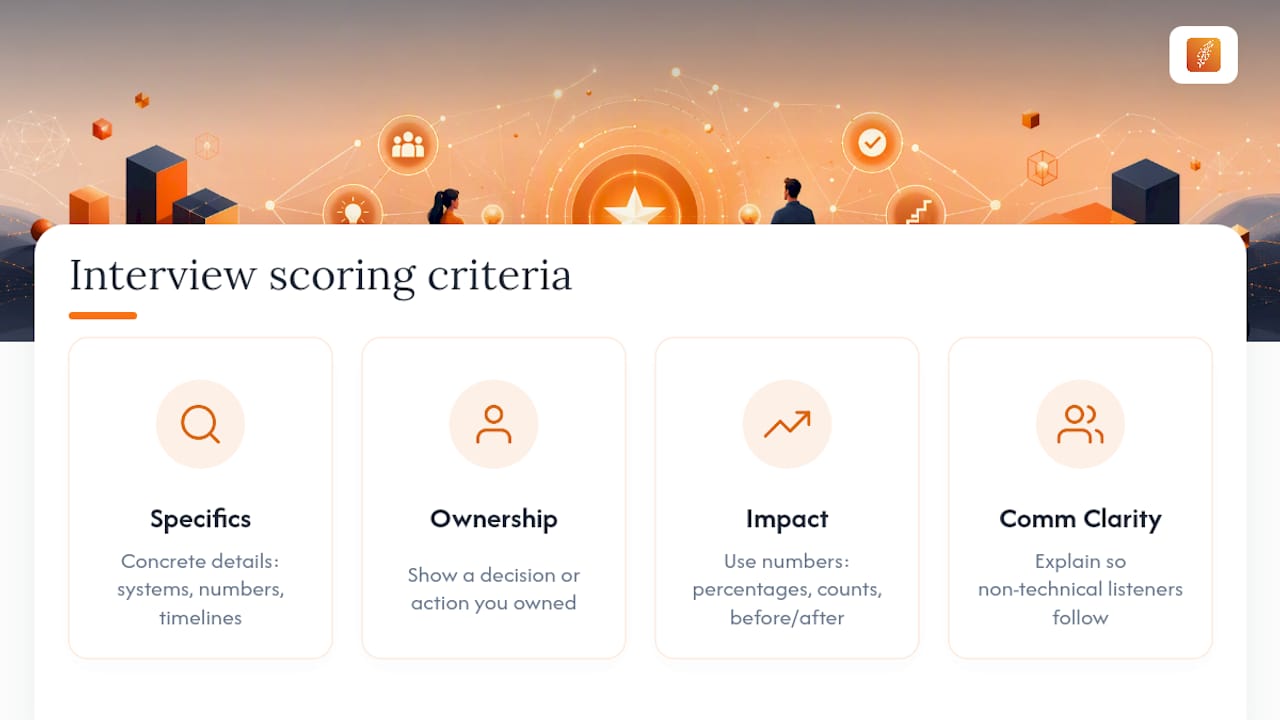
Specificity means concrete details, system names, numbers, timelines, rather than a story that could describe almost any project. Ownership means the interviewer can point to a decision or action that was distinctly yours, not the team's. Measurable impact is the result beat of your STAR-L answer doing its job: a number, a percentage, a before-and-after comparison. Communication clarity covers whether a non-technical panelist could follow your explanation, which matters even in engineer-to-engineer interviews because it signals how you'll explain your work to product managers or customers later.
Many companies run behavioral rounds with four or five well-chosen questions across 45 to 60 minutes, allowing eight to twelve minutes per question for real follow-up, rather than rushing through a long checklist. That pacing gives interviewers room to test whether your answer holds up under a second or third probe, which is often where scoring differences actually appear.
Addressing Gaps or Weak Spots in Your Answers
Every candidate has at least one competency where their story bank feels thin, maybe you've never led a cross-team conflict, or your failure stories all feel minor. Don't paper over the gap with a fabricated or exaggerated story. Interviewers who ask two or three follow-up questions will surface the seams almost immediately, and a story that unravels under scrutiny does more damage than an honest "I haven't had a large-scale version of that yet, but here's a related situation."
Reframe instead. If you lack a big incident-response story, use a smaller one and be explicit about scale: "This was a smaller-scope outage, but the decision-making process was the same." If you're weak on cross-functional influence, look for adjacent examples, mentoring a junior teammate, negotiating scope with a product manager, that demonstrate the same underlying skill even if the label doesn't match exactly.
For genuine skill gaps, name them honestly and pair the admission with what you're doing about it. "I haven't managed an incident at that scale, but I've been shadowing our on-call rotation to build toward it" reads as self-aware rather than evasive. Interviewers generally respond better to a candidate who acknowledges a boundary than one who stretches a story past its real weight.
Cultural Fit and Fairness in IT Behavioral Interviews
Behavioral interviews are meant to test how you work with people, not whether you match a team's existing personality. That distinction matters because "culture fit" questions can drift into unconscious bias if interviewers aren't careful, rewarding candidates who simply resemble the people already on the team.
The more defensible version of this evaluation is "culture add": does your background, working style, or perspective bring something the team doesn't already have? When you're asked something like "How do you see yourself fitting into a team like ours?", answer with specifics about how you collaborate, how you handle disagreement, and what kind of environment helps you do your best work, rather than trying to guess and mirror the interviewer's own style.
If you're interviewing with a team that has published values or an engineering culture doc, reference it honestly rather than reciting buzzwords. Interviewers can tell the difference between a candidate who read the values page and a candidate who genuinely reflects on how their own experience aligns with it. And if a question ever feels like it's probing something unrelated to job performance, background, personal life, unrelated demographics, it's fair to redirect the answer back toward your working style and skills.
Behavioral Interview Tips for Virtual and Remote IT Interviews
Remote behavioral interviews strip away some of the cues that would normally help you read the room, so you have to compensate deliberately. Look at the camera, not the screen, when you're delivering the core of your answer; it's a small adjustment that makes a real difference in how present you seem.
Keep your STAR-L answers slightly tighter over video than you would in person; two minutes rather than three. Video calls amplify the feeling of rambling, and pauses that would feel natural in a room can read as dead air on a screen. Have your index cards or story-bank notes within eyeglance range, not to read from, but as a quiet anchor if you lose your place.
Test your setup before every interview: lighting, microphone, and a stable connection. A dropped call mid-answer forces you to restart your pacing and can throw off an otherwise strong response. Finally, treat the first behavioral question as your warm-up, the same way you would in person, since easing into the rhythm of speaking out loud matters even more when you can't read the interviewer's body language for feedback.
What Actually Separates a Good Story From a Great One
The biggest gap I see between candidates who get offers and candidates who don't isn't the quality of their experience. It's whether they've actually sat down and pulled the specific moments out of that experience, the decision point, the number, the thing they'd do differently, versus candidates who talk in generalities about being "a good communicator" or "someone who handles pressure well."
Conventional advice tells you to prepare for behavioral questions by thinking about your strengths. That's backwards. The candidates who perform best in these rounds prepare by thinking about their decisions, the specific moment they chose one trade-off over another, and then let the interviewer draw the conclusion about the strength. Nobody remembers a candidate who claimed to be collaborative. Interviewers remember the one who described exactly how they got a skeptical database team to sign off on a schema change three days before a deadline.
If there's one adjustment worth making this week, it's this: stop trying to sound impressive, and start trying to sound specific. Specificity is what interviewers can actually score. Everything else is decoration.
— Diego
Let Pluckjobs Sharpen Your Story Bank Before the Interview
Building six to eight tight STAR-L stories is only half the work. Matching the right story to the right role, and getting in front of the actual hiring manager who's evaluating them, is the part most candidates skip. Pluckjobs is built specifically for IT and cybersecurity job seekers, combining AI-powered role discovery with hiring manager contact data so you're not guessing which competencies a given team actually cares about.
Pluckjobs complements the practice routine in this article in a few concrete ways:
- Maps your existing stories against the specific competencies a target role's listing emphasizes, so you know which of your six to eight stories to lead with.
- Surfaces hiring manager contact details so you can research the person actually running your interview loop, not just the company.
- Generates tailored resumes and application materials aligned to the same competencies you're rehearsing for the behavioral round.
Start a free trial at Pluckjobs and turn your story bank into interviews instead of cold applications.
Sources
- Behavioral Interview Questions for Engineers (2026 Guide) — NextMantra
- 30 common IT interview questions and how to answer them — ASU Career & Professional Development
- Top 30 behavioral interview questions for tech (With Answers for 2026) — PracHub Knowledge Hub
- Interviewchamp
FAQ
What Are the Top Behavioral Interview Questions for IT Roles?
The highest-frequency prompts cover conflict with a teammate, a project failure, a decision made under ambiguity, a cross-team collaboration, and a delivery deadline under pressure, the five competencies this article's question bank is built around.
What Is the STAR-L Method for Answering Behavioral Questions?
STAR-L stands for Situation, Task, Action, Result, and Learning, an extension of the classic STAR framework that adds a closing reflection on what you took away from the experience.
What Are Some Common Behavioral Interview Questions in Tech?
Tech interviews commonly ask about a production bug you diagnosed, a disagreement over a technical decision, a deadline you almost missed, and a time you had to explain a delay to a non-technical stakeholder.
How Long Should a Behavioral Interview Answer Be?
Aim for two to three minutes per answer, following roughly a 10/10/50/15/15 split across the Situation, Task, Action, Result, and Learning beats of STAR-L.
How Many Stories Should I Prepare for a Behavioral Interview?
Six to eight versatile stories, each mapped to two or three competencies, typically cover the majority of questions asked across a standard IT behavioral round.