
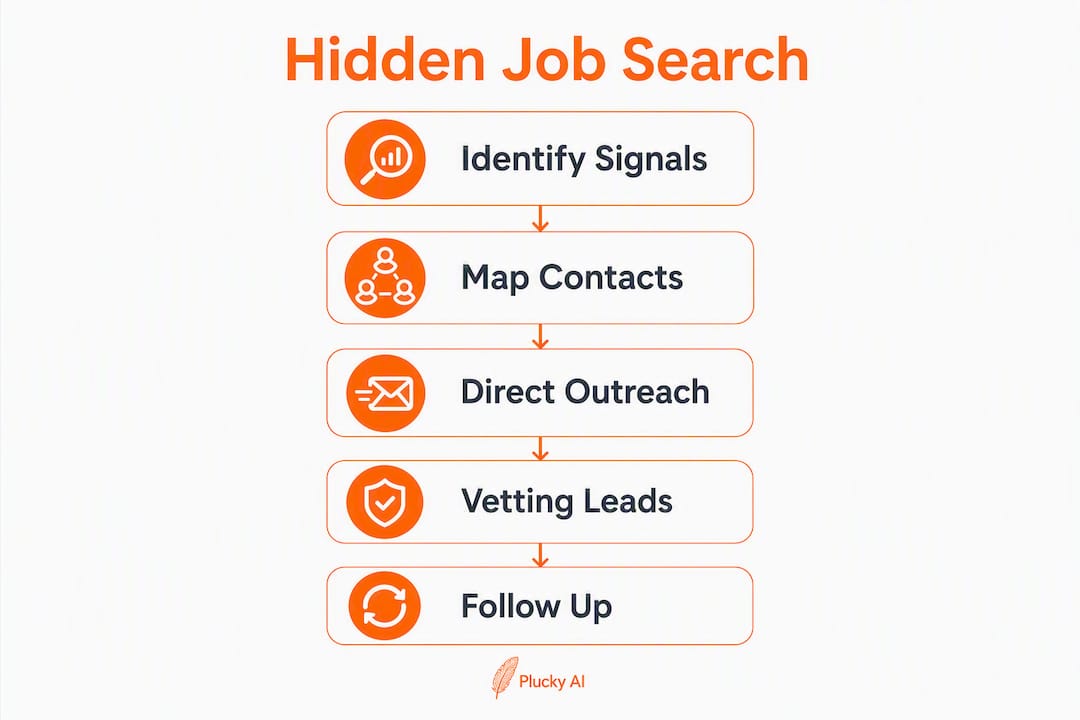
An estimated 60–80% of senior roles are filled before appearing on a job board, primarily through referrals, direct outreach, or internal hiring. For IT and cybersecurity professionals, that means the most competitive positions are won through signal monitoring, org mapping, and direct outreach, not by refreshing LinkedIn. The industry term for this is the hidden job market, and accessing it requires treating your search like an intelligence operation.
Start here, in the first hour:
- Build a list of several target companies based on recent funding, product launches, or stack alignment with your skills.
- Subscribe to each company's career page or ATS feed (Workday, Greenhouse, Lever) for direct alerts.
- Identify two hiring decision-makers per company and draft one personalized outreach message.
Early signals and direct outreach consistently outperform public job boards for hidden roles because employers prefer referrals and targeted networks to reduce hiring costs and vetting time.
Table of Contents
- How do you find unadvertised IT job openings?
- Which hiring signals actually predict unadvertised openings?
- How to map the hiring org and find the right contacts
- What outreach templates actually get responses?
- How to vet an unadvertised lead and spot red flags
- What does a realistic hidden-job search timeline look like?
- How Pluckjobs supports an intelligence-led hidden-job search
- Key Takeaways
- The part most IT professionals get wrong
- Pluckjobs puts the playbook on autopilot
- Further reading and sources
- FAQ
How do you find unadvertised IT job openings?
Seven tactics, ranked by impact:
-
Build a target company list. Select 20–30 companies using signals: Series B/C funding announcements, new product launches, stack overlap with your expertise, and recent contract wins. A company hiring fast rarely advertises every role publicly.
-
Monitor career pages directly. Crawling ATS-driven portals like Workday, Greenhouse, and Lever gives you a 48–72 hour speed margin over aggregated boards. Set up a free tool like Visualping to alert you the moment a careers page changes.
-
Activate your network strategically. Roughly 80% of professional hires come through networking and referrals, not applications. Referrals and alumni connections are the primary channel for hidden IT roles. Request informational interviews with hiring authorities, not just peers.
-
Build technical visibility. Contributing to open-source projects, publishing engineering blog posts, and speaking at conferences positions you as a subject-matter expert. Hiring managers actively search for specialists before writing a job description.
-
Track recruiter and contractor signals. Internal recruiters posting contract-to-hire roles on LinkedIn or Dice often signal a team that needs headcount but hasn't opened a permanent req yet. Those postings are a direct window into unadvertised permanent demand.
-
Send researched, specific outreach. Generic cold messages fail. Researched outreach that references a recent product release, a specific engineering challenge, or a company milestone generates markedly better response rates.
-
Automate career intelligence. Tools that aggregate hiring signals, enrich contact data, and monitor ATS pages let you run this playbook at scale without spending 15+ hours a week on manual research.
Pro Tip: When you identify a contractor posting for a role that matches your background, contact the hiring manager directly within 48 hours. Contract postings often precede a permanent hire by 4–8 weeks.
Which hiring signals actually predict unadvertised openings?
Treating job search like a sales and intelligence operation means monitoring events that predict hiring before a req is written. The table below maps the most reliable signals to their typical lead time and monitoring method.

| Signal | Typical Lead Time | How to Monitor |
|---|---|---|
| Series A/B/C funding round | 4–12 weeks | Crunchbase, SEC filings, Google News alerts |
| New office or regional expansion | 3–8 weeks | Press releases, LinkedIn company updates |
| Senior leadership hire (VP Eng, CISO) | 2–6 weeks | LinkedIn, company blog, press releases |
| Major product launch or contract win | 2–8 weeks | GitHub activity, company blog, PR Newswire |
| Spike in contractor postings | 1–4 weeks | LinkedIn, Dice, direct ATS monitoring |
Stage matters. At a seed-stage startup, a funding announcement almost always precedes a wave of infrastructure and security hires. At an enterprise, a CISO hire or a major contract win is the stronger signal. Mid-market companies tend to respond fastest to direct outreach after a product launch.
Expect a few weeks to a few months between a detected signal and a live opening. The goal is to reach the hiring manager during that window, before the req is posted publicly.
How to map the hiring org and find the right contacts
Identifying the right person to contact is more than half the work. Follow these steps:
-
Map the org. Use LinkedIn to find engineering managers, team leads, and department heads at your target companies. Cross-reference with the company's engineering blog, GitHub org, and product pages. Authors of recent technical posts are often the people with hiring authority.
-
Confirm the decision-maker. Look for managerial signals: who posts team updates, who comments on job-related content, who is listed as a contributor on recent commits or product documentation. A title of "Senior Engineering Manager" or "Director of Security" is a strong indicator.
-
Find contact details ethically. Use professional contact sources like Apollo-style enrichment tools, company contact pages, or verified referrals. Never scrape private user data. State your intent clearly in every message and never impersonate internal staff.
For a deeper look at managing your outreach data across multiple target companies, the Pluckjobs blog covers practical workflows for IT professionals.
What outreach templates actually get responses?
A three-touch sequence works for most unadvertised outreach:
-
Initial message (Day 1). Reference one specific, recent company event. Keep it to three sentences: who you are, why this company specifically, and one concrete value you bring. Subject line pattern: "[Specific skill] + [company challenge or recent milestone]" — for example, "Zero-trust architecture after your Series B."
-
Follow-up (Day 5–7). Add one new data point, a link to a relevant OSS project or post you authored, or a brief question about their current infrastructure direction. Do not restate the first message.
-
Final touch (Day 12–14). Short, direct. Acknowledge you have reached out twice, offer a specific time for a 15-minute call, and make it easy to say no. This removes pressure and often generates a response.
For warm referral intros, lead with the mutual connection's name in the first sentence and ask for a specific, time-bounded conversation, not a general "chat."
Pro Tip: Personalize at scale by keeping a one-line note per target company in a spreadsheet: the most recent signal you detected and one technical detail about their stack. Two unique data points per message is enough to stand out.
How to vet an unadvertised lead and spot red flags
Not every hidden opportunity is worth pursuing. A quick checklist:
- Clarity of role: Can the contact describe the scope of work, reporting line, and expected start date? Vague answers after two exchanges are a warning sign.
- Budget signals: Is the role funded? Ask whether headcount has been approved. A hiring manager who cannot answer this is often exploring, not hiring.
- Contract vs. permanent clarity: Confirm the employment type in writing before investing time in a process.
- Public hiring signals: Does the company's recent activity (funding, growth, new leadership) support the claim that they are hiring? Cross-check against what you already know.
Red flags to exit immediately: requests for unpaid work samples, pressure to use nonstandard payment platforms, inconsistent job descriptions across messages, or promises of "expedited hiring" without a written offer or contract terms. For a full breakdown of common mistakes to avoid in this process, the Pluckjobs blog has a dedicated guide.
Ghost jobs — postings open for months with no real hiring intent — are common on public boards. Direct outreach to a verified hiring manager sidesteps this problem entirely.
What does a realistic hidden-job search timeline look like?
- Weeks 1–2: Build target list, set up signal alerts, map decision-makers.
- Weeks 3–6: Send first outreach wave, monitor responses, refine messaging.
- Weeks 6–12: Active conversations, interviews, and offers from early outreach.
Weekly effort tiers: light (3–5 hours, maintaining alerts and one outreach per week), focused (8–12 hours, active outreach and follow-up cadence), full-hunt (15+ hours, parallel conversations across 20+ targets).
Typical costs are modest, including professional contact enrichment tools, event or community membership fees for niche IT or cybersecurity groups, and optional premium GitHub or conference access. The ROI case is straightforward: job posting costs employers significant amounts per hire, which is why they prefer referrals. Positioning yourself as a referral-equivalent through direct outreach compresses your timeline and removes you from the applicant pool entirely.
How Pluckjobs supports an intelligence-led hidden-job search
Pluckjobs is built specifically for the playbook described above. Its core capabilities map directly to each tactic:
- SerpAPI-powered career-page crawling surfaces roles on Workday, Greenhouse, Lever, and Ashby before they reach aggregators.
- Apollo contact intelligence enriches hiring manager profiles with verified work email and outreach data.
- AI resume and ATS tuning aligns your application materials to each specific role's requirements.
- Outreach automation supports a personalized follow-up cadence without sacrificing the specificity that drives response rates.
- Hiring-signal aggregation monitors funding, leadership changes, and product launches across your target company list.
Pluckjobs operates on a credit-based model with a free trial, so you can test the signal discovery and contact enrichment workflow before committing to a paid plan. For IT and cybersecurity professionals running a stealth job search, the platform handles the research overhead that most candidates skip entirely.
Key Takeaways
Proactive signal monitoring combined with direct hiring-manager outreach is the most reliable method to access unadvertised IT and cybersecurity roles before they reach public boards.
| Point | Details |
|---|---|
| Hidden market scale | 60–80% of senior roles are filled before appearing on job boards. |
| Speed advantage | Monitoring ATS portals directly gives a 48–72 hour lead over aggregated boards. |
| Networking drives hires | Roughly 80% of professional hires come through networking and referrals, not applications. |
| Outreach timing | Expect 2–12 weeks between a detected signal and a live opening; contact early. |
| Pluckjobs automates the playbook | SerpAPI crawling, Apollo contact enrichment, and outreach automation in one platform. |
The part most IT professionals get wrong
The hidden job market is not a secret network you need an invitation to join. It is a structural preference. Employers fill roles through referrals and direct outreach because posting publicly costs them $1,000–$5,000 per hire and floods their pipeline with unvetted applicants. The moment you understand that, the strategy becomes obvious: remove the friction for them.
What most IT professionals underestimate is how early the window opens. A CISO hire, a Series B close, a new product launch — these events create hiring needs weeks before anyone writes a job description. The candidates who win are the ones already in conversation with the hiring manager when that need crystallizes. Waiting for the posting means competing with hundreds of applicants for a role the team has already mentally filled.
The second mistake is treating outreach as a numbers game. Sending 50 generic messages produces worse results than sending 10 researched ones. A single message that references a specific engineering challenge the company is facing, tied to a concrete skill you bring, will outperform a week of mass applications. That specificity is what signals you are worth a conversation, not just a resume in a queue.
Pluckjobs puts the playbook on autopilot
Most IT professionals have the skills to win unadvertised roles. The gap is intelligence: knowing which companies are hiring before they post, finding the right contact, and following up at the right time. Pluckjobs closes that gap directly.
The platform crawls 130+ company career pages nightly, aggregates funding and leadership signals across your target list, and delivers enriched hiring-manager contact data so your outreach is specific from the first message. The credit-based model means you pay for results, not a subscription you forget to cancel. IT and cybersecurity professionals using Pluckjobs skip the job-board queue entirely and go straight to the decision-maker.
Start your free trial and run the signal-discovery workflow on your target company list today.
Further reading and sources
- How to Find the Hidden Job Market in 2026 — Waypoint
- The Hidden Job Market in IT and How to Access It — Fortray Global Services
- The Hidden Job Market in 2026: How to Find Jobs That Never Get Posted — StylingCV
- Hidden-apply: Practitioner Guide to Early Career-Page Monitoring
- What Is the Hidden Job Market? — Indeed Career Advice
- How to Find a Job in IT: Your 2026 Career Guide
- Job Search Strategy for IT and Cybersecurity Pros — Pluckjobs Blog
- Long-Game Job Search Strategy for IT Professionals — Pluckjobs Blog
Next step: Pick five companies from your target list, set up a Visualping alert on each careers page, and send one researched outreach message this week. That single action puts you ahead of the majority of IT job seekers still waiting for a posting.
FAQ
What percentage of IT jobs are never publicly posted?
Between 60–80% of senior roles are filled before appearing on a job board, primarily through referrals, direct outreach, and internal hiring.
How do you monitor company career pages for early openings?
Subscribe directly to ATS portals like Workday, Greenhouse, and Lever, or use a page-monitoring tool like Visualping. Direct monitoring gives you a 48–72 hour advantage over aggregated job boards.
What signals predict unadvertised IT hiring?
Funding rounds, new leadership hires, major product launches, and spikes in contractor postings are the most reliable indicators. Expect 2–12 weeks between the signal and a live opening.
How does Pluckjobs help find hidden IT roles?
Pluckjobs uses SerpAPI to crawl company career pages and Apollo contact intelligence to surface verified hiring-manager data, automating the signal monitoring and outreach steps of the hidden-job playbook. A free trial is available at pluckjobs.io.
Is cold outreach to hiring managers effective for unadvertised roles?
Yes, when it is specific. Researched outreach that references a recent company event or technical challenge generates significantly better response rates than generic cold applications.