
TL;DR:
- A passive IT job search involves building visibility through targeted profile signals and weak ties. It requires minimal weekly effort, relies on AI-driven role discovery, and can generate recruiter conversations within two months. Maintaining discretion with profile updates and strategic engagement maximizes success over the long term.
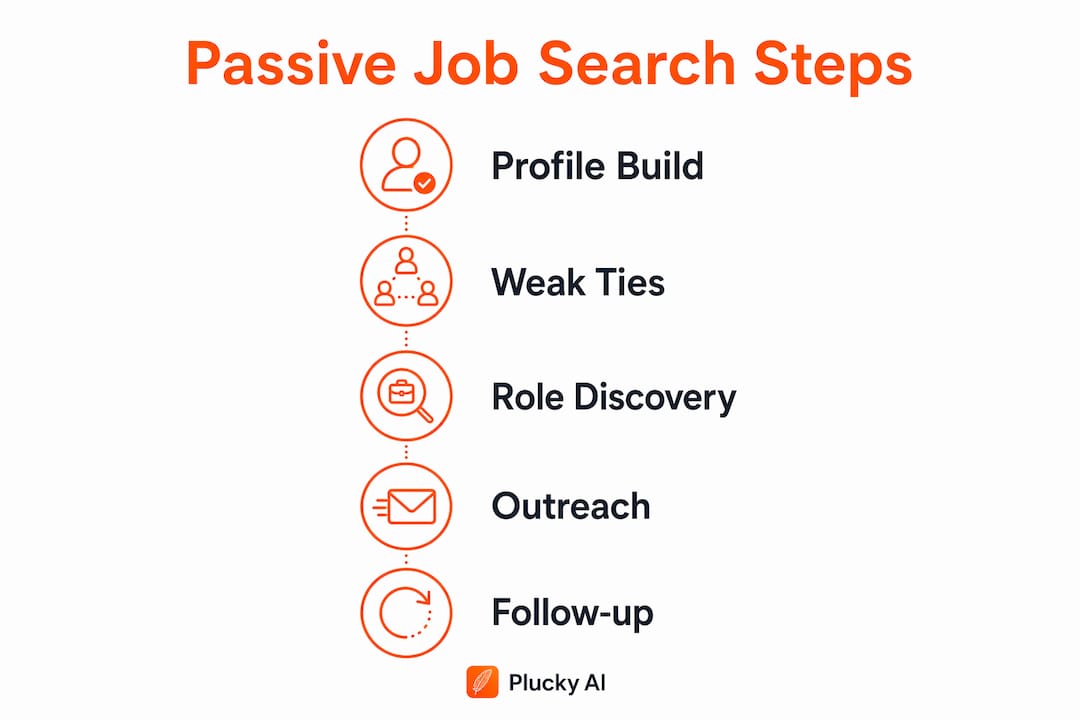
The most effective way to approach a passive IT job search is a five-step workflow you can start today: (1) rewrite your LinkedIn headline with role-specific keywords, (2) activate weak-tie connections at target companies, (3) publish one micro-win per month, (4) run an AI-powered role discovery and hiring-manager outreach pipeline, and (5) track a small set of KPIs weekly. Career strategists frame this as a "digital greenhouse" approach — cultivate signals rather than broadcast availability. Realistic outcome: meaningful recruiter conversations within 30–60 days, and one to three offers within 90 days.
Start today — run these four actions in under 60 minutes:
- Update your LinkedIn headline to a keyword-first format (see Section 3 for formulas).
- Turn off LinkedIn profile-update notifications before making any changes.
- Identify three to five target companies and connect with one vendor or alumni contact at each.
- Set up a job-alert keyword filter in your AI discovery tool for your top two role titles.
Table of Contents
- Why passive search works better for senior IT pros
- How to build a profile that recruiters find without "Open to Work"
- Which low-risk activities actually get hiring managers to notice you
- How to run an AI-powered role discovery and outreach pipeline
- Outreach templates and a cadence that fits passive search etiquette
- What to publish publicly vs. keep private in your portfolio and GitHub
- How to measure progress and know when to adjust
- Risks and red flags to avoid during a covert IT job search
- Why this guide is credible
- Key Takeaways
- The long game is the only game worth playing
- Pluckjobs runs this passive workflow for you
- Useful sources
- FAQ
Why passive search works better for senior IT pros
The U.S. Bureau of Labor Statistics defines passive job search methods as those that cannot result in an offer without additional action — meaning you surface in a recruiter's search, they contact you, and the process begins. That distinction matters strategically: passive candidates are pre-vetted by definition, which is why hiring managers actively seek them for senior individual contributor, staff engineer, and security leadership roles.
Passive search suits you when you are currently employed, your specialty is narrow (cloud security architecture, OT/ICS, zero-trust network design), or you are targeting a single metro market where relationships outweigh volume. A structured 90-day passive sprint requires roughly four hours of setup and about 12 minutes of daily maintenance — far less effort than an active campaign while producing comparable offer volume. Active search makes more sense when you face a layoff deadline or need a role in under 30 days.
Hybrid is often the right call. Run passive signals continuously, then layer in targeted active applications only for roles that match your top criteria. You control the volume.
How to build a profile that recruiters find without "Open to Work"
A keyword-rich, future-facing headline combined with a targeted About section is the single highest-ROI change you can make. Recruiters run boolean searches on LinkedIn and ATS platforms; if your exact specialty terms are absent, you simply do not appear.
Headline formulas that work:
Senior Cloud Security Engineer | AWS | Zero Trust | SIEMStaff Platform Engineer | Kubernetes | GitOps | FinTechCybersecurity Architect | NIST CSF | SOC 2 | Healthcare
High-value keyword sets by specialty:
- Cloud/DevSecOps: Terraform, AWS/GCP/Azure, CI/CD, SAST, DAST
- Cybersecurity: SIEM, EDR, MITRE ATT&CK, SOC, incident response
- Network/Infrastructure: SD-WAN, BGP, zero trust, Cisco, Palo Alto
- Data/ML Engineering: Spark, Databricks, MLOps, dbt, Snowflake
Drop the most obscure, role-specific terms into your Projects and Skills fields. Recruiters searching for "Databricks MLOps" will rank candidates who list it in Projects higher than those who bury it in a job description paragraph.
Before/after headline example:
- Before:
Senior Engineer at Acme Corp - After:
Senior Cloud Security Engineer | AWS | Zero Trust | SOC 2
Pro Tip: Add a "Featured" project entry that describes a sanitized architecture challenge you solved. Title it with your target role keywords. This plants an algorithm breadcrumb that surfaces you in recruiter searches without any "seeking" language.
Which low-risk activities actually get hiring managers to notice you
High-signal, low-noise activities outperform grand public posts for passive candidates. Hiring managers and recruiters read comment sections during silent background checks — a thoughtful two-sentence comment on a CISO's post about threat intelligence carries more weight than a self-promotional article.
Do:
- Comment on posts by target-company leaders with a specific technical observation (two to three sentences, no self-promotion).
- Publish a monthly micro-win: a two-to-three sentence post describing a problem you solved, with no employer name.
- Engage vendor communities (AWS re:Post, Palo Alto Live Community) where hiring managers lurk.
Don't:
- Post "excited to share I'm open to new opportunities" — it signals desperation to passive-search audiences.
- Like or comment on competitor job postings where colleagues might see the activity.
- Connect with 20 new people in one week; a sudden connection spike is a visible signal.
Weak ties — acquaintances at target companies, vendor reps, conference contacts — raise your passive outreach probability more than cold connections. Reconnect with one weak tie per week via a genuine technical question or article share, not a job ask.
Pro Tip: When commenting, lead with a specific data point or counterexample, keep it under 60 words, and end with a question directed at the author. Silent hiring managers who read the thread will see your name, your expertise, and your engagement style — all without a single word about availability.

How to run an AI-powered role discovery and outreach pipeline
Run a repeatable pipeline: AI job matcher → role filter → hiring-manager harvest → tailored outreach. AI screening tools prioritize explicit keywords, public OSS contributions, and mutual-connection metadata when shortlisting passive candidates, so every step in this pipeline feeds those signals.
Step-by-step workflow:
- Role discovery (15 min/week): Set keyword alerts for your top two to three role titles in your AI job matcher. Filter by company size, tech stack, and location.
- Signal filter (10 min/week): Prioritize roles posted within 72 hours — first-mover timing materially increases response rates.
- Hiring-manager enrichment (10 min/role): Pull the hiring manager's name, title, and mutual connections using contact-intelligence data.
- Outreach template injection (5 min/role): Feed the role description and hiring-manager profile into your AI tailoring tool to generate a personalized first message.
- Scheduling (as needed): Block personal calendar time for calls; use a personal email for all outreach.
| Pipeline step | Tool role | Your action |
|---|---|---|
| Role discovery | AI job matcher (SerpAPI-powered) | Set role title + stack keywords |
| Signal filter | Alert engine | Flag roles under 72 hours old |
| Hiring-manager enrichment | Contact intelligence (Apollo) | Pull name, email, mutual connections |
| Outreach template | AI resume/message tailoring | Inject role context, generate draft |
| Scheduling | Personal calendar | Block off-hours slots |
Pluckjobs combines Apollo contact intelligence with SerpAPI role discovery to handle steps 1 through 4 in a single platform, which removes the manual enrichment step that most passive candidates skip entirely.
Pro Tip: Set a daily inbox rule that routes any recruiter reply to a personal folder. Respond within 24 hours — passive candidates who reply fast are perceived as more selective, not more desperate.
Outreach templates and a cadence that fits passive search etiquette
Short, context-rich outreach positions you as a collaborator, not an applicant. Keep every message under 100 words and lead with a specific observation about the company or role.
Template 1 — LinkedIn DM to hiring manager:
Hi [Name], I noticed [Company]'s recent move to [specific initiative]. My background in [specialty] maps closely to what you're building. Happy to share a few thoughts if useful.
Template 2 — Email intro to recruiter:
Subject: [Role title] — [Your specialty] background [Name], a mutual connection suggested I reach out. I'm not actively searching but I'm selectively open to the right opportunity in [domain]. Would a 15-minute call make sense?
Template 3 — Reply to inbound recruiter:
Thanks for reaching out. The role looks interesting. Could you share the JD and comp range? I can confirm fit quickly from there.
Outreach cadence:
| Step | Timing | Intent |
|---|---|---|
| Initial message | Day 1 | Establish context, invite a reply |
| First follow-up | — | One-line bump, add one new detail |
| Second follow-up | — | Brief, gracious, leave the door open |
| Respectful close | — | Thank them, signal future openness |
What to publish publicly vs. keep private in your portfolio and GitHub
Publish non-sensitive project summaries and a sanitized public portfolio; keep full attachments and proprietary samples private until a recruiter asks. AI screening tools actively surface public OSS contributions and portfolio artifacts when shortlisting passive candidates.
| Artifact | Public | Private |
|---|---|---|
| Architecture diagrams | Yes — redact PII and company name | Full internal versions |
| OSS contributions | Yes — link from LinkedIn | Proprietary forks |
| Resume PDF | ATS-clean one-page version | Full master resume |
| Metrics/dashboards | Anonymized results only | Internal KPIs |
| Code samples | Generic, non-proprietary scripts | Client-specific code |
Bullet transformation example:
- Internal: "Reduced MTTR by 34% on Acme Corp's SOC platform."
- Public: "Reduced mean time to response by 34% on a mid-market SOC platform serving 200+ endpoints."
Checklist — what to hide:
- Company-confidential SLA figures tied to a named client
- Internal dashboard screenshots with product names visible
- Proprietary architecture diagrams without redaction
How to measure progress and know when to adjust
Track five KPIs: profile views per week, inbound recruiter contacts per month, meaningful conversations (calls booked), interviews, and offers. For a long-game passive search, these metrics tell you exactly where the funnel is leaking.
A/B tests worth running:
- Headline variant A (role title first) vs. variant B (specialty keyword first) — run for 30 days, compare profile views.
- Comment style: technical observation vs. question-led comment — track which generates profile clicks.
- Outreach subject line: role-title-led vs. mutual-connection-led — compare reply rates over 20 sends.
Reporting cadence:
- Weekly (5 min): Check profile views and inbound recruiter messages.
- Monthly (20 min): Review conversation rate; swap underperforming headline or comment style.
- 90-day review (1 hour): Assess full funnel; decide whether to shift from passive to hybrid.
Risks and red flags to avoid during a covert IT job search
The core risk is visibility — changes that colleagues or internal systems can detect. Small, incremental profile updates are far less likely to alert internal stakeholders than a sudden overhaul.
The safest profile change is the one no one notices. Update one field per week, not ten fields in a single session. LinkedIn's activity feed can surface bulk edits to your connections.
Do/don't list:
- Do turn off "Notify your network" before any profile edit.
- Do use a personal device and personal email for all outreach.
- Don't schedule interviews during core work hours without a plausible cover.
- Don't connect with your current manager's direct reports at target companies.
Legal checklist — review with counsel if applicable:
- Does your employment agreement include a non-compete clause, and what is its geographic and time scope?
- Does your NDA restrict discussing the technologies or architectures you've worked on?
- If you work in defense or with export-controlled data, does your clearance or contract restrict outside employment discussions?
For a deeper look at stealth job search tactics while employed, Diego's 2026 playbook covers scheduling and interview logistics in detail.
Pro Tip: Schedule all calls before 8 AM or after 6 PM local time, or during a confirmed personal appointment. Use a personal phone number and a neutral background for video calls. Never take a recruiter call from your work laptop.
Why this guide is credible
This guide draws on Diego's IT job-search writing for Pluckjobs, including IT Job Search While Employed: The 2026 Stealth Playbook and the Job Search Strategy for IT and Cybersecurity Pros post. The workflow is grounded in authoritative external sources:
- BLS active/passive job search definitions (primary labor-market authority)
- Career strategy research on keyword-first profile optimization and weak-tie cultivation
- AI screening signal research from Evy's technical role screening analysis
- Pluckjobs platform capabilities: Apollo contact intelligence + SerpAPI role discovery, AI resume tailoring, and hiring-manager outreach data
Pluckjobs is purpose-built for IT and cybersecurity professionals running exactly this kind of discreet, AI-driven search.
Key Takeaways
A passive IT job search works when you combine keyword-rich profile signals, weak-tie cultivation, AI-powered role discovery, and a conservative outreach cadence tracked against five clear KPIs.
| Point | Details |
|---|---|
| Profile is the foundation | A keyword-first headline and targeted About section is the highest-ROI single change you can make. |
| Weak ties outperform cold outreach | Reconnect with one vendor or alumni contact per week to raise passive inbound probability. |
| AI pipeline cuts manual work | Role discovery, hiring-manager enrichment, and outreach templating can run in under 50 minutes per week. |
| Measure five KPIs | Track profile views, inbound contacts, conversations, interviews, and offers; review monthly. |
| Pluckjobs runs the workflow | Pluckjobs combines Apollo contact intelligence and SerpAPI role discovery to handle enrichment and outreach in one platform. |
The long game is the only game worth playing
Most IT professionals treat a job search as a fire drill — reactive, stressful, and compressed into a few frantic weeks. That is the wrong frame. The passive approach is a career infrastructure decision: you build the signals once, maintain them lightly, and let compounding visibility do the work over months and years. The professionals who get the best offers are rarely the ones who applied the most. They are the ones who were already visible when the right role opened. If you want to go deeper on the long-term strategy behind this, Diego's long-game job search post on the Pluckjobs blog covers the multi-year career cultivation angle in detail.
Pluckjobs runs this passive workflow for you
Passive search works best when the discovery and outreach steps run on autopilot. Pluckjobs gives IT and cybersecurity professionals the job-matcher, hiring-manager enrichment, and AI tailoring components needed to run this workflow at scale — without cold applying to job boards.
Pluckjobs combines SerpAPI-powered role discovery with Apollo contact intelligence to surface relevant roles and the right hiring manager's contact in one step. Plucky AI then generates a tailored outreach message and a role-specific resume version, so your first contact is always personalized. All activity stays private — no public "open to work" signal, no employer-visible footprint. Ready to run a discreet, AI-driven passive search? Start with Plucky AI or visit pluckjobs.io to see the full platform.
Useful sources
- U.S. Bureau of Labor Statistics — Active vs. Passive Job Search Definitions: Primary authority on how passive search is defined statistically.
- SHRM — How to Target Passive Job Seekers: Employer-side perspective on how passive candidates are sourced and engaged.
- The Smart Passive Job Search: Let Your Next Role Find You (CoPREP): Keyword-first profile strategy and the digital greenhouse framing.
- Passive Job Search: How to Look Without Looking (nBridge): Weak-tie cultivation, comment visibility, and employer-risk controls.
- Passive Job Search: The 90-Day Auto-Pilot Strategy (FastApply): Timeline benchmarks and setup/maintenance time estimates.
- How AI Assists Technical Role Screening in 2026 (Evy): AI screening signal priorities for passive candidates.
- Diego — IT Job Search While Employed: The 2026 Stealth Playbook (Pluckjobs): Scheduling, interview logistics, and employer-risk controls for employed IT pros.
- Diego — Job Search Strategy for IT and Cybersecurity Pros (Pluckjobs): Strategy-level guidance tailored to IT and cybersecurity roles.
FAQ
What does a passive IT job search actually mean?
A passive job search means positioning yourself to be found by recruiters and hiring managers rather than actively applying. Per the BLS definition, passive methods cannot result in an offer without additional action from the employer's side.
How long does a passive search take to produce results?
Meaningful recruiter conversations typically start within 30–60 days of profile optimization. A structured 90-day passive sprint can produce multiple offers, depending on specialty and market demand.
How do I search for IT jobs without alerting my employer?
Turn off LinkedIn's "Notify your network" setting before editing your profile, use a personal device and email for all outreach, and make incremental profile changes rather than a bulk overhaul in one session.
How does Pluckjobs support a passive IT job search?
Pluckjobs combines SerpAPI role discovery with Apollo contact intelligence to surface relevant roles and hiring-manager contacts without requiring you to apply cold. Plucky AI then generates tailored outreach and resume versions for each role.
Which profile change has the highest impact for passive discoverability?
Rewriting your LinkedIn headline to lead with your role title and top two to three technical keywords is the single change most likely to surface you in recruiter boolean searches immediately.