
TL;DR:
- In 2026, IT hiring focuses on skills, AI literacy, and strategic referrals rather than mass applications. Building a targeted portfolio, tailoring resumes for ATS, and cultivating referral networks significantly improve job prospects. Focused effort and clear demonstration of impact help professionals advance faster within their organizations or land new roles.
An effective IT job search strategy in 2026 centers on three pillars: targeting roles that match in-demand skills, passing AI-driven applicant tracking systems (ATS), and building referral networks that move your application to the top of the pile. The tech hiring market has shifted. Employers now plan deliberate, skills-focused hiring, with 50% of companies adding staff while emphasizing upskilling over raw headcount. Mass applying to every open role is the fastest way to burn weeks with nothing to show. This guide gives you the focused approach that actually works.
What are the top skills and roles shaping the 2026 IT job market?
The global Net Employment Outlook for tech sits at 35% in Q3 2026, down 7 points from the prior quarter. That cooling signals a more selective market, not a dead one. Employers are hiring with intention, and they know exactly what they want.
The skill priorities employers report in 2026 break down clearly:
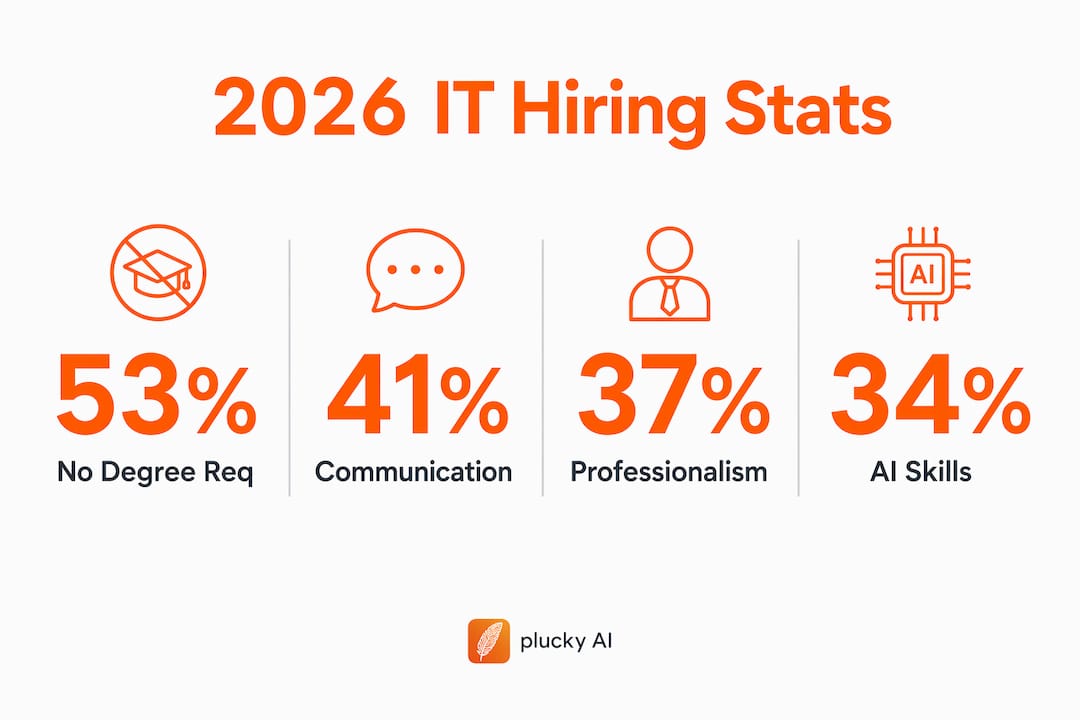
- Communication and collaboration: 41% of employers list this as a top hiring criterion
- Professionalism and reliability: 37% prioritize this above technical depth
- AI technical skills: 34% actively seek candidates who can work with AI tools
- Adaptability: 34% want professionals who adjust quickly to new systems and workflows
- AI literacy and traditional IT roles: 30% and 29% respectively round out the technical demand
That ranking surprises most IT professionals. Communication beats coding fluency on the employer priority list. The reason is straightforward: technical problems in 2026 rarely live inside a single system. They cross teams, budgets, and business units. A network engineer who can explain a firewall decision to a CFO is worth more than one who cannot.
AI jobs present a dual market path: automation is replacing some routine roles, while hybrid AI positions are emerging that require both technical execution and strategic thinking. Cybersecurity and cloud remain the strongest hiring areas. Professionals who combine one of those specializations with AI literacy sit in the best position in the current market.

53% of employers have dropped traditional degree requirements in favor of skills-based hiring. That shift means certifications, GitHub projects, and demonstrated outcomes now carry more weight than a four-year degree on a resume.
How to optimize your resume and online profiles for ATS
Modern ATS tools do not read resumes the way humans do. They scan for exact keyword matches against the job description. A resume that describes "network administration" when the job posting says "network management" can fail the filter before a recruiter ever sees it.
The most effective resume approach in 2026 follows these steps:
- Mirror the job description language exactly. Copy the specific terms the employer uses, including acronyms like SIEM, SOC, or IAM, when they appear in the posting.
- Lead with certifications. CompTIA Security+, AWS Certified Solutions Architect, and Certified Ethical Hacker (CEH) all function as ATS keywords that push resumes past initial filters.
- Use standard section headers. ATS tools parse "Work Experience," not "Where I've Been." Avoid creative formatting that confuses parsing software.
- Quantify outcomes. "Reduced incident response time by 30%" ranks higher than "improved security processes" in both ATS scoring and recruiter attention.
- Keep formatting clean. No tables, no text boxes, no graphics inside the resume file. ATS tools often cannot read them.
Pro Tip: Run your resume through a free ATS checker before submitting. Paste the job description and your resume side by side to spot keyword gaps. Fix those gaps before you apply, not after you get rejected.
Certifications help overcome AI resume screening, but experience and project portfolios ultimately secure the role. A certification gets you past the filter. Your GitHub profile and project work close the interview.
Your LinkedIn profile deserves the same attention as your resume. Use the headline field to include your target role title and top two skills. Active LinkedIn engagement through regular posts, comments, and shares raises your profile visibility to recruiters who search the platform daily. Treat LinkedIn as a publishing channel, not just a digital resume. For a deeper breakdown, the guide on using LinkedIn for IT job search covers profile optimization in full detail.
What practical steps build a strong project portfolio?
A project portfolio is the single best way to prove skills that certifications only claim. Hiring managers in IT and cybersecurity want to see that you have solved real problems, not just passed a multiple-choice exam.
Build your portfolio with these steps:
- Pick problems that matter to employers. Build a home lab that simulates a SOC environment. Create a Python script that automates a common sysadmin task. Set up a cloud infrastructure using AWS or Azure free tiers. These topics appear in job descriptions every day.
- Document everything with a clear README. Every GitHub repository needs a README that explains what the project does, why you built it, what technologies you used, and how to run it. Hiring managers spend less than two minutes reviewing each project.
- Record a short demo. A two-minute screen recording showing your project in action does more than ten paragraphs of description. Upload it to YouTube and link it in your README.
- Avoid tutorial clones. A to-do app or a basic CRUD application tells a hiring manager nothing. Build something that solves a specific problem, even a small one.
- Keep repositories public. Private repositories are invisible to recruiters. Make your best three projects public and pin them to the top of your GitHub profile.
The fastest path to an entry-level IT role combines one strong certification with three real projects on GitHub, plus active networking for referrals. Professionals who follow this focused method typically land their first role within 2–4 months. That timeline beats the average for candidates who mass-apply without a portfolio.
How does strategic networking and referrals accelerate IT job search success?
Referrals are the highest-conversion channel in IT hiring. Referrals increase job offer odds 4x compared to cold applications. That number alone should change how you allocate your job search time.
Most IT professionals spend 80% of their time applying online and 20% networking. The ratio should be reversed. Here is how to build a referral pipeline that produces results:
- Connect with hiring managers directly on LinkedIn. Send a short, specific note that references their team or a recent company announcement. Generic connection requests get ignored.
- Engage with posts before you ask for anything. Comment thoughtfully on posts from people in your target companies for two to three weeks before reaching out. You become a familiar name, not a cold contact.
- Ask for informational interviews. A 20-minute call to learn about someone's role costs nothing and frequently ends with a referral or a direct introduction to the hiring team.
- Attend virtual and in-person meetups. BSides security conferences, local AWS user groups, and ISACA chapter events put you in rooms with people who hire.
Pro Tip: Track every networking conversation in a simple spreadsheet. Note the person's name, company, date of contact, and any follow-up action. Networking without tracking is just socializing.
Avoid ghost jobs by filtering out listings posted more than 30 days ago. Many of these roles are already filled or frozen. Time spent applying to ghost jobs is time not spent building referral relationships. For a broader look at common mistakes that cost IT professionals interviews, the article on IT job search mistakes is worth reading before you submit another application.
What career advancement strategies help IT pros move up without switching jobs?
Internal mobility is one of the most underused tools in IT career advancement. Moving up inside your current organization is faster, lower risk, and often more financially rewarding than jumping to a new employer.
The key is upskilling for the role you want, not the role you have. If you are a help desk analyst targeting a security analyst position, start studying for CompTIA CySA+ now. Volunteer for any project that touches the security team. Make yourself useful to the people who make that hiring decision.
Demonstrating business impact of technical work can increase promotion chances by 15–25%. The shift in mindset is from "I fixed the server" to "I reduced downtime by 40%, which protected $200,000 in daily transaction volume." That framing speaks the language of every manager above you.
Layoff-resilient IT careers are built on scarce skills, cross-functional visibility, and the ability to move across teams. Professionals who stay siloed in one function are the first cut when budgets tighten. Volunteer for cross-departmental projects. Present your team's work in all-hands meetings. Build relationships outside your immediate group.
- Translate technical outcomes into business language before every performance review and every conversation with leadership.
- Identify the skills gap between your current role and your target role, then close it with one certification or one project at a time.
- Network inside your company the same way you network outside it. Internal referrals drive promotion decisions more than performance scores alone.
Key takeaways
An effective IT job search strategy in 2026 requires skills-based targeting, ATS-ready resumes, a real project portfolio, and referral-driven networking to outperform the competition.
| Point | Details |
|---|---|
| Skills-based hiring dominates | 53% of employers dropped degree requirements; certifications and projects now decide hiring outcomes. |
| ATS keyword matching is non-negotiable | Mirror job description language exactly to pass automated screening before a recruiter sees your resume. |
| Referrals multiply offer odds | Referrals increase job offer likelihood 4x compared to cold online applications. |
| Portfolio beats certification alone | Three real GitHub projects plus one strong certification is the fastest path to an IT role in 2–4 months. |
| Business impact drives promotion | Framing technical work in revenue and risk terms increases promotion chances by 15–25%. |
What I've learned watching IT professionals search in 2026
The biggest mistake I see IT professionals make is treating the job search like a numbers game. They apply to 50 roles a week, get no responses, and conclude the market is broken. The market is not broken. Their approach is.
The professionals who get hired fastest in 2026 are the ones who apply to fewer roles with far more precision. They spend an hour tailoring one application instead of 10 minutes blasting out 20. They know the hiring manager's name before they submit. They have already commented on that manager's LinkedIn post twice this month.
The AI hiring tools that screen resumes have made the bar for getting noticed higher, not lower. A generic resume now fails faster than it did three years ago. That is actually good news for professionals willing to do the work. Your competition is still mass-applying. You do not have to be.
One more thing: the search takes longer than most people expect. The average IT job search in 2026 runs 3–5 months for mid-level roles. Build that timeline into your plan. Psychological resilience matters as much as technical skill when you are in month two with no offer. Keep networking. Keep building. The compounding effect of consistent effort is real, even when it is invisible.
— Diego
How Pluckjobs fits into your 2026 IT job search
IT professionals who want precision over volume get it with Pluckjobs. The platform combines AI-powered resume tailoring with SerpAPI-driven role discovery and Apollo contact intelligence, so you find the right role and the right hiring manager in one place.
Pluckjobs surfaces curated IT and cybersecurity job listings matched to your skills, generates tailored resumes for each application, and delivers direct hiring manager outreach data. No more cold applying to black-hole job boards. If you are ready to run a focused, data-driven IT job search, Pluckjobs gives you the tools to do it right.
FAQ
What are the top IT skills employers want in 2026?
Employers in 2026 prioritize communication (41%), professionalism (37%), AI technical skills (34%), and adaptability (34%). Cybersecurity and cloud specializations remain the strongest technical hiring areas.
How do referrals help in an IT job search?
Referrals increase job offer odds 4x compared to cold applications. Building LinkedIn relationships and attending industry events are the most direct ways to generate referrals.
Do I still need a degree to get an IT job in 2026?
No. 53% of employers have dropped traditional degree requirements in favor of skills-based hiring. A strong certification, a real project portfolio, and demonstrated outcomes now carry more weight than a four-year degree.
How long does an IT job search take in 2026?
A focused search using one target role, one certification, three GitHub projects, and active networking typically produces results within 2–4 months for entry-level roles. Mid-level searches often run longer.
How do I pass ATS screening for IT jobs?
Mirror the exact language from the job description in your resume, use standard section headers, and lead with relevant certifications. Avoid graphics, tables, and creative formatting that ATS tools cannot parse.