
TL;DR:
- AI-assisted resume tailoring refines your verified experience to match specific job descriptions without inventing new content. It speeds up applications by using a proof bank, evidence mapping, and targeted prompts to ensure accuracy and ATS compatibility. The key to success is guiding AI with verified facts and controlling its edits to maintain credibility.
AI-assisted resume tailoring is defined as the process of using artificial intelligence to rewrite and realign your existing verified experience to match a specific job description. This is not the same as asking AI to generate a resume from scratch. The industry term is "AI-assisted tailoring," and it works by editing what you already have, not inventing what you don't. An MIT/NBER randomized trial with 480,948 job seekers found that AI editing increases hires by +7.8% and wages by +8.4%. For IT and cybersecurity professionals applying to roles with precise technical requirements, understanding how AI writes job-specific resumes is the difference between getting screened in or filtered out.
How AI writes job-specific resumes: the core workflow
The AI-assisted tailoring workflow follows a clear sequence. Skipping any step produces generic output that reads like every other resume in the pile.
-
Build a master resume. Start with a single document that contains every role, project, tool, certification, and measurable result from your career. This is your source of truth. Nothing goes into a tailored resume that isn't already in the master.
-
Extract requirements from the job description. Copy the full job posting into a document. Identify the required skills, preferred tools, and role-specific language. For a SOC analyst role, that might include SIEM platforms like Splunk or IBM QRadar, incident response procedures, and specific compliance frameworks like NIST or SOC 2.
-
Build an evidence map. Create a simple table with three columns: job requirement, matching evidence from your master resume, and a "do not add" flag for anything you cannot support. Evidence mapping prevents hallucinations by explicitly marking unsupported claims before you ever open an AI tool.
-
Prompt AI to rewrite, not generate. Paste your existing bullet points and the job description into ChatGPT or a similar tool. Instruct it to rewrite using alignment and rephrasing only. A reliable prompt structure: "Rewrite this bullet to mirror the language in the job description. Do not add skills, tools, or metrics I have not provided."
-
Run an AI resume checker. Tools like Enhancv and ResumeStart analyze your tailored draft against the job description for keyword gaps and ATS parsing issues. This step catches problems that manual review misses.
-
Verify every claim manually. Read the final draft against your master resume line by line. If a bullet contains a tool, metric, or scope you cannot defend in an interview, remove it.
Pro Tip: Paste the job description and your master resume into the same prompt window. Ask the AI to identify the top five gaps between your experience and the role requirements before you start rewriting. This gap analysis shapes every subsequent prompt.
How does AI improve keyword alignment and ATS compatibility?

Applicant tracking systems score resumes by matching text against job description keywords. A resume that uses "vulnerability assessment" where the job description says "vulnerability management" can score lower, even if the experience is identical. AI identifies these gaps and closes them.
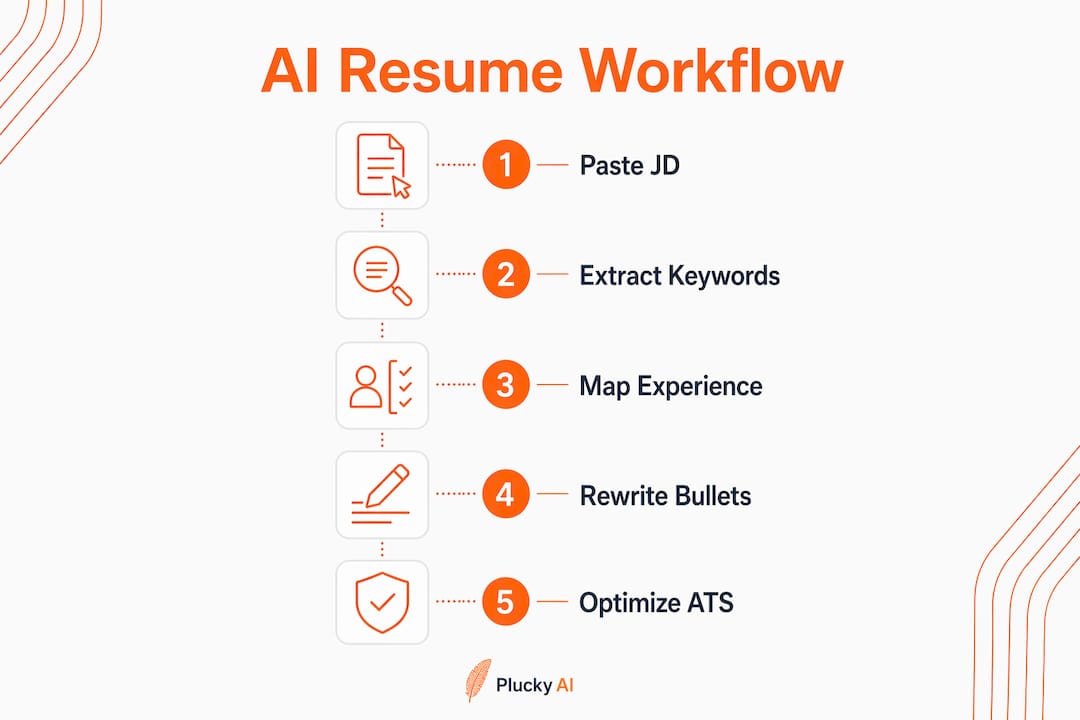
The multi-step AI tailoring process covers keyword detection, bullet rewriting, and ATS validation in sequence. Each step builds on the last. Running them out of order produces inconsistent results.
AI keyword alignment does three specific things well:
- Detects missing terms. AI compares your draft against the job description and flags keywords that appear in the posting but not in your resume.
- Reframes existing experience. If you managed firewall rules using Palo Alto Networks but the job description says "network perimeter security," AI rewrites the bullet to include both phrasings naturally.
- Flags ATS parsing errors. Tables, headers, and graphics in resume files often break ATS parsers. AI resume checkers like those built into Enhancv flag these formatting issues before submission.
The risk to avoid is keyword stuffing by paraphrase. This happens when AI inserts a required term into a bullet without real supporting evidence. The bullet passes the ATS scan but fails the human review. Structured bullet point format reduces this risk by requiring every bullet to follow the pattern: action verb + scope + tool or method + measurable result or verifiable artifact.
| Approach | Result |
|---|---|
| AI generates resume from scratch | High risk of hallucinated skills and generic phrasing |
| AI rewrites existing bullets with job description language | Accurate, ATS-aligned, and defensible in interviews |
| AI adds keywords without supporting evidence | Passes ATS but fails human review |
| AI checks formatting and keyword gaps only | Safe validation step with no fabrication risk |
What strategies prevent AI from producing generic or hallucinated content?
Generic AI resumes come from one source: allowing the AI to fill blanks. Best results come from supplying facts and asking AI to mirror job description language only where those facts support it. The fix is structural, not stylistic.
These strategies keep AI output accurate and specific:
- Supply only verified facts. Never paste a blank section and ask AI to fill it. Every input must come from your master resume.
- Use explicit "do not add" flags. When a job requirement has no matching evidence in your master resume, mark it in your evidence map. Include the instruction "do not add unsupported skills or metrics" in every prompt.
- Request multiple variants. Ask AI to produce three versions of each bullet. Reviewing options forces you to evaluate which version is most accurate, not just which sounds best.
- Read the draft aloud. AI output often shifts your voice toward corporate phrasing. Reading aloud catches sentences that don't sound like you and signals where the AI has drifted from your actual experience.
- Audit against your master resume. Every tool, certification, and metric in the tailored resume must trace back to a specific entry in the master document.
Pro Tip: For cybersecurity roles, replace invented metrics with references to verifiable artifacts. Instead of "reduced incident response time by 40%," write "documented incident response procedures in a runbook reviewed by the security operations team." Artifacts are defensible. Invented percentages are not.
Task-based prompting produces better results than asking AI to rewrite an entire resume at once. Break the work into focused tasks: one prompt for the summary, one per job role, one for the skills section. Each focused prompt gives the AI a tighter scope and produces more accurate output.
Section-by-section rewriting also reduces repetitive phrases and keeps your original voice intact. Broad resume generation erases personality. Targeted section editing preserves it.
How can IT and cybersecurity professionals speed up tailoring with AI?
Speed comes from preparation, not from asking AI to do more work. The fastest tailoring workflow starts before you open any AI tool.
-
Build a proof bank. A proof bank is a structured list of every verifiable metric, project outcome, and tool from your career. For a network security engineer, that includes firewall rule sets managed, number of endpoints monitored, SIEM platforms configured, and compliance audits passed. A detailed proof bank cuts tailoring time by about 70% compared to reconstructing evidence from memory for each application.
-
Copy the job description and run a gap analysis first. Paste the full job posting into ChatGPT or a similar tool alongside your master resume. Ask it to identify which requirements you meet, which you partially meet, and which you cannot support. This takes two minutes and shapes every subsequent decision.
-
Produce bullet variants for each role requirement. For each requirement you can support, ask AI to write two or three bullet variants. Select the one that most accurately reflects your experience and best matches the job description language.
-
Use AI resume builders for final validation. Platforms like Enhancv and ResumeStart run automated checks for keyword coverage, ATS compatibility, and formatting errors. These checks take under five minutes and catch issues that manual review misses.
-
Verify before submitting. Speed without verification produces errors. A final read against your proof bank takes ten minutes and prevents claims you cannot defend in an interview.
IT and cybersecurity job seekers who maintain a current proof bank and use AI for faster job application tailoring can produce a fully tailored resume in under an hour. Without a proof bank, the same process takes three to four hours. The preparation investment pays back on every application.
Pro Tip: Update your proof bank immediately after completing a project, not at job search time. Details like the number of systems affected, tools used, and outcomes achieved are easiest to capture while the work is fresh.
Key takeaways
AI-assisted resume tailoring works because it edits your real experience to match job description language, not because it generates new content.
| Point | Details |
|---|---|
| AI edits, not authors | Supply verified facts and ask AI to rewrite, never to invent skills or metrics. |
| Evidence mapping prevents hallucinations | Build a table linking job requirements to your proof before prompting any AI tool. |
| ATS alignment requires structured bullets | Use the action verb + scope + tool + result format to pass ATS scans without keyword stuffing. |
| Proof bank speeds up tailoring | A current proof bank of metrics and artifacts cuts tailoring time by about 70%. |
| Section-by-section prompting retains your voice | Targeted prompts per resume section produce more accurate output than broad generation. |
What I've learned about AI and IT resume writing
The most common mistake I see IT and cybersecurity professionals make is treating AI as a ghostwriter. They paste a job description, ask for a resume, and accept whatever comes back. The output sounds polished. It also contains tools they've never used and metrics they cannot explain.
The professionals who get results treat AI as an editor with no memory. They bring the facts. They control what goes in. They ask AI to improve the language, not to fill gaps. That distinction sounds simple, but it changes everything about how you prompt and how you review the output.
Cybersecurity roles are particularly unforgiving. A hiring manager who spent ten years in incident response will ask you to walk through a specific scenario from your resume. If that scenario came from AI and not from your actual work, the interview ends quickly. The job search mistakes that cost IT professionals the most are almost always credibility failures, not keyword failures.
The AI resume writing tips that actually work share one trait: they start from honesty. Build the proof bank. Map the evidence. Let AI improve the prose. That workflow produces resumes that hold up under scrutiny and get you into rooms where you can demonstrate what you actually know.
— Diego
Pluckjobs and AI-powered resume tailoring for IT professionals
Pluckjobs is built specifically for IT and cybersecurity job seekers who need tailored resumes without the manual grind. The platform combines AI-driven keyword analysis with role-specific guidance to help you rewrite existing experience to match each job description accurately.
Pluckjobs connects job description requirements directly to your verified experience, suggests bullet rewrites grounded in what you've actually done, and flags ATS compatibility issues before you submit. It also integrates hiring manager outreach data so your tailored resume reaches the right person. IT and cybersecurity professionals can start tailoring with Pluckjobs and move from job description to submission-ready resume faster, without sacrificing accuracy or voice.
FAQ
Can AI write a resume effectively for cybersecurity roles?
AI writes resumes effectively when used as an editor, not an author. An MIT/NBER study found AI editing increases hires by +7.8%, but only when applied to human-written content with verified facts.
What is an evidence map in AI resume tailoring?
An evidence map is a table linking each job requirement to a matching item in your existing resume, with a "do not add" flag for unsupported claims. It prevents AI from inventing skills or metrics during the rewriting process.
How do I avoid keyword stuffing when using AI on my resume?
Structure every bullet as action verb + scope + tool or method + measurable result. This format satisfies ATS keyword requirements without inserting terms that lack supporting evidence.
What is the fastest way to tailor a resume with AI?
Build a proof bank of verifiable metrics and project outcomes before you start. Professionals with a current proof bank reduce tailoring time by about 70% compared to reconstructing evidence from memory per application.
Does AI change my voice when rewriting resume bullets?
AI output often shifts toward corporate phrasing. Reading the draft aloud and prompting AI for section-by-section rewrites rather than full resume generation preserves your original voice and keeps claims auditable.