
A strong brand manager resume leads with a headline like "Brand Manager | 7 years driving $4M+ campaigns across CPG and DTC channels | Brand Strategy, Go-to-Market, P&L Management," exports as a real-text PDF, and fits one page for early-career candidates or two pages for senior roles. Before you open your resume file, run through this checklist:
- Contact block: name, city/state, phone, email, LinkedIn URL
- Professional summary: 3–4 lines, ATS keywords front-loaded
- Core competencies: 8–12 keywords in a single-column block
- Work experience: reverse-chronological, 4–5 metrics-first bullets per role
- Certifications: listed before education for experienced candidates
- Education: degree, institution, graduation year
- Skills and tools: platforms, analytics tools, and software
- Format: single-column layout, 10–12pt sans-serif font, real-text PDF export, no tables or embedded images
Table of Contents
- What does a strong brand manager resume look like by seniority?
- How do you write experience bullets that pass ATS and impress hiring managers?
- Which resume sections and formatting rules give you the best ATS results?
- What hard and soft skills should you list on a brand manager resume?
- How do you use a resume template and tailor it to each job posting?
- What should your resume headline and summary say at each career stage?
- How do you write a brand manager resume with little or no direct experience?
- Why does a brand manager resume need to prove both creativity and commercial results?
- Key Takeaways
- What actually separates a brand manager resume that gets read from one that gets skipped
- Useful sources and further reading
- FAQ
What does a strong brand manager resume look like by seniority?
Hiring managers screen dozens of resumes per role. The ones that earn callbacks share one trait: they prove both creative judgment and commercial results, not one or the other. Below are annotated snippets you can copy and adapt.
Entry-level / associate brand manager
Headline: Associate Brand Manager | Consumer Insights, Campaign Execution, Cross-Functional Collaboration

Summary: Marketing graduate with 2 years of internship experience supporting brand strategy and digital campaign execution for CPG brands. Skilled in consumer research, creative brief development, and performance reporting. Seeking a brand associate role where data-driven insights translate into measurable market impact.
Experience bullets:
- Developed consumer segmentation analysis using syndicated data, identifying two underserved audience groups that informed a revised messaging brief adopted by the creative team.
- Coordinated social media content calendar for a 12-SKU product line, increasing average post engagement by 34% over one quarter.
- Supported go-to-market planning for a seasonal product launch, contributing to a cross-functional team of 8 across marketing, sales, and supply chain.
Page length: 1 page. At this stage, a second page signals padding, not depth.
Mid-level brand manager
Headline: Brand Manager | $2M+ A&P Budget | FMCG | Brand Strategy & Consumer Insights
Summary: Brand Manager with 5 years of experience in FMCG brand strategy, consumer insights, and integrated campaign management. Proven record of growing brand awareness and delivering revenue targets. Adept at translating market research into creative briefs and managing agency relationships from brief to final execution.
Experience bullets:
- Led rebranding of a heritage snack line, lifting unaided brand awareness from 31% to 44% over 18 months through repositioned packaging and a refreshed media mix.
- Managed a multi-million dollar A&P budget across TV, digital, and in-store channels, delivering revenue exceeding the fiscal year's target.
- Commissioned and analyzed Nielsen consumer panel data to identify underserved segments, driving substantial incremental revenue.
- Briefed and managed creative agency across three product launches, reducing time-to-market by 3 weeks versus prior-year average.
Page length: 1–2 pages. Two pages are acceptable when experience spans multiple brands or categories.
Senior brand manager / brand director
Headline: Senior Brand Manager | $120M Portfolio | P&L Ownership | Brand Strategy & Market Expansion

Summary: Senior Brand Manager with 10+ years of experience managing large-scale brand portfolios across FMCG and DTC channels. Deep expertise in P&L management, go-to-market strategy, and cross-functional leadership. Track record of delivering above-target brand equity growth and revenue performance in competitive categories.
Experience bullets:
- Managed a large brand portfolio across multiple markets, delivering year-over-year revenue growth exceeding the category benchmark.
- Launched a plant-based product line that generated significant first-year sales above target, supported by substantial A&P investment.
- Led a team of 6 brand managers and coordinated with product, sales, and executive stakeholders to align annual brand planning.
- Directed consumer insights program using primary research and syndicated data, informing a brand repositioning that lifted brand consideration by 11 points.
Page length: 2 pages. Directors and VPs with multi-brand scope should use the second page for earlier roles and certifications.
Pro Tip: Tools like ResumeWorded, Enhancv, and Indeed's resume builder offer free templates and ATS scoring. Use them to check formatting, but replace their generic bullet suggestions with your own quantified results.
How do you write experience bullets that pass ATS and impress hiring managers?
Generic duty descriptions are the most common reason brand manager resumes fail both ATS and human review. The fix is a repeatable formula.
The STAR-with-stack formula: Action verb → method or tool → scope (dollar amount, team size, markets) → measurable business outcome.
Every bullet should answer: What did you do, how did you do it, at what scale, and what happened as a result?
- Identify the activity. Start with a strong action verb: Led, Developed, Managed, Launched, Commissioned, Directed, Repositioned, Negotiated.
- Name the method or tool. Specify the insight source, media channel, or framework: "using Nielsen panel data," "via a three-channel media mix," "through A/B testing on Meta."
- State the scope. Budget, portfolio size, team headcount, number of markets, or SKU count.
- End with the outcome. Revenue, awareness lift, market share, time saved, or cost reduction.
Before and after rewrites:
| Before (duty) | After (impact) |
|---|---|
| Responsible for brand campaigns | Led integrated campaign across TV, digital, and OOH for a $1.8M budget, delivering 108% of revenue target |
| Worked with creative agency | Briefed and managed creative agency across 4 product launches, cutting time-to-market by 3 weeks |
| Conducted market research | Commissioned consumer segmentation study via Nielsen data, identifying 2 underserved segments that drove $3.4M incremental revenue |
| Managed social media content | Developed and executed social content strategy for 12-SKU line, lifting engagement 34% in one quarter |
| Supported product launch | Co-led go-to-market for a plant-based SKU that reached $8.2M in Year-1 sales against a $6M target |
Embedding ATS keywords naturally: Place your top three keywords (Brand Strategy, Go-to-Market Strategy, Brand Management) in the professional summary and repeat them in your top two experience bullets. ATS systems weight keyword placement by position, so a keyword in the summary earns more than the same keyword buried in a third-page bullet.
Pro Tip: Tie every consumer insights or segmentation project to a business outcome. "Identified two underserved segments using Nielsen data, drove $3.4M incremental revenue" is the kind of strategy-to-execution chain that recruiters scan for in the first third of your resume.
Which resume sections and formatting rules give you the best ATS results?
Section order is not cosmetic. ATS parsers weight content near the top of the document, so your summary and core competencies need to appear before your work history, not after it.
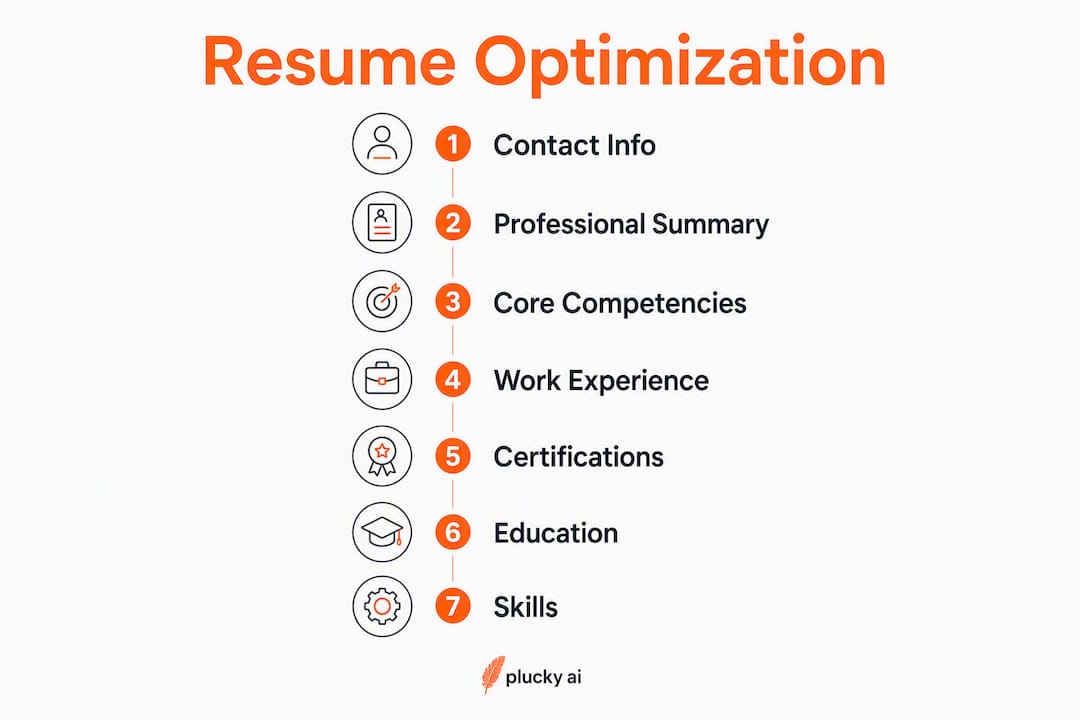
Recommended section order
Contact information → Professional Summary → Core Competencies → Work Experience → Certifications → Education → Skills and Tools
Certifications go before education for experienced candidates because a Google Analytics certification or a PMP credential is more immediately relevant to a hiring manager than your undergraduate degree year.
Formatting rules that protect ATS accuracy
Two-column or sidebar layouts reduce ATS parsing accuracy, with some systems struggling to correctly assign content to the right fields when columns are present. Single-column layouts parse reliably across major ATS platforms. Specific rules to follow:
- Font: 10–12pt sans-serif (Calibri, Arial, or Helvetica). Avoid decorative or serif fonts.
- Margins: 0.5–1 inch on all sides.
- Dates: Use a consistent format: "Jan 2022 – Mar 2024" or "2022–2024." Never abbreviate inconsistently.
- Company line: Bold the company name; use plain text for your title and dates on the same or next line.
- No tables, text boxes, or icons: These break parsers. A skills block formatted as a simple comma-separated list or a two-column text list (not a table) is fine.
- Export: Save as a real-text PDF, not a scanned image or a Word file with tracked changes. A real-text PDF preserves font rendering and allows parsers to extract text accurately.
- Bullets per role: Limit to 4–5 bullets, each no longer than two lines. Longer bullets dilute the impact of your strongest results.
Hiring context: According to Indeed's Hiring Lab, the U.S. labor market for marketing and brand roles remains competitive, with employers prioritizing candidates who can demonstrate measurable brand performance alongside strategic planning credentials.
What hard and soft skills should you list on a brand manager resume?
The right keyword set depends on the role level and sector, but most brand manager job descriptions draw from the same core vocabulary. Place 8–12 keywords across your summary and core competencies block, with your top three appearing in the summary itself.
| Keyword | Category | Best placement |
|---|---|---|
| Brand Strategy | Strategy | Summary + Core Competencies |
| Go-to-Market Strategy | Strategy | Summary + Top bullet |
| Brand Management | Strategy | Summary + Core Competencies |
| Market Analysis | Analytics | Core Competencies + bullet |
| Consumer Insights | Analytics | Summary + bullet |
| Campaign Management | Execution | Core Competencies + bullet |
| P&L Management | Commercial | Summary (senior roles) + bullet |
| Budget Management | Commercial | Core Competencies + bullet |
| Cross-Functional Leadership | Soft skill | Core Competencies |
| Agency Management | Execution | Core Competencies + bullet |
| Brand Equity | Strategy | Summary + bullet |
| Product Launch | Execution | Core Competencies + bullet |
For tools, list platforms relevant to your experience: Nielsen, Kantar, Google Analytics, Salesforce Marketing Cloud, Asana, Tableau, Meta Ads Manager, or Sprinklr. Only list tools you can discuss in an interview.
Avoiding keyword stuffing: Natural phrasing beats a hidden keyword block. "Developed go-to-market strategy for a $2M product launch" reads cleanly and contains two keywords. A skills section that lists "Brand Strategy, Brand Management, Brand Equity, Brand Positioning, Brand Architecture" in sequence looks padded and may trigger spam filters in some ATS. Group related terms and let your bullets carry the weight. For broader context on in-demand marketing skills and how employers rank them, SemLocal's marketing skills breakdown is worth a scan.
How do you use a resume template and tailor it to each job posting?
A template gives you a clean starting structure. Customization is what gets you the interview. Use the single-column template below as your base, then run the six-step checklist before every submission.
Single-column template
[FULL NAME]
[City, State] | [Phone] | [Email] | [LinkedIn URL]

PROFESSIONAL SUMMARY
[3–4 lines. Front-load 2–3 keywords. State title, years of experience, top result, and value proposition.]

CORE COMPETENCIES
[Keyword 1] | [Keyword 2] | [Keyword 3] | [Keyword 4] | [Keyword 5] | [Keyword 6]
[Keyword 7] | [Keyword 8] | [Keyword 9] | [Keyword 10]

WORK EXPERIENCE
[Company Name] — [City, State]
[Job Title] | [Start Month Year] – [End Month Year]
• [Action verb + method + scope + outcome]
• [Action verb + method + scope + outcome]
• [Action verb + method + scope + outcome]
• [Action verb + method + scope + outcome]

CERTIFICATIONS
[Certification Name] — [Issuing Body] — [Year]

EDUCATION
[Degree], [Major] — [University Name] — [Graduation Year]

SKILLS AND TOOLS
[Tool 1], [Tool 2], [Tool 3], [Tool 4], [Tool 5]
6-step customization checklist
- Keyword match: Copy the job description into a text document. Highlight every skill, tool, and qualification. Cross-check against your summary and core competencies. Add any missing high-frequency terms naturally.
- Reorder bullets: Move the bullet most relevant to the job's primary requirement to the top of each role. ATS and recruiters both read top-to-bottom.
- Tighten the summary: Rewrite the first line to mirror the exact job title in the posting. If the posting says "Senior Brand Manager, Personal Care," your summary should open with that phrase.
- Add measurable outcomes: If any bullet still reads as a duty, apply the STAR-with-stack formula before submitting.
- Format check: Confirm single-column layout, consistent date format, no tables or images, and font size 10–12pt.
- Filename and export: Save as
FirstName-LastName-BrandManager-[CompanyName].pdf. A specific filename signals attention to detail and makes it easier for recruiters to locate your file.
For a deeper walkthrough on tailoring your resume per job posting, Pluckjobs' guide covers keyword matching and ATS alignment in detail.
LinkedIn sync: After submitting, update your LinkedIn headline to match the title in your resume. Recruiters who find your application may cross-reference your profile, and a mismatch creates doubt.
What should your resume headline and summary say at each career stage?
The professional summary is the first thing a recruiter reads after the contact block. It needs to do three things in four lines: state your title and experience level, signal your top commercial or creative result, and embed your primary keywords.
Headline templates
- Entry-level: Associate Brand Manager | Consumer Insights | Campaign Execution | Cross-Functional Teams
- Mid-level: Brand Manager | $2M+ A&P Budget | FMCG | Go-to-Market Strategy
- Senior: Senior Brand Manager | $120M Portfolio | P&L Ownership | Multi-Market Brand Strategy
- Agency-to-in-house transition: Brand Strategist | Agency-Side Creative Leadership | In-House P&L & Insights
Summary snippets by level
Entry-level: Marketing graduate with 2 years of internship experience in CPG brand strategy and digital campaign execution. Skilled in consumer research, creative brief development, and cross-functional coordination. Eager to bring data-driven insights to a brand associate role focused on measurable market impact.
Mid-level (FMCG): Brand Manager with 5 years of experience in FMCG brand strategy, consumer insights, and integrated campaign management. Managed $2.1M A&P budgets and delivered above-target revenue results across two product categories. Strong track record in agency management and go-to-market execution.
Senior (tech/DTC): Senior Brand Manager with 10 years of experience leading brand strategy and P&L management for DTC and tech brands. Directed multi-market campaigns with budgets exceeding $4M, consistently delivering double-digit brand awareness growth. Experienced in building and leading brand teams of up to 8 direct reports.
Agency-to-in-house: Brand Strategist with 6 years of agency-side experience developing integrated campaigns for CPG and retail clients. Transitioning to in-house brand management with a proven record in creative brief development, consumer insights, and campaign performance analysis. Comfortable with both creative judgment and commercial reporting.
Tone guidance: For creative-heavy roles (agency, fashion, lifestyle), lead with creative brief authorship and campaign results. For commercial roles (FMCG, pharma, tech), lead with P&L scope and revenue outcomes. Senior roles should always include budget size or portfolio value in the headline or first summary line.
How do you write a brand manager resume with little or no direct experience?
Limited experience is not a disqualifier. What matters is showing that you understand the strategy-to-execution chain and can provide evidence of it, even from internships, academic projects, or adjacent roles.
Lead with projects and internships
Structure every project bullet the same way you would a paid role: action → method or tool → brief scope → measurable result. Even if the metric is engagement, test conversions, or a professor's evaluation, a number is better than no number.
- Developed a brand repositioning brief for a student-run CPG simulation, presenting to a panel of 4 faculty judges; brief was selected as the top submission in a cohort of 22.
- Executed a social media A/B test for a nonprofit client during a marketing internship, testing two headline variants across 3,000 impressions; the winning variant lifted click-through rate by 18%.
- Conducted primary consumer research (15 in-depth interviews) to identify purchase barriers for a local retail brand, delivering a segmentation report that informed the client's Q3 messaging strategy.
Portfolio and case-study items to include
If you have a portfolio, link it in your contact block or summary. Include items like campaign briefs, A/B test summaries, consumer research snapshots, or brand audit presentations. Even a well-documented class project demonstrates the insight-to-brief-to-activation chain that hiring managers look for in brand candidates.
Transferable skill phrases
When formal budget ownership is missing, frame your contribution in terms of scope and outcome:
- "Contributed to cross-functional team of 8 across marketing, sales, and logistics for a regional product launch"
- "Managed content calendar and performance reporting for a 12-SKU product line"
- "Supported consumer insights analysis using syndicated data, informing a revised creative brief"
These phrases show process familiarity and collaborative execution without overstating authority you did not hold. For agency-to-in-house transitions, the TBE Agency blog covers the shift from client-service to brand ownership in practical terms.
Why does a brand manager resume need to prove both creativity and commercial results?
The most common mistake in brand management resumes is optimizing for one dimension only. Candidates from creative backgrounds list campaigns and aesthetics. Candidates from analytics backgrounds list data and dashboards. Hiring managers want both, and the research supports this clearly.
Industry practice expects candidates to demonstrate both creative brief authorship and P&L literacy. Resumes that show both increase interview invite rates for senior roles. The strategy-to-execution narrative should be explicit: link consumer insight → brief → activation → metric. Recruiters scan for that chain in the first 30% of your resume content.
What to quantify on your resume:
- P&L scope: total portfolio value or A&P budget managed
- Awareness and consideration: unaided awareness lifts, brand consideration index movement
- Revenue impact: sales against target, incremental revenue from a new segment or SKU
- Market share: category share movement over a defined period
- Efficiency: agency cost savings, time-to-market reduction, campaign ROI
Example phrases linked to research findings:
- "Grew unaided brand awareness from 31% to 44% over 18 months" (awareness lift)
- "Managed $4.2M A&P budget, delivering 103% of revenue target" (budget + commercial outcome)
- "Launched plant-based line to $8.2M Year-1 sales against a $6M target" (launch performance)
- "Identified two underserved segments via Nielsen data, driving $3.4M incremental revenue" (insight-to-revenue chain)
"Hiring managers value evidence of both creative brief authorship and budget/P&L management; resumes that show both increase interview invite rates for senior roles." — LumiCV Brand Manager Resume Guide
Pro Tip: Before submitting, run your resume through Pluckjobs' AI resume check at pluckjobs.io/start. The platform aligns your keywords to the specific job description and flags missing ATS terms before your application reaches a recruiter.
Key Takeaways
A brand manager resume that passes ATS and earns interviews combines metrics-first bullets, single-column formatting, and a professional summary that front-loads your top three keywords and your strongest commercial result.
| Point | Details |
|---|---|
| Lead with metrics | Every experience bullet should include scope (budget, portfolio size) and a measurable outcome (revenue, awareness lift, market share). |
| Single-column format | Use a single-column layout, 10–12pt sans-serif font, and export as a real-text PDF to maximize ATS parsing accuracy. |
| Front-load keywords | Place your top three keywords (Brand Strategy, Go-to-Market Strategy, Brand Management) in the professional summary and top bullets. |
| Tailor per posting | Run the 6-step customization checklist for every application: keyword match, reorder bullets, tighten summary, add outcomes, format check, and rename the file. |
| Prove both skill sets | Show creative brief authorship AND P&L or budget ownership on the same resume to qualify for senior brand roles. |
What actually separates a brand manager resume that gets read from one that gets skipped
Most brand manager resumes fail at the same point: they describe what the candidate did without proving what it was worth. A hiring manager reviewing 40 resumes in a morning is not reading for effort. They are scanning for proof that you can own a brand commercially, not just execute campaigns.
The candidates who get called in share a specific pattern. Their summary opens with a number or a scope statement. Their top bullet names a business outcome, not a task. Their skills block matches the language of the job description, not a generic marketing glossary. And their formatting is clean enough that the ATS never had to guess where one section ended and another began.
What most guides underemphasize is the creative-to-commercial bridge. Brand managers who come from agency backgrounds often write resumes that read like creative portfolios: strong on campaign craft, thin on revenue accountability. Candidates from analytics or product backgrounds do the opposite. The resumes that consistently earn senior-level interviews are the ones that show both: "I wrote the brief AND I owned the P&L." That combination is rare enough that hiring managers notice it immediately.
One more thing worth saying plainly: ATS optimization is not about gaming the system. It is about writing clearly enough that a parser can read your resume the same way a human would. Single-column layout, real-text PDF, consistent date formatting, and keywords placed where they belong in context. That is not a trick. That is just a well-written document.
Useful sources and further reading
The following sources informed this guide and offer additional depth on brand manager resume standards, ATS best practices, and role expectations.
- Brand Manager Resume Example — ATS-Optimized for 2026 | JobVouch — ATS keyword placement, section order, and formatting rules
- What Is a Brand Manager? Responsibilities, Skills, and Salary | Coursera — Role definition, responsibilities, and salary context
- Brand Manager Job Description Template | Rework — Hiring-side expectations and brand management job description language
- Indeed Hiring Lab — U.S. labor market context for marketing and brand roles
- AMA Certifications — American Marketing Association professional certifications relevant to brand managers
- PMP Certification | PMI — Project management credential useful for cross-functional brand leadership roles
Pluckjobs resources for brand manager candidates:
- How to customize your resume per job posting — Step-by-step ATS keyword matching and tailoring guide
- How AI writes job-specific resumes for IT pros — How Pluckjobs AI adapts resume content to specific job descriptions
- Common IT job search mistakes to fix in 2026 — Resume errors and practical fixes for technical professionals
Run your brand manager resume through Plucky AI to get ATS keyword alignment, hiring manager outreach data, and a tailored resume in one workflow.
FAQ
What skills should a brand manager include on a resume?
Include a mix of strategic skills (Brand Strategy, Go-to-Market Strategy, Market Analysis), commercial skills (P&L Management, Budget Management), and execution skills (Campaign Management, Agency Management, Product Launch). Add 2–3 relevant tools such as Nielsen, Google Analytics, or Salesforce Marketing Cloud.
What is the role of a brand manager?
Brand managers develop and execute brand strategies, conduct market research, manage budgets, and coordinate across product, sales, and executive teams to build brand equity and drive revenue growth.
How long should a brand manager resume be?
One page for candidates with fewer than 5 years of experience; one to two pages for mid-level and senior brand managers with multi-brand or multi-market scope. Never exceed two pages regardless of seniority.
What is a strong branding statement for a brand manager resume?
Lead with your title, years of experience, top commercial result, and 2–3 keywords: for example, "Brand Manager | 5 years driving $2M+ A&P budgets in FMCG | Brand Strategy, Go-to-Market, Consumer Insights." Keep it to one line in the headline and expand it to 3–4 lines in the professional summary.
How do you make a brand manager resume ATS-friendly?
Use a single-column layout, export as a real-text PDF, place your top three keywords in the professional summary and top bullets, and avoid tables, text boxes, or embedded images. ATS parsers weight keyword placement by position, so front-loading your summary with high-frequency terms directly improves your score.