
TL;DR:
- Most senior roles are filled through the hidden job market before public postings appear. Building relationships and targeting specific companies increase the chances of getting hired without applying online. Consistent outreach over weeks yields better results than mass applying to job boards.
A zero-application job search is a method where you secure job opportunities without submitting formal online applications, focusing instead on networking, direct outreach, and professional visibility to reach hiring decision-makers before a role is ever posted. The industry term for the opportunity pool this method targets is the hidden job market, and it is far larger than most job seekers realize. 60–75% of knowledge-work hires above $80K originate from this market rather than public job boards. That single fact reframes the entire job search game for IT and cybersecurity professionals. If most senior roles never reach a public listing, then submitting applications is not a strategy. It is a lottery.
What is a zero-application job search and why does it work?
A zero-application job search works because it targets the hiring process before competition enters. Most job seekers wait for a role to appear on a job board, then compete against hundreds of other applicants. This approach skips that queue entirely by building relationships and visibility with the people who make hiring decisions.

The hidden job market is the engine behind this strategy. Approximately 43% of job postings at large U.S. firms are filled via referral or internal routes, with the public posting serving only as administrative documentation. That means nearly half of all listed roles are already decided before you click "Apply." The posting exists to satisfy HR compliance, not to find a candidate.
Understanding this shifts your entire approach. Instead of responding to job listings, you position yourself as the obvious choice before a listing exists. You build relationships with hiring managers, stay visible in your professional community, and get referred into conversations that never go public.
"The best jobs aren't posted. They're filled by the person someone already knows and trusts."
This is not a fringe tactic. It is how most senior hires in IT, cybersecurity, and knowledge work actually happen.
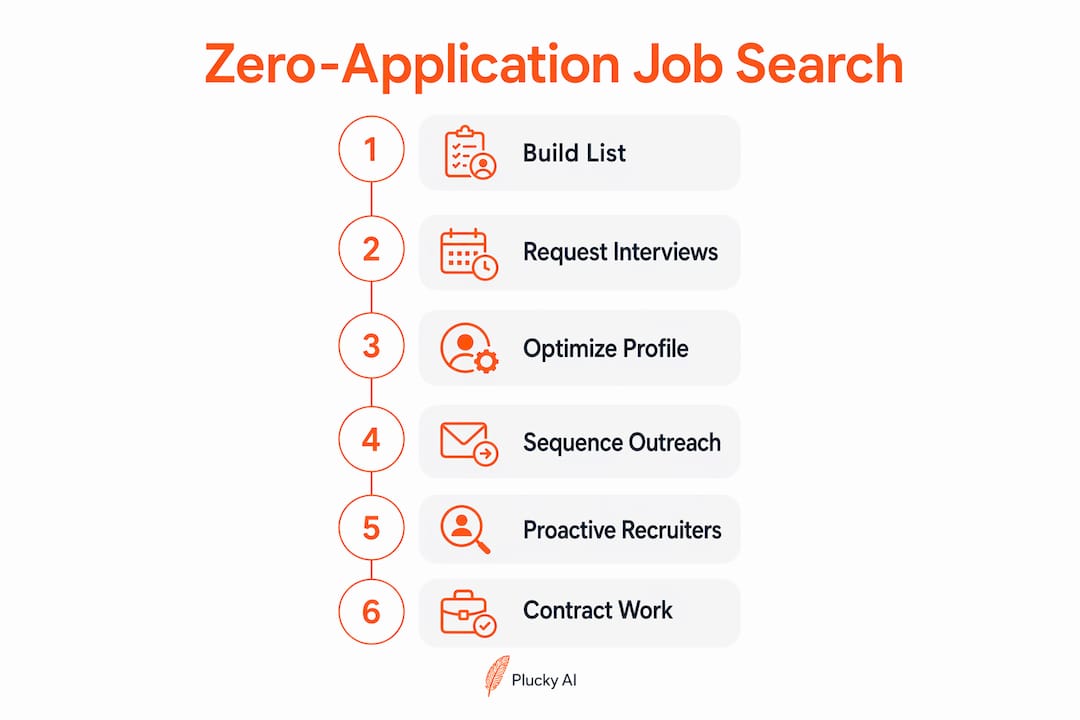
How to find jobs without applications: core zero-application tactics
The most effective no-application job strategies share one trait: they prioritize relationships over transactions. Each tactic below builds toward a warm introduction rather than a cold submission.
1. Build a target company list
Target mapping with 25–40 dream companies and their key decision-makers is the foundation of any zero-application search. Without a focused list, your outreach becomes scattered and ineffective. With one, every conversation you have moves you closer to a specific goal.
Start with companies where your skills solve a known problem. For cybersecurity professionals, that might mean firms that recently disclosed a breach or are scaling their cloud infrastructure. For IT professionals, target companies mid-migration or building new engineering teams.
2. Request informational interviews
Informational interviews of 20–30 minutes focused on learning and advice produce far better outcomes than direct job asks. They lower the stakes for the person you are contacting and create genuine relationship-building moments. Ask about their team's challenges, not about open roles.
This approach works because it reframes you as a peer, not a supplicant. People enjoy sharing expertise. A 25-minute conversation about cloud security trends builds more goodwill than a dozen cold applications.
3. Optimize your LinkedIn profile for discoverability
Recruiters use advanced algorithms like LinkedIn 360Brew to find candidates. Optimizing your profile with role-family keywords and outcome-oriented language increases your findability without you applying to anything. Posting industry-specific content amplifies this effect further.
For IT and cybersecurity professionals, this means using specific terms like "zero trust architecture," "SOC analyst," or "cloud security engineer" in your headline and summary. Generic titles like "IT professional" do not surface in recruiter searches.
Pro Tip: Post one short LinkedIn insight per week about a technical topic in your specialty. Recruiters who find your profile through search will see active, credible expertise rather than a dormant page.
4. Sequence your outreach from warm to cold
Top candidates follow a deliberate outreach sequence: internal mobility first, then warm introductions, then weak ties, then inbound recruiters, then cold outreach, and formal applications only as a last resort. Each step down this sequence reduces your conversion rate. Warm introductions convert at a fraction of the effort that cold applications require.
5. Build recruiter relationships proactively
Recruiters fill confidential and unposted roles regularly. Connecting with specialized IT and cybersecurity recruiters before you need a job gives you access to opportunities that never reach a job board. Treat recruiters as long-term allies, not one-time contacts.
6. Use contract work as a foot in the door
Short-term contract or consulting work with a target company gives you direct access to internal hiring conversations. Many full-time IT roles are offered to contractors who have already proven their value. This is one of the most reliable alternative job search methods available.
How does a zero-application search compare with traditional job hunting?
The difference in outcomes between these two approaches is significant. A warm introduction produces a 50% chance of a job offer from interviews secured through the hidden market. Cold applications produce roughly a 1% conversion rate. That gap is not marginal. It is the difference between a method that works and one that mostly does not.
The median applicant count for tech postings is 257. That means your cold application competes against 256 others before a recruiter reads a single line. Ghost postings make this worse. Many posted roles are already filled or were never real openings, created only for compliance or pipeline-building purposes.
A warm-introduction conversation quickly diagnoses whether a role is actively hiring, saving weeks of wasted effort on positions that were never available.
Here is how the two approaches compare across key dimensions:
| Dimension | Zero-application search | Traditional application search |
|---|---|---|
| Competition level | Low (1 to 5 candidates) | High (100 to 257 applicants) |
| Conversion to interview | High via warm intro | Very low via cold apply |
| Time per opportunity | High upfront, lower overall | Low upfront, high overall |
| AI resume screening | Bypassed entirely | Major filter barrier |
| Emotional impact | Energizing, relationship-driven | Draining, rejection-heavy |
| Best for roles above $80K | Yes | Rarely |
The psychological difference matters too. Sending 50 applications and hearing nothing back is demoralizing. Having five genuine conversations with people in your target companies is energizing, even when the timeline is longer.
Applications still have a place. For entry-level roles, government positions, or highly structured hiring processes, formal applications are often required. The zero-application approach does not eliminate applications entirely. It deprioritizes them in favor of methods with far better returns.
How to implement a zero-application job search: practical steps
Execution is where most job seekers fall short. The tactics above only work with consistent, organized follow-through.
- Build your target list first. Write down 25–40 companies where your skills fit. Add the names and LinkedIn profiles of hiring managers and team leads at each one. This list is your working document.
- Use a job search CRM. A job search CRM tracks every contact, conversation, and follow-up. Without one, outreach becomes disorganized and follow-ups get missed. A spreadsheet works at minimum. Dedicated tools work better.
- Craft personalized outreach messages. Generic messages get ignored. Reference a specific article the person wrote, a project their company announced, or a technical challenge relevant to their industry. One sentence of genuine specificity outperforms three paragraphs of generic flattery.
- Follow up consistently. Persistence and consistency in outreach over time is the defining factor in hidden market success. Most job seekers give up after one unanswered message. A polite follow-up three to five business days later doubles your response rate.
- Stay visible between conversations. Share technical insights on LinkedIn. Comment on posts from people at your target companies. Visibility keeps you top of mind without requiring a direct ask.
Pro Tip: Set a weekly goal of five new outreach messages and two follow-ups. Consistency over six to eight weeks produces far better results than a burst of 30 messages in one day.
Common pitfalls include targeting too broadly, asking for a job in the first message, and failing to follow up. The hidden job market is open 24/7, but it rewards deliberate, patient effort. For a deeper look at mistakes to avoid, the common IT job search mistakes guide covers the most frequent errors IT professionals make in their searches.
Key takeaways
A zero-application job search outperforms traditional methods because it targets the hidden job market, where 60–75% of senior knowledge-work roles are filled before a public posting ever appears.
| Point | Details |
|---|---|
| Hidden market dominates senior hiring | 60–75% of roles above $80K are filled via referrals and internal routes, not job boards. |
| Warm introductions convert far better | A hidden market interview produces a 50% offer rate versus roughly 1% from cold applications. |
| Target mapping drives focus | Build a list of 25–40 companies and decision-makers to direct all outreach with purpose. |
| Outreach sequencing matters | Start with warm introductions and internal contacts before moving to cold outreach or applications. |
| Consistency beats volume | Steady weekly outreach over six to eight weeks outperforms a one-time burst of mass applications. |
Why I think the zero-application mindset is the real shift
Most job seekers treat their search like a numbers game. Send more applications, get more interviews. That logic made sense when job boards were new and competition was lower. It does not hold anymore.
What I have seen work, repeatedly, is the mindset shift from applicant to proactive professional. The moment you stop waiting for permission to be considered and start building relationships with people who can hire you, the entire dynamic changes. You are no longer one of 257 resumes. You are the person someone already knows.
The discomfort is real. Reaching out to a hiring manager you have never met feels presumptuous. Asking for a 20-minute conversation feels like an imposition. But most people in technical fields genuinely enjoy talking about their work. A well-crafted, specific message gets a response far more often than job seekers expect.
The mistake I see most often is impatience. Job seekers try the approach for two weeks, get two non-responses, and go back to submitting applications. The hidden market takes six to eight weeks of consistent effort to produce results. The pipeline builds slowly, then accelerates. Giving up before that acceleration is the single biggest reason this method fails for people who try it.
Embrace the discomfort of direct outreach. The IT job search strategy that feels harder upfront almost always produces better results downstream.
— Diego
How Pluckjobs supports a zero-application job search
Pluckjobs is built for IT and cybersecurity professionals who want to move beyond mass applications. The platform combines Apollo contact intelligence with SerpAPI-powered role discovery to surface precision job matches and the hiring manager contact data you need to reach out directly.
With Pluckjobs, you get the target company intelligence, outreach data, and tailored resume tools in one place. No more cold applying to roles that were already filled. Plucky AI handles the research so you can focus on the conversations that actually lead to offers. If you are ready to run a zero-application search with real data behind every outreach, Pluckjobs gives you the infrastructure to do it.
FAQ
What is a zero-application job search?
A zero-application job search is a method of finding employment without submitting formal online applications, relying instead on networking, direct outreach, and professional visibility to access the hidden job market.
How effective is the hidden job market compared to job boards?
A warm introduction through the hidden job market produces a 50% chance of a job offer from interviews secured, compared to roughly 1% from cold applications on job boards.
How many companies should I target in a zero-application search?
Career experts recommend building a focused list of 25–40 target companies with identified decision-makers to keep outreach specific and manageable.
Does a zero-application search still require a resume?
Yes. A strong resume remains necessary for conversations that progress to formal hiring stages, but in a zero-application search it is shared directly with a contact rather than submitted through an applicant tracking system.
How long does a zero-application job search take to produce results?
Consistent outreach over six to eight weeks typically produces the first meaningful conversations. The hidden job market rewards persistence over time, not volume in a single burst.