
TL;DR:
- Hiring signals are observable events like funding announcements or leadership changes that indicate imminent company hiring. Recognizing and acting on these signals early gives IT and cybersecurity professionals a competitive advantage before job postings go live. Proper interpretation helps candidates and managers align their strategies and improve recruitment outcomes.
A hiring signal is an observable business event that indicates a company is likely to recruit soon, often weeks before a job posting goes live. For IT and cybersecurity professionals, recognizing these indicators separates proactive candidates from reactive ones. Hiring signals include funding announcements, leadership changes, office expansions, and clustered job postings. Each one reveals something about a company's strategic direction. Understanding what is a hiring signal, and how to read one correctly, gives both job seekers and hiring managers a measurable edge in a market where the best roles fill fast.

What is a hiring signal and why does it matter?
A hiring signal is a detectable business event that precedes formal recruitment activity by days, weeks, or months. The practical implication is significant: candidates who act on signals before a role is posted face less competition and can reach hiring managers during the planning phase, not the filtering phase.
The strongest signals fall into three categories: corporate development events, organizational changes, and operational patterns. A $10M Series A funding round, for example, typically correlates to 10–20 new hires within the following quarter. That is a budget approval and a headcount expansion plan in one announcement.
Organizational signals carry equal weight. New executives are three times more likely to make significant hiring decisions within their first 90 days, especially when building functions that did not previously exist. A new Chief Information Security Officer at a mid-size fintech is not just a personnel change. It signals a security team build.
Operational signals are subtler but often the most reliable. When a company posts a Head of Platform role alongside three senior engineers and a DevOps lead within two weeks, that is functional clustering. Functional clustering signals a budget-backed, urgent mandate rather than routine backfilling.
What types of hiring signals exist in IT and cybersecurity?
Hiring signals vary in strength and lead time. The table below maps signal type to typical lead time and what it usually predicts for technology roles.
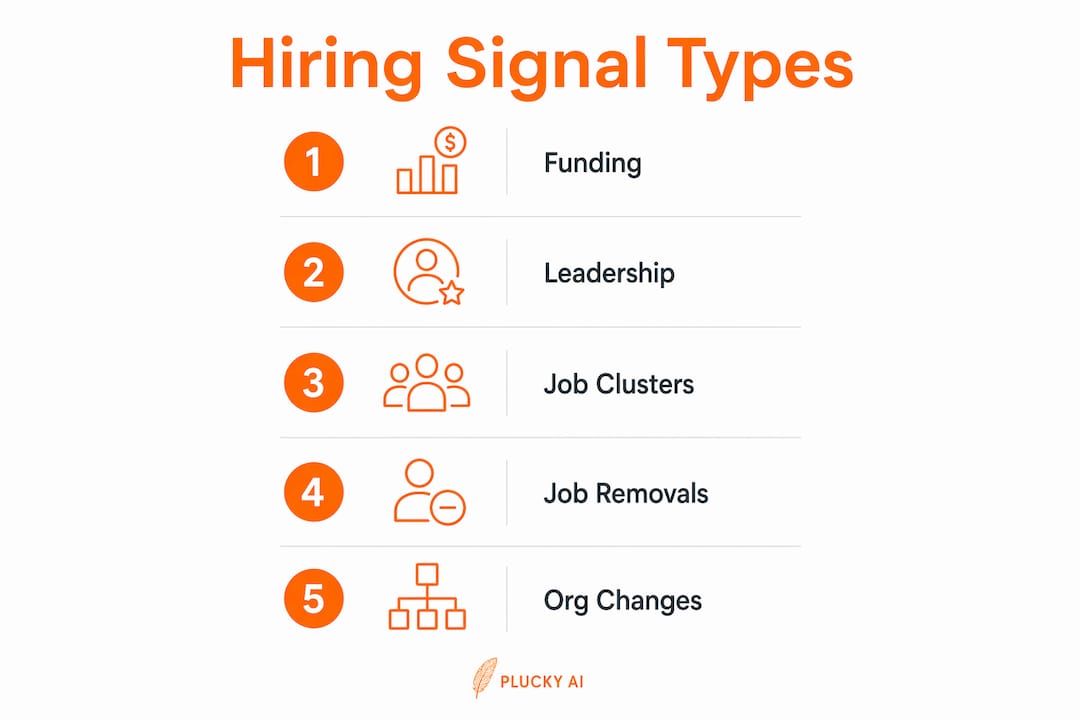
| Signal type | Typical lead time | What it predicts |
|---|---|---|
| Funding announcement | 60–90 days | Headcount surge across engineering and security |
| New executive hire | 30–60 days | Team build or function creation |
| Functional role clustering | 2–4 weeks | Specific team expansion or new product initiative |
| Office or market expansion | 4–8 weeks | Regional IT and infrastructure hiring |
| Job post removal | Immediate | Budget freeze, strategic pivot, or role elimination |
Funding announcements trigger a hiring surge within 60 to 90 days, particularly in technology companies where headcount approvals follow budget releases closely. Cybersecurity roles are often among the first approved because compliance and infrastructure requirements are non-negotiable at scale.
Job post removals deserve special attention. Disappearing roles often signal significant company trajectory changes, including budget freezes or strategic pivots. A cybersecurity team that suddenly pulls three open analyst roles is telling the market something. Reading that signal correctly prevents wasted outreach.
Pro Tip: Set up Google Alerts for target company names combined with terms like "Series B," "appoints," or "expands." You will catch corporate development signals the moment they are published, not days later.
How can job seekers in IT and cybersecurity use hiring signals?
Job seekers who act on hiring signals before roles are posted gain access to hiring managers during the planning window, not the screening queue. The approach requires a shift from reactive job board monitoring to proactive signal tracking.
Here is a practical sequence for IT and cybersecurity candidates:
- Identify target companies. Build a list of 20–30 companies in your sector where you would realistically work. Focus on companies with active growth indicators such as recent funding or new product launches.
- Monitor signal sources. Track LinkedIn for executive announcements, Crunchbase for funding rounds, and company newsrooms for expansion press releases. Check job boards weekly for functional clustering patterns.
- Interpret the signal correctly. A new CISO hire at a healthcare SaaS company means a security team build is likely. A single analyst posting at the same company may be a backfill. The context changes your approach entirely.
- Reach out before the posting goes live. Use the signal window to contact the hiring manager directly. Reference the business event, not the job opening. "I saw your company closed a Series B and is expanding its cloud infrastructure team" is a stronger opener than "I am applying for the DevOps role."
- Tailor your preparation to the signal. If the signal points to a new product launch, research the technology stack. If it points to a compliance initiative, prepare to discuss frameworks like SOC 2 or NIST CSF.
The IT job search strategy that works in 2026 is built on signal awareness, not volume applications. Candidates who send 10 targeted, signal-informed outreach messages outperform those who submit 100 cold applications.
Pro Tip: When you reach out to a hiring manager based on a signal, keep the message to three sentences. State the signal you noticed, your relevant experience, and one specific question about the team's direction. Brevity signals confidence.
How do hiring managers use hiring signals to improve recruitment?
Hiring managers who detect signals early reduce time-to-hire and attract stronger candidates by starting recruitment during the planning phase rather than after job postings go live. The shift from reactive to proactive recruitment is the core benefit.
Practical applications for hiring professionals include:
- Anticipating workforce needs. When your company closes a funding round or announces a new market entry, start building candidate pipelines immediately. Do not wait for headcount approval to finalize before sourcing begins.
- Aligning recruitment with strategic events. A new product launch in cybersecurity analytics requires specific skills. Identifying that signal internally allows recruiters to target candidates with the right certifications, such as CISSP or CEH, before the role is formally approved.
- Using clustered hiring to build cohesive teams. When multiple related roles open simultaneously, treat them as a team build, not individual searches. Sourcing candidates who can work together from the start produces better long-term outcomes.
- Prioritizing outreach based on signal strength. A funding announcement is a stronger signal than a single job posting. Allocate recruiter time accordingly.
- Monitoring competitor signals. When a direct competitor posts a cluster of security engineering roles, that signals a product or compliance initiative. Understanding what talent they are chasing helps you compete for the same pool or anticipate market shifts.
The hiring manager intelligence that separates good recruiters from great ones is the ability to read organizational context, not just job descriptions. A signal detection system shifts recruitment from job-post response to proactive strategic planning.
Common misconceptions when interpreting hiring signals
Not every signal guarantees imminent hiring. Misreading context is the most common and costly mistake both candidates and recruiters make.
The most frequent errors include:
- Assuming all leadership changes mean growth. A new CTO can mean modernization or a response to a failing technology approach. The difference matters. A replacement hire often signals internal problems, not expansion.
- Treating backfill roles as strategic signals. A single job posting for a role that existed before is almost always a backfill. Companies with first-time roles show two to three times higher hiring intent than backfill positions. Prioritize new function hires.
- Ignoring negative signals. Removed job postings, executive departures without announced replacements, and office closures are all signals. They indicate budget freezes or strategic pivots that make outreach poorly timed.
- Acting on isolated signals without pattern confirmation. One data point is noise. A funding announcement combined with three new engineering postings and a new VP of Engineering hire is a pattern. Patterns are reliable. Isolated events are not.
Pro Tip: Before reaching out based on a signal, spend 10 minutes checking the company's LinkedIn page for recent departures. A wave of exits alongside new postings tells a very different story than a clean expansion.
Signals form part of a predictable organizational planning cycle. Sequence and context matter more than any single event. A new CISO hire followed by three security analyst postings two weeks later is a sequence. That sequence is far more reliable than either event alone.
Practical steps to act on hiring signals in 2026
Both job seekers and hiring managers can build a repeatable process for signal detection and response. The following steps apply across both perspectives.
- Set up automated monitoring. Use Google Alerts, LinkedIn job change notifications, and Crunchbase funding alerts for your target company list. Automate the signal collection so you spend time interpreting, not searching.
- Build a signal log. Track each signal with the company name, signal type, date detected, and your planned response. A simple spreadsheet works. The goal is to see patterns across companies over time.
- Use AI-powered tools for role discovery. Platforms that combine contact intelligence with job signal detection surface opportunities before they reach general job boards. Pluckjobs combines Apollo contact data with SerpAPI-powered role discovery to deliver early signal matches for IT and cybersecurity professionals.
- Engage hiring managers early and specifically. Reference the exact signal in your outreach. Generic messages get ignored. Signal-specific messages demonstrate market awareness, which is itself a sign of a good hire in technical roles.
- Incorporate signals into interview preparation. If a company's signal points to a cloud migration initiative, prepare to discuss AWS architecture decisions and trade-offs. In interviews, discussions about trade-offs reveal deeper fit than rehearsed answers. Hiring managers in cybersecurity and IT specifically look for candidates who can explain why they chose one approach over another.
Tracking job search metrics alongside signal activity gives you a feedback loop. If signal-informed outreach produces more responses than cold applications, you have evidence to double down on the approach.
Key Takeaways
Hiring signals are the most reliable early indicators of recruitment activity, and reading them correctly determines whether you act during the planning window or after the competition has already applied.
| Point | Details |
|---|---|
| Definition of a hiring signal | An observable business event that precedes a job posting by days to months. |
| Strongest signal types | Funding rounds, new executive hires, and functional role clustering predict imminent hiring. |
| Candidate advantage | Outreach before a role is posted reaches hiring managers during planning, not filtering. |
| Hiring manager benefit | Early signal detection reduces time-to-hire and improves candidate pipeline quality. |
| Biggest pitfall | Treating backfill roles and leadership replacements as growth signals leads to wasted effort. |
Signals over noise: what 15 years in tech recruitment taught me
The single biggest mistake I see IT and cybersecurity professionals make is waiting for the job posting. By the time a role appears on a job board, the hiring manager has often already spoken to two or three candidates through their network. The posting is a formality.
What changed my approach was realizing that companies telegraph their hiring needs constantly. A Series B announcement is not just a financial event. It is a hiring roadmap. A new CISO appointment is not just a personnel change. It is a signal that a security team build is 30 to 60 days away. Once you start reading company news through that lens, the job market looks completely different.
The part that most guides get wrong is the nuance around negative signals. Candidates and recruiters alike tend to focus on positive indicators and ignore the warning signs. A company that removes five security roles in a week is telling you something critical about its financial health or strategic direction. Acting on that signal by avoiding outreach saves you weeks of wasted effort.
My honest prediction for 2026 and beyond: AI will surface signals faster, but human judgment will still determine whether a signal is worth acting on. The professionals who combine long-game job search strategy with signal awareness will consistently outperform those who rely on volume alone. Data tells you when. Judgment tells you whether.
— Diego
Pluckjobs puts hiring signals to work for IT and cybersecurity professionals
Recognizing a hiring signal is only half the equation. Acting on it fast, with the right contact and the right message, is where most candidates fall short.
Pluckjobs is built for exactly this moment. The platform combines Apollo contact intelligence with SerpAPI-powered role discovery to surface early hiring signals for IT and cybersecurity professionals before roles hit general job boards. You get precision job matches, direct hiring manager contact data, and tailored resume support in one place. No cold applying. No guessing who to contact. If you are ready to move from reactive to proactive, start with Pluckjobs and get ahead of the next hiring wave before it crests.
FAQ
What is a hiring signal in recruitment?
A hiring signal is an observable business event, such as a funding round, leadership change, or clustered job postings, that indicates a company is likely to hire soon. These signals typically precede formal job postings by days to months.
What are the strongest hiring signals for IT roles?
Funding announcements, new executive hires, and functional role clustering are the strongest indicators. A $10M Series A, for example, typically correlates to 10–20 new hires within the following quarter.
How do I find hiring signals before jobs are posted?
Monitor Crunchbase for funding rounds, LinkedIn for executive appointments, and job boards for clusters of related roles opening within the same two-week window. Automated alerts make this process repeatable.
Can a hiring signal be negative?
Yes. Removed job postings, executive departures without replacements, and office closures are negative signals that indicate budget freezes or strategic pivots. Recognizing them prevents poorly timed outreach.
How should I use a hiring signal in an interview?
Reference the specific business event that triggered your interest in the company. In interviews, discussing trade-offs and strategic decisions tied to that event reveals deeper fit than rehearsed answers, which is exactly what hiring managers in cybersecurity and IT look for.