
TL;DR:
- Hiring manager intelligence uses AI analytics to predict candidate success and improve hiring decisions. It integrates data from resumes, interviews, and outcomes to support managers across the recruitment process. Effectively implementing it requires validated competency profiles, ATS integration, and outcome feedback.
Hiring manager intelligence is defined as the use of AI-driven analytics and enriched recruitment data to help hiring managers make faster, more accurate selection decisions. The standard industry term for this practice is "hiring intelligence," and it sits within a broader family that includes talent intelligence and interview intelligence. What separates hiring manager intelligence from a basic applicant tracking system is its focus on prediction, not just tracking. It tells you which candidate is most likely to succeed in the role, not just which one submitted an application. Pluckjobs surfaces this kind of contact and role data for IT and cybersecurity hiring teams, making the concept immediately practical for tech-focused recruiters.
What is hiring manager intelligence and how does it work?
Hiring manager intelligence is defined as AI-driven decision support that uses recruitment data to predict candidate success and optimize sourcing. The term clusters under three related concepts: hiring intelligence, talent intelligence, and interview intelligence. Each focuses on a different part of the recruitment funnel, but all three share a data-to-decision orientation rather than simple reporting.

The core inputs are resumes, structured assessments, interview transcripts, and historical hiring outcomes. AI and machine learning transform those raw inputs into ranked candidate shortlists, pipeline bottleneck alerts, and sourcing channel performance scores. An ATS tracks workflow steps. Hiring intelligence predicts what happens next.
Because "hiring manager intelligence" is not yet a universal industry term, practitioners operationalize it through these subsets like hiring intelligence and interview intelligence. That ambiguity is worth naming early. If your team adopts an intelligence platform without agreeing on which subset you are solving for, you will measure the wrong outcomes.
What are the main components and data sources?
Hiring intelligence draws from two data streams: internal HR records and external labor market feeds. Internal data includes past hiring decisions, performance reviews, and attrition records. External data includes real-time labor supply signals, salary benchmarks, and competitor hiring activity.
The key components that make up a functioning hiring intelligence system are:
- Candidate success forecasts. Predictive scores that rank applicants by likelihood of performing well in the role, based on historical outcome data.
- Pipeline bottleneck detection. Flags stages where candidates drop off or stall, so hiring managers can intervene before time-to-hire inflates.
- Sourcing channel ROI. Measures which job boards, referral programs, or outreach campaigns produce the highest quality hires per dollar spent.
- Interview evidence scoring. Structured rubric scores from interview transcripts that replace subjective impressions with comparable data points.
- Competency gap analysis. Maps candidate profiles against validated role success criteria rather than keyword matches.
The distinction between an ATS and an intelligence layer matters here. Hiring intelligence delivers predictive guidance on which candidates to prioritize and why. An ATS tells you a candidate moved from phone screen to final round. Intelligence tells you that candidate has a high probability of accepting and staying past 12 months.
| Data Input | What It Produces |
|---|---|
| Resumes and assessments | Candidate fit scores against role competency profiles |
| Interview transcripts | Rubric-based evaluation scores for structured comparison |
| Historical hiring outcomes | Predictive models for future candidate success |
| External labor market feeds | Sourcing strategy calibration and salary benchmarking |
| ATS pipeline data | Bottleneck detection and time-to-hire forecasting |
How does hiring manager intelligence improve decision-making?
The practical value of hiring manager intelligence shows up at four specific decision points in the recruitment process.
- Job brief calibration. Talent intelligence adjusts job briefs against external labor market realities before candidate screening begins. A hiring manager who insists on five years of experience in a skill that is only two years old gets corrected by market data, not by a recruiter's opinion.
- Candidate shortlisting. Intelligence platforms surface ranked slates based on predictive fit scores. Hiring managers review evidence, not gut feelings. This closes the gap between perceived and actual evaluation quality.
- Interview evaluation. Structured rubrics tied to role success criteria produce comparable scores across all interviewers. AI-based scoring rewards structured answers and reduces the inconsistency that comes from different interviewers weighting the same answer differently.
- Offer and retention decisions. Correlating past hiring outcomes with current candidate profiles lets hiring managers predict not just who will accept an offer, but who will still be performing well at the 18-month mark.
Pro Tip: Build your competency profiles before you open a requisition. Intelligence platforms score candidates against the criteria you define. Vague criteria produce vague scores.
Intelligence systems augment hiring managers rather than replace them. Ranked candidate slates and structured evidence surface the data. The hiring manager still makes the call. The difference is that the call is now grounded in something more reliable than a 45-minute conversation and a strong handshake.
How does hiring manager intelligence differ from talent and interview intelligence?
The three intelligence types target different stages of the hiring process. Mixing them up leads to optimizing the wrong part of the funnel.
Market intelligence and interview intelligence serve distinct decision stages. Market intelligence calibrates the brief and the candidate pool. Interview intelligence improves evaluation quality once candidates are in the funnel. Hiring manager intelligence sits at the intersection, pulling from both to support decisions at every key stage.
Talent intelligence focuses on workforce skills and labor market trends. Talent intelligence synthesizes internal skills data and external labor market supply signals to create a real-time workforce picture. It is primarily strategic and longer-term, used for workforce planning and skills gap forecasting months ahead.
Interview intelligence concentrates on capturing and scoring interview data. Interview intelligence captures and transcribes interview data to analyze candidate responses against job-relevant rubrics, producing structured, comparable evidence rather than subjective impressions.
Hiring manager intelligence is the operational layer. It takes outputs from both talent intelligence and interview intelligence and presents them as decision-ready guidance for the hiring manager at each process stage.
| Intelligence Type | Primary Focus | Decision Stage |
|---|---|---|
| Talent intelligence | Workforce skills and labor market trends | Strategic workforce planning |
| Interview intelligence | Capturing and scoring interview responses | Candidate evaluation |
| Hiring manager intelligence | Decision support across the full funnel | Sourcing through final selection |
What are best practices for implementing hiring intelligence?
Adoption fails when organizations treat intelligence as a reporting layer rather than a decision support tool. Without outcome correlation, intelligence dashboards risk being sophisticated but ineffective. The following practices prevent that outcome.
- Build validated competency profiles first. Define the skills, behaviors, and outcomes that predict success in each role before configuring any scoring model. Keyword searches produce keyword matches, not performance predictors.
- Integrate with your ATS for real-time scoring. Intelligence platforms need live pipeline data to flag bottlenecks and update candidate rankings as new information arrives. A disconnected intelligence tool is just a spreadsheet with better branding.
- Train hiring managers to interpret scores, not just read them. A fit score of 82 means nothing without context. Managers need to understand what competencies drove the score and where the candidate showed gaps.
- Use rubric-first interview design. Rubric-first approaches emphasize validating rubrics that reflect true role success criteria. Without validated rubrics, AI scoring replicates existing human biases rather than correcting them.
- Monitor hiring outcomes and feed them back into the model. The intelligence loop closes when you track whether hired candidates actually performed as predicted. That feedback improves future scoring accuracy.
- Avoid treating intelligence as a compliance checkbox. Structured rubrics improve fairness and auditability, but only if interviewers are trained to apply them consistently.
Pro Tip: Run a 90-day outcome audit after your first cohort of intelligence-assisted hires. Compare predicted fit scores against actual performance ratings. The gap tells you exactly where your competency model needs refinement.
You can also review recruitment workflow metrics to identify which pipeline stages benefit most from intelligence integration before you invest in a full platform rollout.
What measurable impacts does hiring manager intelligence produce?
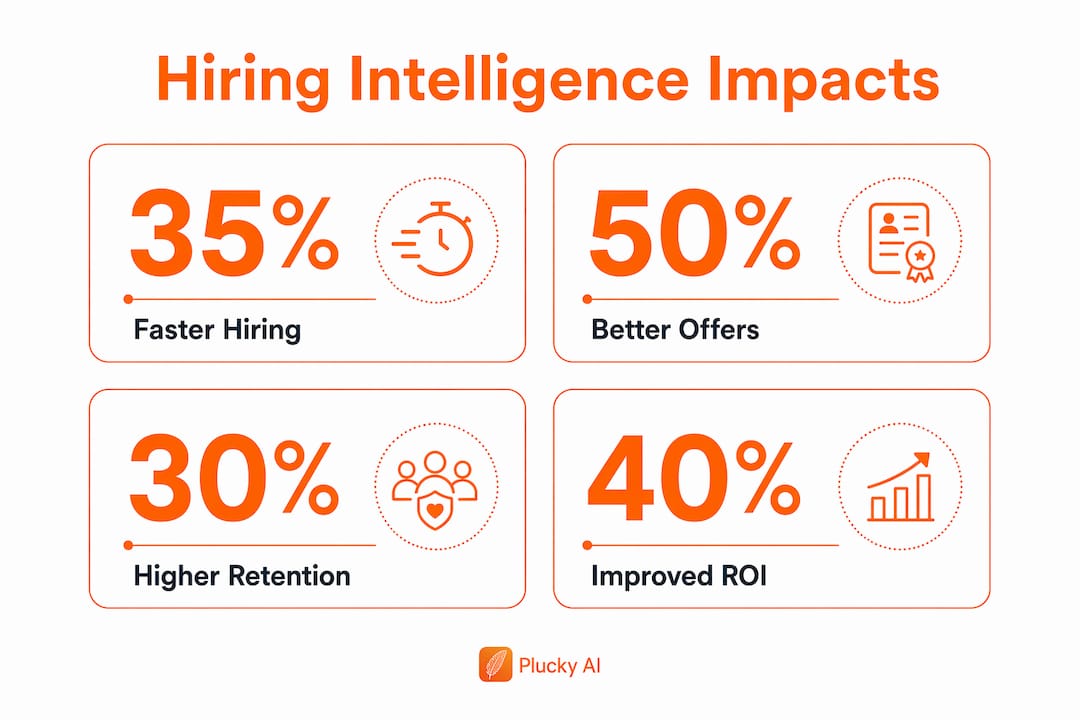
The practical gains from hiring manager intelligence show up across four measurable recruitment outcomes.
Faster time-to-hire. Pipeline bottleneck detection identifies where candidates stall. Hiring managers who act on those signals reduce the time between application and offer without sacrificing evaluation quality.
Higher interview-to-offer conversion. Ranked shortlists built on predictive fit scores mean hiring managers spend interview time on candidates who are genuinely qualified. Fewer interviews per hire is a direct cost reduction.
Improved retention rates. Linking competencies, interview evidence, and hiring outcomes into a feedback loop produces selection decisions grounded in evidence. Candidates hired against validated success criteria stay longer and perform better.
Better sourcing ROI. Sourcing channel scoring shows which pipelines produce the highest quality candidates. Hiring teams can reallocate budget from low-yield job boards to high-yield channels without waiting for an annual review.
| Outcome | Intelligence-Driven Mechanism |
|---|---|
| Faster time-to-hire | Bottleneck detection flags stalled pipeline stages |
| Higher conversion rate | Predictive shortlists reduce low-fit interviews |
| Improved retention | Outcome-correlated competency models improve selection |
| Better sourcing ROI | Channel scoring redirects budget to high-yield sources |
| Reduced evaluation bias | Standardized rubrics replace subjective impressions |
Key takeaways
Hiring manager intelligence is the most direct path from raw recruitment data to better selection decisions, but only when it is built on validated competency profiles and closed-loop outcome tracking.
| Point | Details |
|---|---|
| Define the intelligence type first | Clarify whether you need talent, interview, or hiring intelligence before selecting a platform. |
| Competency profiles drive accuracy | Build role success criteria before configuring any scoring model to avoid keyword-match errors. |
| ATS integration is non-negotiable | Real-time pipeline data is required for bottleneck detection and live candidate ranking. |
| Rubrics prevent bias replication | Validated, role-specific rubrics stop AI from amplifying existing interviewer inconsistencies. |
| Outcome feedback closes the loop | Tracking post-hire performance against predicted scores is what makes intelligence models improve over time. |
Why most hiring intelligence rollouts stall at the dashboard stage
I have watched organizations invest in intelligence platforms and then spend six months admiring the dashboards without changing a single hiring decision. The problem is almost never the technology. It is that no one defined what a good hire looks like before the platform went live.
The most common failure mode is treating intelligence as a reporting upgrade rather than a decision support system. A dashboard that shows you 47 candidates in the pipeline is not intelligence. Intelligence tells you which three of those 47 are worth your time and why. That distinction requires validated competency profiles, trained interviewers, and a feedback loop connecting predictions to outcomes.
The second failure mode is expecting the platform to replace manager judgment. It does not. What it does is give managers better evidence to act on. I have seen hiring managers override a high fit score because of something they observed in a final interview. That is exactly how it should work. The score narrows the field. The manager closes the decision.
The future of this space is tighter integration between labor market data and real-time candidate scoring. Hiring managers who understand how to read and challenge intelligence outputs will make better decisions than those who either ignore the data or follow it blindly. The skill is not learning the platform. The skill is knowing when the data is telling you something true.
— Diego
Pluckjobs brings hiring intelligence to IT and cybersecurity recruiting
Hiring manager intelligence works best when the underlying contact and role data is accurate and current. Pluckjobs combines Apollo contact intelligence with SerpAPI-powered role discovery to give IT and cybersecurity hiring teams precision candidate matches and direct hiring manager outreach data in one place.
Pluckjobs surfaces the right roles and the right people without requiring manual sourcing across disconnected tools. Tailored resumes, verified contact data, and AI-powered role matching work together so hiring managers spend time evaluating candidates, not finding them. Start with Pluckjobs to see how AI-driven recruitment intelligence applies directly to tech hiring workflows.
FAQ
What is hiring manager intelligence in simple terms?
Hiring manager intelligence is AI-driven decision support that uses recruitment data, including resumes, interview transcripts, and historical outcomes, to help hiring managers select better candidates faster.
How is hiring intelligence different from an ATS?
An ATS tracks workflow steps like application received and interview scheduled. Hiring intelligence predicts which candidates are most likely to succeed and identifies where the pipeline is losing qualified people.
What data does hiring manager intelligence use?
It draws from resumes, structured assessments, interview transcripts, historical hiring outcomes, and external labor market data to generate predictive fit scores and sourcing recommendations.
Can hiring intelligence reduce bias in recruitment?
Yes. Structured interview rubrics tied to validated role success criteria replace subjective impressions with comparable, auditable scores across all candidates.
How do you become a hiring manager who uses intelligence tools effectively?
Build validated competency profiles for each role, integrate your intelligence platform with your ATS, and track post-hire performance to close the feedback loop between predictions and actual outcomes. You can also review IT hiring workflows to understand where intelligence tools add the most value.