
TL;DR:
- A confidential job search involves actively seeking new employment without alerting your current employer or network. It requires careful device separation, controlled signals on platforms like LinkedIn, and discreet communication with recruiters to protect your reputation, income, and security. Using specialized tools that act as a buffer and managing references privately help ensure your search remains truly private.
A confidential job search means actively pursuing new employment while currently working, without alerting your employer, colleagues, or professional network. For IT and cybersecurity professionals, the stakes are higher than most: a leaked search can cost you project authority, damage vendor trust, trigger preemptive replacement, or complicate active security clearances. According to a 2023 YouGov and Bankrate survey, 56% of employed Americans are actively looking for a new job at any given time, so you are far from alone. The goal is controlling your career narrative, not hiding something shameful.
The core elements of a private job search:
- Personal devices only. Never use work laptops, phones, or WiFi.
- Private email and phone number separate from any employer domain.
- LinkedIn set to recruiter-only signals, not the public "Open to Work" frame.
- References curated from former managers, not your current supervisor.
- Interviews scheduled before 9 AM, at lunch, or after 5 PM. See the detailed guidance on how to schedule interviews discreetly to avoid alerts to your current employer.
Pro Tip: Resume files carry hidden metadata. Before sending any document, strip file properties in Microsoft Word (File → Info → Inspect Document) or export to PDF via a clean machine. Employer domain email addresses embedded in document headers are a common, easily overlooked leak.
Table of Contents
- Why confidentiality matters more in IT and cybersecurity
- Your confidential job search checklist, step by step
- How to harden your digital footprint
- How to work with recruiters while staying confidential
- When to go public: timing your transition
- AI-assisted tools and their privacy trade-offs
- Ready-to-use templates for a discreet search
- Key Takeaways
- The part most IT professionals get wrong about discretion
- Pluckjobs makes discreet job searching more precise
- Useful sources
- FAQ
Why confidentiality matters more in IT and cybersecurity
Confidentiality protects your authority, income, and security posture simultaneously. In most industries, a leaked job search is awkward. In IT and cybersecurity, it can be operationally damaging.

Security teams run on trust. If your employer learns you are looking, you may be quietly removed from sensitive projects, lose access to systems before you are ready to leave, or find your clearance renewal delayed. Small cybersecurity communities are tightly networked, and word travels faster than most professionals expect.
The financial risk is just as real. Losing your current role before a new offer is signed means losing income, benefits, and negotiating leverage. Maintaining confidentiality keeps you in the stronger position throughout the process.
Your confidential job search checklist, step by step
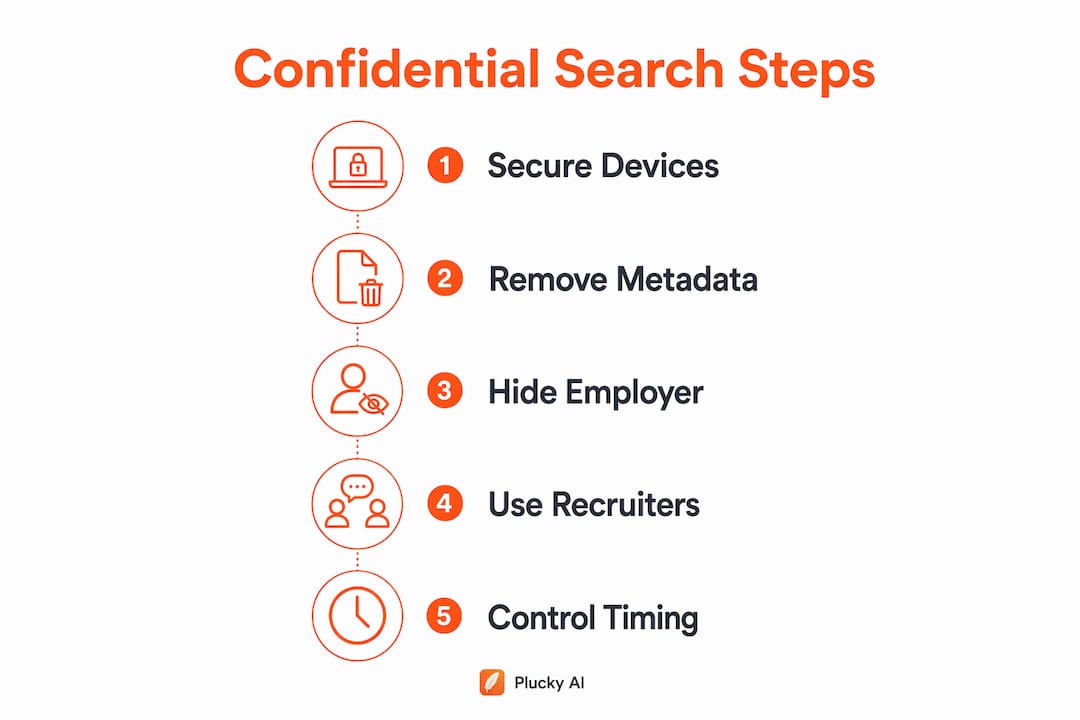
Follow this sequence to close the most common leak vectors before they cost you.
- Separate your devices. Use a personal laptop and personal phone for all search activity. Never use company hardware, even for a "quick" email.
- Create a dedicated search email. A Gmail or ProtonMail address with no employer affiliation. Use it exclusively for applications and recruiter contact.
- Switch to personal data. When searching at or near the office, use your phone's mobile data, not company WiFi.
- Schedule interviews off-hours. Request slots before 9 AM, at lunch, or after 5 PM. For final rounds, use a personal day rather than explaining your absence.
- Curate your reference list now. Former managers, trusted mentors, and long-term external clients only. Brief each one on confidentiality before you reach the offer stage.
- Prepare an anonymous resume version for public job boards and early-stage outreach (see Section 8 for the template).
Common leak vectors and quick mitigations:
| Leak vector | Risk | Mitigation |
|---|---|---|
| Work laptop / WiFi | Employer monitoring logs | Personal device + mobile data only |
| Corporate email | IT visibility | Dedicated personal or ProtonMail address |
| LinkedIn "Open to Work" | Visible to all, including employer | Recruiter-only setting |
| Resume metadata | Employer name in file properties | Strip metadata before sending |
| Current supervisor as reference | Direct disclosure | Former managers and external clients only |
Pro Tip: On your anonymous resume, replace employer names with descriptors ("Top-10 US financial services firm, 3,000 employees") and redact project code names entirely. Keep quantified achievements and technology stacks. Specificity about results, vagueness about identifiers.
How to harden your digital footprint
The most common leaks come from platform signals and resume metadata. Fix these first.
LinkedIn:
- Go to Settings & Privacy → Visibility → turn off "Share profile updates with your network."
- Enable the recruiter-only "Open to Work" signal. It is not foolproof against internal tooling that aggregates signals, but it is far safer than the public green frame.
- Browse company career pages in private mode or a separate browser profile.
- Block specific employers from seeing your profile under Job Seeking Preferences.
GitHub and public repositories:
- Audit commit messages and repo names for employer identifiers or project code names.
- Move sensitive work to private forks or sanitized repos before updating your profile.
Browser and tracking hygiene:
Browser fingerprinting and ad-tech tracking can link your activity across services. Frequent visits to a target company's careers page create detectable patterns, even from personal devices.
Pro Tip: Use a dedicated browser profile or an ephemeral session (Firefox containers, Chrome profiles, or a lightweight VM) exclusively for job-search activity. This isolates cookies, fingerprints, and browsing history from your everyday sessions.
How to work with recruiters while staying confidential
Reputable hiring managers expect confidentiality requests and will not contact your current employer until a signed offer is in hand. State your needs clearly at first contact.
Sample first-contact message:
Red flags to watch for:
- Recruiters who send your resume to clients without prior approval.
- Recruiters whose client list includes your current employer.
- Requests for your current supervisor's contact before an offer is made.
- Contingency recruiters who work high volume and share resumes widely.
For high-sensitivity searches, retained search firms or platforms with written nondisclosure protocols reduce leak risk significantly. Anonymous marketplaces let a recruiter or platform handle outreach entirely, keeping your identity invisible until you authorize contact. You can also request a written confidentiality commitment before sharing your full resume with any party.
When to go public: timing your transition
Go public only after a signed offer and a confirmed start date. If the role requires a background check, wait for clearance before giving notice.
Final-week timeline:
- Sign the offer letter and confirm the start date in writing.
- Confirm background check completion (if required).
- Schedule your resignation conversation with your manager.
- Prepare handover documentation for active projects.
- Notify HR and confirm earned benefits, PTO payout, and COBRA eligibility.
Keep negotiation entirely private. Do not reveal your timeline or competing offers to your current employer. Counter-offers rarely change the underlying reasons you searched.
Pro Tip: Tailor your handover notes to protect your professional reputation, not just to satisfy your employer. A clean exit preserves references and keeps bridges intact, especially in the tight-knit cybersecurity community.
AI-assisted tools and their privacy trade-offs
AI tools can reduce your direct footprint by automating outreach and limiting manual applications, but they introduce data-sharing trade-offs you must manage before uploading anything sensitive.
Privacy checklist for any AI job-search tool:
- What is the data retention policy? Can you request deletion?
- Who sees your profile and resume: the platform, third-party recruiters, or employer partners?
- Does the tool offer anonymous or recruiter-buffered outreach?
- Can you control which employers receive your materials?
Pluckjobs uses Apollo contact intelligence and SerpAPI-powered role discovery to surface precision matches and hiring-manager outreach data without requiring you to post publicly. That architecture functions as a buffer: you control which employers see your materials and when. Before uploading a resume to any AI platform, confirm its export and sharing controls explicitly and request deletion rights in writing.
Pro Tip: Ask any AI tool whether your resume data is used to train models or shared with partner employers by default. If the answer is unclear, treat it as a "yes" and redact sensitive identifiers before uploading.
Ready-to-use templates for a discreet search
LinkedIn settings checklist:
- Turn off "Share profile updates with your network."
- Enable recruiter-only "Open to Work" (not the public frame).
- Set profile visibility to "Public" for skills and headline only; hide current employer from non-connections if possible.
- Block your current employer's domain from seeing your profile under Job Seeking Preferences.
Recruiter first-contact script:
Confidential resume header:
Include: First name + last initial (or full name for direct recruiter sends), personal email, personal phone, LinkedIn URL, city and state only.
Omit: Current employer name, project code names, proprietary client names, and your work email address. For public board submissions, replace employer names with industry descriptors.
Key Takeaways
A confidential job search protects your income, authority, and negotiating leverage by controlling every signal your search produces, from device hygiene to recruiter scripts.
| Point | Details |
|---|---|
| Secure devices first | Use personal hardware and mobile data for all search activity; never use work equipment. |
| Fix LinkedIn before anything else | Switch to recruiter-only "Open to Work" and turn off profile update broadcasts. |
| Set recruiter expectations early | State confidentiality needs at first contact and request written nondisclosure for high-risk searches. |
| Manage references proactively | Brief former managers and external clients before you reach the offer stage; never list your current supervisor. |
| Pluckjobs as a discreet buffer | Pluckjobs automates role discovery and hiring-manager outreach so you control when and to whom your identity is revealed. |
The part most IT professionals get wrong about discretion
Most confidential search advice focuses on LinkedIn settings and device hygiene. Those matter. But the real failure mode in tech and cybersecurity searches is inconsistent signals, not a single obvious mistake.
A security engineer who quietly updates their GitHub profile, accepts a LinkedIn connection from a recruiter at a competitor, and then asks a current colleague for a reference has not made one big error. They have made three small ones that, together, form a readable pattern. Hiring managers in tech are often former practitioners who know exactly what that pattern looks like.
The discipline that actually works is treating your search like an operational security exercise: minimize surface area, compartmentalize information, and authorize disclosure deliberately. That means using platforms that act as a buffer, briefing references before they are contacted, and never letting urgency push you into shortcuts. The IT job search stealth playbook covers the full execution in detail.
Confidentiality is not about deception. It is about controlling your own career narrative until you are ready to make a move on your terms.
Pluckjobs makes discreet job searching more precise
Confidential searches are harder when you have to cold-apply publicly and hope no one notices. Pluckjobs is built for IT and cybersecurity professionals who need precision without exposure.
Pluckjobs combines Apollo contact intelligence with SerpAPI-powered role discovery to surface the right roles and the right hiring managers without requiring you to post your resume publicly or broadcast your availability. The platform handles outreach targeting, resume tailoring, and ATS alignment, so your footprint stays small while your reach stays wide. You control which employers see your materials and when. Before you start, confirm data retention and sharing settings in your account, and use an anonymized resume version for any outreach to employers where your current employer has existing relationships.
Start your confidential search with Pluckjobs and keep the process on your terms from day one.
Useful sources
- YouGov/Bankrate 2023 survey via AskCruit: Source for the 56% statistic on employed Americans actively job-seeking; also covers core confidential search definitions.
- Confidential.Careers blog: Practical guidance on device separation, reference management, and recruiter confidentiality requests.
- MyPersonalRecruiter confidential search guide: Covers retained search, anonymous marketplaces, and written nondisclosure protocols.
- Underdog.io blog: Technical detail on browser fingerprinting, cross-site tracking, and digital hygiene for employed job seekers.
- LeetHire anonymous job search guide: Step-by-step LinkedIn privacy settings and recruiter-only signal configuration.
- Indeed career advice: Broad guidance on scheduling, device hygiene, and discretion when searching while employed.
For platform-specific privacy settings, consult LinkedIn's official Help Center and GitHub's privacy documentation directly, as interface details change frequently.
FAQ
What is a confidential job search?
A confidential job search is the strategic process of actively seeking new employment while currently employed without alerting your employer, colleagues, or broader network to protect your reputation, income, and negotiating leverage.
Should I use the LinkedIn "Open to Work" feature during a discreet search?
Use the recruiter-only setting, not the public green frame. The public frame is visible to everyone, including your current employer. The recruiter-only signal is safer, though it is not guaranteed against all internal recruiting tools.
When should I tell my current employer I am leaving?
Only after you have a signed offer letter, a confirmed start date, and any required background check cleared. Giving notice before that point removes your leverage and income security.
How do I handle references without exposing my search?
Never list your current supervisor. Build a reference list from former managers, trusted mentors, and long-term external clients, and brief each one on confidentiality before they are contacted by a prospective employer.
Can AI job-search tools keep my search private?
They can reduce your public footprint by automating outreach and limiting direct applications, but you must verify each tool's data retention policy, sharing controls, and deletion rights before uploading sensitive materials. Pluckjobs is designed to act as a buffer, keeping your identity controlled until you authorize disclosure.