
Use implied first person on your resume: start every bullet with an action verb and drop pronouns like "I" or "my." Recruiters scan a resume in seconds, and career-advice sources agree implied first person keeps lines tight and results-focused. Explicit "I" statements waste space and read as filler to both humans and applicant tracking systems.
- Use implied first person: "Led a five-person QA team" not "I led a five-person QA team."
- Exception: brief resume summaries or senior-level storytelling lines may use a single deliberate "I," but treat it as rare.
- Fewer pronouns mean more room for keywords, metrics, and skills that actually get parsed.
Key Takeaways
Implied first person, verb-first bullets with pronouns removed, is the resume standard that improves both ATS parsing and recruiter skimming speed.
| Point | Details |
|---|---|
| Default to implied first person | Start bullets with action verbs and cut "I," "my," and "me" throughout the resume. |
| Reserve "I" for exceptions | Use it sparingly, if at all, in summaries or senior storytelling lines, never in bullets. |
| Follow a repeatable edit sequence | Remove pronouns, lead with a verb, fix tense, and add a metric to every line. |
| Keep voice consistent | Never mix explicit and implied first person within the same document. |
| Protect ATS readability | Short, verb-led bullets leave more room for job-specific keywords and clear section headers. |
Table of Contents
- What Does "Resume First Person" Actually Mean?
- When Is It Okay to Use "I" on a Resume?
- How to Rewrite Your Resume in Implied First Person
- Before and After: Real Resume Line Rewrites
- Writing a Resume Summary Without Overusing "I"
- How Voice Choice Affects ATS Scanning and Recruiter Skimming
- Common First-Person Mistakes and Fast Fixes
- Why This Rule Gets Oversimplified
- Sources
- FAQ
What Does "Resume First Person" Actually Mean?
Three voice styles show up on resumes, and only one belongs there.
Explicit first person spells out "I" or "my": "I managed a support desk of 12 technicians." It's grammatically correct and instinctively how most people write their first draft. It's also the style you should edit out before submitting.
Implied first person drops the pronoun but keeps the first-person verb form: "Managed a support desk of 12 technicians." The subject is understood, not stated. This is the format nearly every modern resume guide recommends, including Indeed's breakdown of resume voice.
Third person refers to yourself by name or as "the candidate": "Diego managed a support desk." This creates awkward distance and reads like a press release. Avoid it entirely.
- Explicit first person: grammatically fine, professionally weak
- Implied first person: the industry standard
- Third person: distancing, almost always wrong for a resume
When Is It Okay to Use "I" on a Resume?
Pronouns aren't banned everywhere in your job search, just off the resume bullet list. Cover letters and LinkedIn summaries are conversational documents; full "I" sentences fit there naturally because you're addressing a specific hiring manager directly.
Resume bullets are different. They're telegraphic by design, closer to headline writing than storytelling. A resume summary sits in the middle: it can use one complete sentence, but repeating "I" three times in four lines still reads as amateur.
Senior leaders and founders sometimes use a single first-person line deliberately, often in a summary, to signal ownership: "I built and scaled a security operations team from 2 to 20 analysts." That works once, as a stylistic flourish. Use it twice in the same document and it stops feeling deliberate and starts feeling like you forgot to edit.
- Cover letters and bios: full "I" sentences are appropriate.
- Resume bullets: implied first person only.
- Resume summary: one sentence is fine; avoid stacking multiple "I" statements.
- Executive storytelling lines: a single, sparing "I" can work; more than that undercuts the effect.
Pro Tip: If you're debating whether an "I" earns its place, read the line out loud. If cutting the pronoun changes nothing about the meaning, cut it.
How to Rewrite Your Resume in Implied First Person
Editing into implied first person is mechanical once you know the pattern. Work through your resume line by line using this sequence:
- Delete the pronoun. Cross out every "I," "my," and "me" at the start of a bullet.
- Lead with a strong action verb. Replace what's left with a verb like "led," "built," "reduced," or "automated."
- Fix the tense. Use present tense for your current role ("Manages a team of six") and past tense for every previous role ("Managed a team of six").
- Add a number. Wherever possible, attach a metric: percentage improved, dollars saved, tickets closed, systems migrated.
- Cut duty language. Replace "responsible for" or "helped with" with what you actually did and what changed because of it.
Resume makes the same point: pronoun-free bullets that open with action verbs read faster and land harder with recruiters skimming a stack of applications.
- One verb, one accomplishment, one number per bullet where possible.
- Never mix tenses within the same job entry.
- Keep bullets to one line whenever you can; two lines only for high-impact achievements.
- Front-load the verb, not the context ("Reduced downtime by 40%," not "By automating deployment scripts, downtime was reduced").
A resume built this way isn't just easier to read. It's also easier for an applicant tracking system to parse, since ATS software matches keywords and phrasing patterns far more reliably in short, structured lines than in dense prose.
Before and After: Real Resume Line Rewrites
Seeing the edit in action makes the pattern stick faster than any rule does. Here are five common lines, rewritten:
- Before: "I was responsible for managing a helpdesk team of eight technicians." After: "Managed a helpdesk team of eight technicians, cutting average ticket resolution time by 30%."
- Before: "I helped implement a new cybersecurity monitoring system." After: "Implemented a cybersecurity monitoring system that flagged 200+ threats in the first quarter."
- Before: "Responsible for cloud infrastructure and server maintenance." After: "Maintains cloud infrastructure across 40+ servers with 99.9% uptime."
- Before: "I am an IT professional who works well under pressure and enjoys solving problems." After: "IT support specialist with 5 years resolving network and security issues under tight SLAs."
- Before: "Assisted with the migration of legacy systems to AWS." After: "Led migration of three legacy systems to AWS, reducing infrastructure costs by 22%."
Every rewrite follows the same formula: cut the pronoun, lead with a stronger verb, and attach a number wherever the original made a vague claim.
The pattern holds whether you're an entry-level candidate or ten years into a security career. What changes is the scale of the metric, not the sentence structure.
Writing a Resume Summary Without Overusing "I"
Your resume summary is the one spot where a full sentence is acceptable, but it still shouldn't sound like a diary entry. One sentence, maybe two, and no more than a single implied or explicit "I" total.

Weak summary: "I am a dedicated IT professional who is passionate about cybersecurity and always looking to grow my skills."
Strong summary: "Cybersecurity analyst with 4 years of experience in threat detection, incident response, and SIEM management across finance and healthcare sectors."
The strong version drops the pronoun entirely and replaces vague enthusiasm with specific, scannable credentials. For a deeper walkthrough of IT-specific summary formats, Pluckjobs' guide on writing an IT resume summary that gets read breaks down header structure by role and experience level.
- One sentence, one clear identity statement, zero repeated pronouns.
- Lead with your role title and years of experience, not your personality traits.
- Save soft skills for the interview, not the summary line.
How Voice Choice Affects ATS Scanning and Recruiter Skimming
Voice isn't just a style preference. It directly affects how much useful information fits on the page and how cleanly an ATS parses it.
Verb-first bullets help both systems at once: applicant tracking software matches job-specific keywords more reliably against short, structured phrases, and human recruiters skim faster when every line starts with the same predictable pattern (verb, task, result). Every pronoun you cut is space you can spend on a keyword, a tool name, or a metric instead.
- Start every bullet with a verb, never with "I," "the," or "responsible for."
- Keep tense consistent across each job entry: present for current, past for prior roles.
- Use clear section headers ("Experience," "Skills," "Certifications") so ATS software categorizes content correctly.
- Mirror keywords from the job posting in your skills section, since customizing language per posting improves keyword match rate.
Common First-Person Mistakes and Fast Fixes
Most resume voice problems come down to four repeatable errors. Fix these and the rest of the document usually falls into line.
- Mixed voice. Some bullets start with "I," others are implied first person. Pick implied first person and apply it to every line.
- Weak verbs. "Helped," "assisted," and "worked on" undersell your role. Swap them for "led," "built," "implemented," or "resolved."
- Duty language instead of impact. "Responsible for network security" says nothing about results. Add what changed: "Reduced security incidents by 35% through updated firewall policies."
- Overwritten bullets. If a line takes more than two seconds to read, cut it down to the verb, the task, and the number.
For a categorized list of stronger verbs by function, NueCareer's action verb tool is a quick reference worth bookmarking.
Pro Tip: Read your resume out loud. Any bullet that sounds like you're narrating a job description instead of stating an achievement needs a rewrite.
Where This Guidance Comes From
Diego covers resume mechanics and job search strategy for IT and cybersecurity candidates, including related breakdowns on writing a resume as a teenager entering IT and on how AI tailors resumes to specific job postings. Pluckjobs' Plucky AI platform applies these same implied first-person and ATS-alignment rules automatically when generating tailored resumes for IT and cybersecurity roles, pairing rewrites with hiring manager contact data so the resume and the outreach work together.
Why This Rule Gets Oversimplified
Most resume advice treats "avoid first person" as an absolute rule, and that's where it goes wrong. The real skill isn't memorizing "never use I." It's understanding that implied first person is a readability tool, not a grammar law, which means the rare exception (a founder's summary line, a career-change narrative) deserves judgment, not panic.
Where conventional advice falls short is in the follow-through. Plenty of guides tell you to cut pronouns, then leave you to figure out tense consistency, metric placement, and keyword density on your own. Voice is only half the edit. A resume full of pronoun-free bullets that still says "responsible for network maintenance" hasn't actually improved.
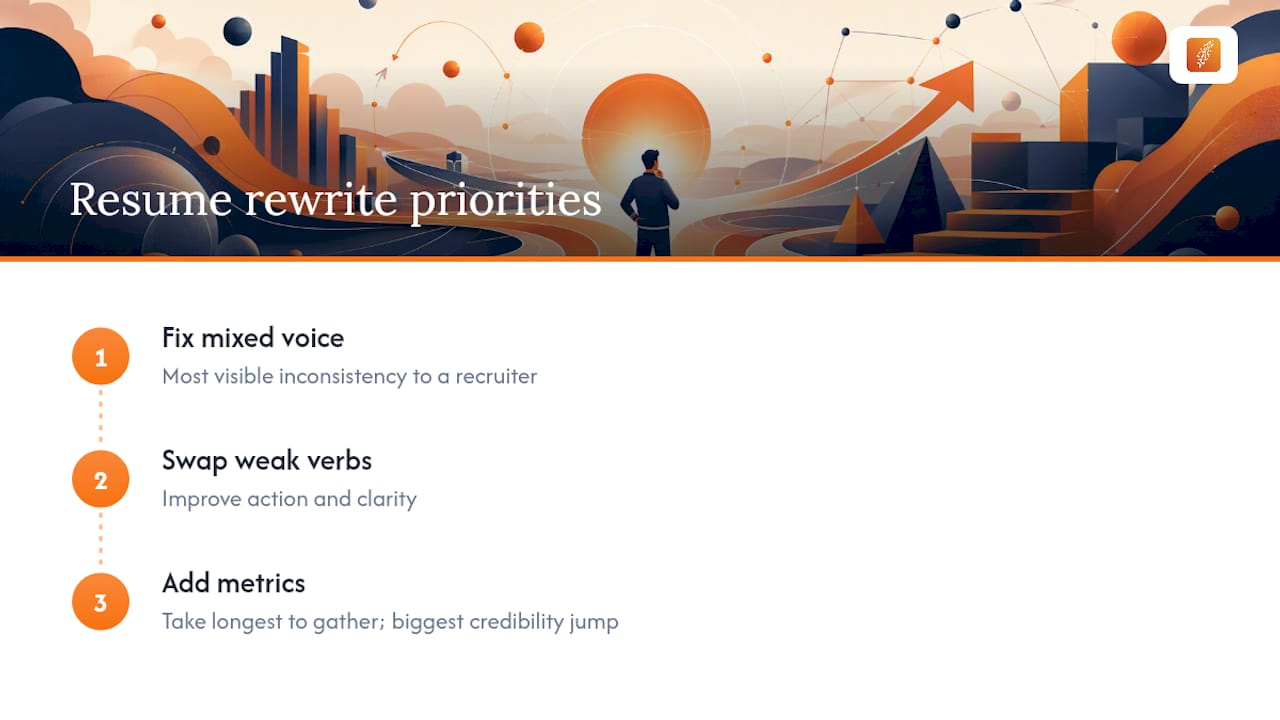
If you're rewriting your own resume this week, prioritize in this order: fix mixed voice first, since it's the most visible inconsistency to a recruiter. Then swap weak verbs. Metrics come last, because they take the longest to gather but deliver the biggest jump in credibility. Do all three, and the pronoun question mostly answers itself.
Sources
FAQ
Is It Okay to Write a Resume in First Person?
Explicit first person ("I," "my") is technically acceptable but discouraged. Implied first person, where you drop the pronoun and keep the action-verb structure, is the recommended standard.
Are Resumes Supposed to Be in First Person?
Resumes use implied first person by convention: bullets read as if "I" precedes them, but the pronoun itself is omitted. This keeps language concise and avoids repetition across a full page of bullets.
What Is the 7 Second Rule for Resumes?
It refers to the idea that recruiters form an initial impression of a resume within seconds of scanning it, which is why verb-first, pronoun-free bullets matter for quick readability. Exact timing varies by source, but the takeaway is consistent: front-load your strongest, clearest information.
Do You Write a Resume in Third Person?
No. Third person, referring to yourself by name or as "the candidate," creates unnecessary distance and reads unnaturally. Stick to implied first person throughout your resume.