
TL;DR:
- A targeted hybrid resume emphasizes relevant skills and projects above work history to aid career changers. It begins with an explicit target role and aligned proof points, then highlights skills from target job descriptions. Focusing on measurable achievements and recent certifications increases the resume's effectiveness for recruiters and ATS systems.
Use a targeted hybrid (combination) resume that names your target role in a 2–4 line summary, leads with a prioritized skills block, and places relevant projects above your dated work history. That structure does more for a career-change application than any other single formatting decision.
Three elements to fix before anything else:
- Targeted summary: Open with the exact job title you want, then list 2–3 transferable proof points. Avoid "seeking to transition" or "aspiring" phrasing entirely.
- Skills section organized by the new field's categories: Mirror the exact terminology from three to five live job postings, not your own vocabulary from the old role.
- Relevant Experience / Projects block above chronological history: When your recent practice is more relevant than your job title, front-load that proof so recruiters see it first.
One line you can copy right now: write a brief summary that opens with the target role title, names two relevant proof points from your history, and closes with what you'll deliver next. Then add a skills header using the exact wording pulled from three target postings.
Table of Contents
- What resume format works best for a career pivot?
- How do you write a professional summary that sells the pivot?
- How do you build a skills section that recruiters and ATS actually read?
- How do you reframe old experience into transferable achievements?
- What projects, certifications, and volunteer work belong on a career-change resume?
- How do you tailor your resume for ATS and the specific job posting?
- Three career-change resume templates you can use right now
- Common mistakes that disqualify career-change resumes
- What does the research say about high-impact career-change resumes?
- Key Takeaways
- The part of career-change resumes most guides get wrong
- Pluckjobs gives IT and cybersecurity career changers a faster path to the right role
- Useful sources and next steps
- FAQ
What resume format works best for a career pivot?
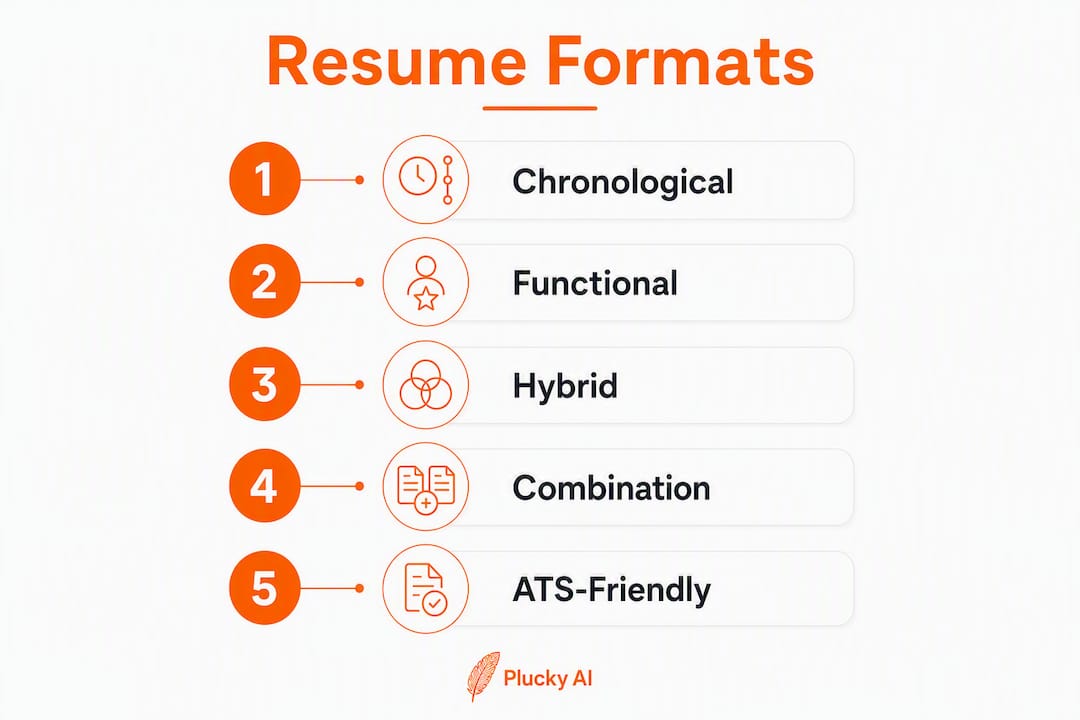
The hybrid (combination) resume wins for career changers because it front-loads relevance. Your skills and summary appear before your job titles, which means a recruiter scanning the top portion of your resume sees what you can do, not where you used to work. The hybrid format pairs a targeted summary and prioritized skills block with a reverse-chronological work history below, so ATS systems still parse your experience in the expected order.
Recommended section order for career changers
- Contact information (name, phone, email, LinkedIn, portfolio/GitHub if relevant)
- Professional summary (2–4 lines)
- Skills (grouped by category, mirroring the target field)
- Relevant Experience / Projects (bootcamp work, freelance, volunteer, or side projects)
- Work Experience (reverse-chronological)
- Education and certifications
- Additional information (languages, clearances, professional memberships)
Place the Relevant Projects block immediately after Skills when your most convincing proof of readiness comes from outside your formal job history. For older roles that predate your pivot by more than ten years, trim them to a single line or drop them entirely. Use a one-page resume for recent graduates or those with limited experience; professionals with extensive history may use a longer resume.
Formatting specs that matter for ATS and humans
| Element | Recommended spec |
|---|---|
| Layout | Single-column only |
| Font | Calibri, Arial, or Helvetica |
| Body text size | 10pt |
| Name size | 14pt |
| Margins | 0.5 inch |
| File format | PDF (unless DOCX is requested) |
| Date format | Consistent throughout (e.g., Month Year – Month Year) |
Avoid text boxes, columns, icons, and tables inside the resume itself. ATS platforms like Workday, Greenhouse, and Lever parse files as raw text from top to bottom. Anything inside a text box or a multi-column layout can be skipped entirely.
Pro Tip: Keep one master resume per target role. When you apply to a specific posting, spend 10–15 minutes swapping bullets, reordering skills, and adjusting summary keywords to match. Never send the master version directly.
How do you write a professional summary that sells the pivot?
A strong career-change summary does one job: convince a recruiter in four lines that you are already thinking like someone in the new role. The formula is straightforward.
Summary formula: Target role title + relevant level or tools + 2–3 transferable proof points (quantified where possible) + what you will deliver next.
Three sample summaries for common pivot scenarios:
-
Mid-career pivot (operations manager to IT project manager): "IT Project Manager with 8 years managing cross-functional teams and $4M+ operational budgets. PMP-certified; completed AWS Cloud Practitioner training in 2025. Reduced process cycle time 22% at [Company] by redesigning workflow tracking. Seeking to apply delivery discipline and stakeholder management to enterprise cloud migrations."
-
Technical bootcamp graduate (marketing to cybersecurity analyst): "Cybersecurity Analyst with a CompTIA Security+ certification and 500+ hours of hands-on lab work in network monitoring and threat detection. Former digital marketing manager with 6 years of data analysis and client reporting. Built a home SOC lab using Splunk and Wireshark; documented findings on GitHub. Ready to bring analytical rigor and communication skills to a SOC team."
-
Manager to individual contributor (engineering manager to senior software engineer): "Senior Software Engineer with 10 years of full-stack development experience and 4 years leading engineering teams of 8–12. Stepped back into IC work by contributing to three open-source Python projects in 2025. Comfortable in both collaborative and independent delivery modes."
Dos: Name the target role in line one. Quantify at least one proof point. Use the field's own vocabulary.
Don'ts: Never open with "I am seeking," "aspiring," or "looking to transition." These phrases signal uncertainty to a recruiter who is already skeptical about a non-traditional background. If you need to briefly explain the pivot, add one sentence at the end of the summary: "Pivoting from [field] to [field] to apply [specific skill] to [specific outcome]." Save the fuller narrative for your cover letter.
How do you build a skills section that recruiters and ATS actually read?
Pull three to five live job postings for your target role and highlight every repeated tool, phrase, and competency. Those repeated terms are your keyword map. Recruiters and ATS platforms increasingly treat skills and tools as primary signals, so matching their exact phrasing matters more than paraphrasing.

Group your skills under category headings that reflect the new field's structure. For a cybersecurity pivot, that might look like:
Security Tools & Platforms: Splunk, Wireshark, Nessus, CrowdStrike
Frameworks & Standards: NIST CSF, ISO 27001, MITRE ATT&CK
Stakeholder Communication: Executive reporting, incident briefings, cross-team coordination
Data & Analytics: SQL, Python scripting, log analysis, SIEM dashboards
Use multiple relevant entries per skill category. Use exact phrasing from postings. Skip proficiency levels unless requested, as they can clutter the resume.
The keyword hack that actually works: copy the job description into a text editor, remove filler words, and look at what's left. The nouns and verb phrases that repeat across three or more postings are the ones your resume must contain, in those exact words, in your summary, skills section, and bullets.
How do you reframe old experience into transferable achievements?
Every bullet in your Work Experience section should answer one question for the hiring manager: "How does this apply to the role I'm filling?" Listing responsibilities does not answer that question. Quantified outcomes do.

The compact CAR template for a single-line bullet: Context (brief) → Action (specific) → Result (metric or scale).
Three before/after rewrites:
Example 1 — Operations to IT Project Management
- Before: "Managed daily operations for a 40-person customer service team."
- After: "Reduced average ticket resolution time 31% by redesigning escalation workflows for a 40-person support team, using Jira to track SLA compliance."
Example 2 — Marketing to Data Analytics
- Before: "Created monthly reports for the marketing department."
- After: "Built automated reporting dashboards in Google Looker Studio that cut monthly reporting time from 12 hours to 90 minutes, covering $2.3M in campaign spend."
Example 3 — Finance to Cybersecurity
- Before: "Ensured compliance with internal audit requirements."
- After: "Led SOX compliance audits across 6 business units, identifying 14 control gaps and reducing audit findings by 40% year-over-year."
Rewriting past duties in outcome language converts generic tasks into industry-agnostic business outcomes that hiring managers in any field recognize. The metric does not need to be dramatic. A percentage, a dollar figure, a time saved, or a scale (team size, number of accounts) all work.
For older or unrelated roles, trim bullets to one or two lines and focus only on skills that transfer. A role from 12 years ago in a completely different industry needs at most two lines. If a job adds nothing to the target narrative, remove it entirely.
What projects, certifications, and volunteer work belong on a career-change resume?
Non-employment proof often carries more weight than an old job title for a career changer. Recent credentials placed high on the resume signal commitment to the pivot and demonstrate practical capability, not just intent.
Format each project entry as a mini-achievement:
Project name | Your role | Date range What you built or did • outcome or metric • tools and skills used
Example: Home SOC Lab | Solo Project | Aug 2025 – Present Deployed Splunk SIEM on a virtual network to detect simulated intrusion events • identified and documented 12 attack patterns using MITRE ATT&CK framework • tools: Splunk, Wireshark, VirtualBox, Kali Linux
Place certifications near the top of the resume when they are recent and directly relevant. A CompTIA Security+, AWS Solutions Architect, or Google Data Analytics certificate earned in the past 12 months belongs just below your summary, not buried under five years of unrelated work history. If you are still in progress, list it as "CompTIA CySA+ (expected March 2026)" rather than omitting it.
For portfolio links, GitHub repositories, or project demos, include the URL in your contact line and reference it in the relevant project bullet. Keep the URL short and clean. A recruiter who sees "github.com/yourname/soc-lab-project" in a bullet knows exactly where to look.
Transparency about gaps plus visible recent learning often reassures hiring managers more than an unrelated job title does. A six-month gap that includes a bootcamp, a certification, and a GitHub project tells a cleaner story than a gap with nothing attached.
How do you tailor your resume for ATS and the specific job posting?
The two-tier customization system keeps tailoring fast without starting from scratch each time.
Tier 1 — Master resume per target role: Build one strong base resume for each role type you're targeting (e.g., one for SOC Analyst, one for IT Project Manager). This version contains your best bullets, your full skills inventory, and two or three summary variations.
Tier 2 — Per-posting tailoring (10–15 minutes): For each application, make these targeted adjustments:
- Swap the summary to match the posting's exact title and top two requirements
- Reorder skills so the most relevant category appears first
- Replace one or two bullets with examples that match the posting's specific language
- Check that the job title in your summary matches the posting's title character-for-character
ATS checklist before you send:
- Single-column layout, no text boxes, no icons
- Consistent date formatting throughout (Month Year – Month Year)
- File saved as PDF (unless the application portal requests DOCX)
- No headers or footers containing critical information (ATS often skips them)
- Job title in summary matches the posting title
- Top three keywords from the posting appear in summary, skills, and at least one bullet
- LinkedIn headline matches the resume title
Customizing your resume per job posting does not mean rewriting from scratch. It means making the right 10–15 minutes of targeted changes so the first third of your resume mirrors what the posting is asking for.
Three career-change resume templates you can use right now
Template 1: Skills-first hybrid (best for technical bootcamp to IT/cybersecurity)
Section order: Contact → Summary (3 lines) → Certifications → Skills (3 categories, 6–8 entries each) → Relevant Projects (2–3 entries) → Work Experience (reverse-chronological, trimmed bullets) → Education
Best for: Career changers with recent technical credentials but limited formal IT job history. The certifications and projects do the heavy lifting before the recruiter reaches the work history.
Template 2: Project-forward hybrid (best for adjacent-industry pivot)
Section order: Contact → Summary (2–3 lines) → Skills (2 categories) → Relevant Experience (freelance, contract, or volunteer work in the new field) → Work Experience → Education → Certifications
Best for: Professionals who have already done some work in the target field (freelance, consulting, volunteer) but whose official job titles don't reflect it. The Relevant Experience block surfaces that work before the chronological history.
Template 3: Leadership-to-individual-contributor hybrid (best for manager to IC pivot)
Section order: Contact → Summary (3–4 lines, emphasizing hands-on technical contributions) → Skills (technical skills first, then leadership) → Work Experience (rewritten to emphasize IC contributions over team management) → Projects → Education
Best for: Managers returning to hands-on technical work. The summary explicitly addresses the IC intent; the skills section leads with technical tools rather than management competencies.
Before/after rewrites (three examples):
| Before | After |
|---|---|
| "Responsible for team training and onboarding." | "Designed onboarding program for 18 engineers, cutting ramp-up time from 6 weeks to 3 weeks." |
| "Worked with vendors on software procurement." | "Negotiated SaaS contracts with 4 vendors, reducing annual software spend by $180K." |
| "Helped with data migration project." | "Contributed to cloud data migration moving 2TB of legacy records to AWS S3; wrote Python scripts to validate data integrity post-transfer." |
Template comparison table:
| Pivot situation | Best template | Key section to prioritize |
|---|---|---|
| Bootcamp graduate → SOC Analyst | Skills-first hybrid | Certifications + Projects |
| Marketing manager → Data Analyst | Project-forward hybrid | Relevant Experience |
| IT Manager → Senior Engineer | Leadership-to-IC hybrid | Technical skills + IC project bullets |
| Finance → Cybersecurity | Skills-first hybrid | Certifications + compliance-related bullets |
| Operations → IT Project Manager | Project-forward hybrid | Relevant Experience + PMP/Agile credentials |
Common mistakes that disqualify career-change resumes
The most damaging errors are not typos. They are structural choices that signal to a recruiter that you haven't done the work of translating your background.
Red flags that get resumes rejected:
- Apologetic language ("hoping to break into," "no formal experience but") in the summary
- Skill-stuffing without proof points: listing 30 skills with no evidence of applying them
- Multi-column layouts that break ATS parsing
- A summary that names your old role instead of your target role
- No evidence of recent practice in the new field (no projects, no certs, no coursework)
- Mismatched titles between LinkedIn and the resume
Pre-send checklist:
- Summary opens with the target role title
- At least 2–3 transferable proof points are present in the summary
- Skills section mirrors the exact wording from the target job posting
- At least one bullet in Work Experience contains a quantified outcome
- File is a single-column PDF
- LinkedIn headline matches the resume title
- No text boxes, columns, or icons in the layout
- Dates are formatted consistently throughout
For employment gaps, one sentence on the resume is enough: "Career break: completed [Certification] and built [Project], [Date]." The fuller explanation belongs in your cover letter or the interview. Recruiters understand gaps; what they want to see is that the time was used intentionally.
What does the research say about high-impact career-change resumes?
The evidence on what actually works for career changers points in one direction: specificity beats volume.
Recruiters scan resumes quickly, leading with measurable results and then adding brief context consistently outperforms listing responsibilities. A bullet that opens with "Reduced onboarding time 40%" gets read. A bullet that opens with "Responsible for onboarding" gets skipped.
The single most common trap career changers fall into is skill-stuffing. Recruiters prefer a few transferable proof points with measurable outcomes over long duty lists. Pair each target skill with one concrete example of applying it to achieve a result that maps to the new role's needs.
The 2–4 line summary naming the target role with 2–3 proof points is the highest-impact framing for switchers because it answers the recruiter's first question ("Why are you applying for this?") before they have to ask it. A summary that leads with your old title forces the recruiter to do interpretive work. One that leads with "Cybersecurity Analyst" or "IT Project Manager" removes that friction immediately.
On ATS behavior: single-column PDFs preserve the top-to-bottom parsing order that platforms like Workday, Greenhouse, and Lever depend on. Multi-column layouts, text boxes, and icons commonly cause content to be skipped or reordered. This is not a minor formatting preference; it is the difference between your resume being read and being discarded before a human sees it.
Exercise to build your proof points: Pull three job postings for your target role. Highlight every skill or tool that appears in at least two of the three. For each repeated skill, write one bullet from your history that shows you applied it: "Used [skill] to [action] → [result]." Two or three of these bullets, placed in your summary and Work Experience section, do more work than a skills list of 25 items.
For IT and cybersecurity pivots specifically, the IT job application checklist from Pluckjobs covers the full pre-submission workflow, including ATS validation and keyword alignment steps.
Key Takeaways
A career-change resume works when it leads with transferable proof, names the target role explicitly, and mirrors the exact language of the job posting throughout.
| Point | Details |
|---|---|
| Use a hybrid format | Place skills and summary above work history so relevance appears before job titles. |
| Name the target role in line one | Open your summary with the exact job title from the posting, not your current or previous title. |
| Pair every skill with a proof point | One quantified example per key skill beats a list of 30 unsubstantiated competencies. |
| Front-load recent credentials | Certifications and projects earned in the past 12 months belong near the top, not buried below old roles. |
| Pluckjobs for IT/cybersecurity pivots | Pluckjobs provides AI resume optimization, ATS keyword alignment, and hiring manager outreach for professionals making technical career transitions. |
The part of career-change resumes most guides get wrong
Most career-change resume advice focuses on format. Use the hybrid layout, put skills first, write a strong summary. That advice is correct, but it misses the harder problem: most career changers undersell their proof and oversell their intent.
The instinct when pivoting is to explain yourself. To write a summary that says "I'm passionate about cybersecurity and eager to apply my background in finance to a new challenge." That sentence tells a recruiter nothing they can act on. It signals that you are asking them to take a risk on you rather than showing them why the risk is already resolved.
The resumes that actually move forward in a career-change application do the opposite. They treat the pivot as already complete. The summary reads like someone who is already in the new role, not someone hoping to enter it. The bullets show outcomes that would matter to a hiring manager in the target field, regardless of where they were achieved. The projects section shows recent, hands-on practice that removes the "but do you actually know this field?" objection before it forms.
The cover letter is where you explain the why. The resume is where you prove the what. Keeping those two jobs separate, and doing each one fully, is what separates the career-change resumes that get interviews from the ones that get polite rejections.
For IT and cybersecurity switchers specifically, the bar for proof is higher than in most fields. A hiring manager filling a SOC Analyst role wants to see lab work, certifications, and documented technical output. A GitHub profile with three projects and a CompTIA Security+ earned six months ago tells a cleaner story than five years of adjacent work with no technical artifacts attached.
Pluckjobs gives IT and cybersecurity career changers a faster path to the right role
Writing a strong career-change resume is step one. Getting it in front of the right hiring manager, with the right keywords, at the right company, is where most professionals stall.
Pluckjobs combines AI resume optimization with ATS keyword alignment and direct hiring manager outreach data, built specifically for IT and cybersecurity professionals. The platform pulls live job postings via SerpAPI, surfaces the exact roles matching your target title, and provides the contact intelligence to reach the person making the hiring decision, not just the applicant tracking system.
For career changers, that means your tailored resume reaches a named hiring manager at a company actively hiring for your target role, not a cold application portal. The credit-based model includes a free trial, so you can test the workflow before committing to a plan. Pluckjobs serves IT and cybersecurity professionals who are serious about making the transition efficiently, with AI-powered tools and human expert input available throughout the process.
Start your free trial at Pluckjobs and see which roles match your target profile today.
Useful sources and next steps
The following resources were used as evidence throughout this guide and are worth bookmarking for your own resume work:
- How to Write a Career Change Resume (Wharton Online) — Wharton's practical framework for front-loading relevant proof
- Career Change Resume (Excelsior OWL) — Writing lab guidance on career-change resume structure
- How to Write a Career Change Resume (SNHU) — Examples and tips from SNHU's career center
Your next three steps: Pull three live job postings for your target role. Build one master resume using the hybrid format above. Create one tailored copy and submit it within 48 hours. Speed matters; a resume that is 90% perfect and submitted today beats a perfect one submitted next week.
For hands-on help with AI resume tailoring, ATS alignment, and hiring manager outreach, visit Pluckjobs.
FAQ
What is the best resume format for a career change?
The hybrid (combination) format is the strongest choice for career changers. It places your skills and professional summary above your work history, so recruiters see your transferable capabilities before they see your job titles.
How do you explain a career change on a resume?
Open your summary with the target job title and list 2–3 transferable proof points. Add one sentence explaining the pivot if needed, and save the fuller narrative for your cover letter.
What is the 7-second rule for resumes?
Recruiters typically spend only a few seconds on an initial scan, which is why the top third of your resume must immediately show your target role, key skills, and at least one quantified result.
What are the top resume mistakes career changers make?
The five most damaging errors are: apologetic language in the summary, skill-stuffing without proof points, multi-column layouts that break ATS parsing, a summary that names the old role instead of the target role, and no evidence of recent practice in the new field.
How long should a career-change resume be?
One page for professionals with fewer than five years of experience; two pages for those with extensive work history. Trim older or unrelated roles to one or two lines to stay within that limit.