
Your resume summary is the first thing a recruiter sees, and eye-tracking research shows they spend a brief moment scanning the top third of a page. That is your entire window. A strong IT resume summary tells a recruiter your title, your best result, and why you fit the role before they consciously decide to keep reading.
What is a resume summary and why does it matter?
A resume summary is a 3–4 line professional snapshot placed at the very top of your resume, above your work history. Think of it as a distilled preview of your full experience section, pulling your strongest facts into one tight statement. For IT professionals, it is often the difference between passing an ATS scan and getting filtered out before a human ever sees your name.
A well-built summary contains four core elements:
- Your job title. State the exact title you hold or are targeting. If it matches the posting, you have answered the recruiter's first question instantly.
- Years of experience. Two facts about scope and context, not a biography.
- A quantified achievement. One number that proves your identity claim: cost reduced, uptime improved, systems deployed, team size led.
- A value statement. One closing line connecting your background to the role, which is also your tailoring slot per application.
Summaries that skip the number and lead with adjectives give recruiters nothing to catch on. The scan moves on. Keep the whole statement to 40–60 words; anything longer tends to get skipped entirely. Eye-tracking data confirms recruiters spend about 7 seconds scanning the page top, so concise summaries are critical.
How to write an effective IT resume summary

The most common mistake is writing the summary first. Write the rest of your resume first. The summary is a distillation, and you cannot distill what does not exist yet. Finish your experience bullets, then come back with your three strongest facts already identified.
Follow this process:
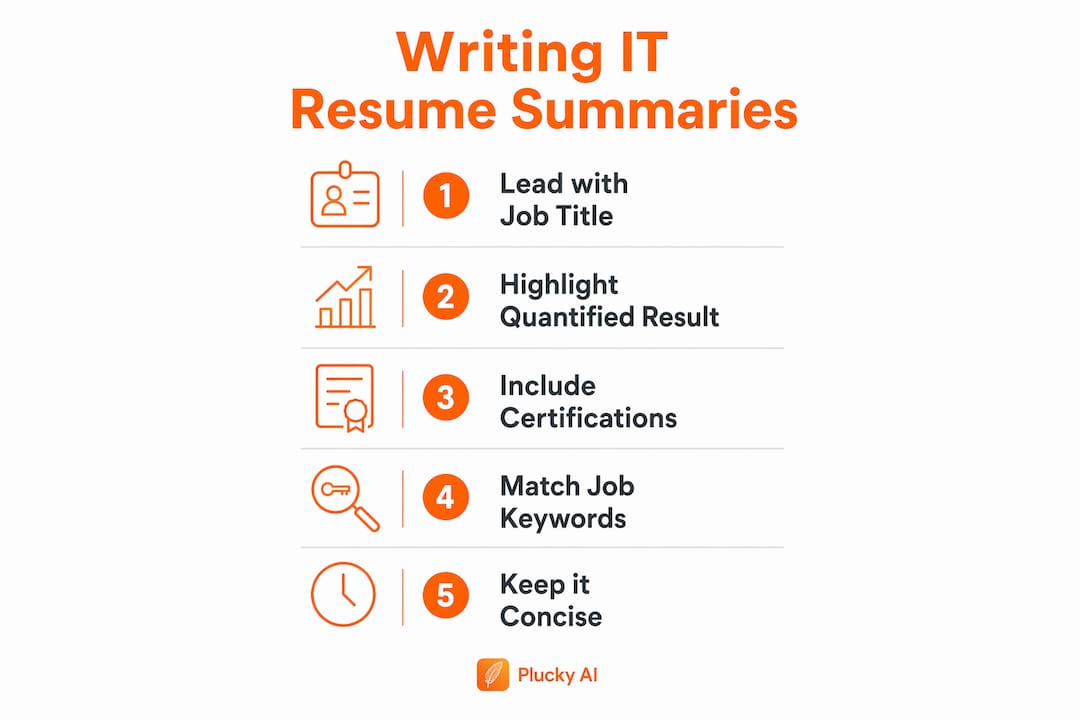
- Pull your top three facts. Scan your finished bullets and pick the biggest number, your most relevant credential or certification, and your clearest scope indicator (team size, budget, system scale).
- Draft four short lines. Identity, outcome, scope, direction, in that order. Do not polish yet.
- Match the job title. Use the exact title from the posting in your opening line. ATS systems place the highest keyword weight on the first 10 words of a summary statement.
- Cut every adjective. Read it aloud. If a line could appear on any other IT professional's resume in your field, it is not done yet.
- Write in implied third person. Start sentences with strong action verbs and avoid "I" or "my." This keeps the tone authoritative and focused on results.
- Rewrite the closing line per application. Your identity, outcome, and scope stay mostly stable. The directional close is your tailoring slot. Five minutes of work per application, and it is the highest-return adjustment you can make.
Pro Tip: Front-load your single strongest quantified result on line one. Recruiters scan for a title match and a number. If line one delivers both, they read the rest. If line one is generic, lines two through four rarely get a chance.
Best practices that separate strong summaries from weak ones
The most common failure mode is vague adjectives. Phrases like "results-driven," "dynamic," or "passionate professional" appear on millions of resumes and carry zero information. Removing generic filler tightens your summary and improves ATS keyword density at the same time.
Do:
- Tailor the job title and closing value statement to each posting.
- Lead with a metric: uptime percentage, cost savings, deployment scale, or project delivery time.
- Use keywords pulled directly from the job description, not synonyms you prefer.
- Keep the summary to 3–4 lines. Concise summaries get read; long ones get skipped.
- Focus on achievements, not duties. "Managed servers" is a duty. "Reduced server downtime by 30% across 200-node infrastructure" is an achievement.
Don't:
- Open with "Experienced IT professional with strong communication skills." That describes millions of people.
- Use first-person pronouns. "I managed" weakens the tone compared to "Managed."
- Repeat your most recent job title and dates verbatim from your experience section. If the summary adds nothing new, cut it.
- Pad with soft-skill claims you cannot back up in the body of the resume. The summary makes claims; the experience section is the evidence.
When to skip the summary entirely: If you are applying to your first job and have no concrete anchor (a shipped project, a relevant certification, a strong internship result), a summary built from coursework adjectives burns your most valuable real estate. Skip it and let a well-organized resume speak first.
Resume summary examples for different experience levels
The right summary looks very different depending on where you are in your career. The table below maps experience level to key traits and what makes each approach work.
| Experience level | Key traits to highlight | What makes it work |
|---|---|---|
| Entry-level | Education, certifications, one quantifiable anchor | Avoids filler; leads with a real credential like CompTIA Security+ |
| Mid-career (3–5 years) | Specific technologies, project outcomes, team scope | Balances technical depth with demonstrated business impact |
| Senior / leadership | Strategic scope, budget ownership, cross-functional results | Quantifies scale: team size, budget managed, systems affected |
| IT specialist | Domain certifications, demonstrated results, project experience | Specificity around domain skills drives recruiter engagement |
| Career changer into IT | Transferable skills, relevant coursework, certifications earned | Frames prior experience as an asset, not a gap |
Entry-level example: "CompTIA A+ certified IT support technician with hands-on experience from a 6-month internship at a 500-person organization. Resolved 95% of help desk tickets within SLA on first contact. Seeking a Tier 1 support role to build toward network administration."
Mid-career example: "Network engineer with 5 years managing Cisco and Juniper infrastructure for financial services clients. Reduced mean time to resolution by 40% by redesigning incident escalation workflows. Pursuing senior network architect roles in regulated industries."
Senior example: "IT director with 12 years leading enterprise infrastructure teams across healthcare and fintech. Oversaw a $3.2M cloud migration that cut operating costs by 22% and achieved 99.98% uptime post-deployment. Looking to drive digital transformation at a growth-stage organization."
Tailoring tips:
- Mirror the exact job title from the posting in your opening line.
- For IT roles, specify technical certifications and project outcomes rather than listing generic skills.
- If the job description emphasizes security, lead with your security credentials and a security-specific result.
- Career changers should frame prior domain knowledge as a differentiator, not a detour.
Pro Tip: Write one "master" summary with your strongest facts, then keep only the closing line fluid. Swap the job title and directional close to match each posting. The rest holds steady across applications.
Research-backed tips for optimizing your summary for ATS and recruiters
The data on resume screening is direct. A Jobscan analysis of 1 million resumes found that 63% lacked any exact-match keywords in their summaries. That is the single most common reason a qualified candidate never reaches a recruiter's desk.
ATS systems do not read your resume the way a human does. They scan for exact strings. "Network security" and "cybersecurity" are not interchangeable in an ATS context unless the job description uses both. Pull the precise terms from the posting and place them in your summary, especially in the first sentence.
Recruiter behavior reinforces the same priority. Recruiters scan for two things: a title match and a number. An adjective-led summary contains neither, so the scan finds nothing to anchor on and moves to the next resume. Front-loading your strongest quantified result on line one directly addresses both signals at once.
Research also shows that tailored summaries yield up to 40% more interviews than generic ones. The tailoring does not require rewriting the whole summary. Swapping the job title to match the posting's language and updating the closing value statement per application captures most of that gain.
Actionable checklist for ATS and recruiter optimization:
- Place your target job title in the first sentence, using the posting's exact wording.
- Include at least two to three exact-match keywords from the job description.
- Lead with a metric on line one, not an adjective.
- Keep the summary to 40–60 words. Longer summaries lose recruiter attention.
- Use the IT job application checklist to verify keyword alignment before submitting.
- Avoid synonyms when the job description uses a specific term. Match it exactly.
- Write the summary last, after your experience section is complete, so you are pulling from real, documented facts.
For IT and cybersecurity professionals, specificity around domain certifications, demonstrated project outcomes, and technical stack experience carries more weight than it does in generalist roles. A summary that names CISSP, AWS Solutions Architect, or a specific compliance framework (SOC 2, NIST) signals domain fluency immediately. Generic IT summaries that list "cloud, networking, security" without context read as filler to a technical recruiter who screens dozens of resumes per day.
AI tools can help generate a first draft and tailor the closing line per application. What they cannot do is choose your strongest fact, because that judgment requires knowing which of your outcomes a hiring manager in your specific field would find most compelling. Draft with AI, then make that call yourself. Pluckjobs combines AI-powered resume tailoring with role-specific keyword intelligence, so your summary aligns with what the actual job posting and hiring manager are looking for, not just what sounds good generically; this mirrors how AI automation tools help SMBs automate repetitive tasks by focusing on precise alignment between tasks and outcomes.
Key Takeaways
A strong IT resume summary leads with a quantified result, matches the job title exactly, and stays within 40–60 words to pass ATS and hold recruiter attention. Recruiters spend just 7 seconds on average scanning the page top, so conciseness matters.
| Point | Details |
|---|---|
| Write the summary last | Finish your experience section first, then pull your three strongest facts. |
| Lead with a metric | Place your best quantified result on line one to give recruiters something concrete to scan. |
| Match keywords exactly | 63% of resumes lack exact-match keywords; use the posting's precise terms, not synonyms. |
| Tailor the closing line | Rewrite only the directional close per application; the rest of the summary stays mostly stable. |
| Skip it when you have nothing concrete | Entry-level candidates without a real anchor are better served by a clean resume than an adjective-filled summary. |
FAQ
What is a good resume summary example?
A strong summary names your job title, states one quantified result, and closes with a directional line tied to the role. For example: "Network engineer with 5 years managing Cisco infrastructure for financial services clients. Reduced mean time to resolution by 40% through redesigned escalation workflows. Targeting senior network architect roles in regulated industries."
What should an IT specialist include in a resume summary?
An IT specialist's summary should specify relevant technical certifications, at least one quantified project outcome, and the domain or technology stack most relevant to the target role. Generic skill lists without context carry little weight with technical recruiters.
What is a strong opening statement for a resume?
The strongest opening line states your exact job title and your best quantifiable result in one or two sentences. Avoid adjectives like "dynamic" or "experienced" on their own. A title match plus a number is what recruiter scanning behavior is looking for.
How do you write a short summary about yourself for a resume?
Write the rest of your resume first, then pull your three strongest facts: your biggest number, your most relevant credential, and your clearest scope indicator. Combine them into 40–60 words using implied third person and strong action verbs, with no first-person pronouns and no soft-skill adjectives.