
TL;DR:
- A job seeker value proposition is a concise statement that explains which employer problem you solve and why you are the best candidate.
- It should be tailored to a specific employer, backed by evidence, and kept under 300 words for maximum impact.
A job seeker value proposition is a concise, forward-facing statement that tells a specific employer exactly what problem you solve and why you are the best person to solve it. Most IT and cybersecurity professionals skip this entirely, relying on resumes and cover letters that describe their past rather than addressing the employer's future needs. That gap is where interviews are won or lost. Understanding what is a job seeker value proposition, and building one that passes scrutiny from a hiring manager in a competitive tech market, is the single most direct path to standing out.
What is a job seeker value proposition?
A job seeker value proposition, often called a personal value proposition or JSVP, is a strategic statement describing how you will make a difference, why you are uniquely equipped to do so, and what evidence supports those claims. That three-part framework separates it from every other job search document. It is not a summary of your career. It is a targeted argument for why one specific employer should hire you over everyone else.

The JSVP sits at the intersection of your skills and the employer's current pain points. A cybersecurity analyst targeting a financial services firm, for example, would not lead with years of experience. They would lead with a specific capability, such as reducing mean time to detect threats, that directly addresses what that firm needs right now. That specificity is what makes the statement credible and memorable.
Crafting a personal brand in IT and cybersecurity requires more than a polished LinkedIn profile. The value proposition statement is the core message that every other channel, your resume, your outreach email, your interview answers, should reinforce. Without it, your personal brand has no anchor.
How does a job seeker value proposition differ from a cover letter or resume?
The distinction matters because most job seekers treat these three documents as interchangeable. They are not. Cover letters summarize personal background; resumes list qualifications and work history. A value proposition focuses entirely on addressing employer problems and solutions.
A resume answers the question: "What have you done?" A value proposition answers the question: "What will you do for us, and why should we believe you?" That shift in framing changes everything about how a hiring manager reads your message.
The structural differences are just as significant:
- Resume: Chronological or skills-based, typically one to two pages, comprehensive
- Cover letter: Narrative, one page, summarizes background and motivation
- Value proposition: 150–300 words, targeted to a specific employer problem, readable in under two minutes
The value proposition is also delivered differently. It goes directly to a hiring manager, not through an applicant tracking system. That direct channel gives it a visibility advantage that a standard application simply cannot match.
Pro Tip: Write your value proposition before you write your resume for each application. The VP forces you to identify the employer's core need first, which then shapes every bullet point on your resume.
What key elements make an effective value proposition?
An effective JSVP contains three non-negotiable components. Miss any one of them and the statement loses its power.
-
The employer's specific problem. Name the challenge the team or company is facing. Generic statements like "I am a results-driven professional" fail immediately because they could apply to any employer anywhere. A statement like "Your SOC team is managing alert fatigue with a lean staff" shows you did your homework.
-
Your unique capability to solve it. This is where your skills, certifications, and experience connect directly to that problem. A CISSP with hands-on SIEM tuning experience addresses alert fatigue differently than a generalist security analyst. Name the specific capability, not just the credential.
-
Evidence that backs your claim. A compelling value proposition must pass the "so what" test, explaining how your skills alleviate specific employer pressures or contribute to measurable goals. Quantified outcomes work best: reduced false positive rates by 40%, cut incident response time from four hours to 45 minutes, or led a zero-trust migration for a 2,000-seat enterprise.
Two additional elements separate good JSVPs from great ones. First, tailor the message to a named hiring manager or team lead, not a generic "To Whom It May Concern." Failing to define the specific audience is the most common mistake job seekers make. Second, keep the entire statement under 300 words. Length signals confidence. A tight, focused message says you respect the reader's time and know exactly what you want to say.
Pro Tip: Read your value proposition out loud. If it takes more than 90 seconds, cut it. Hiring managers in IT and cybersecurity receive dozens of messages weekly. Brevity is a competitive advantage.
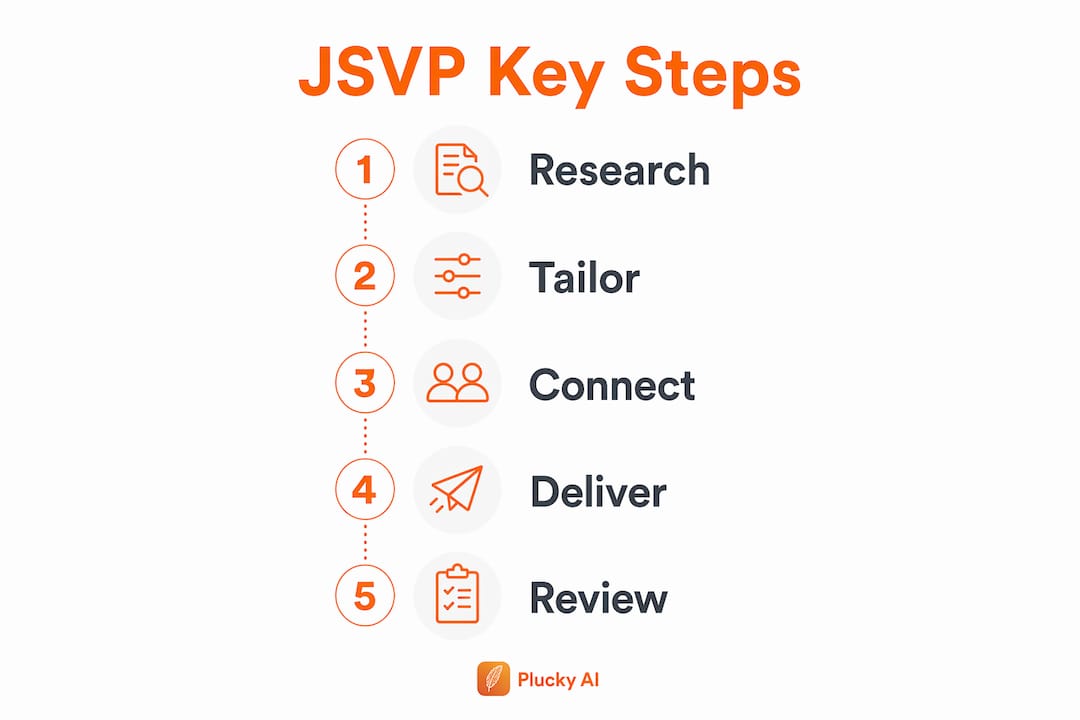
How can IT and cybersecurity professionals research and tailor their value proposition?
Tailoring a value proposition without research produces a generic document. Research is what transforms a template into a targeted argument. IT and cybersecurity job seekers benefit most from researching specific team challenges and company goals before writing a single word.
Start with these research channels:
- Company website and press releases. Look for recent product launches, security incidents, compliance announcements, or technology migrations. Each one signals a current priority.
- LinkedIn company page and employee profiles. The team's current stack, recent hires, and job postings reveal gaps and growth areas. A company posting three cloud security roles is clearly building that capability.
- Industry news and threat intelligence reports. Cybersecurity is reactive by nature. A firm in a sector hit by recent ransomware campaigns has a very specific fear you can address directly.
- The job description itself. Read it as a problem statement, not a checklist. Every required skill is a pain point the team is trying to solve.
Once you have your research, connect it to your capabilities using the hiring manager's priorities as your guide. Framing your pitch around specific business outcomes rather than credentials raises hiring manager response rates. That finding holds especially true in IT and cybersecurity, where hiring managers are often technical leaders who can immediately spot a generic pitch.
Reaching out directly to a team lead or hiring manager on LinkedIn before applying adds another layer of personalization. A brief message referencing a specific challenge the team faces, followed by your value proposition, creates a conversation rather than a transaction.
What are the best practices for delivering your value proposition?
Writing a strong value proposition is only half the work. Delivery determines whether it gets read. Sending your value proposition directly to hiring managers bypasses applicant tracking systems and increases your chance of landing an interview. That direct outreach is the single most impactful delivery decision you can make.
Follow these delivery best practices:
- Use email or LinkedIn direct message. Both channels reach the hiring manager personally. Email is more formal and easier to forward internally. LinkedIn works well for initial contact when you do not yet have an email address. Learn how to find a hiring manager's email before you send anything.
- Keep the subject line specific. "Cloud Security Engineer with Zero-Trust Migration Experience" outperforms "Interested in Opportunities" every time.
- Send it before applying through the ATS. The value proposition creates context. When the hiring manager later sees your resume in the system, they already know who you are.
- Tie it to your interview preparation. Your value proposition is the thesis statement for every interview answer. Practice delivering its core argument verbally in 60 seconds.
- Follow up once, seven to ten days later. A single follow-up is professional. Multiple follow-ups are not.
Common mistakes to avoid include writing a value proposition that reads like a cover letter, using vague language like "passionate about cybersecurity," and failing to name a specific outcome. Keeping your JSVP under 300 words ensures the hiring manager reads it fully. Every word above that limit reduces the chance of full engagement.
Key Takeaways
A job seeker value proposition is a targeted, evidence-backed statement that addresses a specific employer's problem, and it is the most direct tool IT and cybersecurity professionals have for standing out in a competitive market.
| Point | Details |
|---|---|
| Define the employer's problem first | Research team challenges before writing a single word of your value proposition. |
| Use the three-part framework | State the difference you will make, your unique capability, and the evidence that backs it. |
| Stay under 300 words | Short messages get read fully; long ones get skimmed or ignored. |
| Bypass the ATS | Send your value proposition directly to the hiring manager via email or LinkedIn. |
| Tailor to a named person | Generic statements fail; specificity to one hiring manager drives response rates. |
Why most IT job seekers are pitching the wrong thing
I have reviewed hundreds of outreach messages from IT and cybersecurity professionals over the years. The pattern is consistent and frustrating. Most candidates lead with their credentials, their years of experience, their certifications, as if the hiring manager's primary concern is validating a resume. It is not. Their primary concern is a problem they need solved by next quarter.
The shift from "here is what I have done" to "here is what I will do for you" sounds simple. Executing it requires real research and a willingness to be specific in a way that feels uncomfortable. Naming a company's exact challenge in your opening line feels bold. That is precisely why it works.
The professionals I have seen succeed in competitive cybersecurity markets treat their value proposition as a living document. They refine it after every conversation, every interview, every rejection. They track which versions generate responses and which do not. That discipline is what separates a job seeker with a strategy from one who is just applying and hoping.
The balance between technical and business messaging is also worth getting right. A hiring manager who is a CISO thinks in risk and compliance. One who is a VP of Engineering thinks in delivery speed and system reliability. The same core skills need different framing for each audience. Your value proposition is not one document. It is a template with variables you swap out for each target.
— Diego
Pluckjobs makes direct outreach faster for IT professionals
Building a strong value proposition is only effective if it reaches the right person. Pluckjobs combines AI-powered role discovery with Apollo contact intelligence to surface hiring manager contact data alongside every matched role.
Plucky AI uses your career data to help craft concise, targeted outreach messages that reflect your specific value to each employer. No more cold applying through ATS portals that bury your message. Pluckjobs puts your value proposition in front of the person who can actually say yes. IT and cybersecurity professionals use it to cut the time between application and first conversation. If you are serious about your IT job search, Pluckjobs gives you the tools to act on the strategy this article describes.
FAQ
What is a job seeker value proposition in simple terms?
A job seeker value proposition is a short, targeted statement that tells a specific employer what problem you solve and why you are the best person to solve it. It is forward-facing and focused on the employer's needs, not your personal history.
How long should a value proposition statement be?
A value proposition statement should be 150–300 words, readable in under two minutes. Shorter messages get read fully and signal confidence and clarity.
How is a value proposition different from a cover letter?
A cover letter summarizes your background and motivation. A value proposition focuses entirely on the employer's current problem and how your specific capabilities solve it, making it more targeted and more persuasive.
Where should I send my value proposition?
Send your value proposition directly to the hiring manager via email or LinkedIn, not through an applicant tracking system. Direct outreach bypasses automated filters and puts your message in front of the decision-maker.
What is the biggest mistake in writing a value proposition?
The biggest mistake is failing to define a specific audience. Generic value propositions that could apply to any employer have no impact. Tailoring your message to one named hiring manager and one specific problem is what drives results.