
Yes, hiring velocity materially changes your chances, your timing, and how you should apply. The evidence is consistent: employers who move fast get better candidates, and candidates who respond fast get more offers. In 2023, 40% of candidates expected an interview within six days of applying, and 49% said they'd abandon a process that dragged out scheduling. Award-winning employers back this up from the other side, holding to a three to five day "go or no-go" decision window after interviews because it correlates with higher offer acceptance.
Here's the tactical takeaway before the deep dive: prioritize applications where the employer signals a clear, fast timeline. Respond to recruiter outreach within hours, not days. Use AI tools, including a platform like Pluckjobs, to keep your response speed high without sending robotic, copy-paste replies.
- Rank open roles by visible speed signals, not just title or salary.
- Reply to recruiters and hiring managers same-day whenever possible.
- Treat a slow, opaque process as a warning sign worth investigating, not ignoring.
Pro Tip: Set a personal rule: if a recruiter reaches out, reply within four business hours during work days. That single habit puts you ahead of most other applicants competing for the same role.
Key Takeaways
Hiring velocity shapes whether you get hired, how fast you get an offer, and whether you should keep waiting on a slow employer or move on.
| Point | Details |
|---|---|
| Speed predicts outcomes | Reply delay of one hour was linked to a 46% drop in hiring likelihood in marketplace data. |
| Fast decisions matter | Employers holding a 3 to 5 day post-interview decision window see higher offer acceptance. |
| Interview count adds risk | 52% of candidates say four to five interview rounds is too many, raising drop-off odds. |
| Read the signals | Explicit timelines, named hiring managers, and quick scheduling all signal a well-run process. |
| Use AI to keep pace | Pluckjobs pairs role discovery and hiring-manager outreach so you can respond fast without losing personalization. |
Table of Contents
- How Hiring Velocity Affects Candidates: What the Data Shows
- What Does a Fast or Slow Hiring Process Signal?
- Who Feels the Impact of Slow Hiring Most?
- Practical Tactics: Turning Hiring Speed Into Your Advantage
- Reading the Signs in Postings, Outreach, and Interviews
- Decision Rules: When to Follow Up, Negotiate, or Walk Away
- Using AI Tools Without Losing Authenticity
- What Hiring Speed Actually Tells You About a Company
- Let Pluckjobs Handle the Speed Side of Your Job Search
- Sources
- FAQ
How Hiring Velocity Affects Candidates: What the Data Shows
The numbers on hiring speed are stark, and they cut both ways. On the candidate side, a substantial portion of applicants will simply walk away from a slow process rather than wait it out. On the employer side, the fastest-moving companies consistently land better hires and more referrals.
Marketplace experiments summarized by researchers at UCSD found that response delay predicts hiring outcomes almost mechanically: a one-hour delay in replying was linked to a 46% drop in hiring likelihood, and a full-day delay to roughly a 90% drop. That data was measured on the employer-to-worker side of a labor marketplace, but the same logic applies when you're the one replying to a recruiter. Speed reads as competence and interest. Silence reads as disinterest, whether or not that's true.
The Candidate Experience benchmark data reinforces this from the hiring side. Top-performing employers, the ones candidates rate most highly, disposition candidates within 3 to 5 days far more often than average employers, and timely offers within a week substantially increase candidates' willingness to refer others. Macro conditions make this more urgent, not less: hiring in 2026 has slowed across sectors amid softer wage growth and a glut of applicants, which means the gap between fast and slow employers has widened.
| Signal | What the data shows |
|---|---|
| Candidate patience | 40% expect an interview within six days; 49% abandon slow scheduling |
| Decision speed | 3 to 5 day post-interview disposition correlates with higher acceptance |
| Reply delay | 1 hour delay tied to 46% lower hiring likelihood; 1 day to ~90% lower |
| Market context | Time-to-fill has lengthened across sectors in 2026 |
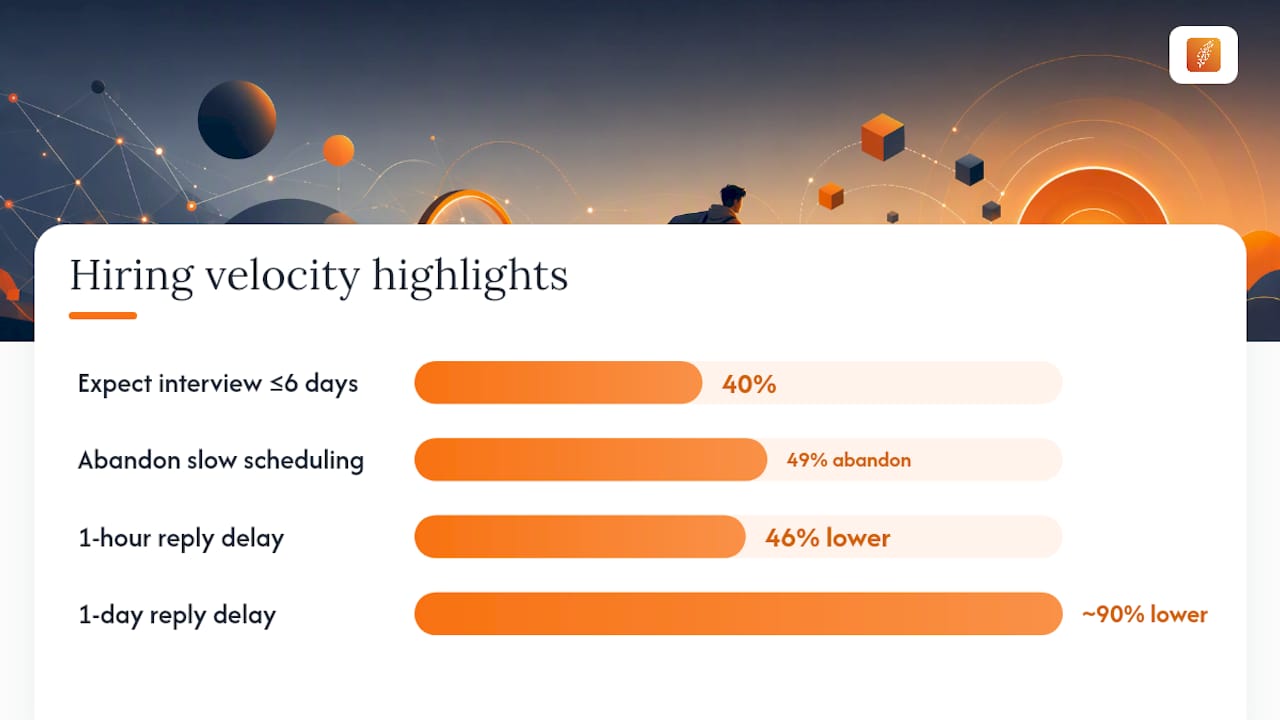
Statistic callout: Nearly half of candidates will quit a hiring process over scheduling delays alone. If a role you want has gone quiet for over a week with no explanation, you are the majority, not the exception, if you start looking elsewhere.
What Does a Fast or Slow Hiring Process Signal?
Speed tells you something about how an employer operates, but you have to read it correctly. A fast process usually means the hiring manager has budget approved, the role is a genuine priority, and the team has its act together operationally. A slow one can mean disorganization, internal disagreement, or simply that the role sits behind a queue of higher-priority approvals.
Positive signals worth trusting:
- Explicit timeline language in the job post or first recruiter message ("we're hiring on a two-week cycle," "final decision by Friday").
- Same-day or next-day scheduling after you apply or interview.
- A named hiring manager who's actually available for the interview, not a rotating cast of strangers.
- Recruiters who mention internal service-level targets, like flagging candidates who've been in a stage more than three days.
Negative signals worth questioning:
- Repeated rescheduling with vague reasons.
- No follow-up communication for more than a week after a final-round interview.
- A job post that's been live for months with no clear reason why.
Nuance matters here. A rushed one-round technical screen for a security engineering role can be a red flag about evaluation rigor, not a compliment about efficiency. On the flip side, a slower pace tied to background checks, security clearance processing, or legal review for a regulated industry isn't a sign of disorganization. The difference is whether the employer explains the delay. Silence is the real problem, not the delay itself.
Pro Tip: Ask directly in your first conversation: "What does your typical decision timeline look like from here?" A confident, specific answer is a good sign. A vague one is data too.
Who Feels the Impact of Slow Hiring Most?
Hiring velocity doesn't affect every candidate equally. Career stage and interview count both change how much pain a slow process inflicts.
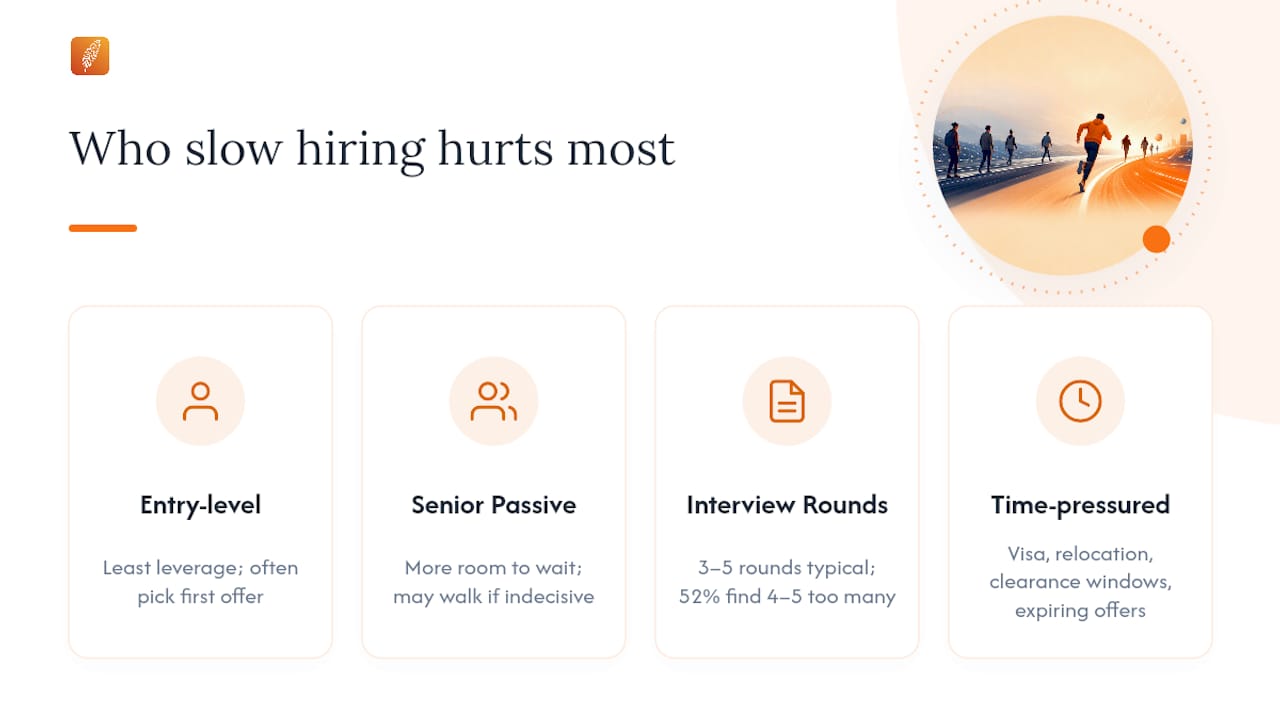
Entry-level and early-career candidates tend to have the least leverage and the most time pressure, since they're often choosing between whichever offer arrives first. Senior candidates and passive job seekers, especially those juggling a counteroffer or a competing process, absorb delay differently. They have more room to wait, but also more reason to walk if a slow employer looks indecisive. Interview count compounds this: research on hiring funnels shows candidates typically go through three to five interviews, and 52% of candidates say four to five rounds is simply too many. Each added round is another point where drop-off risk climbs.
There's also a gender dimension worth naming directly. One academic study found that female candidates, particularly those with lower academic grades, were less likely to apply to selection processes advertised as long, compared to shorter ones.
Long, opaque hiring timelines don't just cost employers good candidates. They quietly filter out qualified people who simply won't wait, and that filtering isn't random across every group of applicants.
Other groups facing real time pressure include candidates working against a security clearance renewal window, people managing a visa or relocation deadline, and anyone already holding a competing offer with its own expiration date.
Practical Tactics: Turning Hiring Speed Into Your Advantage
Once you accept that speed matters, the question becomes what to actually do differently; this practical advice about internal hiring speed and process design for tech companies can guide you: How to speed up tech hiring: a practical guide for startups. Start with triage.
Prioritization checklist before you apply or invest more time in a role:
- Does the post mention a timeline, rolling hiring, or a specific start date?
- Did the recruiter's first message include next steps and a rough schedule?
- Is there a named hiring manager, or just a generic inbox?
- Has the listing been live an unusually long time with no apparent urgency?
Roles that check most of these boxes deserve faster follow-through from you. Roles that check none of them are still worth applying to, but shouldn't be your only pipeline.
Response timing rules: the marketplace data on reply delay applies to you too. Treat any recruiter message like a countdown. Reply within hours where you can, and never let a scheduling request sit more than a day. If an employer goes quiet after promising a timeline, wait exactly that long plus two business days, then send one polite follow-up.
Parallel-process playbook: never run just one process at a time, especially in a market where hiring cycles have lengthened. Keep two or three live simultaneously. If one moves faster and extends an offer while another is still mid-process, it's fair to ask the slower employer for a decision date rather than quietly disappearing.
A short template for that ask:
"I wanted to give you an update. I've received a competing offer with a decision deadline of [date]. I'm genuinely interested in this role. Could you let me know if a decision might be possible before then?"
Pro Tip: Never bluff a competing offer. Recruiters compare notes across companies more often than candidates expect, and getting caught costs you the offer and your reputation.
Reading the Signs in Postings, Outreach, and Interviews
Job postings, recruiter messages, and interview behavior all leak information about actual urgency if you know what to look for.
In job postings, watch for words like "rolling basis," an explicit start date, or a stated number of interview rounds. Vague language like "we're always looking for great people" often signals a low-urgency evergreen post rather than a role someone needs filled now. Learning to spot this early pays off in how you strategically target tech applications instead of spreading effort evenly across strong and weak leads.
In recruiter outreach, time-to-first-reply is itself a signal. A recruiter who responds to your questions within a day, names the hiring manager, and sends a calendar link is running a well-organized outreach process. One who takes a week to answer a simple scheduling question is telling you what to expect if you get an offer.
In interviews, pay attention to whether the hiring manager mentions a decision timeline unprompted, whether interviewers seem to know your background already, and whether anyone commits to a specific next step before you leave the room. Confident, specific process discipline on the employer's side tends to predict a faster, cleaner outcome.
Decision Rules: When to Follow Up, Negotiate, or Walk Away
Consistency beats improvisation here. A few numbered rules cover most real scenarios:
- Silence after a final interview: wait the timeline you were given plus two business days, then send one short, polite check-in. No response after that follow-up is your answer.
- Repeated rescheduling: two reschedules is normal. A third, especially without explanation, is a signal to reduce your investment in that process and prioritize others.
- Competing offers: if you have a deadline from one employer, tell the others plainly and ask for a decision date rather than assuming they'll match your urgency on their own.
- Manager-requested delay: if a hiring manager explains a specific reason for delay (budget approval, internal restructuring), that's different from unexplained silence, and it's reasonable to stay engaged a bit longer.
A short template for the check-in message:
"Hi [name], following up on our conversation from [date]. I remain very interested in the role and wanted to check if there's an update on timeline. Happy to provide anything else that would help the process."
Know when to withdraw. If a process has gone silent twice, missed two stated deadlines, and offers no explanation, it's fair to withdraw and say so directly rather than ghosting in return.
Using AI Tools Without Losing Authenticity
The features that actually help you keep pace without sounding robotic are specific: scheduling automation, smart reply drafts you edit before sending, dashboards that track where every application stands, hiring-manager discovery so you're not applying into a black hole, and resume generation tailored to each specific role rather than one generic version sent everywhere.
The safety rule is simple. AI-drafted replies need a human pass before they go out. Keep a few personalization tokens in every message, mention something specific from the job post or conversation, and never send the identical instant reply to two different recruiters. Research on quick-responder advantage confirms that speed reads as competence, but only when the message still feels like it came from a person who read the role.
A workflow that goes from role discovery to a prioritized application to a personalized reply to a booked interview in under a day beats one that takes a week, even if the underlying resume is identical.
A short case pattern: a candidate targeting cybersecurity roles uses AI-assisted discovery to find roles with strong hiring-manager access, applies same-day, and sends a personalized note to the hiring manager within hours of the post going live. Time-to-first-contact drops from days to hours, without the message reading like a form letter.
What Hiring Speed Actually Tells You About a Company
I've watched enough IT and cybersecurity candidates compare notes to notice a pattern that doesn't get said out loud often enough: candidates consistently underestimate how much a slow process reflects the actual team they'd be joining, not just a hiring department quirk. A security engineering candidate who gets a offer in eight days from one company and radio silence for six weeks from another isn't seeing two random outcomes. They're seeing two different operating cultures.
The counterintuitive part is that fast isn't always a proxy for a good job, and slow isn't always a proxy for a bad one. A meticulous financial services employer running mandatory clearance checks can be slow for good reasons. But when delay comes with silence instead of explanation, that pattern tends to repeat once you're actually employed there. The data on decision windows backs this up structurally, not just anecdotally, and it's worth trusting more than most candidates currently do.
What actually works, based on the evidence and on watching hundreds of applications move through real pipelines, is treating your own response speed as leverage rather than an afterthought. Candidates who reply fast, ask direct timeline questions, and run parallel processes consistently land better outcomes than candidates who wait passively for one employer to move.
Let Pluckjobs Handle the Speed Side of Your Job Search
Pluckjobs turns hiring velocity into your advantage instead of a source of anxiety, by cutting the time between "a role opens" and "you're in front of the hiring manager." The platform combines role discovery with hiring-manager contact intelligence, so instead of applying into a black hole and waiting on an ATS, you can reach the actual decision-maker while a posting is still fresh.
Plucky AI drafts personalized outreach and resume materials tailored to each specific role, then keeps your applications organized so you always know which processes are moving and which have gone quiet. A candidate using this workflow can go from spotting a new cybersecurity opening to sending a personalized message to the hiring manager in the same afternoon, exactly the kind of speed advantage the marketplace data ties to better outcomes. If you want to see how a prioritized, fast, personalized workflow changes your response time, start with Plucky AI and run your next application through it.
Sources
- Candidate expectations report 2023
- CandE 2025 benchmark: the 3-to-5-day decision rule that separates award winners from everyone else
- Looking for work? Don’t worry about seeming too eager
- 10 key takeaways from the 2025 Candidate Experience Benchmark research
FAQ
Does Hiring Velocity Really Affect My Chances of Getting Hired?
Yes. Faster employer decisions correlate with higher offer acceptance and referral willingness, and your own reply speed to recruiters is tied to hiring likelihood in marketplace studies.
How Fast Should I Reply to a Recruiter?
Aim to reply within a few hours during business days. Marketplace data shows a one-hour delay was linked to a 46% drop in hiring likelihood, so speed compounds in your favor.
What's a Reasonable Timeline Before I Follow Up After an Interview?
Wait the timeline you were given plus two business days, then send one short, polite check-in message. Silence beyond that, especially after multiple follow-ups, is a signal to prioritize other opportunities.
Is a Fast Hiring Process Always a Good Sign?
Not always. Fast can mean an efficient, well-run team, but it can also mean a rushed technical evaluation. Ask direct questions about the process to tell the difference.
Can AI Tools Help Me Keep Up With Fast-Moving Employers?
Yes, tools that combine role discovery, hiring-manager contact data, and personalized reply drafts, like Pluckjobs, help you respond quickly without sending generic, copy-paste messages.