
TL;DR:
- AI accelerates job searches by automating repetitive tasks like resume tailoring and application tracking, increasing success rates for IT and cybersecurity professionals. It enables candidates to apply faster, target high-fit roles, and build background systems that work overnight, significantly saving time and improving application quality. However, human judgment remains essential for networking and interviews, and strategic use of AI focuses on supporting, not replacing, personal effort.
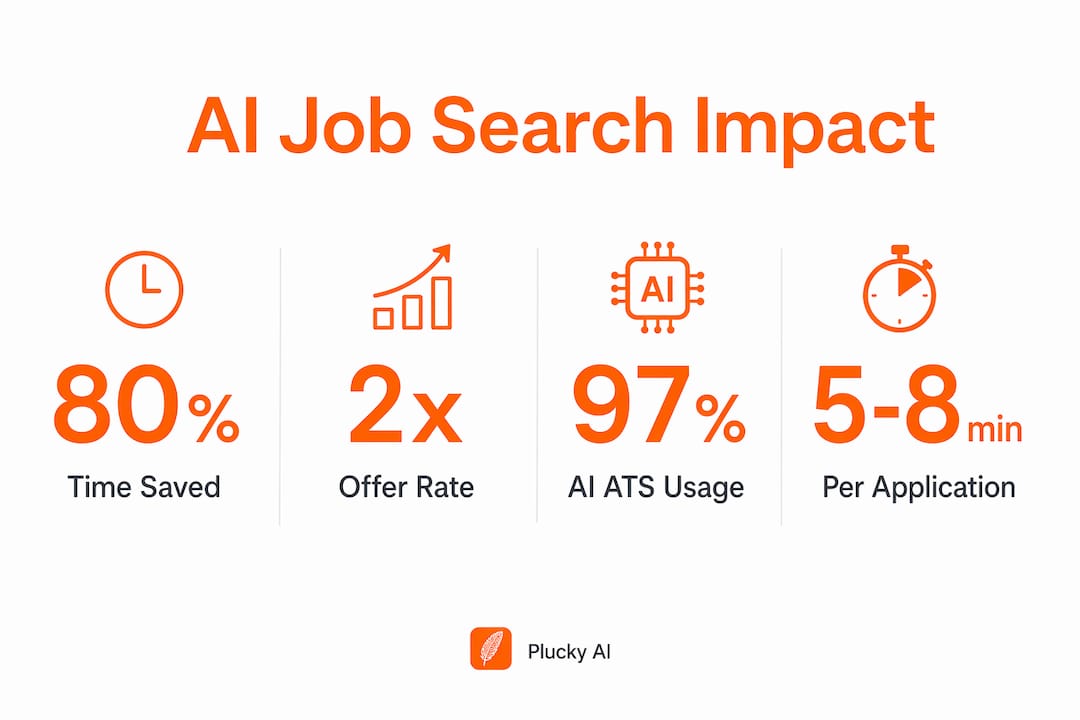
AI improves job search speed by automating the repetitive work that consumes most of a candidate's time, from tailoring resumes to tracking application deadlines. For IT and cybersecurity professionals, this shift is measurable. Job seekers who frequently use AI tools report more than double the job offer success rate compared to those who search manually, 76% versus 33%. Tools like JobWizard and QuickCV are cutting per-application time from 45–60 minutes down to 5–8 minutes. That is not a marginal improvement. It is a structural change in how technical professionals compete for roles.
Why AI improves job search speed: the core mechanics
AI handles the tasks that eat the most time in a job search without adding value proportional to the effort. Understanding which tasks those are helps you deploy AI where it counts.
The biggest time drains in a manual job search fall into three categories:
- Application form completion. AI tools autofill standard fields across job boards, pulling from a stored profile. What used to take 20 minutes per application drops to under two minutes.
- Cover letter drafting. AI generates role-specific cover letters by cross-referencing your experience against the job description. You review and adjust rather than write from scratch.
- Job triage. AI reads listings and scores them against your profile before you ever open them. You spend time only on roles worth applying to.
- Application tracking. AI systems manage follow-up schedules, deadline reminders, and recruiter interaction logs so nothing falls through the cracks.
Each of these tasks is low-judgment but high-frequency. That combination is exactly where automation delivers the most return.
Pro Tip: Build a weekly job search system using AI: Monday for sourcing and scoring, Tuesday and Wednesday for applications, Thursday for follow-ups. Consistent rhythm beats sporadic bursts every time.

The compounding effect matters here. AI job search tools reduce manual application time by up to 80%, which means you can apply to three times as many positions in the same weekly hours. For cybersecurity roles where competition is high and postings move fast, that volume advantage is significant.
How does AI improve resume matching and application quality?
Speed without quality is noise. The reason AI-enhanced job search techniques outperform manual approaches is that they improve both dimensions simultaneously.
97% of Fortune 500 companies now use AI-driven applicant tracking systems that filter resumes using semantic matching and large language model scoring. Generic resumes do not survive this filter. AI tools on the candidate side parse your resume, identify keyword gaps relative to a specific job description, and suggest targeted edits before you submit.
| Factor | Manual Tailoring | AI-Enhanced Tailoring |
|---|---|---|
| Time per application | 45–60 minutes | 5–8 minutes |
| Keyword gap detection | Manual, often missed | Automated, comprehensive |
| ATS compatibility check | Rarely done | Built into workflow |
| Consistency across applications | Variable | Standardized |
| Volume possible per week | 5–10 applications | 15–30 applications |
The table above shows why AI outperforms manual job search on both speed and precision. Manual tailoring is inconsistent because it depends on your energy level and attention on a given day. AI applies the same rigor to every submission.
The smarter play is selective submission. Smart candidates use AI to identify roles with the highest fit score and ignore the rest, rather than mass-applying with generic materials. ATS systems flag high-volume, low-fit submissions as spam. Applying to 10 well-matched roles beats applying to 100 random ones.
Pro Tip: Before submitting any AI-generated application, read it once as if you are the hiring manager. AI catches keyword gaps well, but it sometimes misses tone or context specific to a company's culture. A two-minute review protects your credibility.
For IT and cybersecurity roles specifically, this matters because job descriptions in these fields use precise technical language. A resume that says "network security" when the posting says "zero-trust architecture" will score lower in ATS, even if the skills overlap. AI tools trained on technical job data catch these distinctions automatically.
What advanced AI tools accelerate IT and cybersecurity job searches?
Most job seekers use AI reactively: they open a tool, paste a job description, and generate a cover letter. Technical professionals in IT and cybersecurity can go further by building systems that work in the background without active input.
Background AI agents autonomously discover jobs, score fit against your profile, and prepare draft application materials outside of active sessions. You wake up to a curated list of high-fit roles with draft materials ready for review. This is the difference between using AI as a tool and using it as a system.
Here is what a practitioner-level AI job search workflow looks like for a cybersecurity professional:
- Role discovery. An AI agent scrapes multiple job boards overnight using SerpAPI or similar APIs, filtering by role type, location, and required certifications like CISSP or CompTIA Security+.
- Fit scoring. The agent scores each listing against your resume using a language model, ranking results before you see them.
- Draft preparation. High-scoring roles get a tailored resume variant and cover letter draft generated automatically.
- Review queue. You spend 30–60 minutes each morning reviewing a pre-filtered, pre-drafted queue rather than starting from zero.
"Technical professionals optimize job searching by building AI agents that operate in the background using Claude Code and Playwright for scraping, scoring, and drafting applications." — Roborhythms
IT professionals building these agents with Claude Code and Playwright report waking up to a curated list of high-fit jobs daily. This workflow saves 5–10 hours per week compared to manual searching. For someone actively job hunting while employed full-time, that reclaimed time is the difference between a sustainable search and burnout.
Platforms like Pluckjobs take a similar approach without requiring you to build anything yourself. Pluckjobs combines Apollo contact intelligence with SerpAPI-powered role discovery to surface precision matches and hiring manager contact data in one place, covering the types of IT job boards that matter most for technical roles.
What are the limits of AI in job searching?
AI accelerates the search. It does not replace the judgment required to land the job. Understanding where AI helps and where it falls short keeps your strategy grounded.
- Do not automate the human parts. Networking, informational interviews, and salary negotiation require real relationships. AI can help you identify who to contact, but the conversation itself has to be yours.
- Avoid mass-apply bots. Sending hundreds of applications through automated bots triggers ATS spam filters. The most effective AI users treat AI as a filter to stop applying to low-fit jobs, not a tool to flood systems with volume.
- Review every AI-generated output. AI drafts are starting points. A cover letter that references the wrong company name or misquotes your experience does more damage than no letter at all.
- Track your metrics. Job search metrics like application-to-interview rate and response rate tell you whether your AI-assisted approach is working or needs adjustment.
- Acknowledge equity gaps. AI-enabled job seekers have real advantages, and democratization efforts are ongoing. Not everyone has equal access to premium AI tools, which creates an uneven playing field that the industry is still working to address.
Pro Tip: Set a weekly cap on applications, say 15–20 per week, and use AI to make each one count. Quality control at that volume is manageable. Quality control at 100 applications per week is not.
AI's role in career acceleration is strongest when it handles logistics and you handle strategy. The candidates who get hired fastest are not the ones who automate everything. They are the ones who use AI to free up time for the work that actually moves the needle: preparing for technical interviews, building relationships with hiring managers, and staying current on the tools the market demands.
Key takeaways
AI-powered job search tools reduce per-application time by up to 80% and more than double offer rates for IT and cybersecurity professionals who use them consistently and selectively.
| Point | Details |
|---|---|
| AI cuts application time dramatically | Per-application time drops from 45–60 minutes to 5–8 minutes with AI tools. |
| Selective submission beats mass applying | Targeting high-fit roles avoids ATS spam flags and improves interview rates. |
| Background agents work while you sleep | AI agents using Claude Code and Playwright curate and draft applications overnight. |
| Human judgment stays irreplaceable | Networking and interviews require real effort; AI handles logistics, not relationships. |
| Track metrics to validate your approach | Application-to-interview rate reveals whether your AI-assisted strategy is working. |
The honest case for AI in your job search
I have watched a lot of IT and cybersecurity professionals approach job searching the same way they approach a difficult engineering problem: more effort, longer hours, more applications. That instinct is wrong here.
The professionals I see land roles fastest are not the ones grinding through 50 applications a week manually. They are the ones who spent two hours setting up an AI-assisted system and then applied to 12 highly targeted roles. The AI as leverage framing is the right one. You are not outsourcing your career. You are removing friction so your actual skills and relationships can do the work.
The one thing I would push back on is the idea that any AI tool is plug-and-play. The professionals getting the best results are the ones who treat AI as a workflow to build and refine, not a button to press. That means reviewing outputs, adjusting fit criteria, and paying attention to which applications actually generate responses. The long-game job search strategy for IT professionals is not about speed alone. It is about building a system that compounds over time.
Use AI to handle the busywork. Spend the time you reclaim on the things that actually get you hired.
— Diego
Find IT roles faster with Pluckjobs
Pluckjobs is built specifically for IT and cybersecurity professionals who are done cold-applying into the void. The platform combines Apollo contact intelligence with SerpAPI-powered role discovery to deliver precision job matches, hiring manager outreach data, and tailored resumes in one place. You get the role, the contact, and the application materials without stitching together five separate tools. If you are ready to apply smarter and spend your time on interviews instead of form-filling, start with Pluckjobs and see how AI-powered role discovery changes the pace of your search.
FAQ
How much time does AI save per job application?
AI job search tools reduce per-application time from 45–60 minutes to 5–8 minutes, a reduction of up to 80%. That time savings allows candidates to apply to roughly three times as many positions in the same weekly hours.
Does AI help with ATS resume filtering?
Yes. AI tools parse your resume against a job description, identify keyword gaps, and suggest edits before submission. This matters because 97% of Fortune 500 companies use AI-driven ATS systems that filter by semantic matching.
What are background AI job search agents?
Background AI agents are automated systems that discover jobs, score fit, and draft application materials without active input from the user. These agents can work overnight and deliver a curated, pre-drafted job list each morning, saving 5–10 hours per week.
Can AI replace networking in a job search?
No. AI handles logistics like sourcing, tailoring, and tracking, but networking and interviews require human judgment and real relationships. AI is leverage, not a replacement for the interpersonal work that closes offers.
Is mass applying with AI a good strategy?
Mass applying with AI bots is counterproductive. ATS systems flag high-volume, low-fit submissions as spam. The most effective approach is using AI to filter down to high-fit roles and submitting fewer, stronger applications.