
Target one specific role, build a sniper application workflow, and execute a tracked 7-day plan that prioritizes early, customized submissions. That is the entire playbook. Everything else in this article is the execution detail that makes it repeatable.
To apply to tech jobs strategically, you need six things working together: a defined role target, a skills audit against real job descriptions, a tailored resume and portfolio, a focused sourcing list, an early-application habit, and a tracking system that tells you what to fix. Here is your week-one checklist:
- Define your target role title and work format (remote/hybrid/on-site)
- Pull 10 job descriptions for that role and identify the top 5 recurring skills
- Tailor your resume headline and one bullet to match those keywords
- Build a Tier 1 list of 5 companies and apply on their career pages directly
- Send one personalized LinkedIn message to a connection at each Tier 1 company
- Follow up on any application older than 7 days with a brief, specific note
- Review your tracker every Friday and adjust based on response rate
One-week action plan:
| Day | Task |
|---|---|
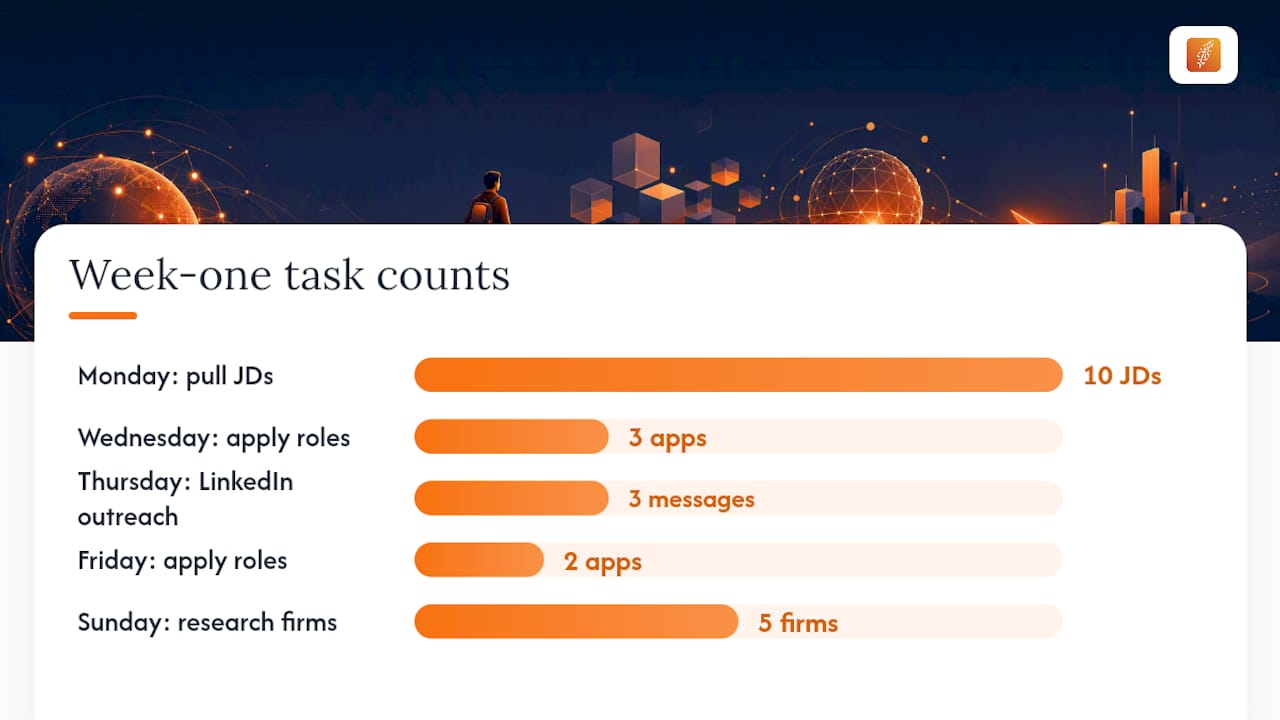
| Monday | Finalize role title, pull 10 JDs, run skills audit |
| Tuesday | Rewrite resume headline and top 3 bullets |
| Wednesday | Apply to 3 Tier 1 companies on career pages |
| Thursday | Send LinkedIn outreach to 3 contacts at target companies |
| Friday | Apply to 2 more roles, review tracker, plan next week |
| Saturday | Work on one portfolio case study or skill gap project |
| Sunday | Research 5 new companies for Tier 2 list |
Pro Tip: *Apply within 48 hours of a job posting going live.
Key Takeaways
Applying to tech jobs strategically requires a defined role target, early submissions on company career pages, and a sniper workflow that customizes each application in under 20 minutes.
| Point | Details |
|---|---|
| Define one role target | Pick a specific title and work format before applying; clarity improves ATS alignment and recruiter response. |
| Apply within 48–120 hours | Early applicants compete against fewer candidates; monitor career pages directly to capture this window. |
| Use the sniper workflow | One tailored headline, one custom bullet, and one company hook sentence produce the largest lift per application. |
| Track every application | Log channel, resume version, and response rate weekly; a sub-10% response rate signals a resume or targeting problem. |
| Pluckjobs accelerates the process | Role discovery alerts, AI resume optimization, and hiring manager contact data reduce manual research time significantly. |
Table of Contents
- How to apply to tech jobs strategically: define your target role first
- Skill audit: match your skills to real job description patterns
- Build a portfolio and resume that pass ATS filters and get you interviews
- LinkedIn and personal brand: how to get found and turn connections into referrals
- Where to find roles: which channels to use and when
- Sniper vs. spray: how to tailor each application and maximize conversion
- Track and measure: a simple application tracker and weekly planning process
- Technical and behavioral interview prep: a role-specific checklist
- Evaluate offers and negotiate: what to ask and how to compare
- Timing: when to apply and why early matters
- Why applications get rejected and concrete fixes
- Tools, templates, and how Pluckjobs fits into this workflow
- What actually works in 2026 for tech job applications
- Pluckjobs cuts the time between finding a role and getting an interview
- Sources
- FAQ
How to apply to tech jobs strategically: define your target role first
Most tech job searches fail before the first application is sent. The reason is almost always the same: the candidate has not decided what they are actually applying for. "Software engineer" is not a target. "Mid-level backend engineer focused on distributed systems, open to remote roles at Series B or later startups" is a target.
Narrowing to one role title and one work format does two things. It aligns your resume keywords with what ATS systems are filtering for, and it signals to recruiters that you know what you want, which is a stronger position than appearing to be open to anything.
Work through these questions before you write a single application:
- What specific team problem do you want to solve? (Infrastructure reliability? Product security? Data pipeline performance?)
- Which tech stack do you have 80% or more coverage on for this role?
- What company size fits your working style: startup, mid-market, or enterprise?
- What are your location and work-authorization constraints?
- What seniority level matches your experience, and what title do companies use for it?
Once you have answers, map alternate titles. A "DevSecOps Engineer" posting might also appear as "Platform Security Engineer," "Cloud Security Engineer," or "Security Automation Engineer." Recruiters do not always use the same label, so knowing which titles to monitor across boards and career pages prevents you from missing relevant openings.
Pro Tip: Before applying anywhere, pull 5–10 job descriptions for your target role and read them in one sitting. If you feel genuinely qualified for 7 or more, your target is calibrated. If you feel underqualified for most, either the role is too senior or the title is wrong.
Poor targeting is one of the most common reasons applications go nowhere. As Susanna Kis argues, candidates who apply for the wrong jobs waste the majority of their effort, and a focused, recruiter-minded positioning step before applying is what separates efficient searches from exhausting ones.
Skill audit: match your skills to real job description patterns
A skills audit is not a self-assessment quiz. It is a data exercise. Pull 10–30 job descriptions for your target role and treat them as a dataset.
Step-by-step method:
- Collect 15–20 JDs from company career pages, not aggregators (aggregators often show stale or duplicate postings).
- Copy the requirements sections into a spreadsheet or a plain text file.
- Highlight every technical skill, tool, and certification that appears in more than 40% of the JDs. These are your core requirements.
- Flag skills that appear in 20–40% of JDs as nice-to-have.
- Note skills that appear in fewer than 20% but cluster in certain company types (e.g., Terraform at infrastructure-heavy companies). These are adjacent skills worth knowing.
- Rate yourself on each core skill: can you demonstrate it in an interview, or only describe it?
The distinction between "can describe" and "can demonstrate" matters more than most candidates realize. A hiring manager asking you to walk through a Kubernetes deployment does not want a definition. They want to see you think through it. For every core skill you can only describe, assign one small project that produces a demonstrable artifact: a GitHub repo, a write-up, a working demo.
Adjacent skills like Git workflows, CI/CD pipelines, and containerization often cause quiet rejections. A candidate who clears the technical bar on core skills but cannot discuss a basic GitHub Actions pipeline gets filtered out at the technical screen without ever knowing why. Test yourself on these before you apply.

Pro Tip: Paste 3–5 job descriptions into an AI assistant and ask: "What are the 10 most frequently required skills across these JDs, and which ones are likely to be screened at the resume stage vs. the technical interview stage?" That prompt produces a prioritized prep list in under two minutes.
Build a portfolio and resume that pass ATS filters and get you interviews
ATS usage is widespread in the 2026 tech market, and the first filter your resume faces is automated. That means keyword alignment is not optional. Your resume headline must match the exact title you are targeting. Your summary must read as a role-specific elevator pitch, not a general career biography.
Resume structure rules:
- Headline: match the exact job title you are applying for ("Senior Cloud Security Engineer," not "Experienced IT Professional")
- Summary: 2–3 sentences, role-specific, with one quantified result and one forward-looking statement
- Experience bullets: metric + action + impact, never a list of responsibilities
- Skills section: place it above the fold; use exact tool names from the JDs (AWS, not "cloud platforms")
- Length: one page for under 8 years of experience; two pages only when every line earns its place
Sample bullets by seniority:
Mid-level: "Redesigned CI/CD security gates in GitHub Actions, cutting mean time to detect misconfigurations from 72 hours to under 4 hours across 12 microservices."
For your portfolio, quality beats quantity. Show 1–3 projects with clear context and outcomes. A case study that explains what the problem was, what your specific role was, what approach you took, and what the result was builds more hiring manager confidence than a GitHub profile full of unfinished repos. The case-study structure recommended for tech portfolios follows four fields: context, role, approach, and outcome.
For proprietary code, describe the architecture and your contribution without exposing confidential data. A well-written architecture diagram with a clear outcome statement is more persuasive than raw code.
Pro Tip: Identify the one resume bullet most relevant to each specific role and rewrite it to match that JD's language before you submit. This 3-minute edit is the highest-ROI customization you can make per application.
LinkedIn and personal brand: how to get found and turn connections into referrals
Your LinkedIn profile is not a second resume. It is a positioning document that works while you are not actively applying. Recruiters search LinkedIn by keyword, location, and title, so your profile needs to surface in those searches before you ever send a message.
Quick optimization checklist:
- Headline: include your target role title, one key skill, and one differentiator ("Cloud Security Engineer | AWS | Zero-Trust Architecture")
- About section: write in first person, open with your current focus and what you are looking for, and close with a specific invitation ("Open to senior security engineering roles at growth-stage companies")
- Featured section: pin one project with a concrete outcome metric
- Experience: mirror your resume bullets but add context that would not fit on a one-page resume
- Recommendations: two or three specific, skill-focused recommendations outweigh ten generic ones
LinkedIn SEO works on the same principle as ATS filtering. Recruiters search for exact phrases like "penetration testing" or "Kubernetes security," not "experienced in cloud environments." Use the exact tool names and role titles from your target JDs throughout your profile.
For outreach, the goal is a conversation, not a job. A message that asks for 15 minutes of someone's time to learn about their team converts far better than one that opens with "I'm looking for a job." Here is a template that works:
"Hi [Name], I've been following [Company]'s work on [specific product or initiative] and found your background in [specific area] genuinely interesting. I'm currently exploring [role type] opportunities and would value 15 minutes to hear how your team approaches [specific challenge]. Happy to work around your schedule."
For referral requests, be specific about the role and make it easy for the person to say yes: "I'm applying for the [Role Title] position posted on [Company]'s career page. If you're comfortable, a brief note to the hiring manager would mean a lot. I'm happy to send you my resume and a one-paragraph summary to make it easy."
Pro Tip: Pin one project in your Featured section that includes a metric.
For a detailed walkthrough of LinkedIn optimization for IT roles, the Pluckjobs blog covers profile fixes with before-and-after examples specific to tech and cybersecurity candidates.
Where to find roles: which channels to use and when
Not all job sources are equal, and the right channel depends on whether you are optimizing for speed or quality. Here is how the main channels compare:
Company career pages are the highest-signal source. Postings are fresh, not aggregated, and applying directly often routes your application to the hiring team faster. The downside is manual monitoring across dozens of sites.
Niche tech boards (Dice, CyberSecJobs, Built In) filter out irrelevant noise and often surface roles that never appear on large aggregators. They are worth checking weekly for your target role.
Large aggregators (Indeed, LinkedIn Jobs) have the highest volume but also the highest competition. Use them for market intelligence and to discover company names, then apply on the company's own career page.
Slack and Discord communities (e.g., Locally Optimistic for data, CISO Slack for security) surface roles before they are posted publicly. A hiring manager posting in a community channel is often looking for a warm referral, not a cold application.
Referrals remain the highest-conversion channel by a significant margin. A referred candidate skips the ATS filter and enters the process with social proof already attached.
Build a tiered company list rather than applying broadly. A focused list of 15–20 companies, as recommended in the 90-day tech offer plan, gives you enough coverage to find open roles while keeping your preparation deep enough to write a specific hook sentence about each company. That depth is what separates a sniper application from a spray.
Career-page monitoring setup:
- Use a tool like Visualping or a custom RSS feed to alert you when a target company's careers page updates
- Check Tier 1 company pages daily, Tier 2 weekly
- Set a Google Alert for "[Company Name] is hiring" to catch announcements before postings go live
Pro Tip: Attend one virtual or in-person tech community event per month. The roles that get filled through community channels rarely appear on job boards, and a brief conversation at an event converts to a referral faster than any cold message.
For a full breakdown of IT job board types and when to use each, the Pluckjobs blog covers the tradeoffs in detail.
Sniper vs. spray: how to tailor each application and maximize conversion
The sniper approach means customizing every element of an application for one specific company and role. The spray approach means sending a standard resume to as many openings as possible. Both have a place, but the conversion math is not close.
Customized applications produce materially higher interview rates than generic ones, and a short, structured tailoring workflow captures most of that lift. The spray approach is useful early in a search for calibration and practice. Once you have a target list, sniper is the only approach worth your time.
20-minute sniper workflow:
- Read the job description and identify the top 3 requirements.
- Write one company-specific hook sentence: "I've been following [Company]'s work on [specific initiative] because it directly connects to my experience with [specific skill]."
- Rewrite one resume bullet to mirror the JD's exact language for the top requirement.
- Write a 3-paragraph cover letter: hook sentence + two specific examples + forward-looking close.
- Apply on the company's career page, not an aggregator.
When to use each strategy:
| Scenario | Recommended approach |
|---|---|
| Tier 1 target company, specific role | Sniper: full customization, referral outreach |
| Tier 2 company, strong role fit | Sniper-lite: tailored headline + one bullet |
| Early in search, calibrating | Spray: standard resume, track response rate |
| Role closes in under 24 hours | Apply immediately, customize what you can |
| Exploratory, no open role listed | Outreach only, no application |
Outreach email template:
Subject: [Role Title] — [Your Name]
Hi [Hiring Manager Name], I came across the [Role Title] opening at [Company] and wanted to reach out directly. My background in [specific skill] maps closely to what you're describing, particularly [specific JD requirement]. I've attached my resume and would welcome a brief conversation. Available [two time slots].
Follow-up sequence: Send a follow-up 5–7 days after applying if you have not heard back. Keep it to two sentences: reference the role and add one new piece of context (a recent company announcement, a relevant project you completed). A second follow-up after another 7 days is acceptable. After that, move on.
Pro Tip: The highest-ROI 20 minutes in any application is spent on the hook sentence and the one tailored bullet. Those two elements are what a recruiter reads in the first 10 seconds. Get those right before touching anything else.

Track and measure: a simple application tracker and weekly planning process
Without a tracker, you cannot tell whether your resume is failing at the ATS stage, the recruiter screen, or the technical interview. Each failure point has a different fix, and you cannot find the right fix without data.
Tracking spreadsheet columns:
- Date applied
- Company and role title
- Channel (career page, referral, board)
- Resume version used
- Outreach sent (Y/N) and date
- Response received (Y/N) and type
- Interview stage reached
- Next action and due date
- Notes (rejection reason if known)
Weekly KPIs to monitor:
- Applications sent that week
- Response rate (responses / applications, rolling 4-week average)
- Interviews booked
- Technical screen pass rate
- Offers received
If you are getting recruiter screens but failing technical rounds, the problem is prep. The tracker tells you which lever to pull.
Your weekly cadence should take 30 minutes every Friday: review what moved forward, note what went silent, update your Tier 1 list if a company has no open roles, and set three specific goals for the following week. This is the planning structure that a structured multi-week job search plan recommends for rapid progress.
Pro Tip: Add a simple color-code system to your tracker: green for active conversations, yellow for waiting, red for silent after follow-up. A visual scan every Monday tells you immediately where to focus your energy that week.
For more detail on managing job search data as an IT professional, including lightweight CRM setups that go beyond a spreadsheet, the Pluckjobs blog has a dedicated guide.
Technical and behavioral interview prep: a role-specific checklist
Interview preparation is not a single activity. It splits into at least three distinct tracks, and mixing them up wastes time.
By role type:
- Software/backend engineers: LeetCode medium-level problems (arrays, trees, graphs), system design (design a rate limiter, design a URL shortener), and one deep-dive on a past project.
- Security engineers/analysts: threat modeling, incident response scenarios, CVE analysis, and tool-specific questions (Splunk, CrowdStrike, Burp Suite depending on the role).
- Data engineers/ML engineers: SQL optimization, pipeline architecture, model deployment, and data quality patterns.
- DevOps/platform engineers: CI/CD design, infrastructure-as-code (Terraform, Ansible), Kubernetes troubleshooting, and on-call scenario walkthroughs.
Behavioral prep:
Build a story bank of 8–10 past situations that cover the most common behavioral themes: conflict resolution, technical leadership, failure and recovery, cross-functional collaboration, and delivering under pressure. Map each story to the STAR format (Situation, Task, Action, Result) and tie the result explicitly to a business outcome, not just a technical one.
Mock interview plan:
- Schedule two mock interviews per week in the two weeks before a target company's technical round
- Use a peer, a mentor, or a structured mock interview platform
- Record yourself once. The gap between how you think you sound and how you actually sound is almost always larger than expected.
- Track which questions you stumble on and drill those specifically
Pre-interview checklist (day before):
- Re-read the job description and your tailored resume
- Review the company's recent news, product launches, or engineering blog posts
- Prepare two specific questions about the team's current technical challenges
- Confirm the interview format, duration, and interviewer names
Pre-interview checklist (one hour before):
- Test your audio, video, and internet connection
- Have your resume, the JD, and your story bank open in separate tabs
- Close all notifications
Pro Tip: Prepare one question that references something specific from the company's engineering blog or a recent technical talk. It signals genuine interest and shifts the conversation from evaluation to dialogue.
Evaluate offers and negotiate: what to ask and how to compare
An offer is not a decision point until you have compared it across every dimension that affects your day-to-day work and long-term trajectory.
Offer comparison checklist:
- Base salary vs. market rate for the role, level, and location (use Levels.fyi, Glassdoor, and Blind for comp data)
- Equity: type (RSUs vs. options), vesting schedule, cliff, and current valuation
- Sign-on bonus and whether it is subject to clawback
- Annual bonus target and historical payout rate
- Benefits: health insurance quality, 401(k) match, PTO policy, and parental leave
- Title and level relative to your current position
- Remote/hybrid policy and whether it is contractually guaranteed
- Growth path: promotion timeline, performance review cadence, and team trajectory
Negotiation script:
"Thank you for the offer. I'm genuinely excited about this role and the team. Based on my research into market rates for this level and location, I was expecting something closer to [target number]. Is there flexibility to get there?"
Deliver this in a call, not email. Give a specific number, not a range. A range signals that you will accept the lower end.
Timing: negotiate after you have a written offer, not during the final interview. If you have a competing offer, mention it factually without using it as a threat: "I do have another offer at [Company] at [number], but this role is my preference if we can close the gap."
Red flags that should change your decision:
- Equity terms that are not in writing before you sign
- A hiring manager who cannot explain the promotion criteria
- A role that has been open for more than 6 months with no explanation
- A request to start immediately with no time to review the offer document
Pro Tip: Frame your counter around role scope and future milestones rather than just current salary. "Given that this role includes [specific responsibility], I'd like to align the comp to a [Senior/Staff] band" is a stronger position than "I need more money."
Timing: when to apply and why early matters
Applying early is not a minor tactical preference. Pluckjobs' analysis of the early-application advantage shows that recruiters often screen the first batch of applicants before a posting closes, meaning a candidate who applies on day one competes against far fewer people than one who applies on day five.
The practical target is within 48–120 hours of a posting going live. Combining early timing with customization multiplies interview chances compared with late generic submissions.
Typical hiring timeline:
| Stage | Typical duration |
|---|---|
| Job posted to recruiter screen | 3–7 days |
| Recruiter screen to hiring manager review | 3–5 days |
| Hiring manager review to technical round | 5–10 days |
| Technical round to final interview | 5–14 days |
| Final interview to offer | 3–7 days |
| Offer to start date | 2–4 weeks |
Follow-up cadence:
- Day 7 after applying: send a brief follow-up if no response
- Day 14: one final follow-up, then move on
- After a technical interview: send a thank-you note within 24 hours referencing one specific topic from the conversation
- After a final interview: follow up in 3–5 business days if you have not heard back
Assume silence after two follow-ups means rejection and keep your pipeline active. Waiting on one company while your tracker goes empty is the most common momentum killer in a tech job search.
Pro Tip: Set up a Visualping or custom RSS alert for your Tier 1 company career pages. When a new role appears, you will know within hours, not days, giving you a real first-mover advantage.
Why applications get rejected and concrete fixes
Most rejections in tech job searches fall into five categories. A full job-search playbook that addresses all of them produces repeatable results. Here are the most common failure points and their fixes.
**1. Fix: run the skills audit in Section 3 before applying to any role.
2. ATS keyword mismatch. A resume that uses "cloud infrastructure" when the JD says "AWS" will not surface in a keyword search. Fix: mirror the JD's exact tool names and role titles in your headline and skills section.
3. Weak bullets. "Responsible for managing security incidents" tells a hiring manager nothing. Fix: rewrite every bullet as metric + action + impact. If you cannot find a metric, use a scale indicator ("across 8 production services," "for a 200-person engineering org").
4. Generic cover letters. A cover letter that could apply to any company at any time signals low interest. Fix: write one company-specific hook sentence that references a real initiative, product, or engineering decision the company has made publicly.
5. Late applications. Applying on day 10 of a 14-day posting means competing against a full pipeline. Fix: monitor career pages directly and apply within 48 hours.
Before/after example:
Before: "Experienced security engineer with skills in threat detection and incident response."
After: "Security engineer with 5 years in cloud-native environments; reduced mean time to detect across AWS infrastructure from 6 hours to 45 minutes by deploying a custom Splunk detection ruleset."
Pro Tip: *Run your resume through a free ATS simulator (Jobscan offers a free tier) before submitting to any Tier 1 company.
Tools, templates, and how Pluckjobs fits into this workflow
The right tools reduce the time between identifying a role and submitting a polished, tailored application. Here is what belongs in your stack:
Tracking and organization:
- Google Sheets or Notion for your application tracker (use the column structure from Section 8)
- Trello or a simple Kanban board for visual pipeline management
Career-page monitoring:
- Visualping for automated career-page change alerts
- Google Alerts for company hiring announcements
Resume and ATS optimization:
- Jobscan for ATS keyword match scoring
- Hemingway Editor for bullet clarity checks
Coding and technical prep:
- LeetCode for algorithm practice
- HackerRank for role-specific assessments
- Excalidraw for system design diagramming
Portfolio hosting:
- GitHub Pages or Vercel for project demos
- Notion for case-study write-ups that do not require a live deployment
Template pack summary:
- Resume bullets: metric + action + impact (see Section 4 examples)
- Cover letter opener: company hook sentence + two specific examples + forward close
- LinkedIn outreach: 3-sentence ask focused on learning, not job hunting
- Follow-up message: 2 sentences, reference the role, add one new piece of context
- Tracking spreadsheet: 9 columns as listed in Section 8
The IT Job Application Checklist on the Pluckjobs blog provides a ready-to-use version of this checklist formatted for IT and cybersecurity roles specifically.
Pluckjobs accelerates three specific parts of this workflow. First, its SerpAPI-powered role discovery surfaces relevant IT and cybersecurity postings before they appear on aggregators, giving you the early-application window that matters most. Second, its AI resume optimization aligns your resume to the exact keywords in each JD without manual copy-paste work. Third, its Apollo-powered hiring manager contact data lets you send a direct outreach message to the person making the hiring decision, not just submit through an applicant portal.
Pro Tip: Use Pluckjobs' hiring manager contact data to send your outreach before you apply through the portal. A recruiter who has already read your name in their inbox is more likely to pull your application from the queue.
What actually works in 2026 for tech job applications
The 2026 tech job market rewards precision over volume. That is not a new observation, but the gap between candidates who act on it and those who do not has widened considerably. Employers receive more applications per opening than at any point in the last decade, ATS filtering is more aggressive, and hiring timelines have compressed at the top of the funnel while stretching at the offer stage.
What I keep seeing work, consistently, is the combination of three things: a narrow role target, an early application on the company's own career page, and one genuinely specific hook sentence that shows the candidate read the job description and the company's engineering blog. That combination is not complicated. It is just disciplined.
The candidates who struggle are almost always doing one of two things: applying to too many roles with a generic resume, or applying to the right roles too late. Both problems are fixable with the tracker and the sniper workflow described in this article. The tracker tells you which problem you have. The sniper workflow fixes it.
Pluckjobs' internal data on IT and cybersecurity rejections points to a common pattern: the most frequent failure is not a skills gap but rather a targeting and timing gap. Candidates who improve in these areas with focused lists, early monitoring, and tailored outreach tend to see better response rates within weeks of changing their approach.
The playbook in this article is repeatable. Run it for four weeks, measure your response rate, and adjust the one variable that is underperforming. That is the entire system.
Pluckjobs cuts the time between finding a role and getting an interview
For IT and cybersecurity professionals who want the sniper approach without spending hours on manual research, Pluckjobs delivers the three inputs that matter most: early role discovery, a tailored resume, and direct access to the hiring manager.
Pluckjobs combines SerpAPI-powered role discovery with Apollo contact intelligence to surface relevant openings before they hit aggregators and give you the hiring manager's contact details in the same workflow. Its AI resume optimization aligns your resume to each JD's exact keywords in minutes, not hours. The result is a faster path from "I found a role" to "I sent a tailored application and a direct outreach message."
- Apply early: role alerts surface postings within hours of going live, so you are always in the first batch
- Tailor faster: AI-generated resume bullets matched to each JD's language, ready to review and submit
- Reach hiring managers: Apollo-backed contact data so your outreach lands in the right inbox, not just the applicant portal
Start your free trial on Pluckjobs and run your first sniper application today.
Sources
The sources below support the playbook in this article. Each entry is flagged for the type of value it provides.
FAQ
How many jobs should you apply to per week in tech?
Quality matters more than volume. A focused approach of 5–10 tailored applications per week consistently outperforms sending 50 generic ones, because customized applications produce materially higher interview rates and give you enough bandwidth to follow up properly on each submission.
What is the 70/30 rule in hiring?
The practical implication is that building a referral pipeline through LinkedIn outreach and community engagement should run in parallel with your direct applications, not after them.
Why do so many tech applications get no response?
The most common causes are ATS keyword mismatches, poor role targeting, and late submissions after a posting has already filled its initial review batch. Fixing your resume's headline and skills section to mirror the JD's exact language, and applying within 48–120 hours of a posting going live, addresses the majority of silent rejections.
How does Pluckjobs help you apply to tech roles faster?
Pluckjobs surfaces IT and cybersecurity roles through SerpAPI-powered discovery before they appear on aggregators, generates ATS-aligned resume bullets matched to each JD, and provides Apollo-backed hiring manager contact data so you can send direct outreach alongside your portal application.
When is the right time to follow up after a tech job application?
Send a brief follow-up 5–7 days after applying if you have not received a response, and a second follow-up 7 days after that. After two unanswered follow-ups, redirect your energy to active applications rather than waiting on a silent pipeline.