
TL;DR:
- Target hospital pages and specialized health IT boards with domain keywords and direct outreach to find healthcare IT jobs efficiently.
- Focusing on targeted channels like HIMSS Jobmine, hospital career sites, and LinkedIn yields the best opportunities and faster responses.
The fastest way to find healthcare IT job openings is to combine targeted hospital career pages and specialized health IT boards with domain-fluent keywords and direct hiring-manager outreach. Generic job boards bury these roles under noise. The three steps that matter most right now:
- Search exact titles ("clinical systems analyst," "integration analyst," "nurse informatician") on hospital career pages and the HIMSS Jobmine board simultaneously.
- Set up saved searches with domain keywords (Epic, HIPAA, HL7, FHIR) so alerts surface new postings within hours.
- Pull hiring-manager contact data and send a brief outreach note before the role fills from the internal referral pipeline.
Pro Tip: Open Pluckjobs alongside your saved searches. Its SerpAPI-powered role discovery surfaces health IT postings across sources in one view, and its Apollo-backed contact data gives you the hiring manager's name before you apply.
Table of Contents
- Where to find healthcare IT openings, ranked by yield
- Which job titles should you actually search?
- How to tailor your resume and beat ATS for healthcare IT roles
- How to surface unadvertised roles through outreach
- How to evaluate a posting quickly and avoid time sinks
- What to expect for timelines and salaries in healthcare IT
- Key Takeaways
- A focused 2-week search plan for healthcare IT roles
- Pluckjobs cuts your sourcing time for healthcare IT roles
- Useful sources for your healthcare IT search
- FAQ
Where to find healthcare IT openings, ranked by yield
Not all channels produce equally. Here is how to prioritize your time.
| Channel | Typical yield | Speed | Unadvertised access |
|---|---|---|---|
| Hospital/health system career pages | High (direct posts) | Medium | Low |
| HIMSS Jobmine / specialized boards | High (targeted roles) | Fast | Low |
| LinkedIn targeted search | Medium-high | Fast | Medium |
| EHR vendor career pages (Epic, etc.) | Medium | Medium | Low |
| Specialized health IT recruiters | Medium | Slow | High |
| HIMSS chapters / user groups | Lower volume | Slow | High |
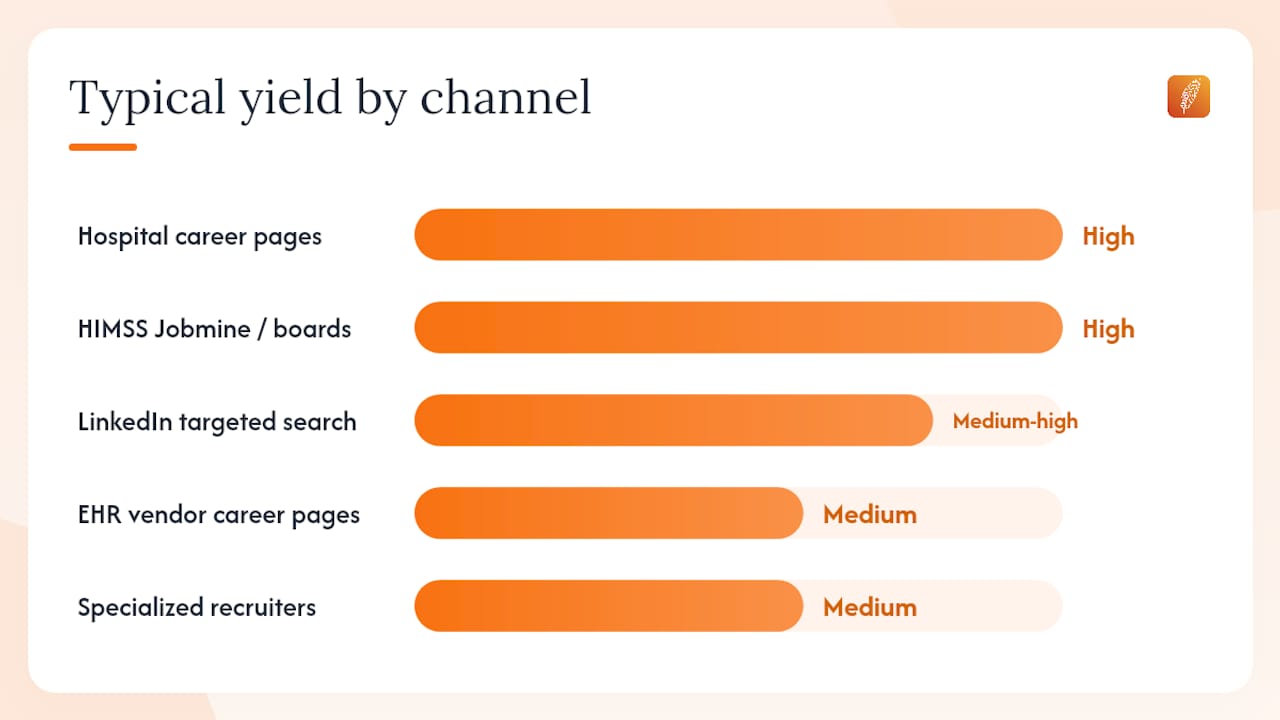
Hospital and health system career pages post roles first, often before they reach any aggregator. Bookmark the careers pages of the top five health systems in your target market and check them every two days. Many, like CVS Health's technology division, also offer talent community sign-ups that push alerts automatically.
HIMSS Jobmine lists roles specifically scoped to health information and technology, from clinical analyst to informatics leadership. The signal-to-noise ratio is far better than a general board.
LinkedIn works best with Premium's advanced filters: set "Healthcare and Hospital" plus "Information Technology" as industries, add title keywords, and save the search. Recruiters actively post here, and many hiring managers respond to cold connection requests when the message is specific.
EHR vendor career pages (Epic Systems, Oracle Health) carry both internal IT roles and implementation consultant positions that blend clinical and technical work.
Specialized health IT recruiters are slower but surface roles that never get posted publicly. A single well-placed recruiter relationship can unlock three to five unadvertised openings per quarter.
Pro Tip: When a posting lists a hiring manager's name or team lead, use Pluckjobs to pull their contact data and send a brief note before submitting your application. Candidates who reach out directly before applying report faster screening callbacks.
Which job titles should you actually search?
The HIMSS Health Information and Technology job descriptions taxonomy covers dozens of roles. These are the titles with the most active postings:
- Software Developer / Software Engineer (health systems, EHR vendors, digital health startups)
- Data Analyst / Healthcare Data Analyst (payers, ACOs, health systems)
- Systems Administrator (hospitals, managed service providers)
- Health Information Technician (hospitals, physician groups, payers)
- Clinical Informatics Analyst / Clinical Systems Analyst (health systems, academic medical centers)
- Integration Analyst / Interface Engineer (health systems, HIEs)
- Cybersecurity Specialist / Information Security Analyst (health systems, payers, vendors)
- Nurse Informatician / Nursing Informatics Specialist (health systems requiring RN licensure)
- Health IT Project Manager / IT Program Manager (health systems, consulting firms)
For Boolean searches on LinkedIn and job boards, try these queries:
"clinical systems analyst" AND (Epic OR Cerner)"integration analyst" AND (HL7 OR FHIR OR "Epic Bridges")"health IT business analyst" AND HIPAA"nurse informatician" AND (remote OR "Pennsylvania")"healthcare data analyst" AND ("SQL" OR "Power BI") AND HIPAA
Adding domain fluency terms (HIPAA, clinical workflow, FHIR, HL7, Epic) filters out generic IT roles that share the same title but have no healthcare context. For a deeper look at cybersecurity-specific titles within health IT, the cybersecurity job titles guide maps those roles clearly.
How to tailor your resume and beat ATS for healthcare IT roles
Domain-fluent keywords plus measurable outcomes beat a generic technical skills list every time. ATS systems at large health systems score resumes against the exact language in the posting, so mirroring their terminology is not optional.
Keywords that move the needle: Epic, Cerner, HL7 v2.x, FHIR R4, HIPAA, clinical workflow, interoperability, CISSP, CPHIMS, RHIA, Epic Bridges, InterSystems Ensemble. A real posting from UnitedHealth Group, for example, explicitly requires Epic Bridges certification and HL7 v2.x development experience for integration analyst roles. If those terms are in the posting, they must appear in your resume.
Sections ATS reads hardest: Skills Summary (top of resume), Certifications, Tools & Technologies, and the first bullet under each role. Put measurable outcomes in those first bullets:
- "Reduced HL7 interface errors by 34% by redesigning ADT message validation logic in Epic Bridges."
- "Achieved HIPAA compliance for 12 integrated systems ahead of a 90-day regulatory deadline."
"Health IT roles require more than technical proficiency. Candidates who demonstrate an understanding of clinical workflows, patient safety implications, and regulatory requirements stand out in a field where the stakes of a misconfigured interface are measured in patient outcomes." — HIMSS New England
Pro Tip: If you come from a purely technical background, add one line of clinical context per role: "Supported Epic go-live for a 400-bed acute care facility" tells a hiring manager you understand the environment, even without clinical credentials. For hybrid roles like nurse informatician, the Geisinger posting shows exactly how employers weight RN licensure alongside IT experience. AI-assisted resume tools like the approach described in how AI writes job-specific resumes can automate much of this keyword alignment.
How to surface unadvertised roles through outreach
Well-targeted outreach and internal referrals frequently surface roles before they are posted publicly. Health systems fill a meaningful share of IT positions through internal referrals, and a single warm introduction can move you past an ATS entirely.
Where to find contacts:
- LinkedIn: search the target health system + job title to find current team members, then look for the hiring manager or director.
- HIMSS community and chapter events: attendees are often hiring managers or know who is.
- EHR user groups (Epic UserWeb, Oracle Health community): active forums where IT staff discuss open positions.
- Specialized health IT recruiters who work exclusively in this vertical.
Outreach sequence:
- Connect on LinkedIn with a one-line note: "I work in health IT integration and noticed your team uses Epic Bridges. Would love to connect."
- After acceptance, send a short message: "I'm exploring clinical systems analyst roles at health systems in [region]. Your team's work on [specific project or system] caught my attention. Are you open to a 15-minute conversation?"
- Highlight one relevant result: "I recently reduced interface downtime by 40% during an Epic upgrade."
- Ask directly: "Is your team hiring, or could you point me to someone who is?"
Dos and don'ts:
- Do follow up once after two weeks if no reply.
- Do keep every message under five sentences.
- Don't send a generic "I'm looking for opportunities" opener.
- Don't attach your resume in the first message.
How to evaluate a posting quickly and avoid time sinks
Focus on role clarity, required versus preferred qualifications, team context, and whether the posting mentions measurable outcomes. A well-written health IT posting names the EHR, lists the reporting line, and distinguishes "required" from "preferred."
Red flags to skip:
- Responsibilities listed as vague verbs ("support IT initiatives," "assist with projects") with no specifics.
- Skill lists that span 15+ technologies with no clear focus.
- No mention of the EHR environment or integration stack.
- The same posting reappearing every 30–60 days (often signals a retention problem or unrealistic expectations).
Positive signals:
- Names the EHR (Epic, Cerner) and specific modules or certifications.
- Lists stakeholders (clinical informatics team, CMO, nursing leadership).
- Includes a success metric or project scope.
Healthcare generates roughly 1.8 million job openings annually, and a growing share of those openings will be technology-related as health systems continue digitizing care delivery. That volume means you can afford to be selective.
When you get an interview invite, ask: team size, current tech stack, on-call expectations, remote policy, and how success is measured in the first 90 days. Those answers tell you more than the posting does.
What to expect for timelines and salaries in healthcare IT
A typical hiring cycle at a large health system runs four to eight weeks from application to offer: one to two weeks for initial screening, one to two weeks for a technical interview, and one to two weeks for a final panel and offer. Vendor and payer timelines tend to be faster (two to four weeks), while academic medical centers often run longer (six to ten weeks). Senior and executive-level roles at any employer type add another two to four weeks for committee review.
For salary benchmarks, check the Bureau of Labor Statistics Occupational Outlook Handbook for health information technologists and medical records specialists, LinkedIn Salary for specific titles in your metro, and employer-posted ranges (now required in many states). The HIMSS Compensation Survey, published annually, is the most role-specific benchmark for health IT professionals and breaks down compensation by title, experience, and geography.
Health care's roughly 1.8 million annual openings create consistent demand across all experience levels, but technology-specific roles within that pool are growing faster as systems expand digital infrastructure. That context matters when negotiating: you are entering a market with structural demand, not a saturated one.
Key Takeaways
The single most effective approach to finding healthcare IT roles is combining targeted channel searches with domain-fluent keywords and direct hiring-manager outreach.
| Point | Details |
|---|---|
| Start with specialized boards | HIMSS Jobmine and hospital career pages yield the highest-quality health IT postings. |
| Use domain-fluent keywords | Include Epic, HL7, FHIR, HIPAA, and CPHIMS in searches and resumes to filter out irrelevant roles. |
| Outreach before you apply | Contacting hiring managers directly before submitting surfaces unadvertised roles and speeds callbacks. |
| Expect 4–8 week cycles | Health system hiring typically takes four to eight weeks; vendors and payers move faster. |
| Use Pluckjobs for role discovery | Pluckjobs combines SerpAPI role discovery with hiring-manager contact data to reduce sourcing time. |
A focused 2-week search plan for healthcare IT roles
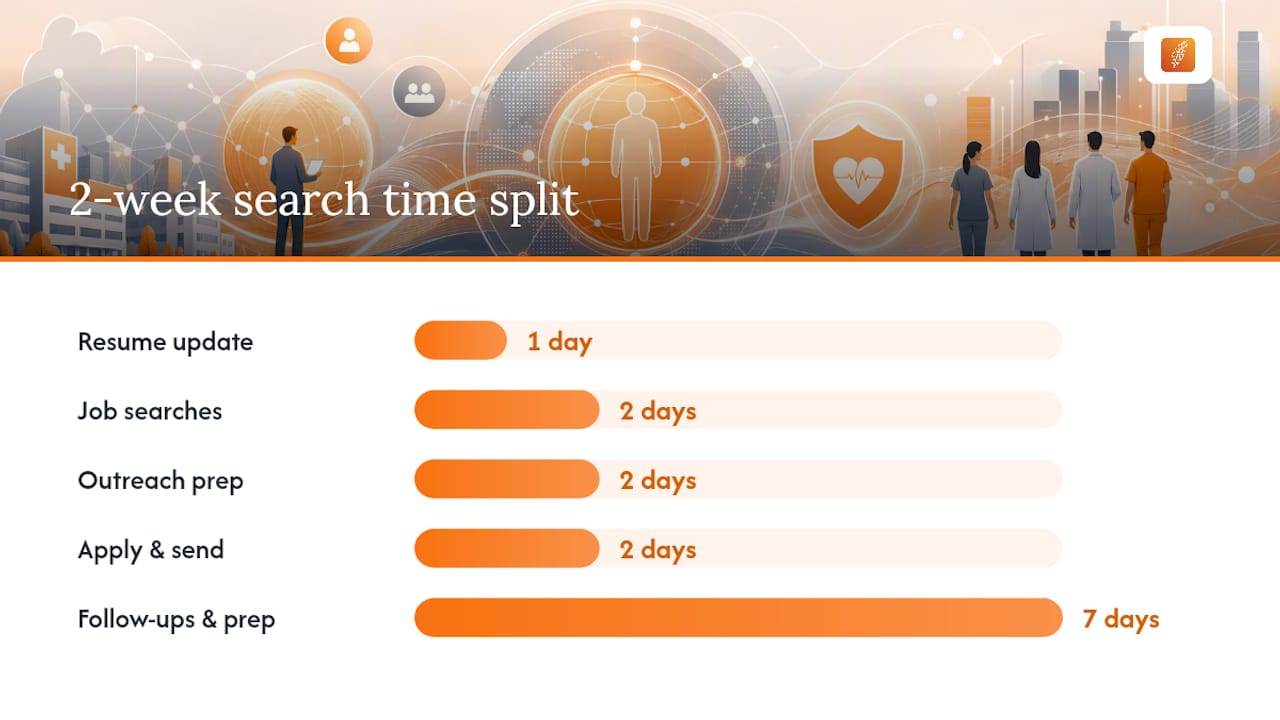
The conventional advice is to "apply broadly and follow up." That approach wastes two weeks. Here is a tighter plan.
Week 1: Build the foundation
- Day 1: Update your resume top section with domain keywords from three real postings. Add one measurable outcome per role.
- Days 2–3: Run Boolean searches on HIMSS Jobmine, LinkedIn, and three target health system career pages. Save searches and set daily alerts.
- Days 4–5: Identify 10 hiring managers or team leads at target employers using LinkedIn. Draft five outreach messages using the sequence above.
- Days 6–7: Send outreach. Apply to the five strongest postings with tailored cover letters that mirror the posting's language.
Week 2: Convert activity into conversations
- Days 8–10: Follow up with any non-responders from week one. Apply to five more roles. Check for new alerts.
- Days 11–12: Prepare for any screening calls. Research the employer's EHR environment and recent system news.
- Days 13–14: Follow up on submitted applications. Expand outreach to HIMSS chapter contacts or EHR user group members.
One personal tip: if you lack direct healthcare experience, lead your outreach message with a transferable outcome ("I reduced system downtime by 40% in a regulated environment") rather than apologizing for the gap. Hiring managers in health IT respond to evidence of rigor, not credentials alone. If you are running this search while employed, the confidential job search guide covers how to keep it discreet.
Pluckjobs cuts your sourcing time for healthcare IT roles
Searching five channels manually, pulling hiring-manager contacts one by one, and rewriting your resume for each posting takes days. Pluckjobs compresses that into a single workflow.
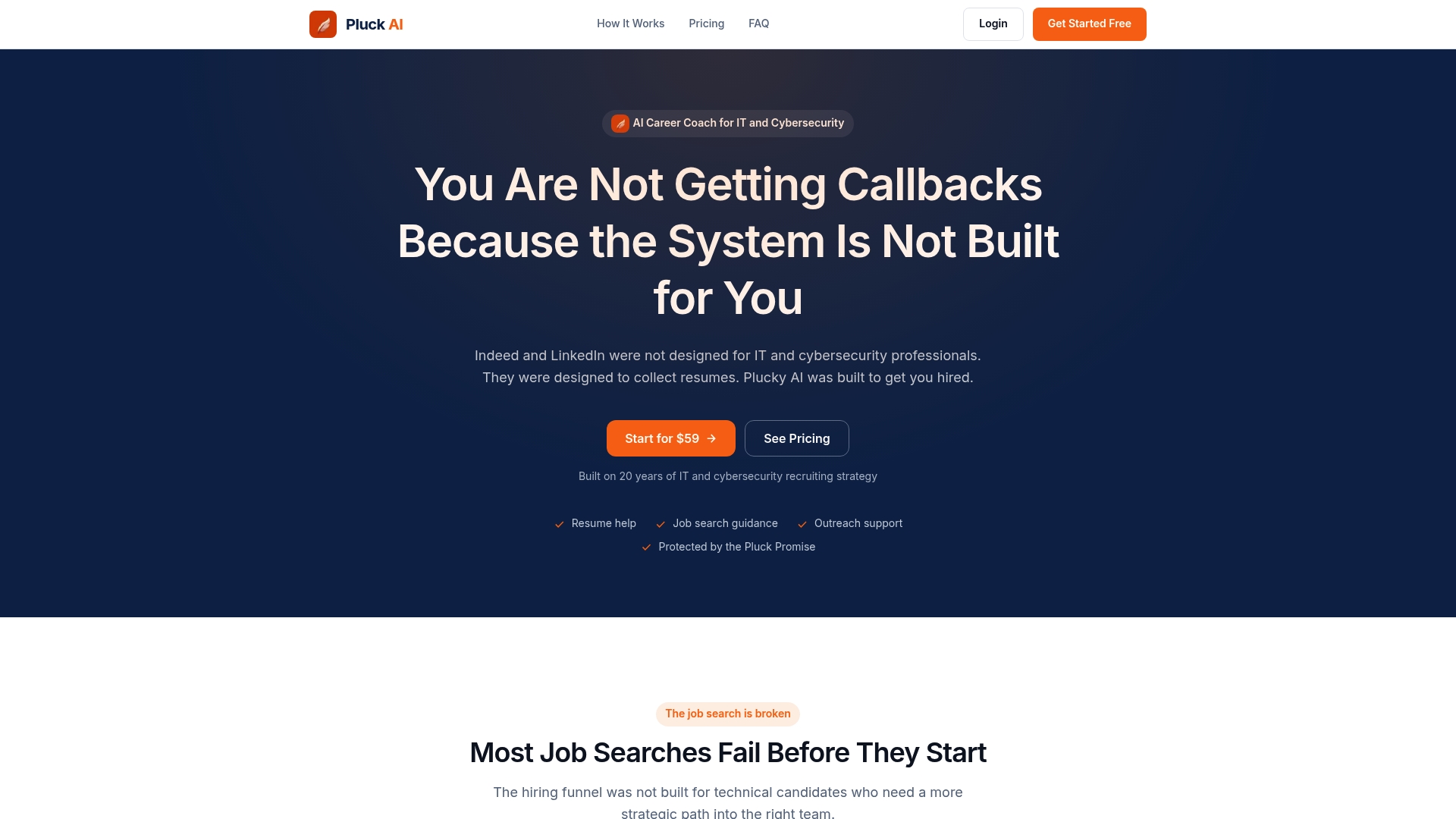
Pluckjobs combines SerpAPI-powered role discovery with Apollo contact intelligence to surface health IT postings and the hiring manager's direct contact in one place. Its AI resume alignment maps your experience to the exact keywords in each posting, including HIMSS taxonomy terms, Epic certifications, and HIPAA-specific language. You get a tailored resume snippet, an outreach template, and the contact to send it to, without the manual sourcing.
The platform is built for IT and cybersecurity professionals who want precision, not volume. For healthcare IT job seekers, that means fewer irrelevant matches and more time spent on roles worth pursuing.
Start your first health IT search on Pluckjobs and run your first query in under five minutes.
Useful sources for your healthcare IT search
The sources below are the highest-signal references for this search. Each one earns its place for a specific reason.
- Health Information and Technology Job Descriptions
- HIMSS New England — Healthcare IT resources
- 7 Important IT Jobs in Health Care
- Jobs, Work & Careers - Healthcare IT Opportunities
- Health IT Business Analyst / Integration Analyst - Remote
- Nurse Informatician IT II (Remote - Pennsylvania) Job in Danville at Geisinger
- Pluckjobs
FAQ
What are the best job boards for healthcare IT roles?
HIMSS Jobmine is the most targeted board for health IT positions. Supplement it with hospital career pages and LinkedIn's industry-filtered search for the broadest coverage.
Which certifications matter most for healthcare IT jobs?
CPHIMS, CISSP, RHIA, and Epic certifications appear most frequently in postings. The right cert depends on your role: CPHIMS for informatics, CISSP for security, Epic credentials for clinical systems work.
How long does a healthcare IT job search typically take?
Most searches run four to eight weeks from first application to offer at a health system. Vendors and payers tend to move in two to four weeks. Senior roles add two to four weeks for committee review.
Do healthcare IT roles require clinical experience?
Most IT-focused roles (developer, analyst, systems administrator) do not require clinical licensure. Hybrid roles like nurse informatician do. Demonstrating familiarity with clinical workflows and HIPAA in your resume compensates for a lack of direct clinical experience in most cases.
How does Pluckjobs help with healthcare IT job searches?
Pluckjobs uses SerpAPI-powered role discovery and Apollo contact intelligence to surface health IT postings and hiring-manager contacts simultaneously, cutting the manual sourcing time that slows most searches.