
The mistakes that stall careers are rarely dramatic. They're quiet habits: staying invisible, skipping skill investment, avoiding the pay conversation, and mistaking being reliable for being recognized. If your title, salary, and responsibilities have not changed over an extended period, one or more of these patterns is likely at work.
You can start reversing course today, not next quarter. Three moves matter most right now:
- Run a 30-minute career audit. List your last four wins, your current skill gaps, and who outside your direct team knows what you actually deliver.
- Update one visible asset. Refresh a LinkedIn headline, resume bullet, or portfolio piece with a specific, measurable outcome.
- Book one strategic conversation. Message your manager or a senior contact this week to ask a direct question about your trajectory.
Small, consistent moves beat sporadic bursts of effort. The Signs Your Career Has Stalled and What They Actually Mean below helps you interpret what you find in that audit, whether the problem sits with you or with the organization around you.
Key Takeaways
Career stagnation results from a specific, correctable set of behaviors: low visibility, stalled learning, weak networks, and avoidance of pay and promotion conversations, not from a lack of ability.
| Point | Details |
|---|---|
| Visibility beats silent performance | Document wins monthly and communicate results directly to decision-makers, not just your immediate manager. |
| Skill investment is non-optional | Block two weekly hours for learning tied to a specific gap in your next target role. |
| Sponsors matter more than mentors | Identify one person willing to advocate for you when you're not in the room. |
| Diagnose before you act | Use the signs checklist to separate personal fixes from structural organizational limits. |
| Follow a sequenced plan | Spread diagnosis, relationship-building, skill work, and the pay conversation across 90 days. |
Table of Contents
- Common Mistakes in Career Stagnation That Quietly Stall Growth
- Signs Your Career Has Stalled and What They Actually Mean
- A 90-Day Plan to Regain Career Momentum
- Myths That Keep Professionals Stuck
- What Career Stagnation Looks Like in Tech, and Where Discovery Tools Help
- Ready to Move Past the Plateau?
- Sources
- FAQ
Common Mistakes in Career Stagnation That Quietly Stall Growth
Most career plateaus trace back to a handful of repeatable behaviors, not a lack of talent. Below are the patterns that show up most often in coaching conversations and workplace research, along with fixes you can act on this month.
1. Waiting to be noticed instead of building visibility
Doing excellent work and assuming it will speak for itself is one of the most common pitfalls in career growth. Leaders reward performance combined with presence: consistently documenting impact and communicating results in ways that build credibility, according to Thrive Global's analysis of workplace psychology. Visibility isn't self-promotion for its own sake. It's a strategic input to how decision-makers form opinions about your readiness for more.
Micro-actions: Send a monthly recap of your wins to your manager. Speak up once per team meeting, even briefly. Volunteer to present results from a project you led.
Who it affects most: Early-career professionals who were taught that "good work speaks for itself" and mid-career professionals who've grown comfortable letting managers advocate on their behalf.
2. Letting your skills stagnate
Skill gaps compound quietly. You don't wake up one day unqualified. You fall behind one missed certification, one skipped course, one ignored industry shift at a time. This is one of the clearest career growth barriers because it's invisible until a promotion or job search forces a comparison against people who kept learning.
Micro-actions: Block two hours weekly for structured learning. Pick one certification or course tied directly to your next role. Ask your manager what skill gap is holding back your next promotion.
Pro Tip: Treat learning hours like meetings. If it's not on the calendar, it competes with everything else and loses.
3. Operating without clear goals or priorities
Ambiguity about what "next" looks like leads to reactive weeks that add up to static years. Without a target, you can't tell whether your daily work moves you forward or just keeps you busy.
Micro-actions: Write one 12-month goal and three supporting quarterly milestones. Review them every two weeks. Share your goal with your manager so it shapes how they assign work.
4. Neglecting your network and sponsors
Performance alone rarely gets professionals into the conversations that shape their future, which is why communities like The Freelance PM Club can help build the network and advocacy needed to advance. Career advancement at senior levels depends heavily on active advocacy from decision-makers, and sponsorship and protected time for growth make the difference, per Psychology Today's coverage of career stalls. A mentor gives advice. A sponsor spends their own credibility recommending you when you're not in the room.
Micro-actions: Identify one potential sponsor inside your organization and one outside it. Schedule a 20-minute coffee chat monthly with someone outside your immediate team. Ask a senior colleague directly what it would take for them to advocate for you.
The importance of networking gets underestimated by exactly the professionals who need it most: high performers who assume competence is enough.
5. Saying yes to everything
Overcommitting feels productive and looks like reliability, but it's often perfectionism wearing a different outfit. Chronic busyness without visible outcomes rarely translates into advancement. It just fills your calendar.

Micro-actions: Before accepting a new task, ask how it connects to your stated goals. Decline or delegate one recurring low-value commitment this month. Track hours spent on visible, high-leverage work versus invisible maintenance work.
6. Avoiding difficult conversations
Skipping the hard conversation, whether it's about scope creep, unclear expectations, or being passed over, keeps problems alive indefinitely. Avoidance feels safer short-term and costs more long-term.
Micro-actions: Prepare three specific talking points before any tense conversation. Schedule the conversation within a week of noticing the issue, not months later. Follow up in writing to confirm what was agreed.
Who it affects most: Mid-career professionals managing up or across, where the stakes of the conversation feel higher and the temptation to wait it out is stronger.
7. Letting your resume and LinkedIn go stale
A weak LinkedIn profile is a missed opportunity that costs you every time a recruiter, hiring manager, or internal decision-maker looks you up, which happens more often than most professionals realize.
Micro-actions: Update your headline to reflect your current focus, not your job title from three years ago. Add one measurable result to your most recent role's description. Refresh your resume's summary section quarterly, even if you're not job hunting.
8. Never asking for the promotion or negotiating pay
Organizations rarely offer more money or more scope unless someone asks. Waiting for recognition to arrive unprompted is one of the strategies for career progression that simply doesn't work in most organizations, however fair that feels.
Micro-actions: Document your impact in dollar or percentage terms whenever possible. Schedule a formal conversation about promotion timelines, not just performance reviews. Research market pay ranges for your role before any negotiation.
9. Confusing being reliable with being visible
Being the person everyone trusts to quietly get things done is valuable, but it can become a trap. Treating your current employer as a permanent safety net, without maintaining a pipeline of relationships or staying visible, is a recurring mid-career blind spot documented by Forbes Coaches Council. Reliability keeps you employed. It doesn't automatically get you promoted.
10. Burnout and losing excitement for the work
When responsibilities feel identical to last year and enthusiasm has faded, that dulled excitement is itself a mistake, because it often leads to disengaged, low-visibility work that reinforces the plateau. Job search burnout and career burnout share the same core symptom: motion without momentum.
Micro-actions: Take a genuine break before making any major career decision. Identify which specific tasks drain you versus energize you. Talk to someone outside your organization about what you actually want next.
11. Mistaking comfort for stability
Comfort and stability aren't the same thing. A comfortable role can be one bad quarter away from instability if you haven't built skills, relationships, or visibility outside it. This overlaps directly with overcoming professional plateaus: the plateau often feels fine right up until it doesn't.
Micro-actions: Ask yourself honestly whether you'd stay in your current role if the pay stayed flat for three more years. Build one skill or relationship this quarter that has nothing to do with your current job security.
12. Failing to communicate impact in business terms
Describing your work in tasks completed rather than outcomes achieved makes it hard for decision-makers to see your value. "I managed the migration" says less than "I led a migration that cut downtime by 40 percent."
Micro-actions: Rewrite three resume bullets using numbers or measurable outcomes. Practice a 60-second summary of your biggest project's business impact. Use that language in your next one-on-one.
Signs Your Career Has Stalled and What They Actually Mean
Stagnation shows up in patterns you can actually observe, not just a vague feeling of being stuck. Watch for these signals:
- Your pay hasn't changed meaningfully in over a year despite strong performance reviews.
- Your core responsibilities look the same as they did 12 months ago.
- You've been passed over for promotion more than once without a clear explanation.
- You haven't been offered a stretch project, a new client, or a cross-functional assignment recently.
- Decision-makers two levels up wouldn't recognize your name if it came up in a meeting.
- Your professional network has gone quiet: no new contacts, no recent conversations with people outside your team.
Two questions help separate what's fixable from what isn't. First: is this within my control? Low visibility, a stale resume, and an underdeveloped network are yours to fix. Second: is this structural? A frozen budget, a flat organizational chart, or a hiring freeze limits everyone, regardless of individual effort.
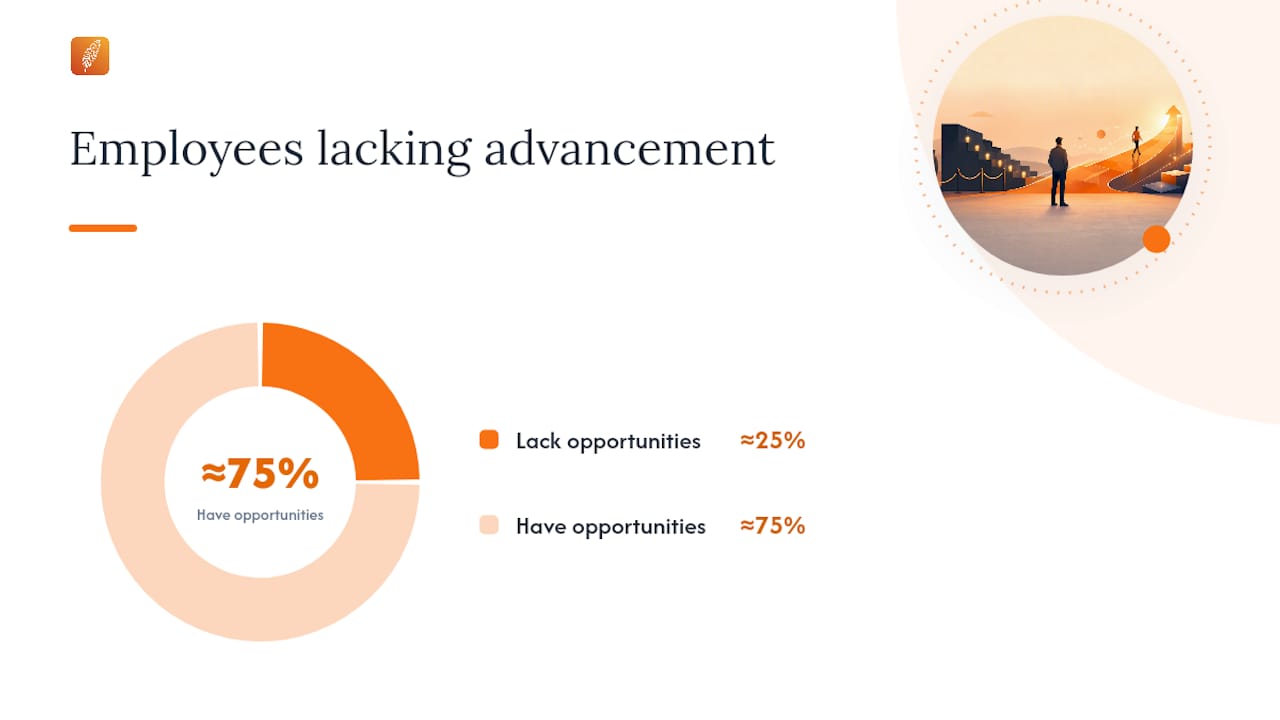
Nearly one in four American employees report they lack opportunities for career advancement, according to Gallup research on workplace advancement, and the same data links mentorship and training participation to higher job satisfaction. If your organization sits in that structural category, the fix may involve seeking mentorship internally or understanding your career trajectory well enough to know when a lateral or external move makes more sense than waiting.
A 90-Day Plan to Regain Career Momentum
Fixing career stagnation works best as a sequence, not a scramble. Spreading diagnosis, relationship-building, skill investment, and the compensation conversation across three months keeps the plan realistic instead of overwhelming.
- Month 1: Diagnose and stabilize. Complete your career audit, update your LinkedIn headline and one resume bullet, schedule a conversation with your manager about growth expectations, and secure one visibility slot, such as presenting at a team meeting.
- Month 2: Invest and connect. Start a course or certification tied to a specific skill gap, hold three strategic outreach conversations with people outside your immediate team, and identify a potential mentor or sponsor.
- Month 3: Deliver and negotiate. Lead or contribute visibly to one project with a measurable outcome, document that impact in concrete terms, and prepare your case for a promotion or raise conversation, or begin an external search if internal movement stays blocked.
Track your progress weekly with a short check-in against four simple metrics:
- Number of visible projects led or contributed to
- New professional contacts made
- Learning hours logged
- Documented, quantified impact statements ready for a resume or review
Ninety days won't fix a structurally frozen organization, but it will tell you clearly whether the block is behavioral or organizational, which is exactly the distinction you need before deciding your next move.
Myths That Keep Professionals Stuck
Certain beliefs feel reasonable but quietly reinforce the exact mistakes hindering advancement. Each one deserves a specific counter-behavior, not just a mental note to "try harder."
- "If I'm good, they'll notice." Reframe: visibility is a skill, not a personality trait. Start a monthly impact update to your manager this week.
- "I need to be fully ready before I ask for more." Reframe: readiness is judged partly on initiative, not just credentials. Ask for one stretch assignment before you feel completely prepared.
- "Loyalty guarantees promotion." Reframe: tenure and advancement are only loosely connected. Schedule a direct conversation about promotion criteria and timelines.
- "Comfort equals success." Reframe: comfort can mask stagnation until it becomes risk. Build one new skill or relationship this quarter outside your comfort zone.
What Career Stagnation Looks Like in Tech, and Where Discovery Tools Help
Technical roles have their own flavor of stagnation. Engineers and security professionals often fall into what amounts to technical tunnel vision: deepening one narrow skill set while their resume and LinkedIn profile quietly fall out of sync with how the market actually describes the roles they'd qualify for next. A stale profile isn't a cosmetic problem in IT and cybersecurity hiring. It's often the first filter that keeps a qualified candidate out of a recruiter's search results entirely.
Common IT job search mistakes tend to compound the general patterns covered above: cold-applying to dozens of listings instead of identifying the specific hiring manager behind a role, or relying on LinkedIn alone when most outreach in technical hiring happens through more targeted channels. When outreach is built around actual role discovery and direct hiring manager contact rather than generic applications, the dynamic shifts from waiting to be noticed toward actively surfacing the right opportunities before they're buried in an applicant pool.
— Diego
Ready to Move Past the Plateau?
Recognizing these mistakes is only half the work. The other half is acting on them with the right tools and the right people in your corner. Pluckjobs was built specifically for IT and cybersecurity professionals who are done cold-applying and ready to find the actual role and the actual hiring manager behind it, combining precision job matching with hiring manager outreach data and tailored resumes in one platform.
If your career audit revealed a stale resume, a thin network, or a job search that's going nowhere despite real effort, Pluckjobs gives you the outreach data and resume tools to fix that directly, rather than waiting for the market to notice you on its own.
If you're still deciding whether a job change makes sense compared to fixing things internally, the Pluckjobs platform is worth exploring as a next step once you've worked through the 90-day plan above.
Sources
- Common Mid-Career Mistakes That Limit Advancement And Growth – Forbes Coaches Council
- Why Women Get Stuck in Their Careers (and How to Move Again) | Psychology Today
- One in four employees report they lack advancement opportunities — Gallup
- Why Smart, Hardworking People Get Stuck — Thrive Global
FAQ
How do you know if your career is stagnating?
Watch for flat pay, unchanged responsibilities over 12 months, repeated promotion denials, and a network that's gone quiet. If several signs overlap for more than two review cycles, treat it as an active problem rather than a phase.
What is the 3-month rule for jobs?
The 3-month rule generally refers to giving a new role at least 90 days before judging whether it's the right fit, since onboarding, ramp-up, and true responsibilities usually take that long to become clear. It's also a reasonable window for testing whether a stagnation fix, like the 90-day plan above, is working.
What are common signs it's time to consider leaving a job?
Repeated signs include stalled pay, no new responsibilities, being passed over for promotion, a shrinking network, and a manager who can't offer a clear growth path when asked directly. When those signs persist after you've tried the fixes in this article, an external search becomes a reasonable next step.
Can burnout cause career stagnation even if I'm performing well?
Yes. Burnout often produces disengaged, low-visibility work even when output stays technically solid, which can quietly reinforce a plateau. Addressing burnout recovery directly is usually a precondition for any other fix to stick.