
TL;DR:
- Career coaching is a structured, goal-oriented process aimed at achieving specific career outcomes within a limited timeframe, whereas mentoring is an informal, long-term relationship focused on broad personal and professional growth. Coaching provides targeted, measurable results through direct feedback and tactical support, while mentoring offers experiential guidance and network expansion based on lived experience.
- Many professionals benefit from both simultaneously, with coaching addressing immediate job search needs and mentoring fostering strategic development and industry insights.
Career coaching is defined as a structured, goal-oriented, time-bound process where a trained professional helps you identify and achieve specific career outcomes, while mentoring is an informal, long-term relationship in which an experienced individual shares wisdom and guidance drawn from their own career path. Understanding the difference between coaching and mentoring is not a matter of preference. It determines whether you get the right support for your situation. Professionals who confuse the two often end up in a mentoring relationship when they need tactical job search help, or pay for coaching when what they actually need is a trusted advisor who has walked their exact path. Both have distinct roles, and both deliver real results when applied correctly.
What are the key differences between career coaching and mentoring?
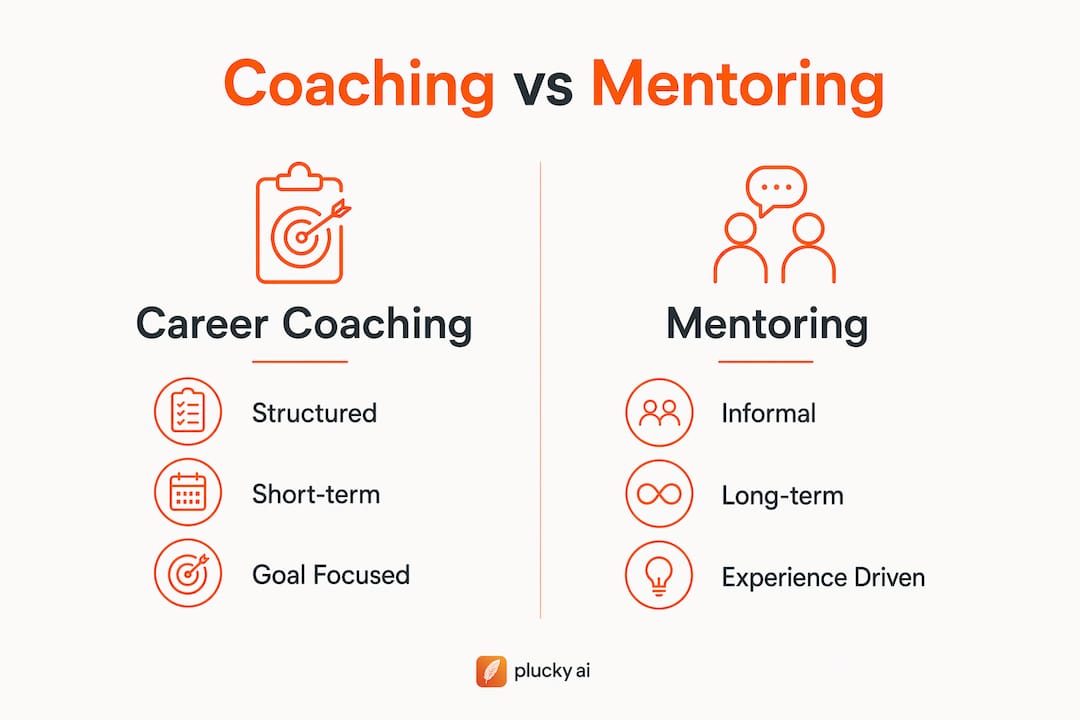
Coaching is a structured, time-bound process focused on specific goals, while mentoring is an informal, long-term relationship centered on personal and career growth. That single distinction shapes everything else about how each relationship works, what you bring to it, and what you get out of it.

Structure and duration
A coaching engagement typically runs three to six months, with scheduled sessions, defined objectives, and measurable outcomes. Mentoring has no fixed end date. It evolves organically, sometimes spanning years, and the agenda shifts as your career does. Mentoring relationships emphasize empathy and role modeling over fixed timelines or deliverables, which makes them less predictable but often more personally meaningful.
Roles and responsibilities
A coach acts as a neutral facilitator. They do not tell you what to do. Instead, they use structured questioning to help you discover your own answers and build self-awareness. Coaches help clients find internal solutions, whereas mentors offer external guidance based on their own career experience. A mentor is an experienced individual who shares knowledge within a relationship built on mutual trust. They give advice. They tell you what worked for them. They warn you about mistakes they made.
Feedback style
This is where the practical difference becomes most visible. Coaches provide objective, often challenging reviews as part of their role, including blunt resume critiques and direct interview feedback. Mentors tend to avoid harsh negative feedback. They offer encouragement and perspective, but rarely the kind of candid critique that a paid coach is expected to deliver.
| Factor | Career coaching | Mentoring |
|---|---|---|
| Duration | Short-term (3 to 6 months) | Long-term (months to years) |
| Structure | Formal, scheduled sessions | Informal, evolving conversations |
| Role | Neutral facilitator | Experienced guide and advisor |
| Focus | Specific goals and performance | Broad career and personal growth |
| Feedback | Direct and challenging | Supportive and advisory |
| Credentials | Formal training often required | Experience-based, no formal credential |
What are the benefits of career coaching for professionals and job seekers?
Career coaching produces measurable, documented outcomes that generic job searching does not. Coached professionals secure roles in an average of three to four months, compared to the six to seven month industry average for independent job seekers. That gap represents real income, real momentum, and real competitive advantage in a tight market.
The financial case is equally clear. Professionals who work with career coaches negotiate salaries 10 to 15% higher than those who negotiate without coaching support, and the typical return on investment for coaching is five to seven times the initial cost. For IT and cybersecurity professionals, where compensation packages are already substantial, even a modest percentage improvement in negotiation outcomes pays for coaching many times over.
Beyond the numbers, coaching delivers psychological benefits that are harder to quantify but equally real. Coaching reduces professional isolation by providing an objective perspective, which helps clients validate their experiences and reduce career anxiety. This matters especially for professionals in technical roles who often lack peers they can speak candidly with about career uncertainty.
Key career coaching benefits include:
- Targeted job search strategy. Coaching replaces broad, unfocused applications with a precise, value-focused approach aligned to your strengths and target roles.
- Confidence and communication skills. Studies show 85% of coaching clients report increased self-confidence, and 75% report improved communication and work performance.
- Career transition support. Coaches are particularly effective when you are pivoting industries, moving into leadership, or re-entering the market after a gap.
- Accountability. Coaching requires active participation and client preparation, including resumes, documented goals, and specific pain points. That structure keeps you moving.
Pro Tip: When selecting a career coach, prioritize industry-specific expertise over general credentials. A coach with a track record in IT or cybersecurity hiring will understand the technical screening process, compensation benchmarks, and role discovery channels that a generalist coach simply does not.
For IT professionals specifically, the long-game job search strategy that combines coaching with targeted outreach consistently outperforms cold applications.
What are the benefits of mentoring for career growth and development?
Mentoring delivers what coaching cannot: lived experience from someone who has already navigated the terrain you are entering. A mentor who spent fifteen years in cybersecurity leadership can tell you which certifications actually matter to hiring managers, which companies have toxic cultures despite strong employer branding, and which career moves look good on paper but stall progression in practice. That kind of insight is not available in any structured coaching program.
Mentoring fosters an environment to gain industry insights, explore career paths, and build networks over time. The network benefit alone is significant. A well-connected mentor in your field can introduce you to hiring managers, recommend you for roles before they are posted, and vouch for your capabilities in ways that no resume can replicate.
The benefits of mentoring for career growth include:
- Real-world industry knowledge. Mentors share the unwritten rules of your field, including which skills are actually valued versus which are listed on job descriptions as filler.
- Expanded professional network. Access to a mentor's network can open doors that cold outreach never reaches.
- Emotional support and perspective. Mentors provide encouragement during setbacks and help you maintain a long-term view when short-term frustrations feel overwhelming.
- Pitfall avoidance. An experienced mentor has made the mistakes you are about to make. Their guidance helps you skip the most costly ones.
- Role modeling. Seeing how a successful professional in your field thinks and operates shapes your own professional identity in ways that structured coaching does not.
The informal and evolving nature of mentoring is a feature, not a limitation. As your career develops, the relationship adapts. A mentor who guided you through your first leadership role may later become a peer, a collaborator, or a professional reference. That longevity creates compounding value that short-term coaching engagements cannot replicate.
How to decide whether career coaching or mentoring is right for you
The right choice depends on where you are in your career and what specific outcome you need right now. These are not mutually exclusive options. Many professionals benefit from both simultaneously, using a coach for tactical job search execution and a mentor for strategic career perspective.
Choose career coaching when:
- You need a job within a defined timeframe and your current approach is not working.
- You are preparing for a high-stakes interview or salary negotiation.
- You are pivoting into a new industry or role type and need a structured transition plan.
- You want objective, candid feedback on your resume, LinkedIn profile, or personal brand.
- You need accountability to take consistent action rather than just planning.
Choose mentoring when:
- You are early in your career and need guidance on which direction to pursue.
- You want to understand the unwritten rules of a specific industry or company type.
- You are seeking a long-term relationship with someone who has achieved what you want to achieve.
- You want to expand your professional network through trusted introductions.
- You need perspective and encouragement during a difficult career period.
Effective coaching depends on industry-specific expertise and coaching methodology, so vetting a coach's track record in your specific sector is non-negotiable before you commit. The same principle applies to mentors. A mentor whose career peaked in a different era or a different industry may offer advice that is well-intentioned but misaligned with current market realities.
Pro Tip: Before approaching a potential mentor, research their career trajectory on LinkedIn and identify two or three specific decisions they made that you want to understand better. Arriving with specific questions signals respect for their time and dramatically increases the likelihood they will agree to the relationship.
A common misconception is that mentoring is free and therefore lower value than paid coaching. The reality is that a strong mentoring relationship requires more sustained effort and mutual investment than a coaching engagement. The absence of a financial transaction does not make it casual.
Practical applications: what coaching and mentoring look like in practice
A typical coaching engagement for an IT professional might begin with a discovery session where the coach reviews your resume, LinkedIn profile, and documented career goals. Sessions then focus on specific deliverables: a revised resume targeting a defined role category, a structured outreach strategy to hiring managers, and interview preparation for technical and behavioral questions. The client arrives at each session with prepared materials and leaves with specific actions to complete before the next meeting. Coaching engagements are transactional in the best sense. Both parties know what success looks like and work toward it deliberately.
A mentoring relationship looks entirely different. Consider a cybersecurity analyst who connects with a CISO through a professional association. Their first few conversations are exploratory. The mentor shares how they moved from technical roles into leadership, which mistakes they made, and what they wish they had known earlier. Over time, the mentor reviews the mentee's career decisions, makes introductions to their network, and provides perspective when the mentee faces difficult choices. There is no fixed agenda, no deliverables, and no defined endpoint.
| Support type | Typical duration | Client preparation | Primary outcome |
|---|---|---|---|
| Career coaching | 3 to 6 months | Resume, goals, pain points | Job placement, skill improvement |
| Mentoring | 1 to 5 years | Relationship building, questions | Career direction, network, perspective |
Technology platforms now facilitate both. AI-powered tools like Pluckjobs help IT and cybersecurity professionals execute the tactical elements that coaching addresses: identifying target roles, surfacing hiring manager contact data, and generating tailored resumes. Mentoring platforms connect professionals with experienced guides in their specific field. The two approaches work best when they address different layers of your career development at the same time.
Key takeaways
Career coaching and mentoring are distinct tools that serve different career development needs, and using the right one at the right time produces significantly better outcomes than treating them as interchangeable.
| Point | Details |
|---|---|
| Coaching is structured and time-bound | Expect defined sessions, specific deliverables, and measurable outcomes within three to six months. |
| Mentoring is long-term and experiential | Mentors share lived experience and networks over years, not weeks. |
| Coaching delivers faster job placement | Coached professionals land roles in three to four months versus six to seven months independently. |
| Vet both coaches and mentors carefully | Industry-specific expertise determines whether the support actually matches your career stage and sector. |
| Combining both is often the strongest approach | Use coaching for tactical execution and mentoring for strategic perspective simultaneously. |
Why most professionals wait too long to get either
I have worked with IT and cybersecurity professionals at every career stage, and the pattern I see most often is not choosing the wrong support. It is waiting too long to seek any support at all. The assumption is that career development is something you figure out on your own, through trial and error, over years. That assumption is expensive.
The professionals who advance fastest are not necessarily the most technically skilled. They are the ones who get objective feedback early, build relationships with people who have already solved the problems they are facing, and take deliberate action rather than hoping the right opportunity appears. Coaching accelerates that process. Mentoring deepens it.
What I find most people overlook is the feedback gap. Most professionals receive almost no candid feedback on how they present themselves, how they negotiate, or how their career narrative reads to an outside observer. A coach fills that gap directly. A mentor fills it indirectly, through the lens of their own experience. Both perspectives are worth having, and neither is a substitute for the other.
The uncomfortable truth is that most professionals who say they cannot afford a career coach are calculating the cost of coaching against their current salary rather than against the salary they would earn with better positioning. That math rarely works in favor of going it alone.
— Diego
How Pluckjobs supports your career development
Pluckjobs is built for IT and cybersecurity professionals who are done with cold applying and ready to execute a targeted job search. The platform combines Apollo contact intelligence with SerpAPI-powered role discovery to surface precision job matches and the hiring manager outreach data you need to get in front of the right people. Pluckjobs also generates tailored resumes aligned to specific roles, so the tactical work that a career coach would guide you through is built directly into the tool. Whether you are working with a coach, building a mentoring relationship, or navigating your search independently, Pluckjobs gives you the infrastructure to move faster and apply smarter.
FAQ
What is the main difference between career coaching and mentoring?
Career coaching is a structured, time-bound process focused on specific goals and measurable outcomes, while mentoring is an informal, long-term relationship where an experienced professional shares guidance and lived experience. The core distinction is that coaches facilitate self-discovery through structured questioning, while mentors offer direct advice based on their own career path.
How long does career coaching typically last?
A standard career coaching engagement runs three to six months, with scheduled sessions and defined deliverables. Coached professionals secure roles in an average of three to four months, compared to six to seven months for independent job seekers.
Do I need a certified coach or can any professional mentor me?
Career coaches often hold formal credentials and use structured methodologies, while mentors rely on experience-based expertise with no formal certification required. For coaching, verify industry-specific track record and methodology before committing. For mentoring, prioritize relevant career experience and genuine willingness to invest time in the relationship.
Can I have a coach and a mentor at the same time?
Yes, and many professionals benefit from both simultaneously. A coach addresses tactical, near-term goals like job search strategy and interview preparation, while a mentor provides long-term career perspective and network access. The two roles complement rather than duplicate each other.
How do I find a qualified career coach for IT or cybersecurity roles?
Look for coaches with documented experience placing professionals in your specific sector, not just general career coaching credentials. Ask for references from clients at your career stage, and confirm they understand the technical screening processes and compensation benchmarks relevant to IT and cybersecurity hiring in 2026.