
TL;DR:
- Preparing for a technical interview requires building coding, system design, and communication skills simultaneously. Candidates often overlook the importance of explaining their thinking clearly to succeed during live sessions.
Preparing for a technical interview means systematically building three skills at once: coding proficiency, system design reasoning, and the ability to explain your thinking under pressure. Most IT job seekers underestimate that last skill. A correct solution delivered in silence can still cost you the offer. The standard preparation window is 4–6 weeks for experienced engineers, and 8–12 weeks for career changers or those returning after a gap. Starting with a clear plan separates candidates who get offers from those who grind without direction.
What are the core skills to master for technical interviews?
Technical interviews test four distinct areas, and each one requires a different preparation approach. Knowing which area to prioritize first saves weeks of wasted effort.
Coding and data structures form the foundation of most rounds. Interviewers focus on medium-difficulty algorithm problems covering arrays, strings, trees, graphs, hash maps, and dynamic programming. The goal is not to memorize solutions. The goal is to recognize which pattern applies to a new problem you have never seen before.
System design rounds appear at mid to senior levels. These sessions evaluate your ability to clarify requirements, estimate scale, define APIs, and discuss architectural trade-offs. A candidate who can explain why they chose a message queue over a direct API call demonstrates real engineering judgment.
Project deep-dives are underestimated by most candidates. Interviewers ask you to walk through past work with technical depth. They want to hear about the architecture, the tech stack decisions, and the specific challenges you solved. If you cannot explain a project at that level, remove it from your resume before the interview.
Behavioral rounds use the STAR method: Situation, Task, Action, Result. The most common mistake is preparing a memorized script. Interviewers probe beyond scripts to test whether your story is real. Prepare flexible stories that you can adapt when the follow-up questions shift direction.
- Arrays, strings, linked lists, stacks, queues
- Trees, graphs, heaps, tries
- Sorting, searching, recursion, dynamic programming
- System design: scalability, fault tolerance, APIs, databases
- Behavioral: STAR method with measurable outcomes
Pro Tip: Focus on understanding problem patterns rather than memorizing solutions. Solving 100–150 carefully selected problems with pattern recognition outperforms grinding hundreds of random questions.
How should you structure your preparation timeline?
A structured timeline prevents the two most common failures: running out of time before covering system design, and burning out from unstructured daily grinding. The right schedule depends on your starting point and target company tier.
- Weeks 1–2: Fundamentals. Cover core data structures and basic algorithms. Solve easy problems to build fluency before touching medium difficulty.
- Weeks 3–4: Pattern fluency. Work through medium problems grouped by pattern type. Sliding window, two pointers, BFS/DFS, and dynamic programming each deserve dedicated days.
- Week 5: Timed mock sessions. Simulate real interview conditions. Set a 35-minute timer per problem and narrate your thinking aloud the entire time.
- Week 6: System design and behavioral. Practice designing systems like a URL shortener, a chat application, or a news feed. Rehearse your STAR stories with a peer or out loud to yourself.
The right problem volume depends on your target. Aim for 75 problems minimum for basic readiness, 150 for solid preparation, and 250–350 if you are targeting top-tier companies. Volume without pattern awareness is wasted time.
| Preparation level | Problem count | Timeline |
|---|---|---|
| Minimum viable | 75 problems | 4 weeks |
| Solid preparation | 150 problems | 6 weeks |
| Top-tier companies | 250–350 problems | 8–12 weeks |
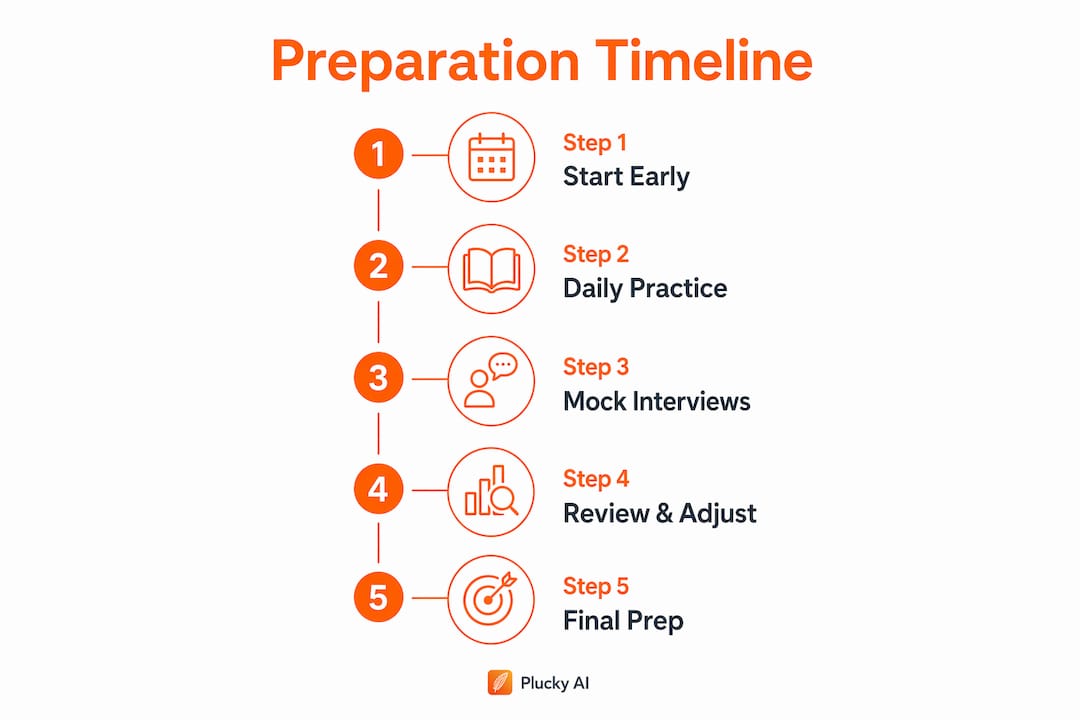
Daily consistency matters more than session length. 1–2 hours of daily practice beats a six-hour Saturday session followed by three days of nothing. Your brain consolidates problem patterns during rest, not during the grind itself.
Pro Tip: Schedule at least two live mock interviews per week during weeks 5 and 6. Verbalizing your thought process with another person present is a different skill than solving problems alone. Build that muscle early.
You can also review the IT job interview question types that appear most frequently across different company tiers to prioritize your study list.
What techniques improve live coding performance?
Live coding performance is a communication skill as much as a technical one. The four-phase narration structure gives you a repeatable framework for every problem you face.
- Clarify. Restate the problem in your own words. Ask about input constraints, edge cases, and expected output format before writing a single line of code.
- Brute force. Describe the simplest solution first, even if it is slow. A correct O(n²) solution is often valued over an incomplete O(n) attempt. Interviewers want to see your reasoning process.
- Optimize. Walk through your improvement out loud. Explain why you are switching from a nested loop to a hash map, or from recursion to an iterative approach.
- Analyze. State the time and space complexity of your final solution. Test it with a normal case, then with edge cases like empty input, single elements, or maximum values.
Silence is the single biggest mistake candidates make during live coding. Live coding examiners listen carefully for verbalized reasoning. Silence signals confusion, even when the code on screen is correct. If you are stuck, say what you are thinking: "I know I need to track the maximum so far, but I am not sure yet whether a stack or a simple variable is the right structure here." That sentence alone keeps the interviewer engaged and shows real problem-solving behavior.
Handling stuck moments productively is a skill you must practice deliberately. Candidates who go quiet for more than 30 seconds lose points fast. Verbalizing stuck moments keeps the conversation alive and often triggers your own breakthrough.
How to prepare for system design and project deep-dives
System design rounds reward structured thinking over raw knowledge. The candidate who follows a clear framework consistently outperforms the one who knows more facts but presents them without order.
- Clarify requirements. Ask whether the system needs to prioritize reads or writes, what the expected user volume is, and what the latency requirements are. Never assume.
- Estimate scale. Calculate rough numbers: requests per second, storage needs, and bandwidth. These estimates drive every architectural decision that follows.
- Define the API. Sketch the core endpoints or interfaces before drawing any infrastructure. This forces clarity on what the system actually does.
- Draw high-level architecture. Place the major components: load balancers, application servers, databases, caches, and message queues. Explain why each component exists.
- Discuss trade-offs. Address consistency versus availability, SQL versus NoSQL, and synchronous versus asynchronous processing. Common design topics include URL shorteners, messaging systems, rate limiters, and notification systems.
For iOS and mobile-focused roles, the same framework applies with platform-specific constraints. A strong resource for system design trade-offs in technology interviews covers how these decisions shift when mobile clients are part of the architecture.
Project deep-dives follow a parallel structure. Explain the architecture, the tech stack choices, and the specific technical challenges you faced. Candidates who cannot explain a project at that depth should remove it from their resume entirely. Listing a project you cannot defend in detail is a liability, not an asset.

| System design component | What interviewers evaluate |
|---|---|
| Requirements clarification | Ability to scope and define the problem |
| Scale estimation | Quantitative reasoning and engineering judgment |
| API definition | Clarity of system boundaries |
| Architecture diagram | Component selection and justification |
| Trade-off discussion | Depth of engineering experience |
What does an effective interview day checklist look like?
Interview day execution determines whether your preparation converts into an offer. Technical readiness alone is not enough if your setup fails or your nerves derail your communication.
- The night before: Sleep at least seven hours. Review your STAR stories once, then stop studying. Last-minute cramming raises anxiety without adding knowledge.
- Technical setup: Test your internet connection, camera, and microphone at least one hour before the interview. Have a backup connection ready, whether that is a phone hotspot or a different network.
- During coding rounds: Start coding only after you have clarified the problem and stated your approach. Narrate constantly. Manage your time by checking the clock at the halfway point.
- During behavioral rounds: Use the STAR method, but keep answers under two minutes. Authentic stories with measurable outcomes land better than polished but vague responses.
- After the interview: Request feedback regardless of the outcome. Each session is data. Candidates who build a feedback loop improve faster than those who treat each interview as a one-time event.
Pro Tip: Drink water before and during the interview. Dehydration increases cognitive fatigue and slows verbal processing. It sounds trivial, but physical state directly affects how clearly you explain your reasoning.
Understanding how interview prep tools work for IT job seekers can also help you build a more consistent feedback loop between practice sessions and real interviews.
Key Takeaways
Effective technical interview preparation combines consistent daily practice, structured problem-solving frameworks, and deliberate communication training across coding, system design, and behavioral rounds.
| Point | Details |
|---|---|
| Start with a timeline | Plan 4–6 weeks for experienced engineers, 8–12 weeks for career changers. |
| Target the right volume | Aim for 75 problems minimum, 150 for solid prep, 250–350 for top-tier roles. |
| Use the four-phase framework | Clarify, brute force, optimize, and analyze every problem out loud. |
| Never stay silent | Verbalizing stuck moments keeps interviewers engaged and shows real reasoning. |
| Prepare system design separately | Practice requirements, scale estimation, and trade-off discussion as a distinct skill set. |
The part most candidates get wrong
The technical interview is a performance, and most candidates prepare for the wrong show. They grind hundreds of problems in silence, then walk into a live session and freeze the moment an interviewer asks a follow-up question.
Silence is the real failure mode. I have watched technically strong candidates lose offers because they stopped talking the moment they hit uncertainty. The interviewer does not know what is happening inside your head. They only know what you say. A candidate who narrates a wrong approach confidently and then self-corrects looks far stronger than one who solves the problem correctly but says nothing for four minutes.
The other mistake I see constantly is treating system design as a senior-level concern. Junior candidates who can discuss trade-offs, even at a basic level, stand out immediately. You do not need to design Twitter from scratch. You need to show that you think about why architectural decisions exist, not just what they are.
Behavioral storytelling is the third area where preparation falls apart. Memorized answers are easily detected by experienced interviewers. The fix is not to memorize better. The fix is to understand your own stories well enough to answer any follow-up naturally. Prepare the skeleton, not the script.
The candidates who succeed treat every mock session as a real interview and every real interview as data for the next one. That mindset compounds faster than any study plan.
— Diego
Pluckjobs can accelerate your interview readiness
Landing the interview is only half the challenge. Converting it into an offer requires practice with real feedback, not just solo problem-solving.
Pluckjobs combines AI-powered role discovery with personalized career tools built specifically for IT and cybersecurity professionals. The Plucky AI platform delivers mock interview sessions, personalized preparation plans aligned to your target companies, and resume optimization that gets you more interview calls in the first place. You practice the right problems for the right roles, with feedback that tells you exactly where your narration or structure breaks down. No generic prep. No cold applying. Find the role, prepare for it precisely, and get hired.
FAQ
How long should I prepare for a technical interview?
Most experienced engineers need 4–6 weeks of consistent daily practice. Career changers or candidates returning after a gap should plan for 8–12 weeks.
How many problems should I solve before a coding interview?
Target 75 problems for minimum readiness, 150 for solid preparation, and 250–350 if you are applying to top-tier companies. Pattern recognition matters more than raw volume.
What is the STAR method in behavioral interviews?
STAR stands for Situation, Task, Action, and Result. Use it to structure behavioral answers with a clear narrative arc and a measurable outcome.
What are the most common system design topics?
Interviewers frequently ask candidates to design a URL shortener, a messaging system, a rate limiter, or a news feed. Each tests requirements clarification, scale estimation, and trade-off reasoning.
Why do candidates fail live coding rounds even with correct solutions?
Silence during problem-solving signals confusion to interviewers, even when the code is correct. Verbalizing your reasoning throughout the session is as important as the solution itself.