
TL;DR:
- IT interview questions fall into four main types: technical, troubleshooting, behavioral, and role-specific. Preparing structured answers and STAR stories for each improves your chances of success.
IT job interview question types are distinct categories of questions designed to evaluate your technical expertise, problem-solving skills, and workplace behaviors. Most IT interviews draw from four core categories: technical knowledge, troubleshooting, behavioral competency, and role-specific scenarios. Coursera's 2026 guide confirms that technical questions alone split into three subcategories covering tools, processes, and hypothetical problem-solving. Knowing which category a question belongs to tells you exactly how to structure your answer before you open your mouth. This guide breaks down each question type with concrete examples and preparation tactics built for IT job seekers in 2026.
1. What are the main IT job interview question types?
Technical interview questions in IT fall into three clear areas: tools and software familiarity, process-oriented questions, and hypothetical situational problems. Each area tests a different layer of your competence. Tools questions check whether you know the software. Process questions check whether you can execute. Situational questions check whether you can think.
Common technical question themes include:
- Tools knowledge: "Which ticketing systems have you used?" or "How do you check IP configuration on a Windows machine?"
- Process questions: "Walk me through how you image a new workstation."
- Hypothetical scenarios: "A user reports their VPN drops every 30 minutes. What do you do?"
- Command-line tasks: "How do you move a file using the command prompt?"
- Networking basics: "What is the difference between a switch and a router?"
These questions are not trivia. They reveal whether you can apply knowledge under pressure, not just recite definitions. Interviewers listen for structured thinking, not just correct answers.
Pro Tip: Before your interview, write out your answers to at least five process questions in full sentences. Speaking through a process out loud is harder than it looks, and practice removes the hesitation that kills credibility.

2. How do troubleshooting questions evaluate your problem-solving approach?
Troubleshooting questions are the most revealing question type in IT interviews. They show the interviewer how your mind works when something breaks. The goal is not to guess the answer immediately. The goal is to demonstrate a repeatable, logical diagnostic process.
A strong troubleshooting response follows this structure:
- Clarify scope. Ask whether the issue affects one user or many. Scope confirmation is a scored behavior in most structured IT interviews.
- Start with the safest, fastest checks. Verify power, cables, and basic connectivity before touching software.
- State your hypothesis. Tell the interviewer what you think is causing the issue and why.
- Run diagnostic tests. Describe the specific commands or tools you would use, such as ping, ipconfig, or Event Viewer.
- Verify the fix. Confirm the issue is resolved before closing the ticket.
- Document the resolution. Explain what you would log and where.
A structured troubleshooting runbook approach, covering hypotheses, diagnostic tests, verification, and documentation, is what separates candidates who get offers from those who get polite rejections. For a "computer won't boot" scenario, a 2026 IT interview guide recommends starting with power checks, then POST indicators, RAM reseating, BIOS detection, and finally boot loader and system files. That sequence shows discipline.
Pro Tip: Verbalize every step as you go. Interviewers are grading your thought process, not just your conclusion. Silence reads as uncertainty, even when you know the answer.
3. What are behavioral and competency-based question types in IT interviews?
Behavioral questions assess how you handled real situations in the past. The underlying logic is that past behavior predicts future performance. Competency-based interviewing, as defined by the University of Washington's HR department, maps each question to a specific job competency such as problem-solving, communication, or escalation judgment.
Common behavioral questions in IT interviews include:
- "Tell me about a time you resolved a critical outage under pressure."
- "Describe a situation where you had to explain a technical issue to a non-technical user."
- "Give me an example of when you escalated a ticket and why."
- "Tell me about a time you made a mistake and how you corrected it."
The STAR method (Situation, Task, Action, Result) is the standard framework for structuring these answers. Some coaches use the EAR method (Event, Action, Result) as a shorter alternative for simpler scenarios. Preparing STAR stories mapped to core IT competencies reduces the risk of incomplete answers when interviewers rephrase the same question differently.
Build a bank of five to seven stories before your interview. Each story should cover a different competency. One story can often answer three or four differently worded questions if you know your material well.
Pro Tip: Write your STAR stories down and read them aloud. Spoken answers feel different from written ones. Rehearsing out loud catches the parts that sound awkward or vague before the interview does.
4. What other specialized IT interview question types should candidates expect?
IT interviews go beyond the three core categories. Depending on the role, you will face questions on security basics, soft skills, and workflow management. IT interview questions commonly test knowledge across networking fundamentals, command-line tasks, security basics, and customer service skills, all in a single interview.
Security basics questions appear even in non-security roles. Expect questions like "What is multi-factor authentication and why does it matter?" or "How would you respond if a user clicked a phishing link?" These questions test whether you understand the basics of protecting an environment, not just fixing it.
Soft skills questions focus on communication and workflow. "How do you prioritize tickets when everything is marked urgent?" and "How do you handle a frustrated user?" are standard in help desk and IT support interviews. Help desk interviews weigh troubleshooting and interpersonal skills heavily because the role is user-facing by definition.
The question mix shifts significantly by role. The table below shows how emphasis changes across four common IT positions.
| Question type | Help desk | Sysadmin | SOC analyst | Network engineer |
|---|---|---|---|---|
| Troubleshooting | High | High | Medium | High |
| Networking/OS depth | Low | High | Medium | Very high |
| Security and logs | Low | Medium | Very high | Medium |
| Soft skills/communication | Very high | Medium | Medium | Low |
| Behavioral/STAR | High | Medium | High | Medium |
IT interview question focus shifts by role, with help desk emphasizing troubleshooting and soft skills, sysadmin roles demanding OS and networking depth, and SOC analysts facing heavy security and log analysis questions. Preparing across all five question types gives you coverage regardless of which role you are targeting.
Key takeaways
Mastering IT interview question types requires preparing for technical, troubleshooting, behavioral, and role-specific questions as four distinct formats, each demanding a different answer structure.
| Point | Details |
|---|---|
| Four core question types | Technical, troubleshooting, behavioral, and role-specific questions each require a different answer approach. |
| Troubleshooting needs structure | Clarify scope, state a hypothesis, run tests, verify the fix, and document the resolution every time. |
| STAR stories are reusable | Five to seven mapped stories cover most behavioral questions regardless of how interviewers phrase them. |
| Role shapes question mix | Help desk interviews weight soft skills heavily; SOC analyst interviews focus on security and logs. |
| Verbalize your process | Interviewers score your thinking method, not just your final answer, especially in troubleshooting scenarios. |
What I've learned about IT interview prep that most guides miss
Most IT interview guides tell you to study the right answers. That advice misses the point. Interviewers are not running a quiz. They are watching how you think when you do not immediately know the answer.
The candidates who consistently perform well in IT interviews are the ones who treat every question as a communication exercise, not a knowledge test. A sysadmin candidate who says "I would start by checking whether this affects one machine or the whole subnet, then verify DNS resolution before touching anything else" sounds more credible than someone who jumps straight to "reinstall the OS." The first candidate shows discipline. The second shows impatience.
The other thing most guides skip is calibrating your technical depth to your audience. If the interviewer is an HR generalist, explaining VLAN tagging in detail loses them. If the interviewer is a senior network engineer, skipping the technical detail loses you. Tailoring your answer depth to match the interviewer's knowledge level is a scored behavior, even when the scoring rubric does not say so explicitly.
My honest recommendation: build your STAR story bank first, then practice troubleshooting scenarios out loud with a timer. Ten minutes of spoken practice beats an hour of reading prep guides. The IT job application process rewards candidates who show up prepared to communicate, not just candidates who know the most.
— Diego
How Pluckjobs helps you prepare for IT interviews
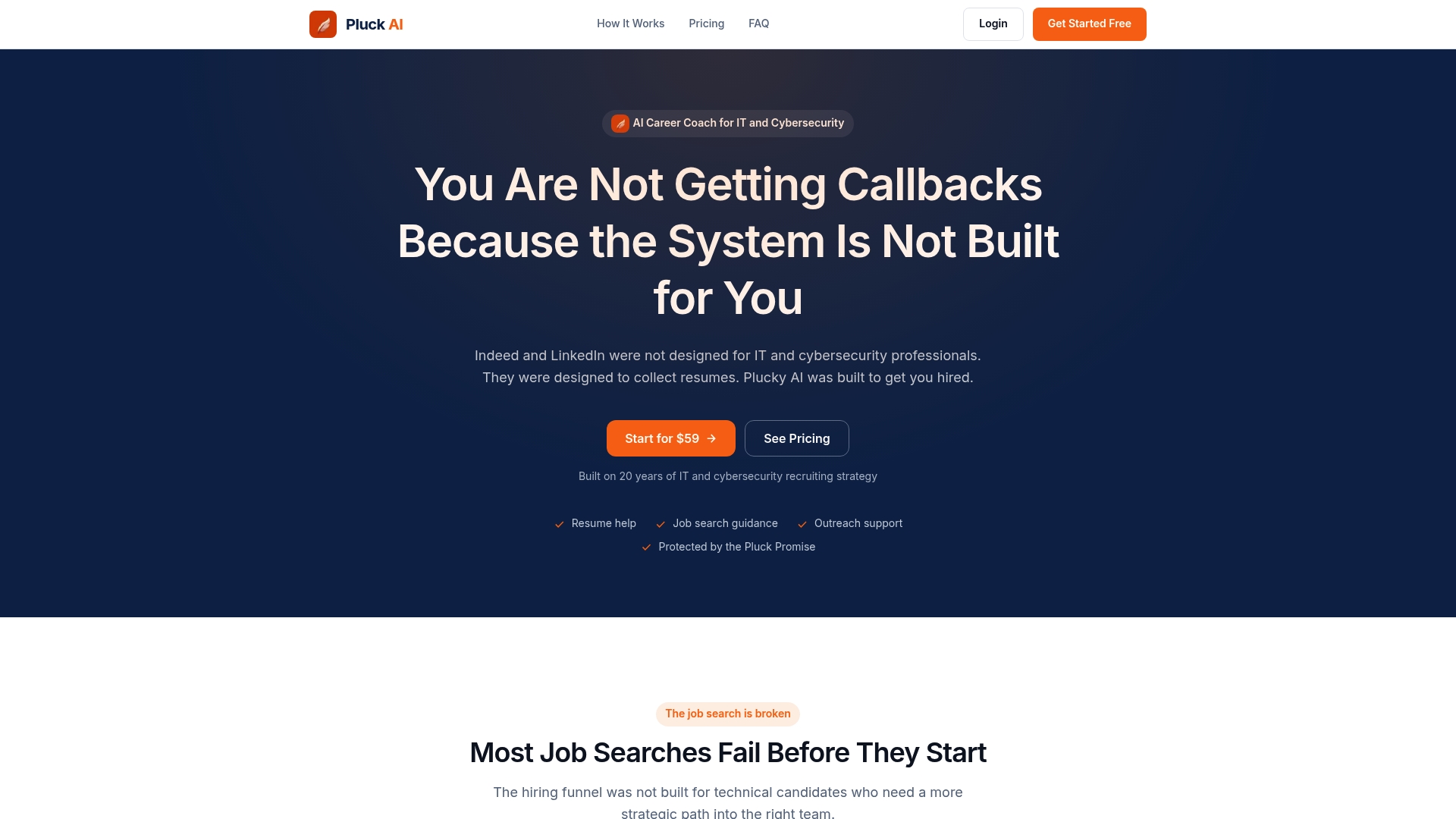
Pluckjobs is an AI-powered job search platform built specifically for IT and cybersecurity professionals. Beyond matching you to open roles, Pluckjobs surfaces hiring manager contact data and generates tailored resumes aligned to specific job descriptions. That means you walk into interviews knowing the role, the team, and the context before the first question lands. For candidates who want to start preparing smarter, Pluckjobs cuts the time between application and interview by removing the guesswork from targeting. No more cold applying to roles that never respond. Find the role, find the person, and get hired faster.
FAQ
What are the main types of IT interview questions?
IT interviews use four main question types: technical knowledge, troubleshooting, behavioral competency, and role-specific scenarios. Each type tests a different skill and requires a different answer structure.
How should I answer troubleshooting questions in an IT interview?
Clarify the scope of the issue first, then state your hypothesis, run diagnostic tests, verify the fix, and document the resolution. Interviewers score your method, not just your conclusion.
What is the STAR method and when do I use it in IT interviews?
STAR stands for Situation, Task, Action, and Result. Use it to structure answers to behavioral questions like "Tell me about a time you resolved a critical issue under pressure."
Do IT interview questions differ by role?
Yes. Help desk interviews emphasize troubleshooting and soft skills. Sysadmin interviews go deeper on OS and networking. SOC analyst interviews focus heavily on security, log analysis, and incident response.
How many STAR stories should I prepare before an IT interview?
Prepare five to seven stories mapped to different competencies such as problem-solving, communication, and escalation. One well-built story can answer multiple differently worded behavioral questions.