
Three actions reliably get cybersecurity job interviews now: an ATS-aligned resume tailored to the exact job description, targeted role discovery that surfaces the right opening and the hiring manager's name, and a short, project-specific cold email sent after you apply. Plucky AI at pluckjobs.io automates all three, combining SerpAPI-powered role discovery with Apollo contact intelligence and AI resume optimization in one credit-based workflow.
- ATS-aligned resume: Match the JD's exact phrasing so the parse-and-rank pipeline surfaces your file.
- Targeted discovery: CyberSeek's June 2025 data shows 514,359 cybersecurity postings in the prior 12 months with a supply-demand ratio of roughly 74%, meaning demand far outpaces supply. Targeting the right subset matters more than volume.
- Hiring-manager outreach: A six-line email referencing a specific project or compliance gap yields far higher reply rates than a blind application.
Pro Tip: Map your skills to the NICE Workforce Framework categories before you apply. Roles tagged under "Protect and Defend" or "Analyze" carry the highest posting volumes and the clearest keyword signals.
Table of Contents
- Why hiring managers, not HR, control who gets a cybersecurity interview
- How to win the ATS parse before a human ever sees your resume
- How to find roles that prioritize AI, compliance, and cloud security
- What to say to a hiring manager to get a reply
- How to measure your results and set realistic interview timelines
- Which skills and certifications to highlight in 2026
- How Plucky AI speeds you from application to interview
- How to prepare for cybersecurity job interviews
- How to build a cybersecurity portfolio that strengthens your candidacy
- How LinkedIn visibility translates into referral interviews
- How to write a cybersecurity cover letter that complements your resume
- How cybersecurity communities surface jobs that never reach job boards
- Key Takeaways
- The sequence that most job seekers skip
- Plucky AI gives you the workflow, not just the advice
- Primary sources and recommended reading
- FAQ
Why hiring managers, not HR, control who gets a cybersecurity interview
Hiring managers are judged on team output, not process compliance. That incentive makes them structurally more willing to consider non-traditional backgrounds when a candidate demonstrates the exact skill to solve a current bottleneck, whether that's AI integration, SOC 2 readiness, or cloud security architecture.
SANS research confirms the shift: hiring emphasis has moved toward AI governance, compliance validation, and documented skills mapping to frameworks like NICE and NIST. Generic "security experience" no longer differentiates. Managers scan for evidence of specific tools and measurable outcomes.
Three resume bullets that land with hiring managers:
- "Deployed CrowdStrike Falcon EDR across 1,200 endpoints; reduced mean time to detect by 40%."
- "Led SOC 2 Type II audit preparation; zero findings in final report."
- "Integrated AWS Security Hub with Splunk SIEM; automated 85% of low-severity alert triage."
Each bullet names a tool, a framework or compliance standard, and a concrete result. That combination is what a manager scans for in under ten seconds.
How to win the ATS parse before a human ever sees your resume
Win the parse first. Feed the ATS the JD's exact phrasing and your resume moves from invisible to visible. Every downstream scoring step, including keyword match, title match, and skills density, depends on a clean parse.
ResumeWin's 2026 ATS guide breaks the pipeline into five stages: Ingest, Parse, Normalize, Match, and Rank. A formatting failure at Ingest kills your candidacy before any human reads a word. The ResumeGeni cybersecurity ATS checklist confirms that Workday and Greenhouse process the majority of cybersecurity analyst applications, so optimizing for those two parsers covers most of the market.
Format checklist:
- Single-column layout, no tables or text boxes
- Standard section headings: Summary, Skills, Experience, Education, Certifications
- Contact info and LinkedIn/GitHub URLs in the header
- Dates in MMM YYYY format (e.g., Jan 2024)
- Skills section placed above Experience
Keyword placement rule: Include high-signal terms in both the Skills section and at least one experience bullet using the Action + Tool + Result structure.
| Weak bullet | ATS-aligned bullet |
|---|---|
| "Responsible for security monitoring" | "Monitored SIEM alerts in Splunk; escalated 12 critical incidents per quarter with zero SLA breaches" |
Pro Tip: Hedge for both lexical and semantic ATS matching. Use the JD's exact phrase ("cloud security posture management") in Skills, then use a close synonym ("CSPM configuration") in an experience bullet. Modern ATS platforms score both.
How to find roles that prioritize AI, compliance, and cloud security
Target roles where AI, compliance, or cloud security appear explicitly in the posting, then find the hiring manager before you apply. Applying broadly without this filter wastes time on roles where your profile won't rank.
- Map to NICE categories — Use the CyberSeek heatmap to confirm which NICE work roles carry the highest open-position counts in your target geography. Prioritize those.
With 514,359 postings and a supply-demand gap favoring candidates, the constraint isn't finding a job, it's finding the right one fast. Axis Intelligence's market analysis reinforces that AI, cloud, and compliance roles are the fastest-growing segments within that total.
Plucky AI's SerpAPI-powered discovery filters postings by skill priority and surfaces the hiring manager's contact data in the same workflow, cutting the manual research step entirely.
What to say to a hiring manager to get a reply
A six-line, project-specific cold email sent after you apply yields the highest incremental reply rate versus a blind application alone. Keep it under 150 words. Reference something specific about their environment or a recent compliance requirement, state one concrete outcome you've delivered, and ask a single question.
Who to contact: The hiring manager, typically one to two levels above the open role. For startups under 50 people, email the founder or CTO directly. Confirm identity via the job posting or LinkedIn before sending.
Six-line template (adapted from CVHive's outreach guide):
Dos and don'ts:
- Send from a custom domain, not Gmail
- Link your resume; never attach it
- Send Tuesday–Thursday between 7–9 AM recipient time
- One follow-up after three business days, max
Follow-up cadence:
| Day | Action |
|---|---|
| — | Send initial six-line email |
| Day 3 | One short follow-up: "Wanted to make sure this didn't get buried." |
| Day 7 | Move on; note the non-reply in your tracker |
How to measure your results and set realistic interview timelines
Track a small set of KPIs and iterate weekly on the highest-leverage variable. More applications without iteration doesn't move the needle; better targeting does.
KPIs to track in a spreadsheet or application tracker:
Time-to-first-interview by seniority:
| Seniority | Realistic timeline |
|---|---|
| Entry-level (0–2 years) | 6–10 weeks |
| Mid-level (3–6 years) | 4–7 weeks |
| Senior (7+ years) | 3–5 weeks |
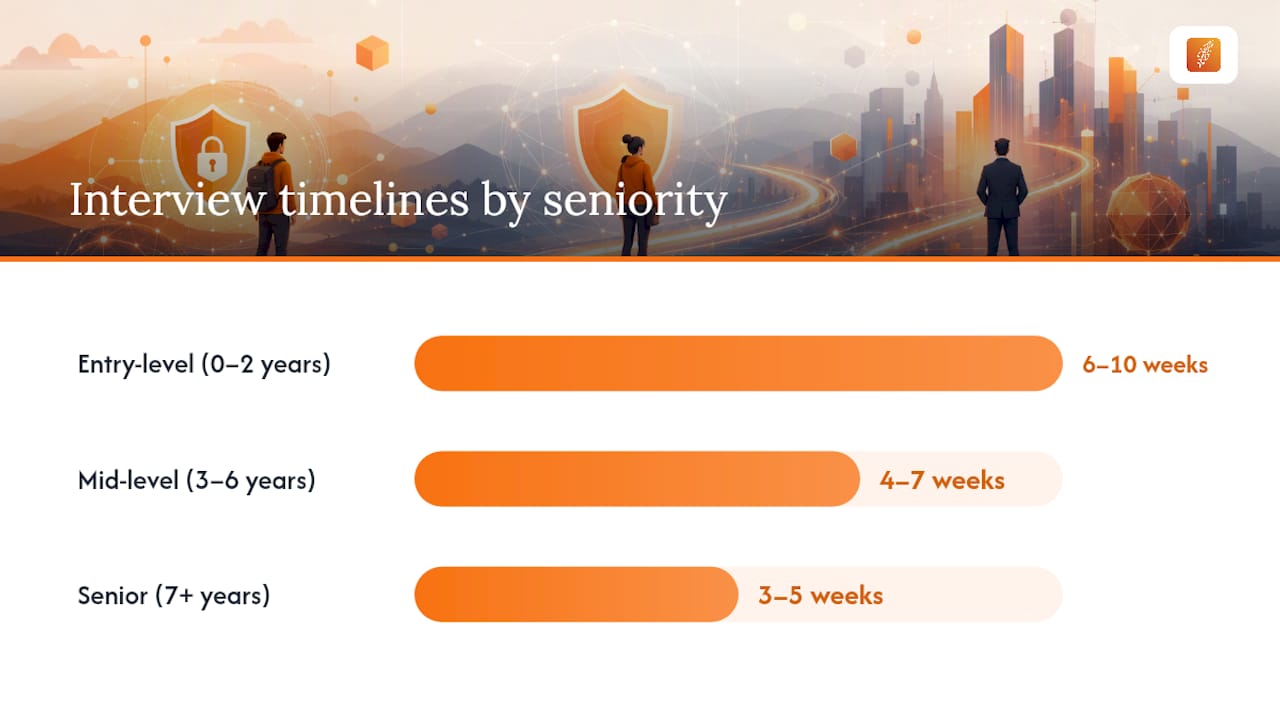
Run two A/B tests in your first 30 days: resume variant A (keywords in summary) vs. B (keywords in bullets), and outreach subject line A (role title) vs. B (compliance topic). Four to six applications per variant gives you enough signal to decide which performs better.
Which skills and certifications to highlight in 2026
AI security, NIST/SOC 2 compliance, and cloud security are the three areas where Robert Half's demand data and CyberSeek postings align. Candidates who frame experience around these areas, with documented outcomes, rank higher in both ATS scoring and manager review.
High-value skills and certifications to surface:
- Cloud security: AWS Security Specialty, Azure Security Engineer (AZ-500), GCP Professional Cloud Security Engineer
- SIEM/EDR tooling: Splunk, Microsoft Sentinel, CrowdStrike Falcon, SentinelOne
- Compliance frameworks: NIST CSF, SOC 2, MITRE ATT&CK, ISO 27001
- Certifications: CompTIA Security+, CISSP, OSCP, GIAC GPEN or GCIH
- AI security: prompt injection defense, LLM security review, AI governance policy
Example resume bullet combining certification and evidence:
"CISSP-certified; designed and implemented NIST CSF-aligned incident response playbook across 14-node SOC team, reducing mean time to respond by 35%."
Documented outcomes tied to named frameworks outperform generic claims every time. SANS research specifically recommends mapping team skills to NICE categories for regulatory validation, and the same logic applies to your resume.
How Plucky AI speeds you from application to interview
Plucky AI automates JD keyword extraction, creates ATS-aligned resume rewrites, finds hiring managers, and sequences personalized outreach, compressing a multi-day manual process into a single session.
Feature-to-step mapping:
- Resume optimization: — AI extracts JD keywords, rewrites bullets to the Action + Tool + Result structure, and scores the result against ATS criteria before you submit.
Start a free trial at pluckjobs.io/start. The first session includes one JD scan, one resume rewrite, and one outreach template. Credits are purchased as a one-time pack or monthly subscription, so there's no long-term commitment required.
Pro Tip: Run the JD scan before you rewrite your resume. The extracted keywords tell you exactly which phrases to place in your Skills section and which bullets to rewrite first.
How to prepare for cybersecurity job interviews
Securing the interview is step one. Converting it requires preparation on three fronts: technical questions, practical exercises, and behavioral framing.
Common technical questions cover network security fundamentals (OSI model, TCP/IP, firewall rules), threat detection (how you'd investigate a phishing alert in a SIEM), and compliance scenarios (how you'd scope a SOC 2 audit). Expect at least one scenario-based question where you walk through an incident response process step by step.

Practical exercises vary by role. Penetration testing roles often include a take-home CTF challenge or a live Metasploit scenario. SOC analyst roles may ask you to triage a sample alert queue. Cloud security roles frequently test your ability to read an AWS IAM policy and identify misconfigurations.
For behavioral questions, use the STAR format (Situation, Task, Action, Result) and anchor every answer to a measurable outcome. "I reduced false positives by 30%" lands better than "I improved the process." The IT interview prep guide covers question types by role in detail.
How to build a cybersecurity portfolio that strengthens your candidacy
A portfolio closes the credibility gap between what your resume claims and what a hiring manager can verify. The most effective format is a public GitHub repository with documented projects, not a PDF list of tools you've used.
Strong portfolio projects include: a home lab writeup documenting a SIEM deployment (Splunk or Microsoft Sentinel), a completed TryHackMe or Hack The Box path with screenshots and notes, a NIST CSF gap analysis applied to a fictional or open-source company, and a custom detection rule written for a specific threat actor TTP from MITRE ATT&CK.
Each project should include a README that states the objective, the tools used, the outcome, and what you'd do differently. That structure mirrors how hiring managers think about work, and it makes your GitHub easy to scan in under two minutes.
How LinkedIn visibility translates into referral interviews
Referral candidates move to interview faster than cold applicants in most hiring processes. LinkedIn is the primary channel for generating those referrals in cybersecurity.
Your profile headline should mirror the job titles you're targeting, not your current title. "Cloud Security Engineer | AWS | NIST CSF | SOC 2" outperforms "Security Professional at [Company]" for both recruiter search and hiring-manager recognition. The About section should open with your top two or three skills and a one-line statement of the problem you solve.
Engage in the feed by commenting on posts from security leaders at target companies. A substantive comment on a CISO's post about AI governance puts your name in front of their network without a cold message. Connect with hiring managers after applying, reference the role in the connection note, and keep it to one sentence.
How to write a cybersecurity cover letter that complements your resume
A cover letter for a cybersecurity role has one job: connect your most relevant experience to the specific problem the team is trying to solve. Three paragraphs is the right length.
Paragraph one names the role and states your single strongest qualification for it. Paragraph two describes one project or outcome that directly maps to a requirement in the JD, using the same terminology the posting uses. Paragraph three closes with a specific ask, such as a 20-minute call to discuss the team's current detection gaps.
Never restate your resume. The cover letter should add context the resume can't, such as why you're targeting this company specifically or how a recent certification maps to their compliance roadmap.
How cybersecurity communities surface jobs that never reach job boards
A significant share of cybersecurity roles, particularly at smaller firms and startups, are filled through community referrals before a public posting goes live. Being active in the right communities puts you in front of those opportunities.
Productive communities include the SANS community forums, ISC2 chapter events, local DEF CON groups, and Slack workspaces like Cybersecurity Mentorship Hub and BlueTeamSec. LinkedIn groups for specific frameworks (NIST, MITRE ATT&CK) also surface hiring conversations.
The tactic that works: answer a technical question publicly, then follow up privately with the person who asked. That interaction establishes credibility before any job conversation starts. Many hiring managers post "looking for someone who knows X" in these spaces days before a formal req opens.
Key Takeaways
Getting cybersecurity job interviews in 2026 requires three coordinated actions: an ATS-parsed, JD-matched resume, targeted role discovery focused on AI/compliance/cloud openings, and a six-line hiring-manager email sent after every application.
| Point | Details |
|---|---|
| ATS parse wins first | Single-column layout, standard headings, and JD-exact keywords in Skills and one experience bullet. |
| Target the right subset | With 514,359 open postings in the prior 12 months and a supply-demand ratio of about 74%, filter by NICE category and AI/compliance signals to maximize interview yield. |
| Six-line outreach works | A project-specific cold email under 150 words, sent Tuesday–Thursday, generates the highest reply rate. |
| Measure and iterate | Track reply rate and interviews weekly; run two A/B tests in the first 30 days to find what moves the number. |
| Pluckjobs automates all three | Plucky AI handles JD keyword extraction, hiring-manager lookup, and outreach sequencing in one session at pluckjobs.io. |
The sequence that most job seekers skip
Most cybersecurity job seekers spend 80% of their effort on the resume and almost none on who receives it. That's the wrong ratio. A perfectly optimized resume sent through a job board portal competes with hundreds of other parsed files. The same resume, preceded by a six-line email to the hiring manager, arrives in a context where the manager is already looking for your name.
The three-step sequence in this guide reflects how hiring managers actually make decisions: they scan for specific evidence of skills they need right now, they respond to candidates who demonstrate they understand the team's current problem, and they move fast when the fit is obvious. Certifications and frameworks matter, but only when they're tied to documented outcomes. Buzzword density without evidence is noise.
The market data from CyberSeek and Robert Half confirms the demand is strong. The gap is execution. Candidates who combine ATS precision with direct outreach consistently reach interviews faster than those who rely on volume alone.
Plucky AI gives you the workflow, not just the advice
Most job seekers read guides like this one and then spend hours manually extracting keywords, hunting for hiring-manager emails, and drafting outreach from scratch. Plucky AI eliminates that gap.
Plucky AI at pluckjobs.io/start runs a full JD keyword scan, rewrites your resume to ATS standards, identifies the hiring manager via Apollo contact intelligence, and generates a personalized six-line outreach template, all in one session. The free trial includes one JD scan, one resume rewrite, and one outreach template. Paid credit packs and monthly plans are available with no long-term commitment. Sign up, run your first JD scan, review the optimized resume, and send outreach through the platform. Most users complete the full workflow in under an hour.
Primary sources and recommended reading
- CyberSeek June 2025 data release (PDF)
- How ATS resume systems actually work in 2026 (and the 7 things they score you on)
- Cybersecurity Analyst ATS Checklist: Built for Workday + Greenhouse (2026) — ResumeGeni
- Cybersecurity jobs statistics (Axis Intelligence)
- Robert Half: Data reveals which technology roles are in highest demand
- Cold Email Hiring Managers: 6 Lines That Get a Reply (2026) | CVHive
FAQ
How many cybersecurity jobs are open in the US right now?
CyberSeek's June 2025 data recorded 514,359 cybersecurity job postings in the prior 12 months, with a supply-demand ratio of about 74%, meaning demand significantly exceeds the available candidate pool.
What is the fastest way to get cybersecurity job interviews?
Combine an ATS-aligned resume with a direct six-line email to the hiring manager sent the same day you apply. Targeting roles that explicitly list AI security, NIST, or cloud platforms further improves your interview yield.
Which certifications do hiring managers look for most in 2026?
CompTIA Security+, CISSP, OSCP, and GIAC certifications (GPEN, GCIH) appear most frequently in postings. Cloud-specific credentials like AWS Security Specialty and AZ-500 are growing in demand alongside compliance-focused roles.
How does Plucky AI help you land cybersecurity interviews?
Plucky AI extracts JD keywords, rewrites your resume to ATS standards, identifies the hiring manager via Apollo contact intelligence, and generates personalized outreach, all in one session at pluckjobs.io/start.
How long does it take to get a cybersecurity interview after applying?
Entry-level candidates typically see first interviews in 6–10 weeks with a targeted approach. Mid-level professionals average 4–7 weeks, and senior candidates with direct hiring-manager outreach often reach interviews in 3–5 weeks.