
AI career coaching uses generative models and job-market data to deliver personalized guidance on resumes, interviews, and career moves, based on your specific background rather than generic advice. It helps most when you need faster, tailored next steps: a resume rewritten for a specific role, a mock interview scored against real questions, or a clear read on which openings match your skills. Platforms that combine AI coaching with structured job data, like Pluckjobs, push that guidance further into action.
TL;DR:
- AI coaching is most effective for targeted job searches, skills-gap analysis, and interview practice, especially when a specific near-term goal exists.
- Key features include persistent memory, ATS-aware resume editing, explainable job matching, and proactive reminders, which enhance real-world application.
- Validating AI-generated suggestions with real job descriptions and human input remains crucial for accurate and fair career guidance.
- Cost varies from free basic tools to paid subscriptions or enterprise licensing, with paid features offering unlimited tailoring and direct hiring manager contact data.
- Due to potential biases and hallucinations, users should treat AI advice as initial drafts and avoid relying solely on AI for final negotiation or legal decisions.
Table of Contents
- What Is an AI Career Coach and How Does It Work?
- When Does AI Career Coaching Help the Most?
- Which Platform Features Actually Matter?
- How Do You Use AI Career Coaching Effectively?
- What Does AI Career Coaching Cost?
- What Are the Limits and Privacy Risks of AI Coaching?
- How Pluckjobs Puts These Best Practices Into Practice
- How Do the Popular AI Career Coaching Platforms Compare?
- What's Next for AI Career Coaching?
- What Do Real Users Say About AI Career Coaching?
- How Do You Choose the Right AI Career Coaching Tool?
- What Are the Ethical Concerns With AI Career Coaching?
- A Practitioner's Take on Where AI Coaching Actually Helps
- Get Personalized AI Career Coaching Built for Tech Job Seekers
- Sources
- FAQ
What Is an AI Career Coach and How Does It Work?
An AI career coach is a software tool that applies generative AI models to your resume, goals, and job history to produce individualized coaching output: tailored resumes, mock interview feedback, skills assessments, and job recommendations. Generative AI can scale personalized, on-demand coaching in a way that human coaches, working one client at a time, simply cannot match for volume.
Three delivery models dominate the market:
- Pure chatbot coaches — general-purpose AI you prompt manually for advice, with no persistent memory of your career history between sessions.
- Platform plus human coach hybrids — AI handles first drafts and analysis, then a human coach reviews and refines the output.
- Integrated job-search platforms — AI coaching is built directly into a system that also finds jobs, tracks applications, and surfaces contacts.
Underneath, most tools rely on the same building blocks: large language models for writing and reasoning, ATS parsing engines that read resumes the way hiring software does, and skills taxonomies that map your experience to job requirements. Researchers at MIT are studying context-aware AI agents that remember your goals across conversations, which is the feature that separates a real coaching tool from a one-off chatbot exchange.
When Does AI Career Coaching Help the Most?
AI coaching earns its keep in a handful of specific situations rather than as a blanket replacement for career judgment. Here's where it tends to deliver the clearest return:
- Targeted job search and role discovery. Instead of scrolling job boards, AI tools can rank openings against your resume and flag which ones are worth your time first.
- Career change and skills-gap analysis. A tool can compare your current skill set against a target role and generate a learning path to close the gap, which matters given how fast required skills are shifting across industries.
- Interview and negotiation practice. Mock interviews with scored feedback let you rehearse behavioral and technical questions before the real thing, and some tools draft negotiation scripts based on comparable offers.
- Internal mobility. Employees eyeing a move within their own company can use AI to map transferable skills onto open internal roles, often a faster path than an external search.
Each of these use cases shares a common thread: they work best when you have a specific, near-term goal rather than an open-ended question like "what should I do with my career?" AI coaching answers narrow questions with precision; it struggles with existential ones.
Which Platform Features Actually Matter?
Plenty of tools call themselves AI career coaches. Far fewer have the features that make coaching genuinely useful rather than a novelty chat window. Look for these before you commit:
- Persistent memory and goal tracking — the tool should remember your target role and prior conversations, not force you to re-explain your background every session.
- ATS-aware resume tailoring — resume edits should target the keywords and formatting that applicant tracking systems actually scan for, not just read well to a human.
- Explainable job matching — a good match score tells you why a role fits, not just that it does, with filters for location, seniority, and compensation.
- Scored mock interviews — feedback should break down specific answers, not just deliver a vague "good job" summary.
- Proactive milestone reminders — the tool should nudge you when it's time to follow up on an application or revisit a stalled goal.
- Hiring-manager outreach support — some platforms go beyond job listings to surface the actual person doing the hiring, which changes the entire application dynamic.
Platform write-ups from tools like Jema describe this exact combination: memory, tailoring, matching, and mock interviews bundled together rather than sold as separate products.
Pro Tip: Test any AI coaching tool with a role you've already researched heavily. If its job-match reasoning matches what you already know about the role's real requirements, you can trust it with roles you know less about.
How Do You Use AI Career Coaching Effectively?
Getting real value out of an AI coach comes down to a repeatable routine, not a single clever prompt. Follow this four-step loop:
- Provide context first. Upload your resume and state your target role or goal in plain terms before asking for anything. Vague inputs produce vague output.
- Request a specific deliverable. Ask for one concrete thing: a tailored resume bullet, a cover letter paragraph, an interview answer structure.
- Iterate against real job descriptions. Paste the actual posting and ask the tool to align your materials to it, then refine based on what changes.
- Validate with a human. Run the final output past a recruiter, mentor, or someone in your target field before you submit anything important.
Sample prompts that tend to produce sharper results:
- "Rewrite this resume bullet to emphasize measurable impact, using metrics from my original draft."
- "Compare my resume against this job description and list the three biggest gaps."
- "Give me a 60-second answer to 'tell me about a time you handled conflict,' based on this project I described."
- "Draft a counteroffer script for a $95,000 offer when my target is $108,000, citing my certifications as leverage."
The validation step matters more than most people treat it. Generative AI works best paired with verified job data and real recruiter outreach rather than used as a standalone oracle. Treat AI output as a strong first draft, not a finished answer, especially for negotiation scripts and anything involving legal or compensation specifics.
What Does AI Career Coaching Cost?
Pricing generally falls into four shapes: a limited free tier for basic resume feedback, monthly or annual subscriptions for ongoing coaching, credit-based models where you pay per coaching session or deliverable, and enterprise licensing for organizations offering coaching as an employee benefit. Vendor pricing pages commonly mix free trials with paid tiers rather than sticking to a single model.
Features that typically sit behind a paywall include unlimited tailored resumes, hiring-manager contact data, and deeper analytics on your application performance.
- Free tiers: basic resume review, limited chat sessions
- Paid tiers: unlimited tailoring, outreach data, advanced tracking
Weigh cost against what a faster job search is actually worth to you: time saved on manual applications, improved interview conversion, and direct access to hiring managers rather than blind submissions.
What Are the Limits and Privacy Risks of AI Coaching?
AI coaching tools can hallucinate, meaning they sometimes generate confident but inaccurate advice about salary ranges, industry norms, or role requirements. Always verify anything role-specific against a real job posting or a person in that field. Academic and workforce researchers recommend pairing AI output with human judgment precisely because these models can be confidently wrong.
Bias is a real concern too. Matching algorithms trained on historical hiring data can replicate the same patterns that have long disadvantaged certain candidates, so a strong match score should never be treated as a fairness guarantee.
On privacy, be deliberate about what you share:
- Avoid pasting sensitive personal details (social security numbers, exact addresses) into any chat tool.
- Check whether a platform lets you export or delete your data.
- Read the retention policy before uploading a full resume history.
Pro Tip: Before you trust an AI-generated salary figure, cross-check it against a public source like a labor-market report. AI tools often lag behind current market rates.
Consult a human career counselor when the stakes involve a major life decision, legal contract terms, or a negotiation where getting it wrong is costly.
How Pluckjobs Puts These Best Practices Into Practice
Pluckjobs was built specifically for IT and cybersecurity professionals, which means the platform addresses several of the gaps described above directly rather than as an afterthought.
- Persistent context: the platform tracks your target roles and application history so you're not re-explaining your background every session.
- ATS-aware resume tailoring: resumes are optimized for the keyword scanning that technical hiring pipelines actually use, detailed further in this technical breakdown of AI-personalized recommendations.
- Role discovery powered by real data: job matching draws on SerpAPI-sourced listings rather than static databases, which keeps recommendations current.
- Hiring-manager outreach: Apollo-based contact intelligence surfaces the actual person hiring for a role, addressing the outreach gap most generic AI coaches leave open.
- Credit-based coaching: sessions combine automated AI output with human expert input where it counts most, like final resume review.
This structure directly answers the memory and outreach limitations flagged earlier: context persistence and direct hiring-manager access are exactly where most standalone chatbots fall short.
How Do the Popular AI Career Coaching Platforms Compare?
Most AI career coaching tools on the market fall into a few recognizable categories rather than a single spectrum of quality. Understanding the category tells you more than any feature list.
General-purpose AI assistants used as career coaches (asking a broad chatbot for resume feedback) offer flexibility and zero cost but no memory, no job data integration, and no verification against real postings. They're useful for a quick brainstorm, weak for a sustained job search.
Dedicated coaching platforms focus on the coaching experience itself: goal tracking, mock interviews, and skills assessments, often layered with a subscription model. These tend to do a better job of the "coach" part but a thinner job of actually connecting you to real openings.
Integrated job-search platforms, Pluckjobs among them, fold coaching into a broader system that includes job discovery, resume tailoring, and outreach. The advantage here is continuity: your resume, your target roles, and your outreach data all live in one place instead of scattered across separate tools.
Enterprise coaching benefits offered through employers typically license a platform for internal mobility and reskilling support, aligned with the kind of large-scale retraining push described in workforce reports on shifting skill demands.
For a technical job seeker, the category that matters most is the one that closes the loop from "here's my resume" to "here's the hiring manager's name," since that's the step most tools skip entirely.
What's Next for AI Career Coaching?
The near-term direction is clear: coaching tools are moving from single-session chat interactions toward persistent, memory-driven agents that track your career over months, not minutes. Research groups studying AI agents for career navigation are specifically focused on this continuity problem, since a coach that forgets your goals every session isn't much of a coach.
Expect deeper integration with real-time labor-market data next. Coaching advice tied to actual job openings and hiring trends rather than static training data will make recommendations more current and less generic.
Skills-based matching will likely get more granular too, moving past job titles toward the specific competencies a role requires, which matters given how quickly in-demand skills are shifting across technical fields especially.
Expect more platforms to blend automated coaching with human review at key decision points, rather than fully automating the entire process. The tools that combine speed with a human check on the moments that matter, salary negotiation, final resume approval, will likely outperform the ones that go all in on automation.
What Do Real Users Say About AI Career Coaching?
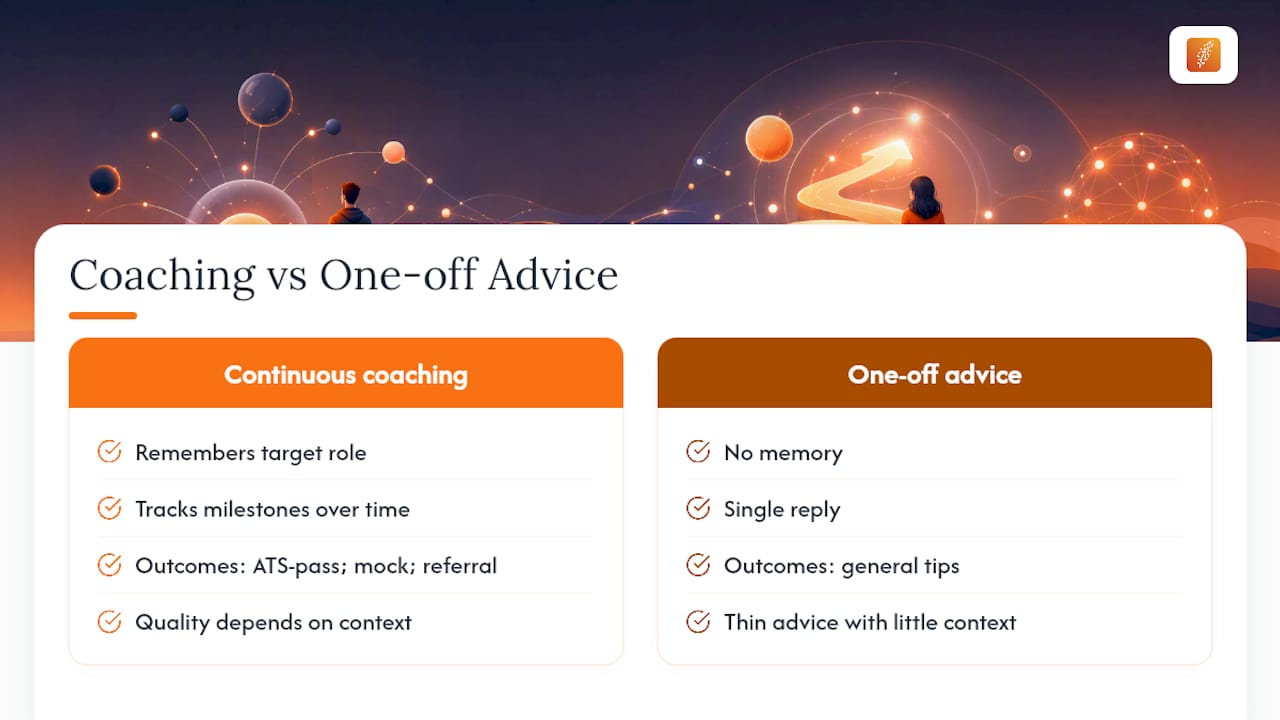
Platform write-ups and practitioner summaries consistently point to the same success factor: coaching continuity beats one-off advice. Summaries of AI career platform usage emphasize that users get the most value when a tool tracks measurable milestones over time rather than answering a single question and moving on.
The pattern shows up across different tools and use cases. A user preparing for a career change benefits less from a single "here's a resume tip" exchange and more from a sustained relationship where the tool remembers their target role, tracks progress on a skills gap, and follows up on stalled applications. That's a fundamentally different experience from typing a question into a general chatbot.
For technical job seekers specifically, the outcomes that matter most tend to be concrete: a resume that clears an ATS filter, a mock interview that surfaces a weak answer before a real interviewer does, or a direct contact at a company instead of a blind application into a portal. These are the moments where AI coaching converts from a nice-to-have into something that changes how a search actually goes.
The honest caveat is that outcomes vary by how much context you give the tool. A coach with a thin picture of your background produces thin advice, regardless of how sophisticated the underlying model is.
How Do You Choose the Right AI Career Coaching Tool?
Start by matching the tool to your actual bottleneck. If your resume isn't clearing ATS filters, prioritize a tool with strong ATS-aware tailoring over one that's heavy on generic chat features. If you're getting interviews but not offers, weight your decision toward mock interview quality and negotiation support instead.
Check whether the tool has memory across sessions before you pay for anything. A platform that forgets your target role every time you log in will waste your time re-explaining context, no matter how polished its interface looks.
Ask what happens to your data. A tool without clear export or deletion options is a red flag, especially if you're uploading a full resume history and salary details.
Weigh the delivery model against your comfort with automation. If you want a human check on high-stakes decisions like a counteroffer, choose a hybrid model over a pure chatbot. If you're comfortable self-editing AI output, a lighter tool might suit you fine.
Finally, test the tool on a role you already understand well. If its reasoning holds up against your own knowledge of that role, you can trust it more on roles where you know less. This single test filters out more bad tools than any feature comparison chart.
What Are the Ethical Concerns With AI Career Coaching?
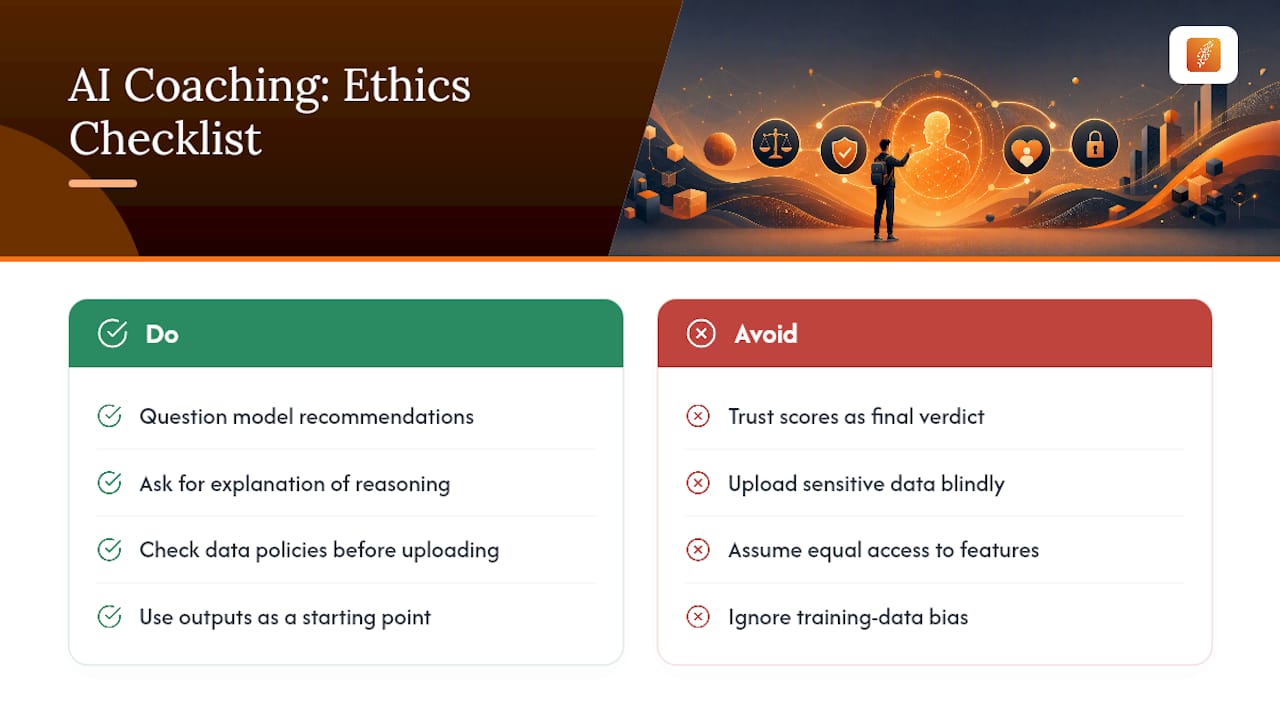
Bias in AI coaching isn't hypothetical. Matching and scoring algorithms trained on historical hiring patterns can quietly reproduce the same disadvantages that have shaped hiring for decades, particularly around nontraditional career paths or gaps in employment history.
Transparency is the second major concern. A tool that gives you a match score without explaining its reasoning leaves you unable to judge whether the recommendation is sound or just a confident-sounding guess. Researchers studying human-AI collaboration generally recommend systems that show their reasoning rather than a black-box output.
Data use raises its own questions. Career coaching tools handle sensitive information: salary history, employment gaps, sometimes health-related accommodations discussed in interview prep. How that data gets stored, whether it trains future models, and whether you can delete it are questions worth asking before you upload anything.
There's also a fairness question in access itself. AI coaching tools that gate their best features behind higher price tiers risk giving the biggest advantage to job seekers who can already afford professional coaching, potentially widening the gap for those who need the help most.
None of this means AI coaching should be avoided. It means treating any output, a match score, an interview grade, a salary suggestion, as a starting point for your own judgment rather than a verdict.
A Practitioner's Take on Where AI Coaching Actually Helps
Most of the hype around AI career coaching oversells what a chatbot can do and undersells what an integrated platform can do. A standalone AI conversation is genuinely useful for drafting and brainstorming, but it has no idea what jobs actually exist right now or who's hiring for them. That gap is where most "AI coach" tools quietly fail their users.
Three quick rules: do give the tool your actual resume and a specific goal, not vague ambitions. Do verify any salary or market claim against a real source before acting on it. Don't treat a match score as gospel, and don't skip a human check before a negotiation conversation.
The most useful thing you can do this week is upload your resume to a tool and run one specific prompt: "match me to open roles in my target field." Watch how the answer changes when the tool has real job data behind it versus just your resume text.
— Diego
Get Personalized AI Career Coaching Built for Tech Job Seekers
Pluckjobs is the AI career coaching platform built specifically for IT and cybersecurity professionals, not general career explorers. Instead of a chatbot that forgets your goals between sessions, Pluckjobs combines resume optimization, ATS keyword alignment, and SerpAPI-powered role discovery with actual hiring-manager contact data, so you're not just applying into a black box.
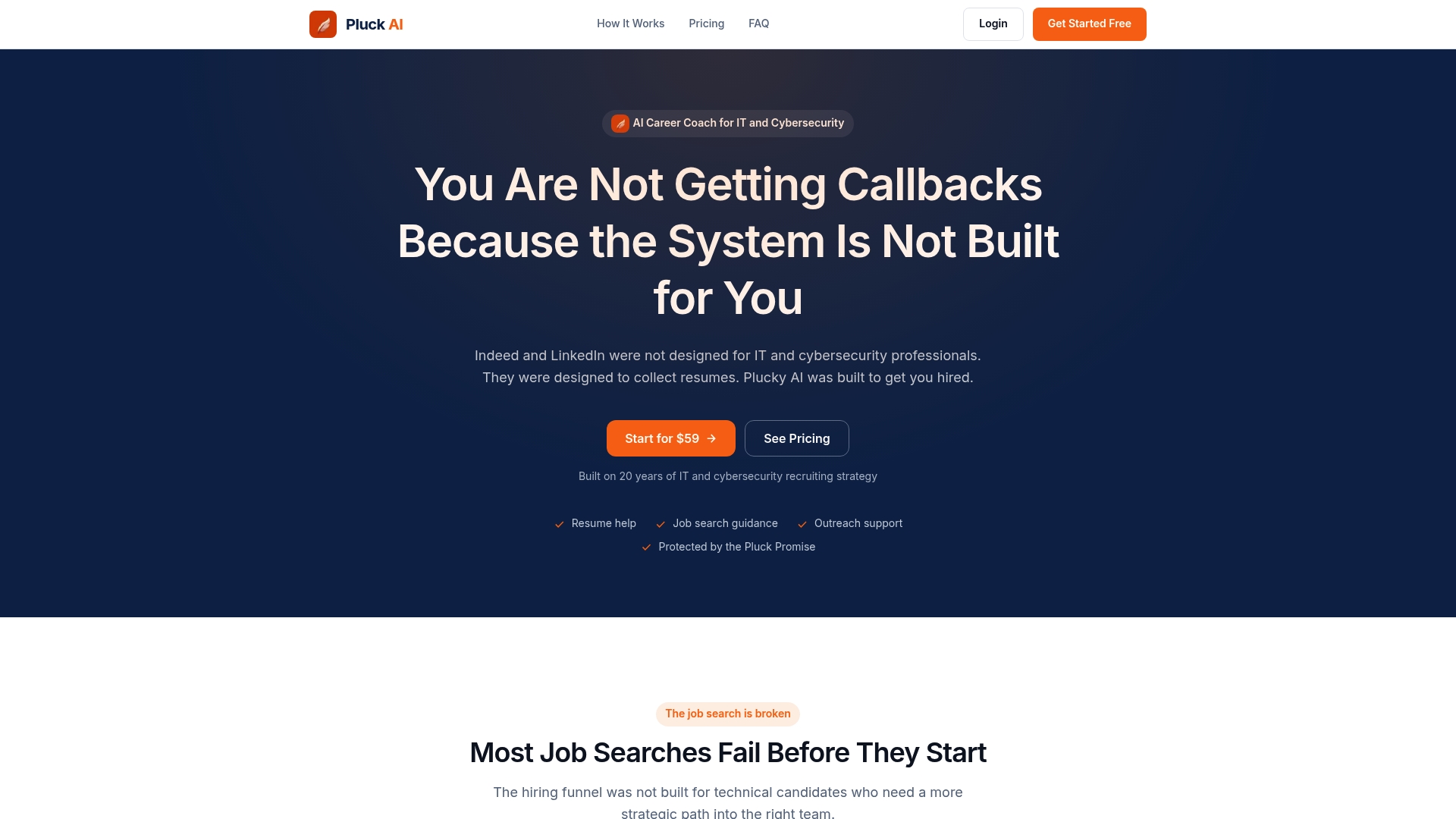
If your last few applications went nowhere despite a strong resume, the problem is often visibility, not qualification. Pluckjobs surfaces the specific hiring manager behind a role and builds outreach around that contact, a step most AI coaching tools skip entirely. The platform's approach to AI job matching for technical roles reflects exactly the persistence and explainable matching this guide recommends.
Start your free trial at Pluckjobs and run your resume against a target role today to see how the matching actually works for your field.
Sources
For deeper background, see JFF's guide on generative AI for jobseekers, the World Economic Forum's Future of Jobs Report, and MIT GenAI's research on AI career agents. For workforce context, read how AI is reshaping careers.
- Get better results for jobseekers with generative AI | JFF
- The future of jobs report 2025 | World Economic Forum
- AI Coach for Skilled Career Navigation | MIT GenAI
- Job Openings and Labor Turnover — news release | BLS
FAQ
How Much Does an AI Career Coach Cost?
Pricing typically ranges from free basic tiers to paid monthly or annual subscriptions, with some platforms using credit-based pricing for individual coaching sessions rather than a flat monthly fee. Costs rise with features like unlimited resume tailoring and hiring-manager outreach data.
Can ChatGPT Be a Career Coach?
A general chatbot like ChatGPT can help draft resume language and brainstorm interview answers, but it lacks persistent memory of your goals and has no access to live job listings or hiring-manager data. It works best as a drafting tool paired with a platform that connects to real job data.
Can ChatGPT Be My Life Coach?
ChatGPT can offer reflective prompts and general guidance, but it isn't built for ongoing, context-aware coaching and can generate confidently wrong advice on specifics like salary norms or industry standards. Treat its output as a starting point, not a substitute for human judgment on major decisions.
Is There a Free AI Career Coach Available?
Many platforms, including Pluckjobs, offer a free trial or limited free tier covering basic resume feedback and job matching before requiring payment for advanced features like unlimited tailoring or hiring-manager outreach. Free tiers are useful for testing whether a tool's reasoning matches your own knowledge of a role before committing to a paid plan.