
TL;DR:
- AI personalizes career recommendations by combining psychometrics, skills, and labor-market signals into ranked, explainable paths. Human oversight and hybrid models are essential for delivering accurate, ethical guidance at scale, especially in specialized fields like IT and cybersecurity.
AI personalizes career recommendations by combining your psychometrics, skill evidence, and real-time labor-market signals into ranked, explainable career paths. The pipeline runs from profile ingestion through hybrid recommender models to a final output that includes ranked career options, skill-gap analysis, and learning pathways. Here is the short version:
- Inputs: Big Five personality scores, RIASEC codes, resume text, certifications, performance data, salary signals, and job-demand trends
- Models: Hybrid recommenders using content-based embeddings, collaborative filtering, learning-to-rank reordering, and LLM-powered NLP
- Outputs: Ranked career list with SHAP-style explanations, missing-skill inventories, and curated learning paths
Human oversight is built into well-designed systems. AI can surface patterns across thousands of data points faster than any counselor, but it cannot fully account for personal values, life constraints, or nuanced trade-offs. Treat every recommendation as a hypothesis to test, not a verdict to accept.
Table of Contents
- How AI personalizes career recommendations differently than traditional counseling
- What data does an AI career system actually use?
- Which algorithms actually power the personalization?
- How the personalization pipeline works, step by step
- How human oversight and explainability are built into these systems
- What are the privacy, bias, and fairness risks in AI career tools?
- Where are organizations actually deploying AI career tools?
- How to prepare for and use an AI career tool effectively
- How are AI career recommendation systems evaluated?
- What do experts say about building trustworthy career-recommendation systems?
- What is the verdict on AI career recommendations?
- Key Takeaways
- A perspective worth considering
- Pluckjobs brings these principles to IT and cybersecurity job search
- Useful sources
- FAQ
How AI personalizes career recommendations differently than traditional counseling
Traditional career counseling relies on structured interviews, standardized assessments like the Holland RIASEC model, and a counselor's professional judgment. That approach works well for individuals with access to a skilled advisor, but it does not scale. A university with 10,000 students and a handful of career advisors cannot deliver individualized guidance to everyone who needs it.
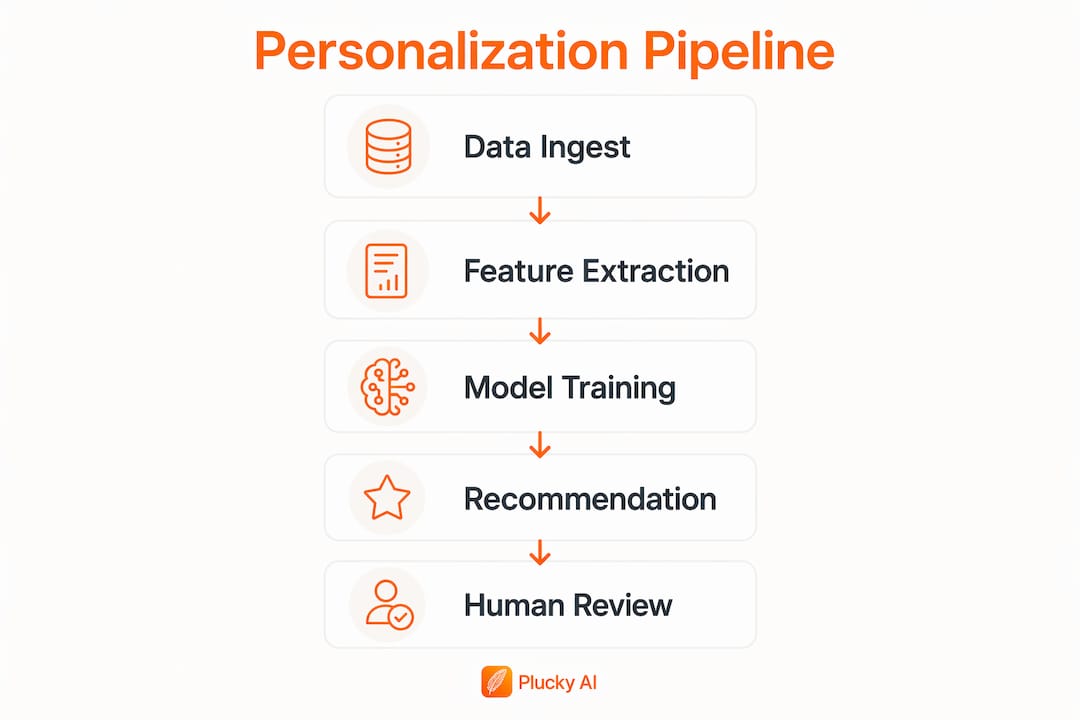
AI augments and scales that individualized guidance rather than replacing human counselors. Where a rule-based system applies fixed RIASEC mappings to a static list of occupations, an AI system ingests live job-posting data, parses resume text with NLP, and updates recommendations as labor-market demand shifts. One deployment study found that an AI-driven career guidance system combining skills mapping, adaptive mentoring, and labor-market intelligence achieved 87% predictive accuracy alongside a 26.7% reduction in students' career-path anxiety.
The practical differences between the two approaches:
- Rule-based systems: Static occupation lists, fixed assessment-to-career mappings, no real-time market data, limited to the counselor's caseload
- AI systems: Dynamic job-posting ingestion, NLP resume parsing, continuous model updates, 24/7 availability, and personalized guidance at scale
Pro Tip: AI excels at pattern recognition across large datasets. Human counselors still outperform it on values clarification, ethical trade-offs, and life-context decisions. Use both.
What data does an AI career system actually use?
The quality of personalized job suggestions depends almost entirely on the quality and breadth of inputs. Six core categories drive most systems:
- Psychometrics: Big Five personality dimensions (Openness, Conscientiousness, Extraversion, Agreeableness, Neuroticism) and RIASEC codes converted into numeric vectors for fit scoring
- Skills and credentials: Extracted skill tags from resumes, LinkedIn profiles, and certifications (AWS, CompTIA, CISSP); normalized against a skills ontology like ESCO or O*NET
- Portfolio and resume text: Raw text parsed by NLP models to extract project scope, technologies used, and inferred seniority level
- Performance and assessment data: GPA, coding-challenge scores, simulation results, and persistence metrics that signal readiness and work style
- Preferences and constraints: Location, remote/hybrid preference, salary floor, industry exclusions, and work-life priorities
- Labor-market signals: Real-time job-posting volume, salary bands, emerging skill demand, and employer hiring velocity
Data quality matters as much as model sophistication. A hybrid recommender fed incomplete or inconsistent skill data will produce confident-sounding but poorly calibrated suggestions.
| Input type | Typical format | What it supports |
|---|---|---|
| Psychometrics | Numeric vectors (Big Five, RIASEC) | Fit scoring and culture alignment |
| Skills and credentials | Skill tags, ontology codes | Competency matching and gap analysis |
| Resume and portfolio text | NLP embeddings | Role-level inference and experience mapping |
| Performance data | Scores, ratings, persistence measures | Readiness and learning-curve prediction |
| Preferences and constraints | Structured filters | Constraint handling and re-ranking |
| Labor-market signals | Job-posting counts, salary bands | Demand weighting and opportunity scoring |

Which algorithms actually power the personalization?
The most capable systems today use hybrid recommender architectures that combine content-based filtering, collaborative signals, supervised prediction, and learning-to-rank reordering. No single method handles every scenario well.
- Content-based filtering: Matches your skill and psychometric vectors to career profiles using cosine similarity or embedding distance. Works well from day one but can over-specialize, surfacing only careers that look exactly like your current profile.
- Collaborative filtering: Finds users with similar profiles and surfaces careers they moved into successfully. Powerful for discovery, but suffers from cold-start problems when your profile is sparse or unusual.
- Hybrid architectures: Combine content similarity, supervised career-cluster prediction, and optional collaborative signals. The hybrid approach is the practical solution to cold-start: content-based extraction fills gaps when collaborative data is thin.
- Embedding-based models and LLMs: Encode resumes, job descriptions, and career profiles into dense vector spaces. Semantic similarity search (approximate nearest neighbor) retrieves candidates that match meaning, not just keywords.
- Graph neural networks: Model relationships between skills, roles, industries, and users as a graph. Useful for surfacing non-obvious career pivots where indirect connections matter.
- Learning-to-rank (LTR): Reorders the candidate list using multiple signals simultaneously, including predicted salary, demand growth, skill-gap size, and user feedback history.
- Agentic query routing: Advanced systems use query complexity identification to route simple questions to fast retrieval tools and complex planning tasks to memory-intensive reasoning models, balancing response speed with depth.
Pro Tip: Ask any AI career tool whether it uses SHAP or feature-attribution methods. If it cannot tell you which inputs drove a specific recommendation, the system is a black box — and you cannot evaluate or correct it.
How the personalization pipeline works, step by step
The pipeline runs from profile ingestion to ranked career suggestions and learning pathways. Understanding each stage tells you where you can intervene.
- Profile ingestion: Your resume, assessment responses, credentials, and preferences are parsed and normalized. NLP models extract skill tags; psychometric responses are converted to numeric vectors.
- Feature construction: Raw inputs are combined into a unified feature store. Skills are mapped to a standard ontology; labor-market signals are joined to create demand-weighted skill scores.
- Candidate generation: An embedding model encodes your profile and runs approximate nearest-neighbor search against a career and job-role index. This produces a large candidate set (typically hundreds of potential paths).
- Constraint handling: Hard filters remove candidates that violate your stated constraints (location, salary floor, industry exclusions). Soft constraints adjust scores without eliminating options.
- Learning-to-rank reordering: An LTR model reorders the filtered candidate set using multiple signals: predicted fit, demand growth, skill-gap size, and your historical feedback. This is where collaborative signals and market data most influence the final ranking.
- Explanation generation: SHAP values are computed for the top-ranked careers, producing a feature-attribution list that shows which skills, credentials, or psychometric dimensions most influenced each recommendation.
- Learning-path recommendation: For each top career, the system identifies missing skills and maps them to courses, projects, and micro-credentials. The learning-path generator produces an explicit gap-closure roadmap.
At each stage, you have a point of intervention: edit your profile at ingestion, add certifications to feature construction, adjust constraints before re-ranking, and supply feedback after reviewing explanations.
How human oversight and explainability are built into these systems
Human-in-the-loop is a design pattern, not an afterthought. Well-built systems treat user control and transparency as core features, not optional add-ons. The goal is a "career copilot" model where AI surfaces options and humans make the final call.
Common user-facing controls to look for:
- Profile editing: Ability to add, remove, or weight skills and credentials after seeing initial results
- Accept/reject/defer: Explicit feedback buttons that update the model's understanding of your preferences
- Constraint adjustment: Sliders or filters for salary, location, and industry that trigger real-time re-ranking
- Explanation requests: On-demand feature-attribution views showing which inputs drove each recommendation
- Counterfactual suggestions: "If you added certification X, these three roles would move into your top 10" — a concrete, testable path forward
On the developer and institutional side, human-in-the-loop design includes auditing workflows, fairness checks, and the ability to override or suppress recommendations that fail quality thresholds.
UI elements worth looking for: SHAP-style ranked feature lists, editable skill-gap plans, and counterfactual career cards. The Steve platform, presented at AAAI, illustrates this pattern well: users can edit inputs, verify speech-recognition accuracy, and observe consistent updates across the system's three personas (Interview Coach, Resume Evaluator, Career Coach).

Pro Tip: If a tool shows you a ranked list but no explanation, treat it the same way you would treat a job offer with no salary information. Push for the reasoning before you act on it.
What are the privacy, bias, and fairness risks in AI career tools?
These systems can amplify existing bias and create privacy exposure unless privacy-by-design and fairness auditing are applied from the start. The risks are specific and addressable.
Risk checklist:
- Demographic proxies: Zip code, school name, and graduation year can act as proxies for race or socioeconomic status, producing biased rankings without any explicit demographic input
- Feedback-loop amplification: If historically underrepresented groups were steered away from certain roles, collaborative filtering will perpetuate that pattern unless corrected
- Re-identification risk: Combining anonymized profile data with external datasets (LinkedIn, public salary surveys) can re-identify individuals
- Data minimization failures: Systems that collect more data than needed increase exposure without improving recommendation quality
Mitigation measures to demand from any tool you use:
- Regular fairness audits testing for disparate impact across demographic groups
- Anonymization and encrypted storage of psychometric and performance data
- Counterfactual fairness testing: would the recommendation change if a protected attribute changed?
- Published transparency reports covering model performance and audit results
- User-accessible data exports and deletion rights
On the legal side, U.S. users should confirm that any platform handling their career data complies with applicable state privacy laws (California's CPRA is the most comprehensive currently in force) and provides clear consent mechanisms before data collection begins. This article is general information, not legal advice; confirm current requirements with a qualified professional for your specific situation.
Where are organizations actually deploying AI career tools?
AI career guidance is in active use across three broad categories, each with distinct goals and data environments.
Higher education: Universities use AI to scale career advising beyond what staffing allows. The majority of university career offices lack the capacity to meet one-on-one with every student. Platforms like COACH (CareerVillage.org) deliver 24/7 personalized guidance, curated development activities, and data-driven readiness tracking that frees advisors for high-complexity conversations.
Enterprise learning and development: Large employers deploy AI for internal mobility, identifying employees whose skills match open roles before external recruiting begins. The data available in enterprise settings (performance reviews, project histories, learning-platform completions) is richer than what consumer tools see, which improves recommendation precision.
Consumer career apps: Job seekers use AI tools for role discovery, resume tailoring, and interview preparation. These platforms typically rely on resume parsing and job-posting data, with psychometric inputs as an optional layer. AI job matching for IT and cybersecurity professionals is a growing segment, where credential specificity (CISSP, CEH, cloud certifications) gives embedding models strong signal to work with.
The measurable impact is real: the AI-driven vocational guidance system cited earlier achieved 87% predictive accuracy alongside a 26.7% reduction in career-path anxiety, demonstrating that well-designed systems improve both match quality and psychological readiness.
How to prepare for and use an AI career tool effectively
Prepare accurate skill evidence, complete psychometric questions honestly, and treat every suggestion as a hypothesis to test, not a final answer.
Before you start:
- Gather your current resume, project descriptions, and any certifications with issue dates
- List your hard constraints: minimum salary, location requirements, industries you will not consider
- Note your soft preferences: remote vs. in-person, team size, growth vs. stability
While using the tool:
- Answer psychometric questions based on how you actually behave, not how you want to be perceived; skewed inputs produce skewed outputs
- Request explanations for every top recommendation; if the tool does not offer them, ask why
- Test counterfactuals: ask what would change if you added a specific certification or skill
- Use AI tools for job search as a starting point for research, not a replacement for it
After reviewing suggestions:
- Track which recommendations you pursued and what outcomes resulted; feed that data back into the system
- Reject or defer suggestions that conflict with constraints the system may not have captured
- Revisit your profile every 90 days as your skills and the labor market evolve
Questions worth asking any provider: What data sources power your labor-market signals? How often is the model retrained? Can I export my data? What fairness audits have been conducted?
How are AI career recommendation systems evaluated?
The most relevant metrics for users are nDCG@K (normalized discounted cumulative gain at K), MAP@K (mean average precision at K), coverage, predictive validity, and user-satisfaction scores.
- nDCG@K: Measures ranking quality — whether the most relevant careers appear near the top of the list. Higher is better; a system with high nDCG@K is getting the order right, not just the set.
- MAP@K: Averages precision across multiple recommendation lists. Useful for comparing systems across diverse user profiles.
- Coverage: The fraction of possible career paths the system can recommend. Low coverage means the system is over-specialized and may miss valid options for unusual profiles.
- Predictive validity: Whether users who follow recommendations actually achieve better outcomes (placement rates, salary growth, job satisfaction). This is the metric that matters most and the one vendors are least likely to publish.
- User-satisfaction and usability scores: Task-completion rates, explanation comprehension, and net promoter scores from real users.
Vendor disclosure checklist: Look for published A/B test results comparing the AI system against a baseline, outcome-tracking data (not just engagement metrics), and fairness audit reports covering demographic subgroups. A vendor that cannot share any of these should be treated with skepticism.
What do experts say about building trustworthy career-recommendation systems?
The top design principle is consistent across research: hybrid models combined with human-in-the-loop controls, explainability layers, and privacy-by-design produce the most trustworthy and effective systems.
Key expert insights:
- Integrate affective measures (persistence, anxiety, confidence) alongside cognitive evidence (GPA, certifications). Bridging both improves match quality and psychological readiness simultaneously.
- Use SHAP for local explanations at the individual recommendation level. Global model explanations tell you how the system works in aggregate; local SHAP values tell a specific user why they got a specific result.
- Solve cold-start with hybrid methods: content-based extraction handles sparse profiles; collaborative signals add discovery value as the profile fills in.
- AI is transforming career growth most effectively when human judgment remains in the loop for values-based decisions and organizational context.
- Fairness audits should be scheduled, not reactive. Testing for disparate impact after a complaint is too late.
Implementation checklist for teams: Audit model outputs quarterly for demographic disparate impact; maintain an editable skill ontology so the system stays current with emerging roles; build feedback loops that update rankings based on real placement outcomes; roll out incrementally with human review of edge cases.
Pro Tip: The single best signal that a career-recommendation system is well-built is whether it can tell you, in plain language, why it did NOT recommend a specific role. That counterfactual capability requires both explainability infrastructure and honest system design.
What is the verdict on AI career recommendations?
AI career-recommendation systems are genuinely useful decision-support tools when they are built with hybrid architectures, explainability, and human oversight — and they are unreliable when they are not. Use them to surface options you might have missed, validate your skill positioning against market demand, and identify specific gaps to close. Do not outsource the final decision.
Recommended next steps:
- Audit your current skill evidence: resume, certifications, and project descriptions should be current and specific
- Choose tools that offer SHAP-style explanations and counterfactual suggestions
- Supply honest psychometric inputs and set explicit constraints before reviewing results
- Provide feedback on every recommendation you accept or reject
- Revisit outputs every 90 days as your profile and the market evolve
- Treat AI recommendations as decision support, not decision replacement
Key Takeaways
AI career-recommendation systems produce their best results when hybrid models, explainability layers, and human-in-the-loop controls are all present — and their worst when any of those three is missing.
| Point | Details |
|---|---|
| Inputs drive quality | Psychometrics, skills, resume text, and labor-market signals together produce more precise suggestions than any single data type alone. |
| Hybrid models outperform single-method systems | Combining content-based filtering, collaborative signals, and learning-to-rank reordering handles cold-start and improves ranking accuracy. |
| Explainability is non-optional | SHAP-style feature attribution shows which inputs drove each recommendation, letting you validate or correct the system's reasoning. |
| Bias and privacy require active mitigation | Fairness audits, data minimization, and anonymization must be built in from the start, not added after deployment. |
| Pluckjobs applies these principles | Pluckjobs delivers AI-powered role discovery and tailored resume creation for IT and cybersecurity professionals, combining real-time job data with targeted outreach intelligence. |
A perspective worth considering
The conversation around AI career guidance tends to split into two camps: enthusiasts who treat ranked career lists as near-oracular, and skeptics who dismiss the whole category as pattern-matching dressed up in marketing language. Both miss the point.
What actually matters is the architecture underneath. A system that ingests rich psychometric and skills data, runs a hybrid recommender with learning-to-rank reordering, surfaces SHAP explanations, and keeps a human in the loop for final decisions is a genuinely useful tool. A system that matches keywords on a resume to job titles and calls it "AI-powered personalization" is not. The difference is not visible from the outside, which is exactly why asking for explainability, fairness audit results, and outcome-tracking data is so important.
For IT and cybersecurity professionals specifically, the credential specificity of the field is an advantage. CISSP, CEH, cloud certifications, and specific technology stacks give embedding models strong, unambiguous signal. That means the gap between a well-built system and a poorly built one is wider in this domain than in generalist career guidance. The stakes of choosing the wrong tool are higher, and so is the payoff from choosing the right one.
Pluckjobs brings these principles to IT and cybersecurity job search
IT and cybersecurity professionals who want AI career guidance that actually reflects their credentials have a specific problem: most consumer tools are built for generalist audiences and treat a CISSP the same way they treat a generic "security" skill tag. That gap is where Pluckjobs operates.
Plucky AI combines Apollo contact intelligence with SerpAPI-powered role discovery to deliver precision job matches built around your actual credentials, not keyword approximations. The platform generates tailored resumes for specific roles and surfaces hiring manager outreach data so you can move from discovery to contact without cold-applying into a void. It is built for the specificity that IT and cybersecurity job searches require. Visit Pluckjobs to see how the platform applies the recommendation principles covered in this guide to your actual job search.
Useful sources
- AI-Driven Career Guidance to Reduce Vocational Students' Career Path Anxiety — Peer-reviewed deployment study reporting 87% predictive accuracy and a 26.7% reduction in career-path anxiety; primary source for the impact statistics cited in this guide.
- AI-based career recommendation (IJEDR) — Technical paper presenting the hybrid recommender architecture (psychometrics, NLP embeddings, LTR, SHAP) that underpins most of the pipeline description in this guide.
- COACH: AI-powered Career Coach (CareerVillage.org) — Practitioner resource covering human-in-the-loop design, privacy-by-design guidance, and real-world university and workforce deployment examples.
- Steve: Your Personal AI Career Coach (AAAI) — AAAI conference paper describing a schema-constrained, LLM-powered career coaching system with editable human-in-the-loop controls and a configurable career-tree ontology.
- Query complexity identification (AAAI) — Source for the agentic query-routing approach that balances latency and reasoning depth in advanced career systems.
- Resumize: explainability in career systems — Practitioner application demonstrating SHAP-based feature attribution for career recommendations, including matched vs. missing skill presentation.
- Your AI Career Toolkit (University of South Florida) — University career center resource illustrating how higher-education institutions are integrating AI tools into advising workflows.
FAQ
How does AI personalize career recommendations for each user?
AI ingests your psychometrics, skills, resume text, and labor-market signals, then runs a hybrid recommender that ranks career paths by predicted fit, demand, and skill-gap size. SHAP-style explanations show which inputs drove each result.
What is the cold-start problem in AI career tools?
Cold-start occurs when a new user's profile is too sparse for collaborative filtering to work. Hybrid architectures solve it by using content-based skill extraction to generate initial recommendations until enough behavioral data accumulates.
Can AI career tools introduce bias into recommendations?
Yes. Demographic proxies (zip code, school name) and feedback-loop amplification from historical hiring patterns can produce biased rankings. Fairness audits, data minimization, and counterfactual testing are the standard mitigations.
How should I evaluate whether an AI career tool is trustworthy?
Ask for SHAP-style explanations, published fairness audit results, and outcome-tracking data (placement rates, not just engagement). A tool that cannot provide any of these three should be used with caution.
Does Pluckjobs use AI to personalize job recommendations for IT professionals?
Pluckjobs combines SerpAPI-powered role discovery with Apollo contact intelligence to deliver precision job matches and tailored resumes for IT and cybersecurity professionals, applying the credential-specific matching that generalist tools typically miss.