
TL;DR:
- Ghosting in IT hiring occurs when employers remain silent after application or interview, without providing feedback or closure. Most applications are filtered out by applicant tracking systems or ghost job postings, causing candidates to receive no response. Responding with a professional, single follow-up after one week can improve chances without damaging prospects.
Ghosting in IT job searches is defined as employer silence after a candidate applies or interviews, with no rejection, no feedback, and no closure. This is not a rare experience. About 89% of job applications receive no response at all. That number means the average IT professional sending out 20 applications can expect to hear back from fewer than three of them. The root causes are systemic: applicant tracking systems (ATS) filter candidates before any human sees their resume, ghost job postings fill pipelines without real hiring intent, and recruiter overload leaves even strong candidates in permanent limbo. Understanding why IT job seekers get ghosted is the first step toward building a search strategy that actually works.
Why IT job seekers get ghosted by ATS and AI screening
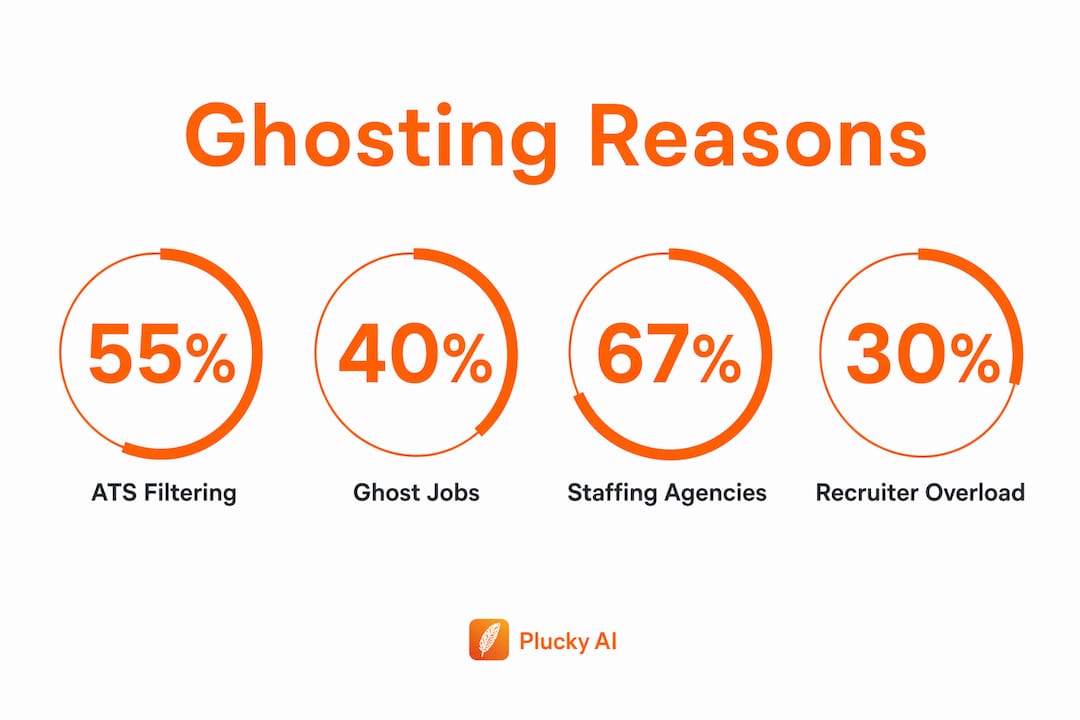
ATS software is the first and most common reason IT candidates never hear back. These systems scan resumes for keyword matches, experience thresholds, and formatting compliance before any recruiter reads a single line. AI filtering removes candidates automatically without feedback, and those candidates receive no notification. The system simply moves on.

For IT professionals, this creates a specific problem. Job descriptions in tech often list 10 to 15 required skills, and ATS systems may reject a resume that matches 12 of them because it lacks the exact phrasing for the other three. A candidate with five years of cloud infrastructure experience may be filtered out because the resume says "AWS EC2" while the job description says "Amazon Elastic Compute Cloud." The ATS reads these as different things.
Common ATS pitfalls for IT resumes include:
- Using graphics, columns, or tables that parsing engines cannot read correctly
- Listing certifications by acronym only (CISSP, CEH) without spelling out the full name
- Omitting exact job title keywords from the target role
- Burying skills in a dense paragraph instead of a dedicated skills section
- Using headers like "Core Competencies" instead of "Skills," which some systems do not recognize
Pro Tip: Mirror the exact language from the job description in your resume's skills section. If the posting says "penetration testing," your resume should say "penetration testing," not "pen testing" or "ethical hacking."
Over 50% of job seekers experienced ghosting in the past year, and the surge correlates directly with AI-driven recruiting overload. As companies adopt AI screening tools to manage high application volumes, the gap between candidate effort and employer response grows wider. Understanding how AI affects job search speed helps IT professionals adapt their approach before the ATS even sees their resume.
What are ghost jobs and how do they cause candidate silence?
Ghost jobs are real job postings with no immediate hiring intent. Companies post them to build talent pipelines, signal growth to investors, or benchmark current salaries against market rates. Between 18% and 22% of active job postings are ghost jobs at any given time. In tech, where companies frequently announce hiring plans before budgets are approved, that percentage runs even higher.
The table below shows the most common reasons companies post ghost jobs and the effect on candidate communication.
| Reason for ghost posting | Effect on candidates |
|---|---|
| Pipeline building for future roles | Applications collected but never reviewed |
| Budget approval pending | Role paused mid-process with no notification |
| Internal candidate already selected | External applicants ignored after initial screen |
| Market salary benchmarking | No hiring intent; candidates receive no response |
| Organizational restructuring | Role requirements change; existing applicants dropped |
Beyond ghost jobs, shifting company priorities cause ghosting even when a role was genuine at the time of posting. 81% of hiring managers cite shifting priorities as the primary reason they go silent after an interview. A budget freeze, a leadership change, or a decision to promote internally can kill an active search overnight. The recruiter often has no authority to communicate this externally and no process that requires them to do so.
Recruiters often cannot provide updates because:
- Legal or HR policy restricts what they can say about open roles
- The decision to pause hiring comes from above their level
- They are managing 30 to 50 open roles simultaneously and cannot track every candidate
- The ATS does not prompt them to send rejections when a role is paused rather than closed
Understanding the IT job application workflow helps candidates recognize where in the process communication typically breaks down and set realistic expectations before applying.
Why do recruiters and staffing agencies ghost IT candidates?
Recruiter ghosting is not random. It follows predictable patterns tied to workload, agency incentives, and organizational structure. Staffing agencies ghost 67% of candidates compared to just 2% for direct employers. That gap exists because agency recruiters are paid on placement, not on communication. Once a candidate is no longer the top contender for a role, the financial incentive to maintain contact disappears.
Direct employer recruiters ghost for different reasons. They typically manage multiple open roles under pressure to fill positions quickly. When a strong candidate emerges, weaker contenders get deprioritized without formal rejection. Turnover inside recruiting teams compounds the problem. When a recruiter leaves mid-process, their candidate pipeline often goes with them. No one inherits the follow-up responsibility, and candidates simply fall through the gap.
Key recruiter behaviors that lead to ghosting in IT hiring:
- Prioritizing the top one or two candidates and ignoring the rest
- Avoiding difficult conversations about role cancellations or budget holds
- Losing track of candidates when ATS records are incomplete
- Failing to update candidates after internal decisions change the role requirements
Pro Tip: When working with a staffing agency, ask the recruiter directly: "What is your typical communication timeline if I am not selected?" A professional recruiter will give you a clear answer. One who hedges is a signal to manage your expectations accordingly.
Recruiters ghost candidates primarily due to internal organizational issues, not candidate performance. Knowing this matters because IT professionals often internalize silence as a signal that their skills are lacking. That interpretation is almost always wrong.
How should IT candidates respond to ghosting?
Ghosting rarely reflects interview performance or candidate quality. The backup candidate practice is one of the most common causes of post-interview silence. Recruiters keep strong finalists in limbo while a preferred candidate completes background checks or negotiates an offer. The backup candidate receives no update because the recruiter wants to preserve the option without making a commitment.
The most effective response to ghosting follows a clear sequence:
- Wait one full week after the stated decision date before following up.
- Send one polite, professional email asking for a status update on the role.
- Express continued interest without pressure or emotional language.
- If no response arrives within five business days, send one final message and move on.
- Do not contact the hiring manager directly unless the recruiter has been unresponsive for more than two weeks.
Aggressive follow-ups deprioritize candidates further. Recruitment expert Bonnie Dilber advises a single polite check-in after one week as the optimal approach. Multiple messages, emotional language, or escalating to senior staff before that window closes signals poor judgment to hiring teams.
Professional curiosity in follow-up emails outperforms accusatory or emotional messages every time. A subject line like "Following up on the senior network engineer role" and a two-sentence body asking for a timeline update is all that is needed. Candidates who treat follow-up as a professional inquiry rather than a grievance get better results. Reviewing common IT job search mistakes can help you identify other patterns that reduce your response rate before ghosting even becomes the issue.
Pro Tip: Keep a simple spreadsheet tracking every application: company, role, date applied, recruiter name, and follow-up date. This removes the emotional weight from follow-up decisions and turns them into a process.
Key Takeaways
IT job seekers get ghosted because of systemic hiring failures, not personal shortcomings, and the most effective response is a structured, low-volume follow-up strategy combined with parallel applications.
| Point | Details |
|---|---|
| ATS filters cause silent rejections | Mirror exact job description language in your resume to pass automated screening. |
| Ghost jobs are widespread | Up to 22% of postings have no immediate hiring intent; apply selectively and verify role activity. |
| Agency recruiters ghost most | Staffing agencies ghost 67% of candidates; set communication expectations upfront. |
| Shifting priorities drive post-interview silence | 81% of hiring managers cite internal changes, not candidate quality, as the reason for ghosting. |
| One follow-up is the limit | Send a single polite check-in after one week; multiple messages reduce your chances further. |
The uncomfortable truth about ghosting in IT hiring
Ghosting is a symptom of broken hiring infrastructure, not a judgment on your skills. I have watched technically strong IT professionals spend weeks replaying interviews in their heads, convinced they said something wrong, when the role was quietly frozen the day after they left the building. That kind of self-doubt is understandable. It is also almost always misdirected.
The hiring process in tech was not designed with candidate experience as a priority. ATS systems were built to filter volume, not to communicate. Agency recruiters are measured on placements, not on courtesy. Ghosting creates long-term reputational damage for employers, according to Clemson University research, but most companies have not yet felt enough pain from that dynamic to change their behavior.
The practical response is to treat every application as a lottery ticket, not a job offer. Run five to ten active applications at any given time. Keep a financial buffer that removes urgency from your search. When you follow up, do it once, do it professionally, and then redirect your energy to the next opportunity. The candidates who get hired fastest are not the ones who chase the hardest. They are the ones who apply the most strategically and stay emotionally detached from any single outcome.
Ghosting will not disappear from IT hiring anytime soon. The systems that produce it are deeply embedded. What you can control is how much of your time and confidence you invest in any single application before you have an offer in hand.
— Diego
Pluckjobs cuts through the silence for IT professionals
IT job seekers spend too much time applying blind and waiting for responses that never come. Pluckjobs was built specifically to change that equation for IT and cybersecurity professionals.
Plucky AI combines Apollo contact intelligence with SerpAPI-powered role discovery to surface real, active roles and the direct contact details of the hiring managers behind them. Instead of submitting to an ATS and hoping, you apply with context, reach the right person, and move faster through a process designed to ignore you. Pluckjobs also generates tailored resumes matched to each role's exact language, which directly addresses the ATS keyword filtering that causes most silent rejections. If you are tired of sending applications into a void, start with Pluckjobs and apply with precision.
FAQ
Why do most IT job applications get no response?
About 89% of job applications receive no response because ATS systems filter candidates automatically and many postings are ghost jobs with no active hiring intent.
What is a ghost job in IT hiring?
A ghost job is a posted role with no immediate hiring intent, often used for pipeline building or salary benchmarking. Between 18% and 22% of active postings fall into this category.
Why do staffing agencies ghost IT candidates more than direct employers?
Staffing agencies ghost 67% of candidates compared to 2% for direct employers because agency recruiters are paid on placement and have little financial incentive to maintain contact with candidates they are not actively placing.
How long should I wait before following up after an interview?
Wait one full week after the stated decision date, then send one polite email. Recruitment expert Bonnie Dilber identifies a single check-in after one week as the optimal approach. Multiple follow-ups reduce your chances of a response.
Does getting ghosted mean I performed poorly in the interview?
No. Recruiters ghost candidates primarily due to internal organizational issues such as budget freezes, role changes, and shifting priorities. Candidate performance is rarely the cause of post-interview silence.