
The best tech resume action verbs are concrete, calibrated words that describe work you can defend in an interview, ideally paired with a metric. If a verb doesn't hold up under a follow-up question ("Walk me through that"), it doesn't belong on your resume.
Start with this drop-in list, then match each verb to the seniority and scope you actually had:
- Built — for something you created from scratch
- Shipped — for features that reached production
- Designed — for architecture or system decisions
- Optimized — for measurable performance gains
- Debugged — for root-cause fixes
- Automated — for eliminating manual work
- Scaled — for handling growth in load, users, or data
- Migrated — for platform or infrastructure moves
- Instrumented — for monitoring, logging, or observability work
- Profiled — for performance diagnosis
Don't overclaim. If you didn't own the decision, use "implemented" or "contributed to" instead of "led" or "architected." Recruiters and hiring managers notice the difference fast.
Key Takeaways
Strong tech resume action verbs work because they describe defensible, specific work and pair naturally with a measurable outcome.
| Point | Details |
|---|---|
| Start with concrete verbs | Use built, shipped, optimized, debugged, or automated instead of vague phrasing like "worked on." |
| Calibrate ownership language | Reserve "led" or "architected" for work you truly owned; use "contributed to" otherwise. |
| Match verbs to category and level | Development, data, DevOps, and security each call for different verbs, scaled to junior, mid, or senior scope. |
| Pair every verb with a metric | A verb without a number tells half the story; add percentages, time saved, or scale where possible. |
| Get faster, tailored rewrites | Plucky AI from Pluckjobs rewrites bullets against specific job postings so verb choice matches ATS keywords automatically. |
Table of Contents
- What Are Tech Resume Action Verbs and Why Do They Matter?
- Top Action Verbs by Technical Category
- How Do You Choose the Right Verb for Each Bullet?
- Before and After: Rewriting Weak Resume Bullets
- Common Mistakes to Avoid When Picking Action Verbs
- What Recruiters Wish Applicants Knew About Verb Choice
- Rewrite Your Bullets Faster With Plucky AI
- Sources
- FAQ
What Are Tech Resume Action Verbs and Why Do They Matter?
Action verbs are the words that open each resume bullet and name the work you did, in active voice, without hedging. "Optimized database queries" beats "was responsible for database performance" every time.
They matter for three practical reasons:
- Recruiter scanning — recruiters spend seconds per resume, and a strong verb up front signals real technical work instead of a job description restated.
- ATS and keyword fit — applicant tracking systems match phrasing against job postings, so precise verbs like "engineered" or "containerized" often align better than vague ones.
- Interview defensibility — every verb you choose becomes a question you'll answer later, and engineering hiring managers can spot marketing language quickly.
Top Action Verbs by Technical Category
Different roles reward different verbs. A backend engineer and a SOC analyst aren't competing for the same words, and your resume shouldn't treat them like they are. University career-office lists group verbs by contribution type for exactly this reason: leadership, analysis, design, data, and results each call for a different vocabulary.
Development and Programming: built, shipped, engineered, refactored, architected, implemented, coded, integrated.
Data and Analytics: analyzed, modeled, visualized, extracted, aggregated, forecasted, cleaned, mined.
DevOps, SRE, and Infrastructure: automated, provisioned, containerized, deployed, monitored, scaled, orchestrated, hardened.
Security and Cyber: hardened, audited, remediated, detected, investigated, patched, encrypted, monitored. Example: "Remediated 200+ critical vulnerabilities across production systems following quarterly penetration tests."

QA and Testing: tested, validated, automated, verified, diagnosed, reproduced, documented. Penn State's engineering career resource lists "tested" and "debugged" among the verbs that read as precise rather than inflated.
System Administration and IT Support: configured, resolved, maintained, escalated, provisioned, troubleshot, documented.
Product and Technical Program Management: coordinated, prioritized, scoped, launched, aligned, tracked, delivered.
Leadership and Mentoring: mentored, onboarded, coached, trained, guided, reviewed.
Seniority changes the verb, not just the outcome. A junior engineer writes "contributed to" or "implemented." A mid-level engineer writes "developed" or "owned." A senior engineer writes "architected" or "led," but only when the title matches the authority.
How Do You Choose the Right Verb for Each Bullet?
Before you write a bullet, answer one question: what did you actually do? Use this checklist to map the work to a verb family, drawing on the decision framework Rejectless outlines for engineering resumes:
- Did you create something new? Use built, designed, or developed.
- Did you improve something existing? Use optimized, reduced, or streamlined performance language tied to a number.
- Did you fix a problem? Use debugged, resolved, or patched.
- Did you investigate an issue? Use diagnosed, traced, or identified.
- Did you handle growth or load? Use scaled, automated, or provisioned.
- Did you coordinate people or decisions? Use led only if you owned the call. Otherwise, use contributed to, supported, or coordinated.
Before and After: Rewriting Weak Resume Bullets
Weak verbs like "worked on" or "helped with" tell a hiring manager nothing about scope or outcome. Career-office guidance from the University of Michigan recommends replacing these starters with precise verbs that lead the sentence.
-
Before: "Worked on backend features for the checkout system."
-
Before: "Helped with database performance issues." After: "Optimized slow-running SQL queries, cutting average response time from 800ms to 150ms."
-
Before: "Was responsible for incident response." After: "Diagnosed and resolved a production outage affecting 10,000 users within 45 minutes."
-
Before: "Helped migrate the app to the cloud."
-
Before: "Worked on test automation."
-
Before: "Helped train new hires." After: "Mentored two junior engineers through onboarding, both promoted within a year."
-
Before: "Led the team on a redesign." (when you didn't own the decision) After: "Contributed to a UI redesign initiative, implementing 15 of 40 component changes."
-
Before: "Managed the security audit." (when you supported it) After: "Supported a security audit, remediating 12 high-severity findings."
Common Mistakes to Avoid When Picking Action Verbs
- Vague verbs. "Worked on" and "helped" describe nothing measurable.
- Marketing-speak. Words like "synergized" or "leveraged" read as corporate filler, not engineering work.
- Overclaiming. Writing "spearheaded" when you were one of five contributors invites a hard question in the interview.
- Repetition. Using "developed" in six consecutive bullets flattens your resume and signals a thin vocabulary.
Recruiters flag these patterns immediately, and they often follow up specifically to test whether the ownership language holds up.
Pro Tip: If you can't explain the decision behind a verb in an interview, replace it or remove it before you submit the resume.
What Recruiters Wish Applicants Knew About Verb Choice
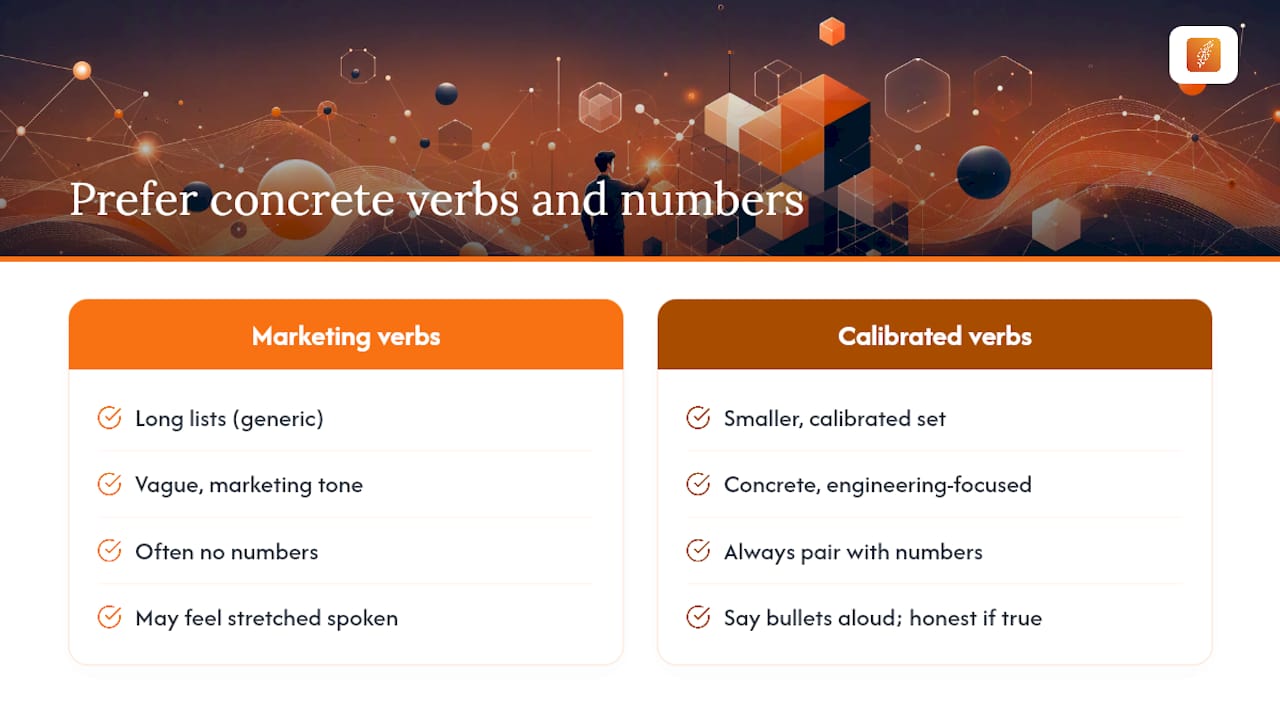
Recruiters and engineering hiring managers can spot marketing-style verbs quickly, and a smaller, calibrated set of concrete engineering verbs consistently outperforms long lists of generic "power verbs."
That single insight from techinterview's engineering resume guidance should change how you edit. Calibrate "led" against "contributed to" honestly, and always pair the verb with a number the reader can picture.
Pro Tip: Practice saying each bullet out loud before an interview. If the verb feels like a stretch when spoken, it's a stretch on paper too.
A hiring coach's take on verb choice
Resume coaching for IT and cybersecurity candidates shows a clear pattern: candidates who calibrate their verbs to actual scope get more callbacks than those who inflate titles. Precision reads as confidence, not modesty.
Rewrite Your Bullets Faster With Plucky AI
Pluckjobs' Plucky AI reads a job posting and rewrites your resume bullets with verbs calibrated to that specific role, aligning them to the ATS keywords the posting actually uses instead of guessing at a generic list. For IT and cybersecurity professionals juggling dozens of applications, that's the difference between manually second-guessing every "led" versus "contributed to" and getting a tailored draft in minutes.
Plucky AI also surfaces the hiring manager behind each role, so once your bullets are sharp, you're not just submitting into a black hole. If you want to see how your current bullets read against a real job description, start a free trial on Pluckjobs and run your resume through the rewrite tool before your next application.
Sources
- Action Verbs for Engineering Resumes: What to Use, What to Cut – techinterview
- Action Verbs for Engineering Graduate Students – Duke Graduate Student Programs and Services
- Action Verbs | Penn State Engineering
- 100 Action Verbs for Software Engineer Resumes (By Category) | Rejectless
FAQ
What Are Tech Resume Action Verbs?
They're active, specific verbs like "built," "optimized," or "debugged" that open resume bullets and describe real technical work instead of vague responsibility statements.
Which Action Verbs Work Best for Software Engineers?
Built, shipped, engineered, refactored, architected, and debugged consistently perform well because they describe concrete, defensible engineering work.
Should I Use "Led" if I Wasn't the Team Lead?
No. Use "contributed to" or "supported" instead, and reserve "led" for situations where you actually owned the decisions.
How Do I Avoid Repeating the Same Verb Too Often?
Pull from category-specific lists organized by contribution type, such as development, data, security, or leadership, and vary the verb every two or three bullets.
Can Pluckjobs Help Me Rewrite My Bullets?
Yes. Plucky AI rewrites resume bullets against specific job postings, aligning verb choice and ATS keywords to the role you're targeting.