
Always counter a written IT or software offer. Get the final agreed package in writing before you accept anything, and never negotiate off a verbal offer alone.
TL;DR:
- Most offers should be negotiated only after receiving a detailed written package, and verbal commitments should never be used as leverage.
- Building market-based target numbers requires triangulating data from sources like BLS, compensation platforms, and internal parity to justify your counteroffer.
- Non-salary components such as sign-on bonuses, equity, and title often provide more flexibility than base salary, especially at larger or established firms.
- When countering, use brief, specific scripts that express enthusiasm, state your target figures, and give a clear reason, avoiding lengthy explanations or ultimatums.
- Understanding each company's signals and leveraging real competing offers responsibly can improve your negotiation position without risking damage to the relationship.
Table of Contents
- When Should You Start an IT Salary Negotiation?
- How Do You Research Market Salary Ranges for IT Roles?
- Which Compensation Components Are Actually Negotiable?
- What Should You Say and Write When Countering an Offer?
- How Do You Use Leverage Without Overplaying It?
- What Are the Most Common Mistakes in Tech Salary Negotiation?
- How PluckJobs Supports IT Salary Negotiation
- How Do You Assess Your Own Market Value in IT?
- Do Regional and Cultural Norms Change How You Negotiate?
- How Should You Negotiate When Moving From Contract to Full-Time?
- How Do You Negotiate Remote Work, Training, and Career Growth?
- The Real Gap in Most Salary Negotiation Advice
- Ready to Negotiate From a Position of Data, Not Guesswork?
- Sources
- FAQ
When Should You Start an IT Salary Negotiation?
The moment to negotiate is after you have a written offer in hand, never before. A verbal "we'd like to offer you the role" from a recruiter is not a negotiable document. It's an invitation to wait for the real one.
Push for a written offer that includes a detailed breakdown such as base salary, sign-on bonus, RSU or equity value with vesting schedule, bonus targets, and start date. Recruiters sometimes want a verbal yes before the paperwork goes out, but agreeing early gives away your leverage before you even see the numbers. Once the written offer arrives, the standard, well-tested rhythm is to take a few business days to research and build your counter, then respond by email with specific numbers rather than a vague request for "more."
Here's what that looks like in practice:
- If a recruiter asks for a verbal commitment, say something like: "I'm excited about this and want to move forward. Can you send the formal written offer so I can review the full package?"
- If you need more time to research, say: "This looks great. I'd like a few business days, ideally by [date], to review the details before I respond."
- If a recruiter pressures you to decide same day, treat that as a signal, not a deadline. Legitimate offers survive a short, professional pause.
Two to five days is enough to run the numbers, check your other pipeline, and draft a counter. It is not enough time to look unserious, and industry playbooks built around 2026 hiring cycles treat that window as standard practice, not an aggressive ask.
How Do You Research Market Salary Ranges for IT Roles?
Guessing at a number is the fastest way to either lowball yourself or torpedo your credibility with a counter that has no basis. Build your target from real data, triangulated across at least three sources.
1. Start with a public baseline. The Bureau of Labor Statistics publishes median base pay by occupation and region, which gives you a floor for cash compensation. It won't capture equity or bonus structure, but it keeps your low end honest.
2. Layer in tech-specific total-comp data. Crowd-sourced compensation platforms that break out base, bonus, and equity by company and level (Levels.fyi is the most widely used for this) show you what total comp actually looks like at comparable companies. BLS medians tend to sit well below these total-comp figures because they exclude equity.
3. Check internal parity. If you know peers at the company, or can find leveling guides shared publicly, use that to sanity-check where the offer lands relative to existing staff at your target level.
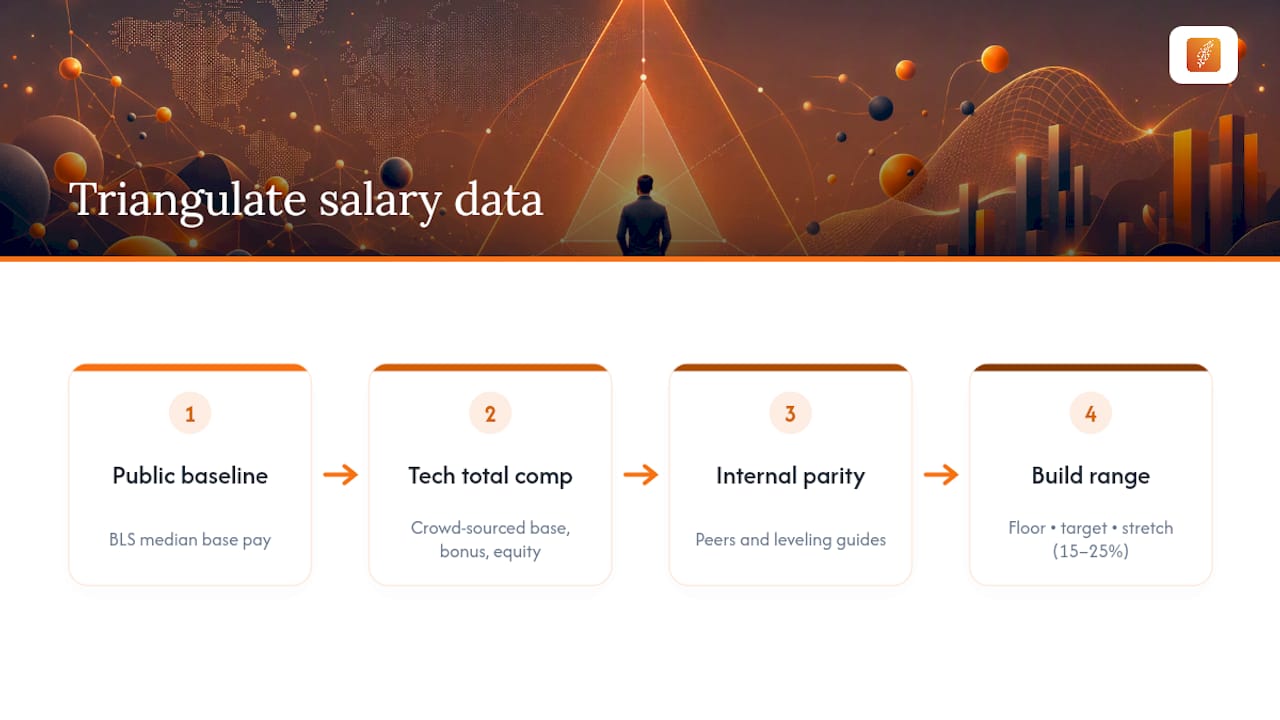
4. Adjust for specialization and location. AI/ML engineering, security engineering, and site reliability roles routinely command a premium over general application development, and metro-area cost-of-living adjustments can shift a number by tens of thousands depending on the market.
Once you have a range, build three numbers: your floor (the minimum you'd accept), your target (what the data supports for your level and specialization), and your stretch (an ambitious but defensible ask).
Statistic Callout: Negotiation guidance built for 2026 offer cycles recommends anchoring your stretch number 15 to 25% above the initial offer, provided you can point to comparable total-comp data to justify it.
If the recruiter says base is fixed at $150,000, that gap becomes your case for a sign-on bonus or an equity refresh instead.
Cybersecurity roles deserve a separate note here. Titles are inconsistent across companies (a "security engineer" at one company does the job of a "security architect" at another), so anchor your research to responsibilities and required certifications, not just job title, when you pull comps.
For a deeper look at how to frame your specific skills against market rate, reviewing your IT career positioning before you start the comp math tends to sharpen your target number considerably.
Which Compensation Components Are Actually Negotiable?
Base salary gets most of the attention, but it's usually the least flexible piece of an IT offer. Understanding which levers move, and which company types tend to move them, changes how you spend your negotiating energy.
Base salary is the most scrutinized number internally because it sets a permanent cost and creates internal-equity comparisons across the team. Larger, established companies often have hard band caps tied to level; smaller or funded startups sometimes have more room simply because their leveling structure is less formalized.
Sign-on bonus is frequently the fastest yes you'll get. It's a one-time cost that doesn't require restructuring the comp band or triggering internal-equity reviews, which is why hiring managers can often approve it faster than a base bump. If a recruiter tells you base is capped, this is usually your next move.
RSUs or equity matter most at public companies and well-funded private ones. At a public company, ask about refresh grants and current vesting cliffs, not just the initial grant size. At an early-stage startup, equity is harder to value and harder to negotiate meaningfully, so weight it lower in your calculations unless you have real visibility into the cap table.
Bonus targets are usually a percentage of base tied to company and individual performance. There's often more room here than people assume, especially at companies where the bonus pool is discretionary rather than formula-locked.
Title costs the company nothing in cash but can matter enormously for your next negotiation. A senior title now becomes your anchor point in two years.
Review cadence is an underused lever. Instead of pushing hard on a number the recruiter can't move, ask for an accelerated review at 6 months instead of the standard 12, with a defined path to a raise if you hit agreed goals.
- Base capped? Pivot to sign-on bonus or an accelerated 6 month review.
- Startup with limited cash? Push equity refresh terms and vesting acceleration instead of base.
- Public company with rigid bands? Focus on sign-on, bonus target, and title.
- Genuinely strong outside offer? Use it to move base directly, since that's the hardest lever to shift without real external pressure.
2026 negotiation playbooks increasingly recommend grading the offer before you counter so you know whether you're making a surgical ask on one component or rebuilding the whole package.
Pro Tip: Never ask for a raise on base alone when a recruiter has already told you it's capped. Restate the same target number as "total first-year value" and let them tell you which components can move. That reframing usually gets you further than repeating the base ask.
What Should You Say and Write When Countering an Offer?
Scripts work because recruiters have heard every rambling justification before. A short, specific counter with a clear number and a brief reason behind it consistently outperforms a vague, lengthy explanation, and it respects the recruiter's time in a way that keeps the conversation collaborative.
1. The call script to buy time. When you get the verbal offer or the written one lands and you're not ready to respond: "Thank you, I'm genuinely excited about this. I'd like a few days to review the full package in detail. Can I follow up by [specific date]?"
2. The opening counter email. Keep it to a few sentences: state your enthusiasm, name your target number, and give one clear reason it's justified.
3. The email when base is capped. Pivot without abandoning your number:
4. The script when you have a competing offer. Be honest, not theatrical: "I want to be upfront. I have another offer at $[figure]. I'd genuinely prefer to join your team, so I wanted to see if there's room to move closer to that number before I make a decision."
5. The non-monetary ask. Sometimes the win isn't cash at all: "The offer looks solid on comp. I'd like to talk about start date flexibility and a training budget for [specific certification], if that's something we can include."
Every one of these scripts shares a structure: gratitude, a specific number or ask, and a brief reason. Skip the apology-heavy openers ("I hate to ask, but…") that undercut your own position before you've made it.
How Do You Use Leverage Without Overplaying It?
Leverage in IT hiring usually comes from one of three places: a competing offer, insight into how the company is doing, or a timeline you control. Using it well means being specific and honest, not vague or theatrical.
A real competing offer is the strongest lever you have, but only if you present it accurately. Naming the actual company isn't required, and sometimes isn't wise if it's a direct competitor, but naming the actual number and timeline is what makes it credible. Vague claims of "other interest" rarely move anyone.
Company signals tell you which lever is worth pushing:
- A recent funding round often means more room on equity or sign-on, less on base.
- A hiring freeze or visible headcount caution suggests base flexibility overrate of hire; sign-on may still move.
- A company in obvious cost-cutting mode (public layoff notices, hiring slowdowns) is a signal to prioritize speed and certainty over squeezing every dollar.
Timing overlapping offer cycles is a skill in itself. If you're further along with one company, it's fair to tell a second company you have a decision deadline and ask if they can accelerate their process. Recruiters manage this constantly, and running parallel search cycles while still employed is standard practice, not a red flag. What actually damages you is silence followed by a fabricated deadline. Real timing pressure works. Invented timing pressure gets discovered.
What Are the Most Common Mistakes in Tech Salary Negotiation?
Most negotiation damage happens before the counter email is even sent. A handful of avoidable errors account for most of it.
- Accepting verbally. Once you say yes out loud, your leverage is gone even if you haven't signed anything.
- Disclosing salary history early. In states with salary-history bans, you can legally decline and redirect to market data for the role and level instead.
- Fabricating a competing offer. It's discoverable, and it damages trust in an industry where recruiters move between companies and compare notes.
- Going silent under pressure. If a recruiter pushes for a same-day answer, ask directly why the urgency exists rather than folding or disappearing.
- Treating negotiation as adversarial. Recruiters expect a counter and rarely rescind a reasonable, professionally delivered request.
If a recruiter does apply real pressure or threatens to pull the offer over a modest, well-justified counter, that's a signal about the company culture worth weighing on its own.
Pro Tip: If a recruiter says "this is our best and final offer" on the first counter, treat it as an opening position, not a wall. Ask what specifically is fixed versus flexible before you concede anything.
How PluckJobs Supports IT Salary Negotiation
Most negotiation advice stops at scripts. The harder problem is knowing whether your specific offer is actually competitive for your role, level, and specialization, and knowing who to talk to if it isn't.
Pluckjobs combines role discovery with hiring manager contact data, so when you're evaluating a written offer, you can see who actually makes the call on comp at that company and reach them directly instead of routing every question through a recruiter. The platform's resume tailoring and outreach tools were built for IT and cybersecurity job seekers specifically, which matters because a security engineer's leverage points look different from a general application developer's. Turning market research into a workable counter is exactly the kind of structured comparison the platform is designed to support, alongside its broader job search metrics tracking for offer timelines and comp benchmarks across your active pipeline.
How Do You Assess Your Own Market Value in IT?
Your leverage isn't just your title. It's the specific combination of stack, scale, and scope you've actually worked at.
Start with depth versus breadth. A developer who has shipped one system end-to-end at production scale, on-call rotation included, often has stronger leverage than someone with broader but shallower exposure across five tools. Recruiters and hiring managers weight ownership heavily, more than a list of technologies on a resume.
Specialization changes your number more than years of experience alone. Security engineering, machine learning infrastructure, and platform/SRE work tend to command premiums over general full-stack development, largely because the talent pool is thinner relative to demand. If you hold a specialized certification (OSCP, AWS Solutions Architect Professional, CISSP) that's directly relevant to the role, that's a concrete data point to include in your justification, not just a resume line.
Scale matters too. Having operated systems at a company with millions of users is a different skill set than a 10 person startup, and it's worth naming explicitly rather than assuming a title conveys it.
Before you name a number, write down three concrete accomplishments tied to metrics: latency improved, incidents reduced, cost saved, features shipped on a deadline that mattered. Framing your specific value proposition this way, rather than leaning on generic years-of-experience claims, is what turns your counter into something a hiring manager can actually justify internally.
Do Regional and Cultural Norms Change How You Negotiate?
Tech salary negotiation isn't identical everywhere, and assuming a Silicon Valley script works globally is a common misstep.
In the United States, negotiation is broadly expected, and a modest, well-justified counter rarely raises eyebrows. Some states and cities have salary-history bans, meaning employers legally cannot ask what you currently earn, which strengthens your position to anchor purely on market data rather than your last paycheck.
Outside major U.S. tech hubs, expectations shift. In smaller regional markets, comp bands tend to be more rigid and total comp skews more toward base with less equity, so your leverage often comes down to sign-on bonus, remote flexibility, and title rather than equity refreshers.
Company culture matters as much as geography. European and some Asian tech offices, particularly at companies with flatter, more consensus-driven cultures, sometimes treat aggressive countering as a poor cultural fit signal even when the number itself is reasonable. Framing matters more in these settings: leading with collaboration language and market data, rather than ultimatums, tends to land better regardless of where you are.
Remote-first companies complicate location further. Some peg your offer to your metro area's cost of living; others pay a flat national or global band regardless of where you sit. Ask directly which model applies before you build your target number, since a strong counter based on San Francisco comps means nothing if the company pays a flat rate tied to a lower cost-of-living index.
How Should You Negotiate When Moving From Contract to Full-Time?
Converting from a contract or contract-to-hire role into a full-time offer is its own negotiation, and treating it like a fresh external offer usually leaves value on the table.
Your contract rate typically included a built-in premium to cover the lack of benefits, the lack of job security, and often the cut a staffing agency takes. When that conversion happens, translate your hourly or contract rate into an annualized equivalent, then adjust down for the value of benefits, but not all the way to a lowball number.
You already have something most external candidates don't: a documented track record inside the company. Use it directly. Point to specific work you delivered during the contract period, not hypothetical future value, and ask the hiring manager or your direct manager what level the full-time role maps to before a number is even discussed.
Watch for a common trap: some companies use the conversion moment to reset your comp lower than your contract rate implied, betting that you'll accept out of relief at getting a "real" offer. Counter that directly by naming your contract-equivalent annualized rate as your floor, not your target, and asking for the same base/equity/sign-on breakdown you'd expect from any other written offer.
If the agency that placed you is still involved in the conversion, clarify early whether a placement fee affects what the company can offer you directly. That single detail changes what's actually negotiable on the company's side.
How Do You Negotiate Remote Work, Training, and Career Growth?
Salary isn't the only line item worth pushing on, and sometimes it isn't even the most valuable one.
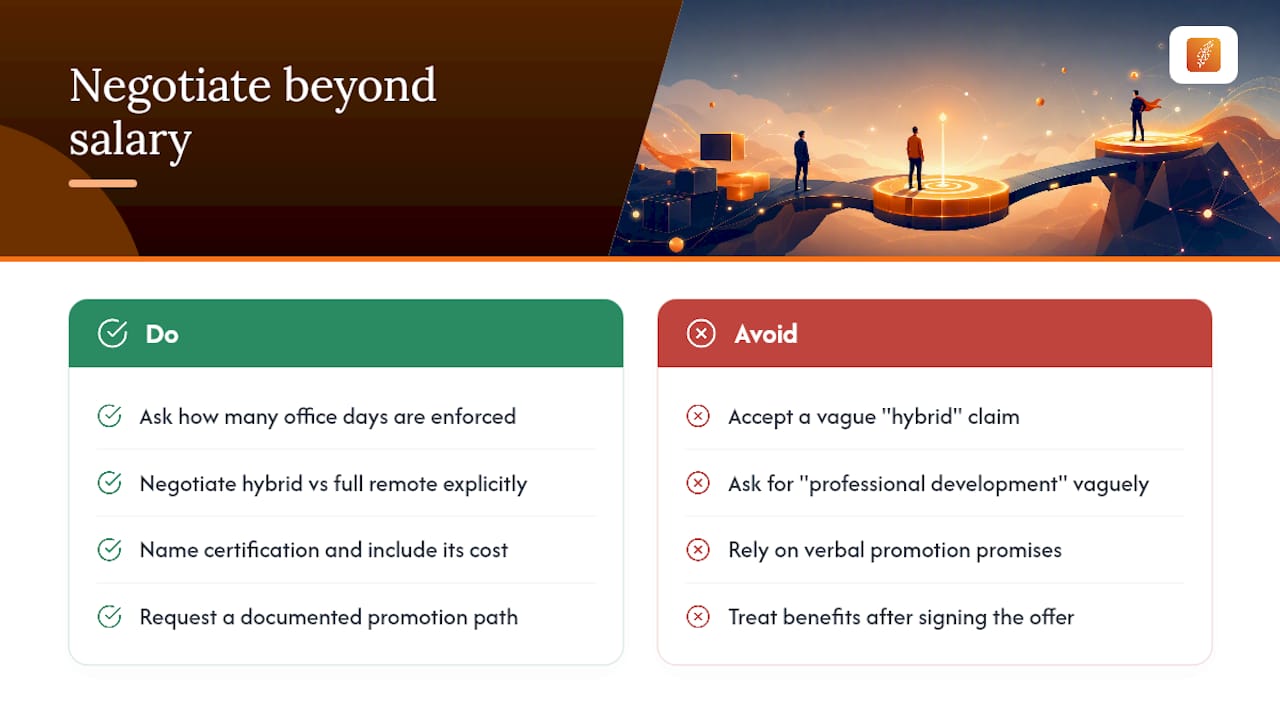
Remote and hybrid flexibility is now a standard negotiation point rather than a special request. If the role is listed as hybrid, ask directly how many in-office days are actually enforced versus nominal, and whether that's negotiable for your specific circumstances. Some companies will trade a small amount of base flexibility for full remote status, since it changes their real estate and equity calculations too.
Training and certification budgets are usually easy yeses because they're a fixed, capped cost rather than an ongoing salary liability. If you're eyeing a specific certification, naming it directly, cost included, gets a faster answer than a vague "professional development" request.
Career progression deserves the same specificity. Instead of asking generally "will I get promoted," ask for a documented path: what does the jump to the next level look like, what's the typical timeline, and can that be written into your onboarding plan. A written 6 month review tied to specific goals is worth more than a verbal promise of "we'll see how it goes."
PTO, remote equipment stipends, and relocation assistance round out the list, and combining these benefit levers with the salary conversation rather than treating them as an afterthought after the offer is signed tends to produce a stronger overall package. None of these cost the company as much as a permanent base increase, which is exactly why they're often the easiest wins in the room.
The Real Gap in Most Salary Negotiation Advice
Most negotiation guides treat every tech offer the same way: research a number, ask for more, repeat a script. That misses the actual skill involved, which is reading what a specific company can move and why. A seed-stage startup and a public company with rigid comp bands require different plays entirely, and generic advice that ignores company stage sends people into the wrong conversation with the wrong ask.
The other overlooked piece is documentation discipline. Plenty of candidates negotiate well verbally, then accept based on a recruiter's summary email instead of a fully itemized written offer. That gap is where disputes happen months later, over vesting start dates or bonus eligibility windows nobody nailed down in writing.
If there's one thing worth doing differently, it's this: grade your offer against real total-comp data before you counter, not after a recruiter pushes back. Knowing your floor, target, and stretch before the first email goes out changes the entire tone of the conversation, because you're negotiating from evidence instead of instinct.
— Diego
Ready to Negotiate From a Position of Data, Not Guesswork?
Grading an offer against real market data takes time most job seekers don't have while they're also managing interviews, references, and a start-date clock. Pluckjobs was built specifically for IT and cybersecurity professionals working through exactly this stage: it pairs role-specific market data with hiring manager contact details, so you're not negotiating blind or routing every question through a recruiter who may not have authority over your comp band.
Run one offer through Plucky AI to see how your base, equity, and sign-on stack up against comparable roles before you send your counter. Between tailored resume support and direct outreach data, it's built to help you walk into the conversation with a number you can actually defend, and a plan for who to send it to.
Sources
- How to negotiate your first job offer (Rutgers Careers blog)
- Salary Negotiation 2026: Initial Offer, Counter, Multiple Offers (TechInterview)
- U.S. Bureau of Labor Statistics, Occupational Outlook Handbook
- Got a verbal job offer but no written offer? Do this next (Rollins Crummer)
FAQ
What Is the 70/30 Rule in Salary Negotiation?
There's no single agreed-upon "70/30 rule" in salary negotiation, and definitions vary depending on the source.
Is a 20% Counter Offer Too Big?
No, a 20% counter sits squarely inside the range recommended by 2026 negotiation guides, which suggest anchoring 15% to 25% above the initial offer when you have market data to back it. What matters more than the percentage is whether you can justify it with comparable total-comp figures for your level and specialization.
How Do I Negotiate My Salary in Tech Specifically?
Get the offer in writing, take 2 to 5 days to research total comp using sources like BLS baselines and tech-specific comp platforms, then send a short email naming a specific target number with a brief justification. If base is capped, pivot to sign-on bonus, equity, or an accelerated review instead of repeating the same ask.
Is It Okay to Negotiate a Salary Offer?
Yes. Recruiters expect a counter on most offers and rarely rescind one over a reasonable, professionally worded request. Staying silent typically costs you more than asking ever will.
What If the Recruiter Says the Offer Is Final?
Treat "final" as an opening position until you've asked which specific components are actually fixed. Base salary is often the least flexible line item, while sign-on bonuses and accelerated vesting frequently still have room even when a recruiter says the total package is locked.