
A strong cybersecurity cover letter names the role, opens with one proof point tied to the job posting, and stays within 250 to 400 words across three to four short paragraphs. It proves you can reduce a specific risk the employer named in the listing, backed by a named tool or framework and a measurable result. Skip the resume recap and skip the generic opener. Hiring managers scan for capability, not enthusiasm.
TL;DR:
- A strong cybersecurity cover letter should directly address a specific risk or goal mentioned in the job posting, backed by measurable results and named tools or frameworks.
- It must be concise, ideally between 250 and 400 words, and structured into clear paragraphs: the hook, proof of accomplishments, motivation, and call to action.
- Tailoring the language to include keywords from the job description and replacing generic phrases with concrete project metrics significantly improves callback chances.
- Replacing vague statements with quantifiable achievements, such as reducing detection time or remediating vulnerabilities, makes the applicant stand out to both ATS and recruiters.
- Using a standardized, four-paragraph structure helps candidates consistently produce impactful, easy-to-scan letters suitable for entry-level through senior roles.
Table of Contents
- What Goes in a Cybersecurity Cover Letter, Paragraph by Paragraph
- A 15-to-30-Minute Workflow for Drafting Your Letter
- Cybersecurity Cover Letter Examples by Experience Level
- Formatting, Length, and ATS Rules That Actually Matter
- Tailoring the Same Letter Across Seniority Levels
- Common Mistakes That Cost Interviews
- How Pluckjobs Speeds Up Cybersecurity Cover Letter Tailoring
- Why the Best Cybersecurity Cover Letters Read Like Incident Reports
- Try Pluckjobs to Cut Cover Letter Time Without Cutting Quality
- Sources
- FAQ
What Goes in a Cybersecurity Cover Letter, Paragraph by Paragraph
A cybersecurity cover letter works like an incident report: state the finding, back it with evidence, close with next steps. Each paragraph has one job, and padding any of them with filler is the fastest way to lose a scanning recruiter's attention.
Here's the paragraph-by-paragraph breakdown that holds up across entry-level, analyst, and leadership roles:
- Hook (1 to 2 sentences): Name the exact role title and drop in one proof point that mirrors something specific in the posting, not a generic skill list.
- Proof paragraph (3 to 4 sentences): Stack two or three quantified accomplishments, each tied to a named tool or framework, such as reducing mean time to detect (MTTD) or cutting alert volume through a specific SIEM tuning project.
- Motivation paragraph (2 to 3 sentences): Give one researched, company-specific reason you want this role, referencing something concrete like a recent breach disclosure, a compliance push, or a product line you'd be protecting.
- Close (1 to 2 sentences): State a direct call to action, invite the conversation, and repeat your contact information.
File naming matters more than most applicants think. "Firstname_Lastname_SecurityAnalyst_CoverLetter.pdf" tells an applicant tracking system and a human exactly what they're opening, while "coverletter_final2.docx" gets buried or flagged. Keep the email subject line just as literal: "Application: Security Analyst, Req #4471" beats "Following up on your posting" every time.
One structural note worth internalizing: the hook should replace any version of "I am writing to express interest in the Security Analyst position." That phrase tells the reader nothing they don't already know from the subject line. Lead with what you can do for them instead.
A 15-to-30-Minute Workflow for Drafting Your Letter
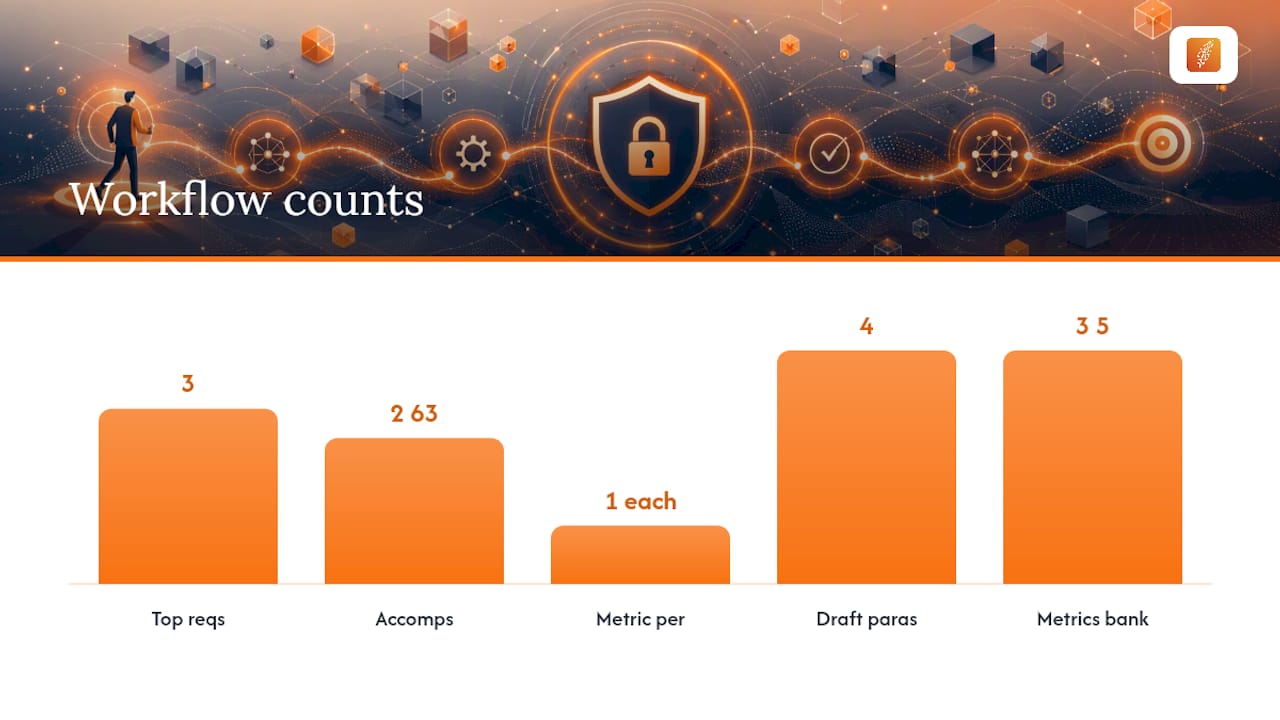
You don't need an afternoon to write a tailored cybersecurity cover letter. You need a sequence. Most applicants waste time rewriting the same sentence five times because they skipped the scanning step and jumped straight into drafting. Here's the order that actually saves time:
- Scan the job posting for the top three requirements and the underlying risk. Read past the buzzwords. If a posting mentions "reduce dwell time" or "support SOC2 audit prep," that phrase is the employer's real anxiety. Circle the tools named (Splunk, CrowdStrike, Wireshark, AWS GuardDuty) and the frameworks referenced (NIST, MITRE ATT&CK, ISO 27001).
- Pick two or three accomplishments that answer that specific risk. If the posting is about detection speed, don't lead with a compliance win. Match the proof to the pain point named in the listing.
- Pair each accomplishment with one metric. "Reduced false-positive alerts by tuning SIEM correlation rules" is fine. "Reduced false-positive alerts 34% by tuning Splunk correlation rules across three log sources" is what gets remembered.
- Draft the four paragraphs in order: hook, proof, motivation, close. Write fast here. Don't edit while drafting; that's a separate pass.
- Insert keywords from the posting naturally, not mechanically. If the listing says "vulnerability management," use that exact phrase somewhere in your proof paragraph rather than a synonym like "patching." Applicant tracking systems and human reviewers both respond to exact phrasing, but stacking five tool names into one sentence reads as padding, not competence.
- Run a final ATS and human pass. Paste the letter into a plain text file to confirm no formatting artifacts survive, then read it aloud once to catch anything that sounds stiff or repetitive.
Pro Tip: Keep a running document of three to five metrics from your current or most recent role, updated monthly. When a posting drops, you're selecting from an existing bank instead of trying to remember numbers under deadline pressure.
The keyword step trips up more applicants than any other part of this workflow. The instinct is to list every certification and tool you've touched, but a cybersecurity cover letter that reads like a keyword dump loses the human reviewer even if it clears the applicant tracking system. The fix is simple: use the posting's own language for the two or three things that matter most, and let your resume carry the rest of the technical inventory.
For entry-level candidates without professional incident response experience, this scan-and-match method still applies. Home lab builds, capture-the-flag placements, and capstone projects count as accomplishments if you can describe their scope. "Configured a segmented home lab simulating a small business network, then ran and documented Nessus scans identifying 12 vulnerabilities across four hosts" reads as real proof, not a hobby mention.
Cybersecurity Cover Letter Examples by Experience Level
These three templates cover the range most applicants need to adapt. Swap the bracketed details for your own tools, metrics, and target company, and the structure holds.
Entry-level example (security analyst, no professional experience):
"I'm applying for the Junior Security Analyst role at [Company]. I'm drawn to [Company] because of your recent expansion into managed detection services, and I'd welcome the chance to bring that lab-tested foundation to your SOC team. I'm available for a call this week and can be reached at [phone/email]."
Why this works: it swaps years of experience for documented project scope and a measurable remediation rate, which Jobscan's guidance on entry-level candidates identifies as the strongest substitute for a thin resume.
Mid-level example (SOC analyst or security engineer):
"I'm applying for the Security Engineer position supporting your SOC. [Company]'s focus on cloud-native detection matches the AWS GuardDuty work I've done, and I'd like to bring that experience to your team. I'm available for a conversation at your convenience."
Why this works: every claim pairs a named tool with a number, which is the exact pattern hiring-focused resume services point to as the difference between a letter that gets a callback and one that doesn't.
Senior/lead example (security program manager or lead):
"I'm writing regarding the Security Program Lead opening at [Company]. I built and ran a vulnerability management program across 1,200 endpoints that cut average remediation time from 45 to 12 days, and I led our SOC2 Type II audit prep, achieving a clean report with zero major findings, a first for the organization. Under my leadership, we avoided an estimated $180,000 in incident response costs by consolidating detection tooling into a single MITRE ATT&CK-mapped dashboard. [Company]'s upcoming compliance expansion into new markets is exactly the kind of program-level challenge I want to take on next. I'd welcome a conversation about how I can support that transition."
Why this works: it translates technical wins into business outcomes, audit results and dollars avoided, which is what separates a program-level letter from an individual-contributor one.
For each example, swap the certification names, tool names, and specific metric to match your own background and the exact job title in the posting. The paragraph structure stays fixed; the content inside it shouldn't.
Formatting, Length, and ATS Rules That Actually Matter
Keep the body between 250 and 400 words. That range isn't arbitrary. Recruiters and hiring managers spend seconds scanning each application before deciding whether to read closely, and a letter that runs long past a single page signals you don't know how to prioritize, which is a bad look for a security role.
Send your letter as a PDF unless the application system specifically requests a Word document. PDFs preserve formatting across devices and rarely trigger parsing errors in applicant tracking systems, while DOCX files occasionally shift formatting depending on the reader's software.
A few formatting habits that consistently help:
- Name the file clearly:
Firstname_Lastname_SecurityEngineer_CoverLetter.pdf - Use the exact job title from the posting in your subject line and opening sentence.
- Mirror the posting's own technical vocabulary. If it says "SIEM" rather than "security monitoring platform," use "SIEM."
- Prioritize terms most likely to appear in both the applicant tracking system's keyword match and a human reviewer's mental checklist: SIEM, EDR, MITRE ATT&CK, NIST, and cloud provider tags like AWS, Azure, or GCP.
- Avoid dense paragraphs. Four short blocks read faster than two long ones, even at the same word count.
By the numbers: Career-guidance research consistently points to 250 to 400 words across four short paragraphs as the sweet spot, because that length matches how quickly hiring managers actually scan applications before moving to the next candidate.
Matching posting language isn't about gaming a filter. Applicant tracking systems flag exact-phrase matches, but the same phrasing also helps a human reviewer confirm, at a glance, that you read the job description closely enough to speak its language.
Tailoring the Same Letter Across Seniority Levels
You don't need to write from scratch for every posting. You need to know what to swap.
- Entry-level: Lead with lab projects, certifications, and capstone results. Be honest about scope. A 12-host home lab is a legitimate proof point when you describe what you scanned and fixed, not an exaggeration to dress up.
- Analyst/engineer (mid-level): Emphasize operational metrics: MTTD, alert reduction percentages, vulnerability remediation SLAs, and the specific SIEM, EDR, or scanning tools behind those numbers.
- Senior/lead/program roles: Pivot from technical detail to business outcome. Frame wins as cost avoided, audit results, or program-level SLA improvements rather than day-to-day tool work.
A quick way to decide which template fits: if your biggest recent win is a project you built yourself, use the entry-level structure. If it's a metric you moved through daily operational work, use the mid-level structure. If it's a program you built or led that changed how the organization handles risk, use the senior structure.
Common Mistakes That Cost Interviews
Most rejected cybersecurity cover letters fail for the same handful of reasons, and they're almost all fixable in one editing pass.
- Generic openers. "I am excited to apply for this position" tells the reader nothing. Replace it with your strongest proof point.
- Repeating the resume verbatim. The cover letter's job is to add context and prioritize, not duplicate a bullet list the reader already has.
- Skipping company research. A letter with zero mention of what the company actually does reads as a mass-sent template, and hiring managers notice within one sentence.
- Inflated or unverifiable claims. Never state a metric you can't explain in an interview. Overstating impact is an ethics problem, not just a résumé polish issue, and it tends to surface fast under follow-up questions.
Before sending, run through this quick checklist: confirm the company name and hiring manager's name are spelled correctly, double-check every number against your own records, verify tool and framework names match their official spelling (MITRE ATT&CK, not "Miter Attack"), confirm the correct file is attached, and paste the text into a plain document to catch any formatting that won't survive an applicant tracking system.
How Pluckjobs Speeds Up Cybersecurity Cover Letter Tailoring
Most of the time lost in this process isn't drafting. It's the research step, finding the right requirements to mirror, identifying who's actually reading the application, and matching your resume language to the posting before you even start the letter.
Pluckjobs approaches that bottleneck as a workflow: scan the role, match it against your background, draft tailored language, then surface the hiring manager's contact details for direct outreach instead of a cold submission into an applicant tracking system queue. The 15-minute AI cover letter workflow built into the platform follows the same paragraph structure outlined above, but automates the keyword-matching step that usually takes applicants the longest.
The practical benefit shows up in time-to-interview. When your resume language, cover letter phrasing, and outreach message all point at the same requirements the posting names, you're not relying on an applicant tracking system to notice a match buried in generic phrasing; you're already speaking the employer's language before a recruiter opens the file. Pairing that with contact information for hiring personnel means the letter can be sent directly to a decision-maker rather than into a general inbox.
If you're actively applying across multiple cybersecurity job titles, that repeatable structure matters more than any single clever sentence.
Why the Best Cybersecurity Cover Letters Read Like Incident Reports
The biggest gap I see between cover letters that get interviews and ones that don't is writing skill. It's framing. Weak letters read like a personal essay about wanting the job. Strong ones read like an incident report: here's the risk, here's what I found, here's what I did about it, here's the measurable result.
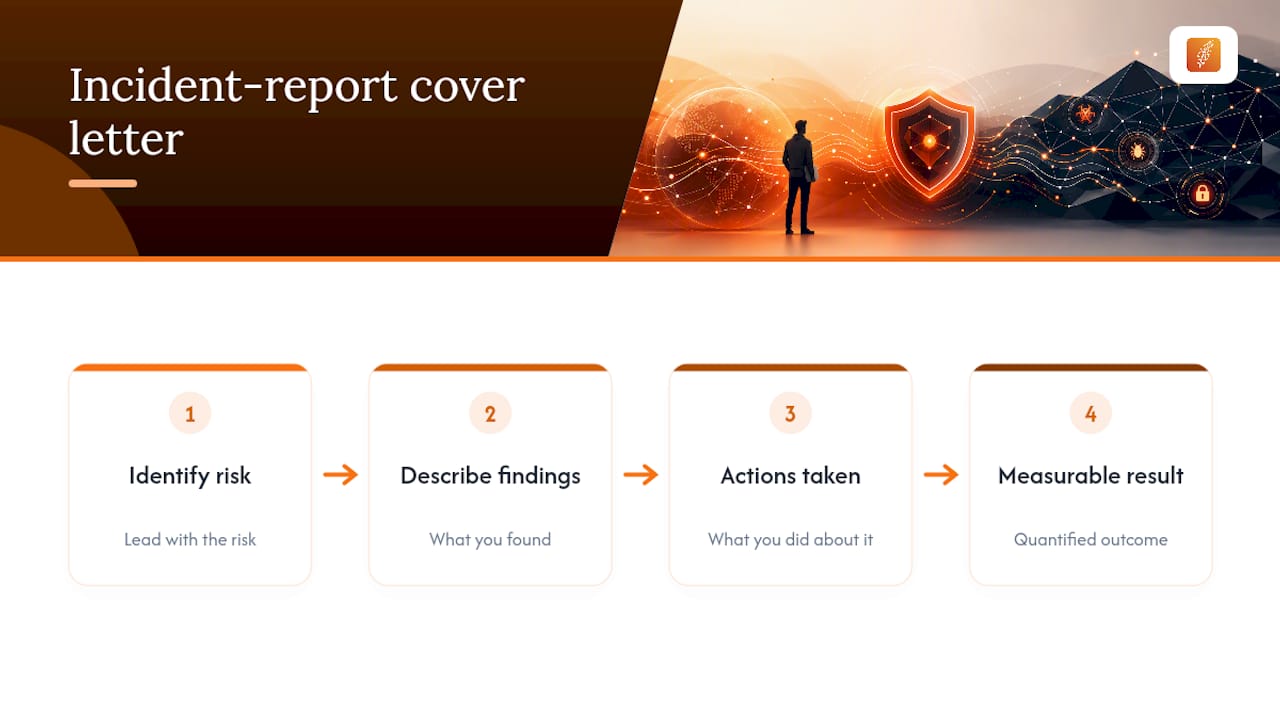
That framing shift is why the four-paragraph structure works across every seniority level in this guide. It forces you to lead with evidence instead of enthusiasm, and evidence is what a hiring manager can actually evaluate.
My practical suggestion: build what I'd call an impact inventory. Keep three metrics on hand at all times, tied to real projects or work you've done, updated whenever something changes. When a posting drops that matches one of those metrics, you're not scrambling to remember numbers under deadline pressure. You're selecting from a bank you already trust.
— Diego
Try Pluckjobs to Cut Cover Letter Time Without Cutting Quality
Writing a genuinely tailored cybersecurity cover letter for every posting takes real time, even with a solid workflow. Pluckjobs exists to compress that time without turning your letter into a template that reads like everyone else's.
The platform combines AI-driven tailoring with hiring-contact intelligence and resume alignment, so the language in your cover letter, your resume, and your outreach message all point at the same requirements a posting names. Instead of cold-applying into a queue, you can identify the actual hiring manager and reach out directly with materials that already match what they're looking for. That's a meaningfully different starting position than submitting through a portal and hoping an applicant tracking system flags you.
If you're applying to multiple roles at once, that alignment compounds fast. Start a free trial at Plucky AI and run your next application through the same scan-match-draft workflow covered in this guide, built to move you from job posting to tailored letter in minutes.
Sources
The guidance in this article draws on structural and length recommendations from Coursera, Jobscan, Indeed, and ResumeAdapter, each of which offers additional sample letters and role-specific phrasing.
For related planning, Pluckjobs covers cybersecurity role types, interview preparation steps, and core competencies for resumes in separate guides worth reading alongside this one.
- How long should a cover letter be? | Coursera
- Cybersecurity cover letter examples & tips for 2026 | Jobscan
- How To Write a Cybersecurity Cover Letter (With Example) | Indeed
FAQ
Can I Use ChatGPT to Write a Cybersecurity Cover Letter?
You can use ChatGPT to draft a starting structure, but it can't verify your actual metrics, tools, or accomplishments, so every claim it generates needs your own fact-check before sending. The strongest letters still come from pairing AI drafting speed with your real project details and numbers.
What 5 Things Should a Cover Letter Include?
A strong cybersecurity cover letter includes the exact job title, one proof point tied to the posting, two or three quantified accomplishments with named tools, a company-specific reason for applying, and a direct call to action with your contact details.
Can I Make $200,000 a Year in Cybersecurity?
Senior and leadership-level cybersecurity roles, particularly security architects, program managers, and specialized engineering positions at larger organizations, can reach that range, though it depends heavily on location, industry, and years of specialized experience. A well-tailored cover letter that shows program-level, business-outcome impact is typically what gets senior candidates into that compensation conversation in the first place.
What Are the 5 C's of Cybersecurity?
Definitions vary across sources, and no single canonical version dominates industry usage, so it's worth confirming which framework a specific employer or certification body references before citing it in an application.
How Long Should a Cybersecurity Cover Letter Be?
Aim for 250 to 400 words across three to four short paragraphs. That length matches how quickly recruiters scan applications while still leaving room for one strong proof point and a quantified accomplishment.