
Pick 3–6 role-defining competencies, prove each one with a quantified achievement, and label your proficiency level explicitly. That combination is what separates a resume that clears ATS from one that gets screened out before a human reads it. Two quick patterns to adapt right now:
- Network Security (Advanced): Hardened perimeter defenses across 12 enterprise sites, reducing critical vulnerability exposure by 34% over two quarters.
- SIEM Operations (Expert): Engineered log ingestion pipeline handling 50K events/day in Splunk, cutting mean time to detect from 4 hours to 22 minutes.
Format tip: place competency labels in a clean, plain-text "Core Competencies" line near the top of your resume so ATS parsers read them as keywords, not images or tables.
Key Takeaways
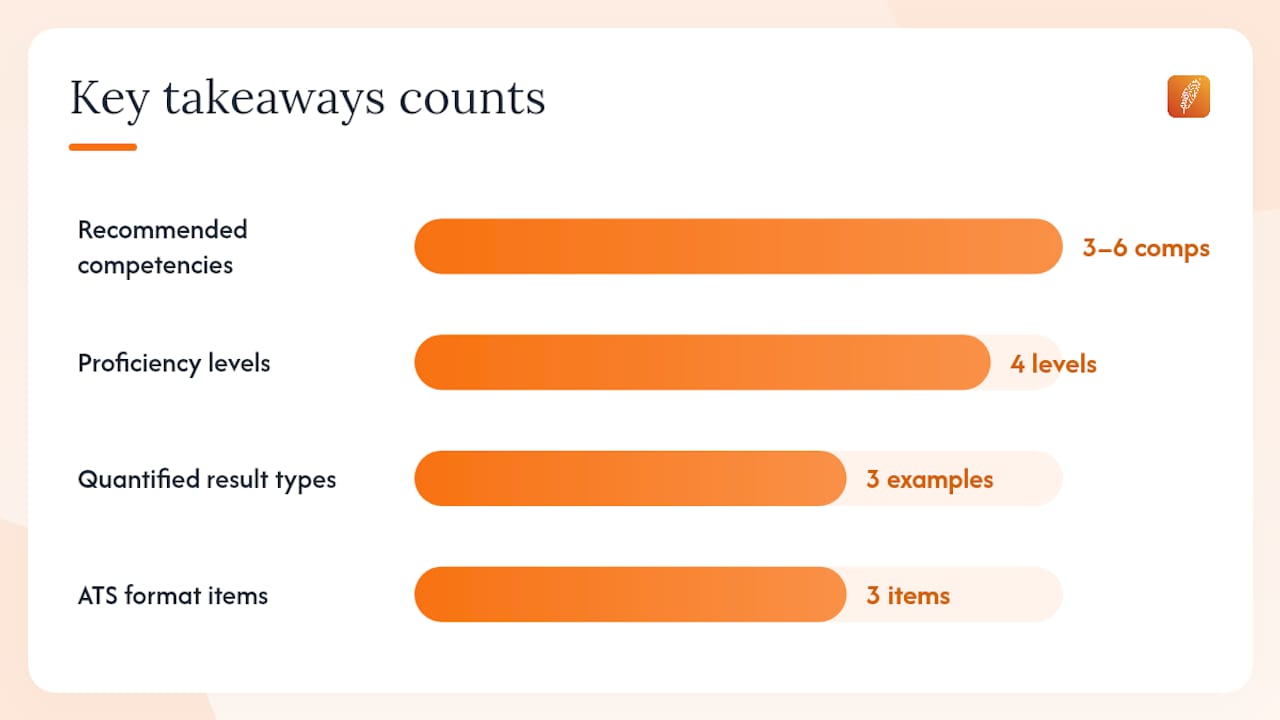
Listing 3–6 role-defining competencies with explicit proficiency levels and quantified achievement bullets is the most effective way to clear ATS and earn recruiter attention in IT and cybersecurity hiring.
| Point | Details |
|---|---|
| Use 3–6 competencies | Focus on role-defining capabilities tied to day-one tasks, not generic skill lists. |
| Label proficiency levels | Use Basic/Proficient/Advanced/Expert and back each label with a metric or outcome. |
| Quantify every bullet | Pair each competency with a measurable result (scale, time saved, risk reduced). |
| Format for ATS | Plain text, standard headings, DOCX format; avoid tables, columns, and graphics. |
| Pluckjobs automates alignment | Pluckjobs maps your competency language to job-description keywords and rewrites bullets for ATS and hiring manager intent. |
Table of Contents
- What are core competencies on a resume, and why do hiring teams care?
- How do you choose the right 3–6 competencies for your IT or cybersecurity role?
- How do you define and present proficiency levels on a resume?
- How do you turn competencies into achievement bullets that ATS and recruiters value?
- Where should you place core competencies on your resume?
- What should you check right before you apply?
- Role-specific competency lists and resume snippets
- Common mistakes with core competencies on resumes
- Sources
- FAQ
What are core competencies on a resume, and why do hiring teams care?
A core competency is a role-defining capability, not a task. "Python scripting" is a skill. "Threat detection engineering" is a competency. The distinction matters because hiring managers and HR competency banks organize roles around capabilities that predict day-one performance, not around tool lists.
Competency banks pair each competency with a title, a definition, and measurable performance statements. That structure maps directly to resume achievement language. When you write "reduced mean detection time by 40%," you are writing a performance statement, not just listing a skill.
Investopedia frames core competencies as strategic strengths that create competitive advantage. For individual job seekers, that means choosing competencies that align with a role's specific needs and demonstrating them with verifiable evidence.
Competencies fall into three categories:
- Functional: Technical capabilities tied to the job (cloud security architecture, incident response).
- Personal: Behavioral strengths (analytical thinking, communication under pressure).
- Leadership: Scope and influence (cross-functional team coordination, program ownership).
Practical guidance recommends keeping HR competency models to 8–12 entries. For a resume, 3–6 role-defining competencies are the most effective. More than that dilutes signal.
Pro Tip: Use Green River's competency performance statements as a phrasing template. Their category breakdowns (communication, job knowledge, initiative, collaboration) map cleanly to IT and cybersecurity resume language.
How do you choose the right 3–6 competencies for your IT or cybersecurity role?
This is a mini job-analysis exercise. It takes 20 minutes and produces a defensible, ATS-aligned competency list.
- Pull the job description and highlight every day-one task. Look for verbs: "monitor," "respond," "architect," "manage." Each verb cluster points to a competency.
- Extract the must-haves. Separate required qualifications from preferred ones. Required items are your non-negotiable competencies.
- Map each must-have to a category. Functional, personal, or leadership. Aim for at least two functional competencies for technical roles.
- Rank by frequency and placement in the JD. Competencies mentioned in the first paragraph of a job description carry more weight with hiring managers.
- Cut to 3–6. If you have eight candidates, drop the ones you cannot prove with a metric or a specific project outcome.
The USDS job-analysis toolkit formalizes this process: define each competency from day-one tasks, back it with 4–5 observable tasks, and assign a proficiency level. Federal hiring panels use this framework to qualify applicants at specific grade levels.
Before editing your resume, run this checklist:
- Every competency appears in the job description or a close synonym does.
- You can name a specific project, metric, or outcome for each one.
- No more than two competencies overlap in meaning.
- At least one competency addresses the role's primary risk or delivery responsibility.
How do you define and present proficiency levels on a resume?
Proficiency levels tell a hiring manager not just what you can do, but how well and at what scale. Two models are common in U.S. hiring.
2-level model: Meets / Exceeds. Simple, used in smaller organizations and entry-level postings.
4-level model: Basic / Proficient / Advanced / Expert. More granular, preferred for senior and federal roles. The USDS framework uses this structure, with examples like 52 weeks at "advanced" qualifying a candidate for a GS-13 position, according to federal hiring guidelines.
| Level | What It Means | IT/Cybersecurity Example Statement |
|---|---|---|
| Basic | Performs with guidance; limited independent scope | Assisted in configuring firewall rules under senior engineer supervision across 3 environments. |
| Proficient | Performs independently on standard tasks | Completed 200+ vulnerability scans using Nessus; documented findings in standardized reports for senior review. |
| Advanced | Handles complex, non-routine tasks; mentors others | Engineered SIEM ingestion pipeline in Splunk for 50K events/day; trained two junior analysts on detection logic. |
| Expert | Defines standards; recognized authority; drives strategy | Designed zero-trust architecture for 3,000-user environment; achieved SOC 2 Type II certification in 9 months. |
When you use a proficiency label on a resume, the bullet beneath it must justify the label. "Advanced" with no supporting metric is a claim. "Advanced" backed by scale, complexity, and outcome is evidence.
How do you turn competencies into achievement bullets that ATS and recruiters value?
Competency listings without proof are the most common resume mistake in IT and cybersecurity. The fix is a before/after conversion.
-
Before: Experienced in incident response. After: Led incident response for a ransomware event affecting 3,000 endpoints; contained breach within 6 hours and restored operations with zero data exfiltration confirmed.
-
Before: Knowledge of cloud security. After: Hardened AWS environment (EC2, S3, IAM) against CIS Benchmark Level 2; reduced misconfiguration findings from 47 to 6 over one quarter.
-
Before: Strong communication skills. After: Translated technical risk findings into executive briefings for C-suite audience of 12; secured $400K budget approval for endpoint detection rollout.
-
Before: Familiar with SIEM tools. After: Automated correlation rules in Microsoft Sentinel, reducing false-positive alert volume by 52% and freeing 8 analyst hours per week.
High-impact action verbs for IT and security: hardened, remediated, automated, reduced, architected, deployed, contained, migrated, audited, trained.
Resume guidance from ResumeWorded recommends integrating competencies into the summary and experience bullets rather than relying on a standalone list. Quantify every competency with a metric where possible.
Pro Tip: Pair each achievement bullet with the platform or tool name it involved (Splunk, CrowdStrike, Terraform, AWS). ATS systems use semantic matching, so "reduced detection time using Splunk" scores higher than "reduced detection time" alone.
Where should you place core competencies on your resume?
Placement depends on resume format and seniority. Three locations carry the most weight:
- Professional summary (top of resume): Name one or two role-defining competencies in the first two sentences. This is the first thing a recruiter reads and the first block most ATS systems parse.
- Experience bullets: This is where competencies get proven. Every bullet should connect to at least one competency from your list.
- Skills or core competencies section: A plain-text, comma-separated or piped list of 3–6 role-defining competencies is most effective for resumes; use this for ATS keyword matching. ResumeGenius recommends tailoring competencies tightly to the job description.
Chronological resume: Competencies live in the summary and experience bullets. A separate skills section is optional but useful for hard-skill keywords.
Hybrid resume: Add a "Core Competencies" block between the summary and experience sections. Keep it to one or two rows of 3–6 items each, plain text, no icons or tables.
ATS formatting rules that apply to both formats:
- Use standard section headings ("Core Competencies," "Skills," "Experience"). Custom labels like "What I Bring" confuse parsers.
- No text boxes, columns, or graphics. ATS systems often skip content inside them.
- Consistent punctuation throughout. Mixed bullet styles signal a poorly formatted file.
- Submit as DOCX unless the posting specifies PDF. Many ATS platforms parse DOCX more reliably.
What should you check right before you apply?
Run this checklist against every application before you submit:
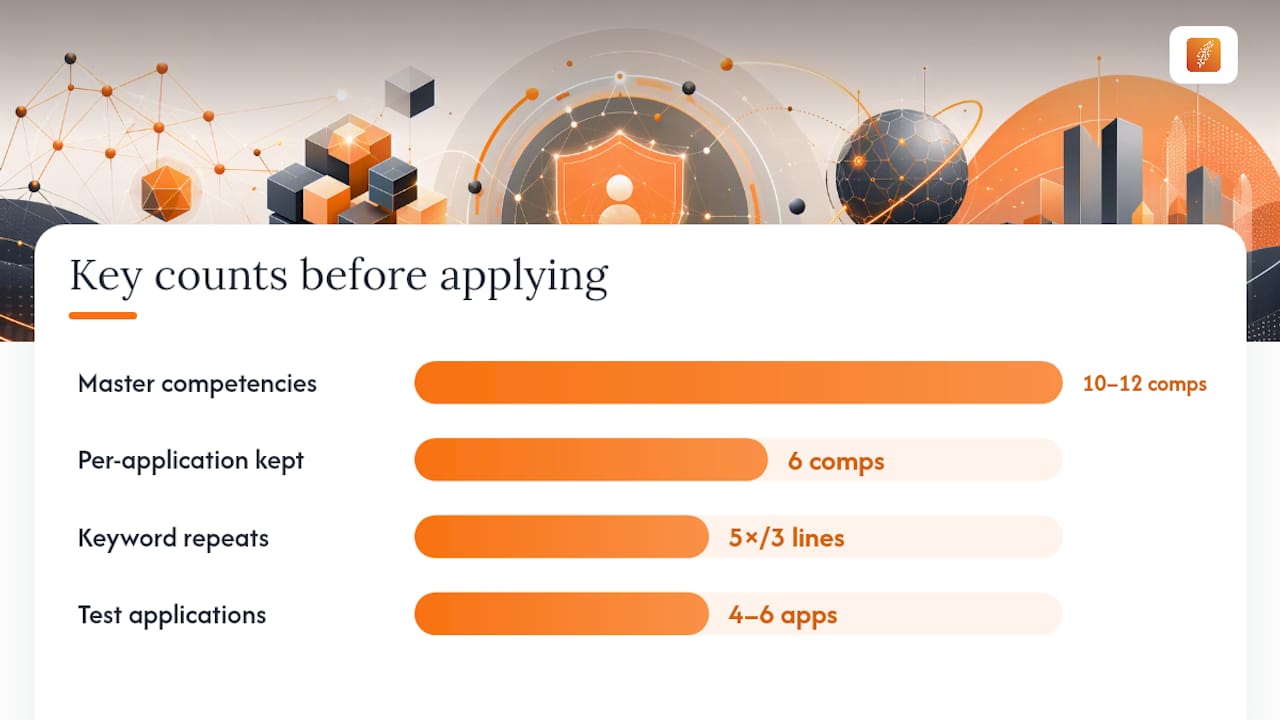
- Primary competency keywords from the JD appear verbatim in your resume (exact match, not just synonyms).
- Irrelevant competencies from a previous role have been removed.
- Each listed competency has at least one supporting bullet with a metric.
- Resume passes a plain-text copy-paste test (paste into Notepad; if it looks clean, ATS will read it cleanly).
- File format matches the posting's preference (DOCX default, PDF only if specified).
- No keyword stuffing: competency terms appear naturally, not repeated five times in three lines.
For tailoring your resume per job posting, a practical approach is to keep a master resume with 10–12 competencies and trim it to 6 for each application.
Pro Tip: Keep two slightly different versions of your resume for the same role tier, varying one or two keyword choices. Track which version generates recruiter responses. Over 4–6 applications, a pattern emerges about which competency language resonates with that employer segment.
Role-specific competency lists and resume snippets
Junior/entry-level IT or security analyst
Core competencies: Network monitoring, vulnerability scanning, log analysis, ticketing systems (ServiceNow), security documentation.
- Monitored 500-node network using SolarWinds; escalated 12 critical alerts per month with zero missed SLA.
- Completed 200+ vulnerability scans using Nessus; documented findings in standardized reports for senior review.
ATS keywords to prioritize: SOC, SIEM, Nessus, CompTIA Security+, incident triage.
Mid-level security engineer
Core competencies: Threat detection engineering, SIEM administration, endpoint security, cloud security (AWS/Azure), scripting (Python, PowerShell).
- Built 15 custom detection rules in Splunk; reduced mean time to detect by 38% over two quarters.
- Automated patch compliance reporting via PowerShell, cutting manual effort from 6 hours to 45 minutes weekly.
ATS keywords to prioritize: SIEM, EDR, CrowdStrike, zero trust, MITRE ATT&CK.
Senior/technical lead
Core competencies: Security architecture, threat modeling, team mentorship, cross-functional program delivery, compliance (NIST, SOC 2).
- Designed zero-trust architecture for 3,000-user environment; achieved SOC 2 Type II certification in 9 months.
- Mentored team of 5 engineers; two promoted to senior roles within 18 months.
ATS keywords to prioritize: zero trust, NIST CSF, SOC 2, architecture review, threat modeling.
Security manager
Core competencies: Security program ownership, risk governance, budget management, executive communication, vendor management.
- Owned $2.1M security budget across 4 product lines; delivered program 8% under budget while expanding coverage.
- Presented quarterly risk posture to board; secured approval for $600K MDR contract.
ATS keywords to prioritize: GRC, CISO, risk governance, MDR, security roadmap.
Common mistakes with core competencies on resumes
Most errors fall into four patterns. Each has a direct fix.
- Listing competencies without proof. Fix: add one achievement bullet per competency before submitting.
- Using vague labels ("strong communicator," "team player"). Fix: replace with functional or leadership competencies tied to a specific outcome.
- Keyword stuffing. Fix: each competency term appears once in the skills section and once in a bullet. No more.
- Claiming expert-level proficiency without evidence. Fix: if you cannot back "expert" with scale and outcomes, drop to "advanced" and prove that instead.
- Copying the same competency list across every application. Fix: tailor to the JD every time. Hiring managers notice generic lists. Common IT job search mistakes often trace back to this exact pattern.
Dos: Quantify every competency. Match JD language. Label proficiency levels honestly. Don'ts: Use graphics or tables in the skills section. List more than 6 competencies. Claim certifications you do not hold.
How these examples and recommendations were assembled
Sources used to build this guidance:
- USDS job-analysis toolkit (proficiency level models and competency justification standards).
- Pierce County and Green River competency banks (performance statement phrasing templates).
- ResumeWorded, ResumeGenius, and Toggl resume guidance (placement, count, and tailoring recommendations).
- Investopedia (strategic framing of competencies as competitive advantage).
All role examples were adapted to U.S. hiring norms for IT and cybersecurity and checked against current ATS best practices.
What this approach means for your search
The guidance here reflects how competency frameworks actually function in U.S. federal and private-sector hiring. Most candidates treat the core competencies section as a keyword dump. The practitioners who get interviews treat it as a structured argument: here is what I do well, here is the level at which I do it, and here is the proof. Pluckjobs' AI resume tooling is built around that same logic, aligning proficiency claims with the exact keyword patterns hiring managers use when they write job descriptions.
Pluckjobs aligns your competencies with the roles that need them
Rewriting competency bullets manually for every application takes time most IT and cybersecurity job seekers do not have. Pluckjobs automates that alignment: its AI resume optimization maps your proficiency statements to the ATS keyword patterns in a specific job description, flags gaps, and rewrites bullets to match hiring manager intent. The result is a tailored resume in minutes, not hours, backed by AI that writes job-specific resumes for IT professionals.
Ready to match your competencies to the right roles? Start with Plucky AI and let the platform do the keyword alignment for you.
Sources
Competency frameworks
- sample-competencies-proficiencies
- Competency Examples with Performance Statements
- 30 Core Competencies Examples & How to Assess Them
- Core Tips: How To Highlight Core Competencies on a Resume
- 175 Core Competencies for Your Resume (with Writing Guide)
- Core competencies definition and business context
- Competency examples with performance statements
Resume writing and ATS
FAQ
How many core competencies should you list on a resume?
List 3–6 role-defining competencies for most IT and cybersecurity roles. A skills section can carry additional keywords for ATS purposes, but the core competencies you feature in your summary and bullets should stay tightly focused at 3–6 role-defining, job-specific competencies.
What is the difference between a core competency and a skill on a resume?
A skill is a specific capability ("Python scripting"). A core competency is a broader, role-defining strength ("threat detection engineering") that combines multiple skills and is demonstrated through measurable outcomes.
Should you include a separate "Core Competencies" section on your resume?
A separate section is useful for ATS keyword matching, but competencies must also appear in your summary and experience bullets with proof. A standalone list without supporting achievement bullets carries little weight with human reviewers.
How do you prove proficiency level on a resume without sounding like you are just making a claim?
Back every proficiency label with scale, complexity, and outcome. "Advanced: managed SIEM ingestion for 50K events/day in Splunk, reducing mean time to detect from 4 hours to 22 minutes" is evidence. "Advanced SIEM skills" is a claim.
Can Pluckjobs help align your competency language to a specific job description?
Yes. Pluckjobs' AI resume optimization maps your proficiency statements to the keyword patterns in a target job description and rewrites bullets to match hiring manager intent, reducing manual tailoring time significantly.