
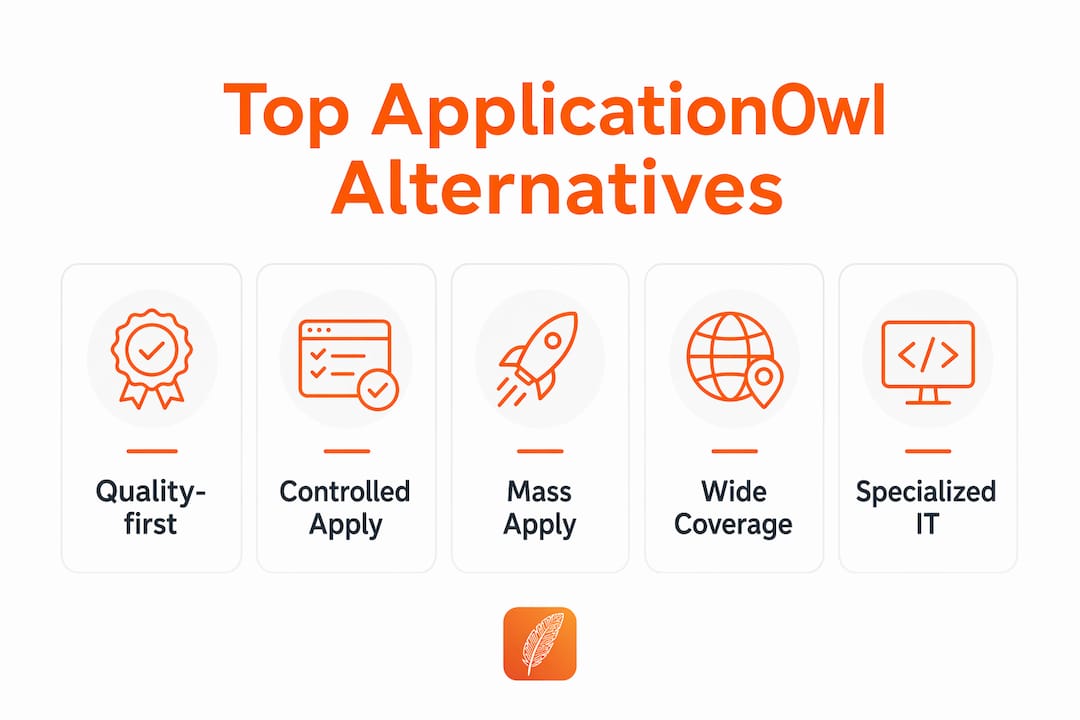
ApplicationOwl has shut down. The platform is no longer active, and if you were relying on it, you need a replacement now. The best approach: combine a quality-first AI coaching or resume-tailoring tool with a controlled auto-apply service that keeps a human in the loop. Here are the top picks by category:
- AI coaching + resume tailoring: Teal, Rezi (best for ATS optimization and narrative alignment; fits IT pros who want every application to count)
- Controlled auto-apply with QA: Simplify Copilot, JobCopilot (best for job seekers who want volume without looking like a bot)
- Mass auto-apply with manual oversight: LazyApply, LoopCV (best for quick-scalers who commit to reviewing every batch before it goes out)
- Hiring-manager precision + role discovery: Pluckjobs (best for IT and cybersecurity candidates who want to reach the actual decision-maker, not just the ATS)
- Wide-coverage one-click apply: AIApply (aiapply.co), Sonara (best for budget-conscious job seekers who want broad board coverage fast)
Table of Contents
- What are the best ApplicationOwl.com alternatives right now?
- How do these tools actually work in practice?
- How do you choose the right tool for your situation?
- Which tool should you try first?
- Key Takeaways
- The automation trap most job seekers fall into
- Pluckjobs is built for IT and cybersecurity candidates who want precision
- Useful sources and further reading
- FAQ
What are the best ApplicationOwl.com alternatives right now?
The table below compares each platform on the dimensions that actually affect hiring outcomes: automation level, customization quality, board coverage, pricing shape, and how applications appear to recruiters.
| Tool | Best for | Automation level | AI resume/cover letter quality | Board coverage | Pricing model | Recruiter risk |
|---|---|---|---|---|---|---|
| Pluckjobs | IT & cybersecurity pros | Controlled + outreach | High (tailored + hiring-manager data) | IT/cyber-focused | Subscription | Low |
| Teal | ATS optimization | Manual + AI assist | High (keyword-matched, narrative-aware) | LinkedIn, Indeed, + more | Freemium / paid | Very low |
| Rezi | Resume tailoring | Manual | High (ATS-scored drafts) | Any (export-based) | Freemium / credits | Very low |
| Simplify Copilot | Controlled one-click apply | Semi-automated | Medium (auto-fill + light tailoring) | 1,000+ boards | Freemium / subscription | Low–medium |
| JobCopilot | Automated apply with filters | High automation | Medium (template-based) | 50+ boards | Subscription | Medium |
| LazyApply | Volume apply, manual QA | High automation | Low–medium | LinkedIn, Indeed, Glassdoor | One-time / subscription | Medium–high |
| LoopCV | European + global volume | High automation | Low–medium | 50+ boards | Subscription | Medium–high |
| AIApply (aiapply.co) | Wide-coverage fast apply | High automation | Medium | Multi-board | Credits / subscription | Medium |
| Sonara | Passive auto-apply | High automation | Low–medium | Multi-board | Subscription | Medium–high |
Pricing callout: Teal and Rezi both offer free tiers that cover core resume-building features. Simplify Copilot has a free browser extension. Credit-based models like AIApply can get expensive at scale; pricing model shape is one of the top decision factors users cite when switching tools. Subscriptions suit heavy users; credits suit occasional applicants who want to test before committing.
Stat to know: G2's comparison data shows board coverage, analytics, human QA, and pricing transparency are the four factors job seekers weight most when evaluating application tools.
How do these tools actually work in practice?
1. Quality-first AI coaching and resume tailoring (Teal, Rezi)
These platforms sit at the low-automation, high-quality end. Teal's job tracker lets you score each role against your resume in real time, flagging keyword gaps before you apply. Rezi generates ATS-scored resume drafts and rates them against job descriptions, so you know your document will clear the first filter. Neither submits applications automatically, which means zero recruiter-spam risk.
Pricing: Teal is free for core features; paid plans unlock unlimited AI suggestions. Rezi offers a free tier and a paid plan with unlimited AI credits. Setup: 15–30 minutes to import your resume and connect job boards. Pros: Highest application quality; very low ATS rejection risk; strong for narrative alignment. Cons: No auto-apply; requires active time investment per role. Best for: IT pros who prefer 10 targeted applications over 200 generic ones. See how AI resume tailoring works in practice.
2. Controlled auto-apply with human-in-the-loop (Simplify Copilot, JobCopilot)
Simplify's browser extension auto-fills application forms across 1,000+ job boards while you stay in control of which roles get submitted. JobCopilot runs automated apply campaigns filtered by your criteria (role, location, salary). Both sit in the middle ground: faster than manual, safer than full mass-apply. Enterprise recruiting guidance consistently recommends automating form-filling while keeping role-selection judgment human.

Pricing: Simplify has a free extension; premium unlocks AI cover letters. JobCopilot runs on a monthly subscription. Setup: Under 30 minutes for Simplify; JobCopilot requires a profile build (roughly 1 hour). Pros: Meaningful time savings; you approve roles before submission; decent cover letter customization. Cons: Cover letter quality varies; JobCopilot's template-based approach can feel generic on some niche roles. Best for: Job seekers who want to apply to 20–40 roles per week without reviewing every form field.
3. Mass auto-apply with manual QA (LazyApply, LoopCV)
LazyApply and LoopCV submit applications at high volume across LinkedIn, Indeed, Glassdoor, and 50+ additional boards. Speed is the value proposition. The tradeoff: high-volume auto-apply workflows commonly trigger spam signals in ATS systems, and recruiters can spot a templated cover letter in seconds.
Pricing: LazyApply offers a one-time purchase option and a subscription tier. LoopCV runs on a monthly subscription. Setup: 30–60 minutes for profile and filter configuration. Pros: High application volume fast; broad board coverage; low per-application effort. Cons: Low customization; elevated recruiter-spam risk; analytics are basic. Best for: Quick-scalers who commit to reviewing every batch and adding at least one tailored line per application.
Pro Tip: Set a daily cap of 15–20 applications in mass-apply tools and add one role-specific sentence to each cover letter. This alone reduces the spam signal most ATS systems flag.
4. Wide-coverage one-click apply (AIApply / aiapply.co, Sonara)
AIApply (aiapply.co) and Sonara both aim for broad board coverage with minimal setup. Sonara runs passively in the background, applying to matched roles without you logging in. AIApply uses a credit model and applies across multiple boards with AI-generated cover letters. Trustpilot reviews for AIApply reflect a mixed experience: users praise the speed but flag inconsistent cover letter quality on technical roles.

Pricing: AIApply uses a credit system; Sonara is subscription-based. Setup: Under 20 minutes for both. Pros: Fastest time-to-first-application; minimal ongoing effort. Cons: Lowest customization; passive apply means less control; credit costs add up at scale. Best for: Budget-conscious job seekers who want to cast a wide net while investing their energy in networking.
How do you choose the right tool for your situation?
Use this six-point checklist before committing to any platform.
- Automation level. Decide whether you want to approve every application or run campaigns. If you are in a specialized field like cybersecurity, controlled apply almost always outperforms mass-apply on interview yield.
- ATS compatibility. Ask whether the tool preserves your original resume metadata and how submissions appear in common ATS exports. Test with a control role: submit one application, then check how it renders in the recruiter's view. Scoring resumes against job requirements is how recruiters evaluate submissions; your tool should align to that logic.
- Human-in-the-loop. The best tools automate form-filling and keyword matching while leaving role selection and narrative to you. Automation without narrative alignment filters candidates out before a human reads the resume.
- Board coverage. Match the platform's board list to where your target roles actually live. For IT and cybersecurity, niche boards and direct company career pages often outperform LinkedIn volume.
- Pricing transparency. Credit systems can inflate marginal cost at scale. Subscriptions suit heavy users applying to 30+ roles per week. Run the math: if a credit plan costs more than a monthly subscription at your target volume, switch models.
- Privacy and data security. Ask where your candidate data is stored, whether personally identifiable information is encrypted at rest, and what deletion guarantees exist. Data sovereignty matters when your resume contains contact details, employment history, and salary expectations.
What recruiters actually see when you mass-apply
Recruiters using ATS platforms score resumes against job requirements automatically. Three signals mark an application as spam: identical cover letter text across roles, resume formatting that breaks on ATS import, and application timestamps that cluster (dozens of submissions within minutes). Any of these can move your application to the bottom of the stack before a human sees it.
Responsible usage rules:
- Cap automated submissions at 15–20 per day.
- Add at least one role-specific sentence to every cover letter, even in auto-apply mode.
- Stop automating and invest in networking when your response rate drops below 5% over two weeks.
- Review every batch before it goes out; never let a tool apply to roles you have not read.
Pro Tip: Stagger submission times across a 4–6 hour window rather than batch-submitting all at once. Most ATS systems log application timestamps, and a cluster of simultaneous submissions from the same candidate is a documented spam signal.
For more on managing the time cost of job searching, the Pluckjobs guide on job search burnout is worth reading before you commit to a high-volume approach.
Which tool should you try first?
For IT and cybersecurity job seekers, start with a quality-first tool like Teal or Rezi for resume alignment, then layer in a controlled auto-apply service like Simplify Copilot or Pluckjobs for outreach efficiency.
Three next steps:
- Sign up for a free tier (Teal or Rezi) and run a keyword-gap audit on your resume against five target roles this week.
- Run a two-week experiment: submit 10 tailored applications and 10 auto-applied ones, then compare response rates.
- Track three metrics: applications submitted, recruiter responses, and interviews booked. A healthy response rate for targeted applications in IT is above 10%; if auto-apply drops below 5%, shift budget to tailoring.
Benchmark: Job seekers who combine AI resume tailoring with targeted outreach consistently report higher interview-to-application ratios than those relying on volume alone, according to Pluckjobs workflow research.
Key Takeaways
Quality-first AI tools paired with controlled auto-apply consistently outperform mass-apply-only approaches on interview yield for IT and cybersecurity job seekers.
| Point | Details |
|---|---|
| Quality beats volume | Tailored applications produce higher response rates than mass-apply alone, especially in IT and cybersecurity. |
| Human-in-the-loop matters | Tools that keep role selection and narrative in your hands reduce ATS spam signals and recruiter rejection. |
| Pricing model shapes cost | Credit systems inflate cost at scale; subscriptions suit job seekers applying to many roles each week. |
| Cap daily auto-apply volume | Limit automated submissions to 15–20 per day and stagger timing to avoid ATS spam flags. |
| Pluckjobs for IT precision | Pluckjobs combines hiring-manager contact data with tailored resumes, making it the strongest option for IT and cybersecurity candidates who want to reach decision-makers directly. |
The automation trap most job seekers fall into
Most people shopping for ApplicationOwl alternatives are really asking: "How do I apply faster?" That is the wrong question. The right question is: "How do I get more interviews per application?" Those two goals pull in opposite directions.
Mass auto-apply tools optimize for submission count. But founders who built coaching-first platforms argue the real problem is narrative alignment: whether a recruiter reading your resume understands, in under six seconds, why you are the right person for this specific role. No auto-apply tool solves that. The best ones just get out of the way and let you solve it yourself.
A two-week experiment that favors tailoring plus selective automation tends to produce a measurable lift in recruiter callbacks compared to two weeks of pure volume. The mechanism is simple: a recruiter who sees a resume that speaks directly to their job description is more likely to move it forward, regardless of how it was submitted. Automation is most valuable when it handles form-filling and board discovery, freeing you to spend that recovered time on one well-written follow-up or a direct message to the hiring manager.
The job seekers who get the most out of these tools are not the ones who set up the biggest campaigns. They are the ones who use automation to buy back time, then spend that time on the parts of the search that actually require a human.
Pluckjobs is built for IT and cybersecurity candidates who want precision
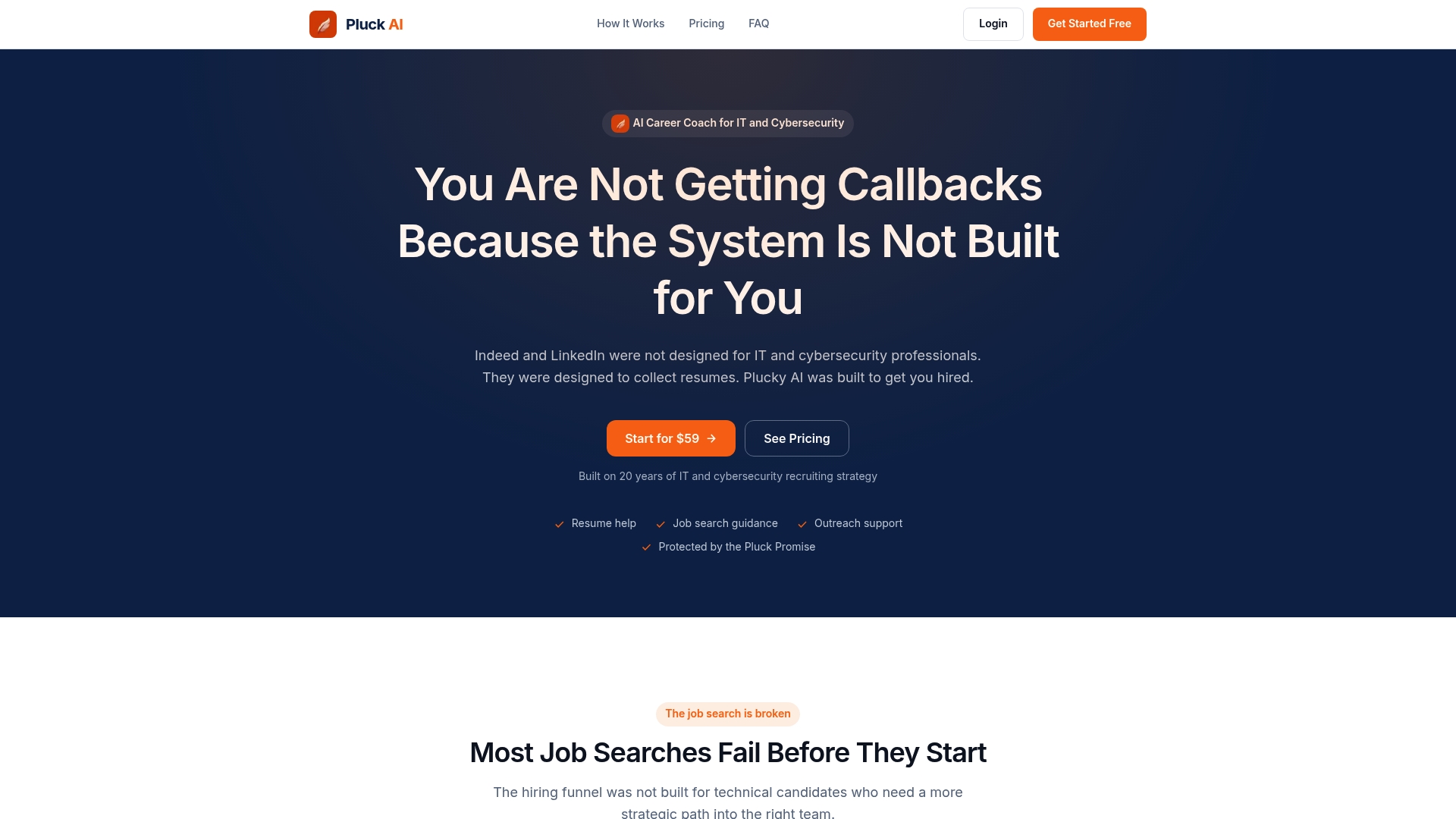
If the alternatives above feel like casting a wide net and hoping, Pluckjobs takes a different route. It combines Apollo contact intelligence with SerpAPI-powered role discovery to surface IT and cybersecurity roles and the hiring managers behind them, so you can reach the actual decision-maker instead of submitting into an ATS black hole.
Key advantages that align directly with the evaluation checklist above:
- Hiring-manager discovery: Pluckjobs surfaces contact data for the person who owns the role, not just the job posting.
- ATS-friendly resume generation: Tailored resumes built to score well against specific job descriptions.
- Integrated outreach data: Role discovery and hiring-manager contact in one workflow, no separate tools needed.
- Data security: Candidate data handled with privacy controls appropriate for sensitive professional information.
Most users are set up and running their first targeted search within 30 minutes of signing up. Start your search on Pluckjobs and run your first hiring-manager search today.
Useful sources and further reading
- How to Use AI Tools for Job Search in IT — Practical workflow for IT professionals combining AI resume tailoring with hiring-manager outreach. Read this before choosing a tool.
- AI in Recruiting: What to Automate and What to Keep Human — Enterprise-grade guidance on automation boundaries; explains why human judgment in role selection protects application quality.
- Types of AI Client Matching Tools for Staffing in 2026 — Technical breakdown of how AI matching algorithms differ in personalization depth; useful for evaluating resume customization claims.
- ApplicationOwl Founder Interview, Voyage LA — The ApplicationOwl founder's perspective on why narrative alignment matters more than submission volume.
- How to Score Resumes Against Job Requirements — Explains how ATS and recruiters evaluate submissions; essential reading before configuring any auto-apply tool.
- Trustpilot: AIApply (aiapply.co) — User reviews covering speed, cover letter quality, and support responsiveness.
- Trustpilot: LazyApply — Community feedback on volume-apply experience, including ATS compatibility notes.
- Trustpilot: Rezi — Reviews focused on ATS scoring accuracy and resume quality.
- IT Job Application Workflow: A Step-by-Step Guide — End-to-end workflow for IT job seekers; pairs well with any tool on this list.
- Top 6 Gigschat.com Alternatives in Job Application Automation 2026 — Broader comparison of automation tools for job seekers who want additional category context.
FAQ
Is AIApply (aiapply.co) free to use?
AIApply offers a credit-based model with a limited free tier, but sustained use requires purchasing credits or a paid subscription. Costs scale with application volume.
What should you use instead of LinkedIn for job applications?
Niche job boards (Dice, CyberSecJobs for IT and security roles), direct company career pages, and platforms like Simplify Copilot or Pluckjobs that aggregate across multiple boards tend to surface roles LinkedIn's algorithm buries.
What is the best alternative to ApplicationOwl for IT professionals?
Pluckjobs is the strongest replacement for IT and cybersecurity candidates because it combines role discovery with hiring-manager contact data and ATS-tailored resumes, addressing the quality gap that mass-apply tools leave open.
Is mass auto-apply safe to use on LinkedIn and Indeed?
Both platforms actively detect and restrict bot-like application behavior. Keeping daily volume under 20 applications and staggering submission times reduces the risk of account flags, but neither platform endorses third-party auto-apply tools in their terms of service.