What is career trajectory in IT?
Your career trajectory in IT is the sequence of roles, skills, and experiences that move you from where you are now toward where you want to be in the technology field. It is not a single job title or a fixed ladder. It is the cumulative pattern of decisions, specializations, and pivots that define your professional arc over time.
A career trajectory in IT is shaped by several concrete elements:
- Roles held: Each position adds domain knowledge and signals your direction to future employers.
- Skills developed: Technical skills (programming languages, cloud platforms, security frameworks) and soft skills (communication, project management) both count.
- Certifications earned: CompTIA A+, Network+, Security+, AWS Certified Solutions Architect, and similar credentials mark early milestones.
- Education: Degrees and bootcamps open initial doors, though their weight decreases as experience accumulates.
- Industry trends: Shifts like cloud adoption, AI integration, and zero-trust security actively reshape which paths stay viable.
The US Bureau of Labor Statistics projects 317,700 annual job openings in IT between 2024 and 2034, a figure that reflects how broad and durable this field remains. That scale means your trajectory is not constrained to one narrow track. You have real options, and understanding them is the first step to choosing deliberately.
What types of career trajectories exist in IT?
IT careers rarely follow a straight line, and that is actually an advantage. Three trajectory types cover most of what you will encounter in practice.
Vertical trajectory is the classic upward move: help desk technician to systems administrator, junior developer to senior engineer, security analyst to CISO. Each step brings more responsibility, higher compensation, and deeper specialization. Vertical moves are the most visible form of career growth and the easiest to explain on a resume.
Horizontal trajectory means moving across domains at roughly the same seniority level to build breadth. A network engineer who transitions into cloud architecture, or a software developer who shifts into DevOps, is following a horizontal path. These moves often feel like a step sideways but pay off when the new domain becomes high-demand.
Zigzag or hybrid trajectory combines both. You move up in one area, then cross into an adjacent domain, then move up again. This pattern is increasingly common in IT because:
- Emerging specializations (AI/ML engineering, cloud security, platform engineering) reward professionals who bring cross-domain context.
- Lateral moves into growing areas can accelerate compensation faster than waiting for the next vertical promotion.
- Employers value IT professionals who understand how different systems and teams interact.
No trajectory type is inherently superior. The right one depends on your goals, your current skill set, and where the market is heading.
Why does understanding your IT career trajectory matter?
Knowing your trajectory gives you a framework for every decision: which certification to pursue, which job offer to accept, which skills to build next. Without that framework, you end up reacting to opportunities instead of creating them.
The IT job market is not static. AI and automation are reshaping which roles grow and which contract. Cloud computing has made on-premises infrastructure skills less central than they were a decade ago. Cybersecurity, by contrast, is expanding fast: information security analysts earned a median wage of $124,910 in 2024 with 29% projected job growth. Professionals who mapped their trajectory toward security years ago are now in a strong position.
317,700 annual IT job openings are projected between 2024 and 2034, according to the US Bureau of Labor Statistics, making IT one of the most consistently growing occupational groups in the American economy.
Career resilience also depends on trajectory awareness. IT professionals who understand their path can identify when a role is a dead end and pivot before the market forces them to. Those who do not plan tend to stay in comfortable but stagnant positions until a layoff or a technology shift makes the decision for them.
How to plan an effective IT career trajectory
Effective planning starts with a realistic picture of where you are, not where you wish you were. Audit your current skills, document your measurable contributions, and identify the gap between your present role and the next two or three positions you want to hold.
A practical planning process looks like this:
- Choose a primary track. Software development, cybersecurity, cloud/systems, networking, data science, and IT support each have distinct progression patterns. Pick one that aligns with your interests and strengths, not just current salary trends.
- Map 2–3 roles ahead. Flexible career plans focus on the next realistic steps rather than a rigid 10-year vision. AI and automation make long-range specificity unreliable.
- Build a business-visible portfolio. Document cost savings, speed improvements, security incidents prevented, or systems uptime you maintained. Measurable outcomes protect you during layoffs and accelerate promotions.
- Plan for lateral moves. Horizontal experience in an adjacent domain (say, moving from sysadmin to cloud engineering) often unlocks roles that pure vertical climbers cannot access.
- Use certifications as on-ramps, not destinations. CompTIA certifications like A+, Network+, and Security+ are standard early-career credentials, but later growth depends more on demonstrated impact than on additional credentials.
- Network with intention. Mentors, peer communities, and professional groups surface opportunities and give you market intelligence that job boards cannot.
- Watch market signals. Follow hiring trends in your target domain. If a skill set is appearing in every job description, that is a signal worth acting on.
Pro Tip: Align your career choices with your actual interests and strengths, not just what is trending. IT professionals who choose paths they value tend to build deeper expertise and sustain motivation through the inevitable slow periods.
Common IT career paths and how they progress
Most IT careers start in one of a handful of entry points and branch from there. Here is how the major tracks typically develop.
IT support and help desk is the most common entry point. Help desk roles build foundational knowledge across hardware, software, and user support before specialization. From there, professionals typically move into systems administration, network engineering, or security analysis.
- Entry: Help desk technician, IT support specialist
- Mid-level: Systems administrator, desktop engineer
- Senior: IT manager, infrastructure architect
Networking suits professionals who want to specialize in how data moves across systems. The path from network technician to network architect is well-defined, with Cisco certifications (CCNA, CCNP) serving as standard progression markers.
Cloud and systems is one of the fastest-growing tracks. Cloud engineers, DevOps engineers, and site reliability engineers are in high demand as organizations migrate infrastructure off-premises. AWS, Azure, and Google Cloud certifications carry real weight here.

Cybersecurity offers some of the strongest salary and growth figures in IT. Information security analysts saw 29% projected growth, and the path from SOC analyst to security architect to CISO is increasingly well-traveled.
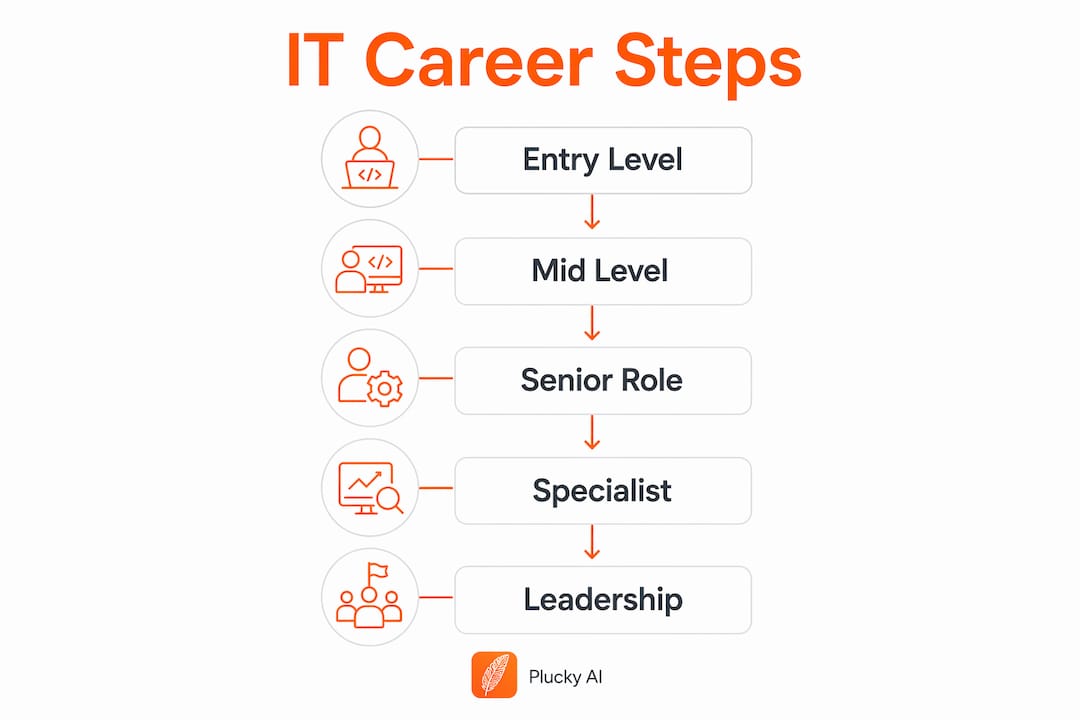
Software development remains the largest single IT track. Software developers earned a median wage of $133,080 in 2024 with 15% projected job growth. Junior developer to senior engineer to principal or staff engineer is the standard vertical path, with lateral options into product management, DevOps, or machine learning engineering.
Data science and analytics has grown from a niche specialty into a core IT function. Data analysts, data engineers, and machine learning engineers each represent distinct sub-tracks with their own toolsets and progression patterns.
Entry roles in any of these tracks are not dead ends. They are where you build the context that makes every subsequent move more credible.
How to build a resilient, adaptable IT career in 2026
The traditional promotion ladder is fragile. Layoffs in the tech sector have repeatedly hit professionals who assumed tenure and title would protect them. The shift toward anti-layoff portfolios reflects a more honest view of career security: what protects you is documented, business-visible impact, not years of service.
The 70-20-10 model offers a practical framework for where to invest your development time. Roughly 70% of career growth comes from on-the-job experience, 20% from professional relationships and feedback, and 10% from formal education and certifications. That distribution means the most important career investment you can make is taking on work that stretches you, not enrolling in another course.
317,700 annual IT job openings projected between 2024 and 2034 signal that demand is not the problem. The challenge is positioning yourself for the right roles at the right time.
One decision that deserves deliberate thought: individual contributor versus management. Management in IT is not a default promotion. It requires a fundamentally different skill set, including people management, budget ownership, and organizational politics. Many senior engineers who move into management discover they preferred the technical work. Choosing your track intentionally, rather than accepting the next available title, produces better outcomes on both paths.
AI is also reshaping which skills stay durable. Automation is absorbing routine tasks in IT support, testing, and basic development. The professionals who stay competitive are those who understand how AI reshapes IT roles and position themselves at the intersection of technical depth and business judgment. Staying current with how AI supports strategic decisions in technology organizations is increasingly part of the job, not a bonus skill.

Pro Tip: Document one measurable business outcome per quarter: a system you stabilized, a process you accelerated, a cost you reduced. That record becomes your most persuasive career asset when promotion cycles or job searches arrive.
Key Takeaways
A career trajectory in IT is a deliberate, adaptable sequence of roles and skills, not a fixed ladder, and the professionals who plan it intentionally consistently outperform those who do not.
| Point | Details |
|---|---|
| Career trajectory defined | It is the cumulative path of roles, skills, and decisions that shape your IT career over time. |
| Three trajectory types | Vertical (upward), horizontal (lateral), and zigzag (combined) each suit different goals and market conditions. |
| Strong market demand | The US BLS projects 317,700 annual IT job openings between 2024 and 2034 across all major tracks. |
| 70-20-10 development model | 70% of IT career growth comes from on-the-job experience, 20% from networking, and 10% from formal education. |
| Anti-layoff portfolio | Documenting measurable business outcomes each year builds career security beyond titles and tenure. |
FAQ
What is the career path in IT?
An IT career path is the sequence of roles a professional moves through in the technology field, typically starting in support or entry-level technical roles before specializing in areas like software development, cybersecurity, networking, or cloud infrastructure.
What is an example of a career trajectory in IT?
A common example is starting as a help desk technician, moving into systems administration, then specializing as a cloud engineer or security analyst. That progression combines vertical moves (more responsibility) with lateral ones (new domain expertise).
Which IT career is best for the future?
Cybersecurity and cloud engineering show the strongest growth projections. Information security analysts have 29% projected job growth, and software developers carry a median wage of $133,080 with 15% growth, both per US Bureau of Labor Statistics data.
Is it hard to switch to an IT career?
Switching into IT is achievable, especially through entry points like help desk or IT support roles, which require less prior experience and serve as a foundation for specialization. Certifications like CompTIA A+ and Network+ are standard starting credentials for career changers.
Pluckjobs is built for IT and cybersecurity professionals who are ready to move their career forward with precision. The platform combines AI-powered role discovery with hiring manager outreach data and tailored resumes, so you spend less time searching and more time interviewing. Start your search and find the role that fits where your trajectory is headed.