
A cloud career trajectory is the sequence of roles, skills, and milestones that carry a person from entry-level cloud work to senior, staff, or architect positions. It typically moves through four stages: junior, mid-level, senior, and staff or principal, each marked by broader scope and less hands-on oversight. If you're starting today, do three things this week: pick one role family (infrastructure, security, DevOps, or development), build one small portfolio project using a real cloud provider, and start one foundational certification or hands-on lab track.
Here's the priority order that actually moves the needle:
- Choose a lane first. Cloud is too broad to learn generically. Cloud security, cloud DevOps, and cloud architecture require different daily skills, even though they share a foundation.
- Build before you certify. A deployed project on GitHub, even a simple one, tells a hiring manager more than a badge does.
- Get one credential that matches your target role. Not three. One that signals direction.
Pro Tip: Recruiters and applicant tracking systems both respond better to specific evidence than general claims. A README that says "deployed a three-tier app on AWS using Terraform and monitored it with CloudWatch" beats "familiar with cloud infrastructure" every time, because it gives a hiring manager something concrete to ask about in the interview.
Key Takeaways
A cloud career trajectory succeeds when a beginner picks one role family, builds deployable proof of skill, and pairs it with one targeted certification instead of collecting credentials broadly.
| Point | Details |
|---|---|
| Pick a lane early | Choose one role family (infrastructure, security, DevOps, development, or architecture) before deep skill-building. |
| Build before certifying | Deployed GitHub projects prove skill faster than certifications alone in most hiring conversations. |
| Follow the skill order | Learn Linux and networking, then containers, then Terraform, then a single cloud provider deeply. |
| Apply before you feel ready | Start applying around month six of a foundational learning plan, not after mastering every listed skill. |
| Use Pluckjobs to close the gap | Pluckjobs pairs AI resume optimization with hiring manager outreach so cloud portfolios reach decision makers directly. |
Table of Contents
- What a Cloud Career Trajectory Looks Like
- Common Cloud Career Paths and Role Families
- Skills and Tools to Learn for Each Cloud Path
- Your Step-by-Step Roadmap to Advance in a Cloud Career
- Which Cloud Certifications Actually Matter
- Three Example Cloud Career Trajectories
- Moving From Non-IT or Adjacent IT Roles Into Cloud
- Job Outlook and Salary Guidance for Cloud Roles
- What Hiring Managers Actually Look for in Cloud Candidates
- How Pluckjobs Speeds Up Your Cloud Job Search
- Sources
- FAQ
What a Cloud Career Trajectory Looks Like
Cloud career paths generally follow four recognizable stages, though the pace between them varies a lot based on your starting point. Cloud engineer career ladders commonly include five standard levels, junior, mid, senior, staff, and principal, with each level expanding in scope and decision-making authority.
- Entry (0 to 1 year): Cloud support, junior cloud engineer, or associate roles. You're following runbooks, deploying pre-defined infrastructure, and learning provider-specific tools.
- Mid-level (1 to 3 years): Cloud engineer or cloud developer. You design smaller systems independently and start owning a service end to end.
- Senior (3 to 6 years): Senior cloud engineer, DevOps lead, or security engineer. You're setting technical direction for a team and mentoring juniors.
- Staff/Architect/Principal (6+ years): Cloud architect, staff engineer, or principal engineer. You influence multi-team technical strategy and make platform-wide decisions.
Where you land on this timeline depends heavily on what you're transferring from. A systems administrator with five years of Linux experience often skips straight into a mid-level cloud operations role. A career changer with no IT background usually starts in cloud support or a junior associate position, and that's a normal, common starting point, not a setback.
Common Cloud Career Paths and Role Families
Cloud work isn't one job. It's a cluster of related but distinct role families, and choosing the wrong one to specialize in early is one of the most common reasons people feel stuck two years in. Here's how the major paths break down.
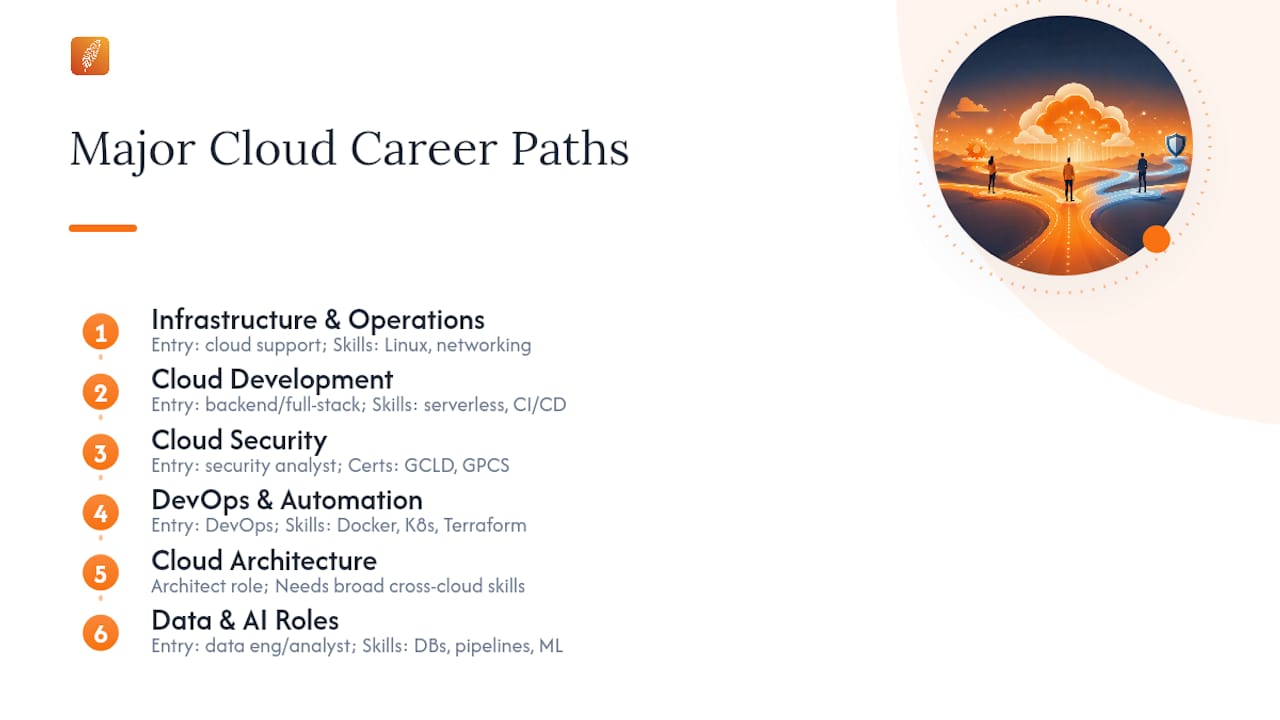
Cloud infrastructure and operations fits people who like systems work, troubleshooting, and reliability. Typical entry roles include cloud support engineer and junior cloud engineer. Core skills: Linux administration, networking fundamentals, and monitoring tools. The AWS Certified Cloud Practitioner works as a first credential here, with the AWS Certified Solutions Architect (Associate) as the next step once you understand provider architecture. Entry-level salaries in this family often land in a broad range that market data commonly reports in the low six figures depending on region and employer, with core early skills centered on Linux, networking, containerization, and infrastructure as code.
Cloud development suits people who already write code and want to build applications that run natively on cloud infrastructure rather than manage the infrastructure itself. Entry points include backend developer or full-stack developer roles at companies running on AWS, Azure, or Google Cloud Platform (GCP). Skills to prioritize: serverless functions, container orchestration, and CI/CD pipelines.
Cloud security is one of the fastest-growing specializations, and it rewards people who like adversarial thinking and compliance detail. Entry roles include cloud security analyst or associate security engineer. Beyond the general provider certifications, GIAC offers targeted cloud security credentials like GCLD for foundational cloud security skills and GPCS for public cloud security specialization, both useful once you've committed to this lane.
Cloud DevOps and automation appeals to people who like building pipelines and eliminating manual work. Entry roles: DevOps engineer, automation engineer. The core toolkit here is non-negotiable: Docker for containerization, Kubernetes for orchestration, and Terraform from HashiCorp for infrastructure as code. The Certified Kubernetes Administrator (CKA) carries real weight in this path because it's vendor-neutral and hands-on.
Cloud architecture is where you land after several years across infrastructure, development, or DevOps. It's less an entry path and more a destination, requiring breadth across networking, security, cost management, and multiple cloud providers.
Data and AI roles in cloud fit people drawn to analytics and machine learning pipelines. Entry roles: data engineer, cloud data analyst. Skills to prioritize: managed database services, data pipeline tools, and basic machine learning platform familiarity on whichever provider you choose.
Many IT hiring managers report that certified staff bring measurable, verifiable value to their teams, which is part of why a well-chosen certification still matters early on, even in an industry that increasingly prizes hands-on proof.
Pro Tip: Don't try to become an architect on day one. Depth in one path, cloud security or DevOps, for example, gets you hired faster than breadth across five paths you've only skimmed. You can widen your scope once you have a title and a paycheck.
Your first project idea should match your chosen path: infrastructure folks should deploy a small multi-tier app with Terraform, security folks should set up and document a cloud security posture audit, and DevOps-minded readers should build a CI/CD pipeline that deploys a containerized app to Kubernetes.

Skills and Tools to Learn for Each Cloud Path
Regardless of which role family you pick, there's a rough learning order that works better than jumping straight to the flashiest tool. Junior cloud roles commonly expect familiarity with Linux, basic networking, containers, and an infrastructure-as-code tool such as Terraform before anything provider-specific.
Learn in this order:
- Linux and networking fundamentals first. Every cloud platform sits on top of these concepts. Skipping this step is the number one reason beginners get stuck debugging things they don't understand.
- Containers next: Docker, then Kubernetes. Docker teaches you how applications get packaged; Kubernetes teaches you how they get orchestrated at scale.
- Infrastructure as code: Terraform. Once you can spin up a container, learn to define infrastructure in code instead of clicking through a console.
- One cloud provider console, deeply: AWS, Microsoft Azure, or Google Cloud Platform. Pick one and go deep rather than sampling all three shallowly.
- CI/CD and monitoring basics. Tools vary by employer, but the concepts (automated deployment, log aggregation, alerting) transfer everywhere.
For hands-on practice, every major provider offers a free tier: AWS Free Tier, Azure's free account credits, and Google Cloud's free trial all let you build real, deployable projects without a corporate account. Push every project to GitHub with a clear README. That public evidence is what helps candidates get hired faster than certifications alone in most hiring conversations.
Your Step-by-Step Roadmap to Advance in a Cloud Career
Timelines vary based on your starting background and how much time you can study weekly. A realistic cloud career path depends on prior experience, weekly study commitment, and target role, and stretches from a few months for people with adjacent IT experience to a couple of years for complete career changers.
- 0 to 12 months: Foundation and first job. Learn Linux, networking, and one cloud provider. Build two portfolio projects. Earn one foundational certification (AWS Cloud Practitioner, Azure Fundamentals, or GCP's equivalent). Start applying at month 6, not month 12. A structured 90-day playbook combining one certification with real projects is a workable template for motivated beginners.
- 1 to 3 years: Specialization and ownership. Choose your role family definitively. Earn a role-specific associate certification. Take ownership of at least one production system. Start mentoring newer hires informally.
- 3+ years: Scope expansion. Move toward senior or architect titles by expanding scope across teams, not by collecting more certifications. Document cross-team technical impact.
Checklist by phase:
- Phase 1: two deployed projects, one certification, applications submitted by month six
- Phase 2: one production system owned, one associate-level certification, first mentoring experience
- Phase 3: documented cross-team impact, leadership on at least one major migration or redesign
Apply before you feel ready. Waiting until you've mastered every skill on a job posting is the single most common reason capable beginners stay stuck longer than necessary.
Which Cloud Certifications Actually Matter
Certifications work best as door-openers early in your cloud career path and lose influence once you're competing for senior or staff roles, where documented impact matters more.
Match your certification to your role family:
- General foundation: AWS Certified Cloud Practitioner or Microsoft Certified: Azure Fundamentals (AZ-900). Either works as a first step regardless of specialization.
- Infrastructure and operations: AWS Certified Solutions Architect (Associate), Azure Administrator Associate, or Google Cloud Associate Cloud Engineer.
- DevOps and automation: Certified Kubernetes Administrator (CKA), paired with hands-on Terraform and Docker practice.
- Cloud security: GIAC's cloud-focused credentials, including GCSA for security automation once you're working in DevSecOps-adjacent roles.
Certifications carry the most weight during your first job search and when recruiters are filtering resumes at scale. Past the senior level, advancement depends on scope expansion and documented cross-team impact rather than additional badges. Don't collect four certifications before your first cloud job. One relevant credential, backed by two solid projects, outperforms a wall of badges with nothing deployed behind them.
Pro Tip: When you list a certification on your resume, pair it immediately with the project where you applied what it taught you. "AWS SAA certified, deployed a load-balanced web app across two availability zones" reads far stronger than the certification name alone. Our guide on presenting core competencies on IT resumes covers this framing in more depth.
Three Example Cloud Career Trajectories
The former database administrator. A DBA's SQL and data modeling skills transfer directly to cloud database engineering. First six months: learn a managed database service (RDS, Cloud SQL, or Azure SQL Database), build a migration project moving an on-premises database to the cloud, and pursue the associate-level certification matching their chosen provider.
The front-end developer. Existing coding skills shorten the path to cloud developer roles. First project: build and deploy a serverless application using AWS Lambda or Azure Functions. Certification: provider-specific developer associate track. Portfolio piece: a working app with a public repo showing the CI/CD pipeline.
The non-technical career changer. Start in cloud support, where communication skills and troubleshooting aptitude matter as much as deep technical knowledge. First 12 months: earn a foundational certification, build one small deployed project, and target support or junior technician roles before pushing toward associate cloud engineer.
Moving From Non-IT or Adjacent IT Roles Into Cloud
Your current skills probably map to a cloud role more directly than you think. A sysadmin's patching and uptime experience translates almost directly into cloud operations. A DBA's query optimization skills map to cloud data engineering.
- Map one existing skill to one cloud role family before you start learning anything new.
- Build one project, earn one certification, make one networking connection in your target specialization within 90 days.
- Target support, junior site reliability, or cloud technician roles first rather than jumping straight for a mid-level title your resume doesn't yet support.
Job Outlook and Salary Guidance for Cloud Roles
Demand for cloud skills tracks broader IT investment closely. Gartner forecasts worldwide IT spending to grow roughly 10.8% in 2026, reaching $6.15 trillion, a signal that employer investment in cloud infrastructure and the people who run it isn't slowing down.
Salary bands widen substantially as you move up the ladder:
- Entry-level: market data commonly places entry cloud engineer salaries in a generally competitive range, varying by region and employer, according to salary and skills data.
- Mid to senior: salary progression accelerates as scope grows, following the five-level career ladder pattern from junior through principal.
- Remote and geography: ranges vary widely by metro area and whether the role is remote, so treat any single figure as a starting reference point rather than a guarantee.
The Bureau of Labor Statistics tracks computer and information technology occupations broadly, offering a useful baseline for comparing cloud-specific roles against the wider tech labor market.
What Hiring Managers Actually Look for in Cloud Candidates
Reviewing how cloud job seekers get matched to open roles surfaces a consistent pattern: hiring managers filter on evidence, not intentions. A candidate who can walk through one real deployed project, including what broke and how they fixed it, consistently outperforms a candidate with three certifications and no story to tell.
The highest-impact interview move is project storytelling tied to a measurable outcome: "reduced deployment time from 40 minutes to 6" beats "worked on CI/CD" every time. The most common pitfall is over-certification paired with weak framing, three badges and a resume bullet that says "AWS certified" with nothing underneath it. Fix that by rewriting every credential as a project sentence, not a label. Job seekers who understand why relying on LinkedIn alone falls short tend to move faster, because direct outreach to hiring managers surfaces roles that never get posted publicly.
How Pluckjobs Speeds Up Your Cloud Job Search
Pluckjobs gets your cloud portfolio in front of the right hiring manager directly, instead of leaving your resume in a queue behind hundreds of other applicants.
Building projects and certifications is half the work. Getting them seen by the right person is the other half, and that's where most cloud job seekers lose momentum. Pluckjobs combines AI resume optimization tuned for ATS keyword matching with direct hiring manager contact data, so your Terraform project and your AWS certification land in front of someone who can actually make a hiring decision, not a filtering algorithm alone. The platform also builds tailored application materials and interview prep specific to IT and cybersecurity roles, which matters when you're trying to explain a career transition clearly. If you've built your first cloud project and earned your first certification, the next move is getting them seen. Start your free trial with Plucky AI and turn your portfolio into interviews.
Sources
- Five tips to help you land your first cloud job
- How to begin building a cloud career (Google Cloud blog)
- Computer and information technology occupations | Bureau of Labor Statistics
- Cloud Engineer Salary, Skills, and Career Path
FAQ
What Is a Career Path in Cloud?
A cloud career path is the progression through role families, cloud infrastructure, security, DevOps, development, or architecture, moving from entry-level to senior and staff positions as skills and scope expand.
Can You Give an Example of a Cloud Career Trajectory?
A common example: a former database administrator moves into cloud database engineering by learning a managed database service, migrating a project to the cloud, and earning an associate-level certification within their first year.
Are Cloud Jobs Still in Demand?
Yes. Gartner projects worldwide IT spending to grow about 10.8% in 2026, reflecting sustained employer investment in cloud infrastructure and the people who manage it.
Do Cloud Engineers Get Paid Well?
Entry-level cloud engineer salaries commonly land in the low six figures depending on region and employer, according to market salary data, with pay increasing substantially as engineers move into senior, staff, and principal roles.