
The AI security roles worth prioritizing right now are AI/ML security engineer, LLM security engineer, adversarial ML specialist (AI red teamer), AI security architect, AI GRC/trust and safety lead, and AI security researcher. Each pulls from a different part of your existing cybersecurity or ML background, and each is hiring at a pace traditional security postings aren't matching.
If you're coming from application security, the AI/ML security engineer or LLM security engineer track is your fastest entry point. If you have a penetration testing or offensive security background, adversarial ML specialist roles reward that instinct directly. If you've spent years in governance, risk, or compliance, AI GRC and trust and safety roles are absorbing new demand as regulators catch up.
Projected salary ranges for these specialized tracks run roughly $130,000 to $280,000 or more, depending on the role and seniority level. That's a wide band, and where you land in it depends heavily on whether you build applied engineering skills or research depth first.
- AI/ML security engineer — hardens ML pipelines and model endpoints against attack.
- LLM security engineer — secures generative AI systems, prompt flows, and retrieval pipelines.
- Adversarial ML specialist — red-teams models to find exploitable weaknesses before attackers do.
- AI security architect — designs secure AI system architecture across an organization.
- AI GRC/trust and safety lead — manages compliance, policy, and risk for AI deployments.
- AI security researcher — builds novel attack and defense techniques, often at frontier labs.
Start by matching your current skill set to the closest role below, then use the transition plan later in this article to close the gaps. Your next move is figuring out which of these six titles fits the resume you already have.
Key Takeaways
AI security careers reward practitioners who pair applied engineering skills with documented adversarial testing experience, and specialization pays more than breadth alone.
| Point | Details |
|---|---|
| Six roles to target | AI/ML security engineer, LLM security engineer, adversarial ML specialist, AI security architect, AI GRC lead, and AI security researcher cover most openings. |
| Salary bands vary widely | Projected ranges run roughly $130,000 to $280,000 or more depending on specialization and seniority. |
| Hands-on proof beats certifications | A documented red team exercise or fixed vulnerability outperforms a certificate alone in interviews. |
| Cross-team fluency matters | Success requires working closely with data science, legal, and traditional cybersecurity teams, not just technical depth. |
| Use Pluckjobs to speed discovery | Pluckjobs surfaces AI security postings other searches miss and connects you directly to hiring managers with tailored resumes. |
Table of Contents
- Top AI Security Roles: Concise Role Profiles
- What Do These Roles Actually Do Day to Day?
- What Do These Roles Pay, and Where Is Demand Concentrated?
- How Do You Transition Into an AI Security Role?
- How Do You Find and Apply for AI Security Jobs?
- Who Do AI Security Teams Work With Every Day?
- Where Is AI Security Hiring Headed Next?
- What Rules and Ethics Should AI Security Professionals Know?
- Which Track Should You Actually Chase First?
- How Pluckjobs Helps You Land an AI Security Role
- Sources
- FAQ
Top AI Security Roles: Concise Role Profiles
Job titles in this field are still settling, but the responsibilities behind them cluster into recognizable patterns. Industry role lists point to a consistent shortlist of emerging AI security positions, and most employer postings map cleanly onto one of the following.
-
AI/ML security engineer. Secures the machine learning pipeline itself: training data integrity, model storage, serving infrastructure, and access controls. This is the natural landing spot for application security or DevSecOps engineers who want to specialize. Alternate titles include "ML security engineer" and "AI infrastructure security engineer."
-
LLM security engineer (generative AI security engineer). Focuses specifically on large language model risks: prompt injection, jailbreaking, data leakage through model outputs, and securing retrieval-augmented generation (RAG) pipelines. Role profiles describe core work around preventing data leakage and building model verification tests. Common alternate titles: "generative AI security engineer," "LLM red teamer."
-
Adversarial ML specialist / AI red team engineer. Attacks models on purpose: evasion attacks, model inversion, data poisoning, membership inference. This role suits penetration testers and red team veterans who want to apply offensive skills to ML systems rather than traditional networks. You'll also see it listed as "AI red teamer" or "adversarial robustness engineer."
-
AI security architect. Designs the security posture for AI systems at the organizational level, not just a single model or pipeline. Amazon's own postings for AI-focused security engineering describe designing security guardrails and performing threat modeling at scale, which is architect-level work even when the title says "engineer." This role suits senior security engineers with architecture experience in cloud or distributed systems.
-
AI GRC / trust and safety specialist. Owns policy, compliance mapping, and risk assessment for AI deployments, often bridging legal, product, and engineering teams. Fits professionals with a governance, risk, and compliance (GRC) or audit background. You'll find this under "AI trust and safety manager" or "responsible AI compliance lead."
-
AI security researcher. Produces original research: new attack techniques, evaluation benchmarks, and defense prototypes, typically at a frontier AI lab. NVIDIA's postings for senior AI security researcher roles require original contributions and evaluation harness-building, not just implementation of existing controls. This track suits people with research publications or a strong academic ML background.
-
Secure MLOps / platform engineer. A hybrid role focused on embedding security gates into CI/CD pipelines for model deployment. It overlaps heavily with the AI/ML security engineer role but leans more toward platform and tooling work than model-level analysis.
-
AI security manager / lead. A people-management layer sitting above the individual contributor roles above, typically requiring 5 to 8 years of combined security and ML exposure before an organization will hand over a team.
-
AI security consultant. Contract or advisory work spanning multiple client organizations, often the path chosen by senior practitioners who want variety over depth in a single company's stack.
Job titles vary by employer, but the underlying work clusters consistently around securing model inputs and outputs and integrating controls into the MLOps lifecycle, regardless of what the job posting calls it.
What Do These Roles Actually Do Day to Day?
Titles tell you what door to walk through. Responsibilities tell you what you'll actually be doing at 10 a.m. on a Tuesday, and they vary more by seniority than by title alone.
At the junior level, expect to run adversarial test suites against existing models, document prompt injection vulnerabilities, and support threat modeling sessions led by someone more senior. Mid-level practitioners own a specific system's security posture: they design the adversarial testing strategy for a RAG pipeline, build model poisoning detection into the training loop, or write the secure MLOps standards a platform team will enforce. Senior engineers and architects set policy across multiple systems and often mentor the junior tier. Research leads set the technical agenda, deciding which attack classes matter enough to invest a quarter of engineering time in.
The work itself breaks into a few recurring categories:
- Threat modeling AI systems specifically, not just the infrastructure around them, including how a model's training data, weights, and outputs can each be attacked separately.
- Adversarial testing and red teaming, from automated prompt injection sweeps to manual jailbreak attempts.
- RAG security work, since retrieval pipelines introduce a new class of data leakage and injection risk that classic web app security testing doesn't cover.
- Model poisoning detection, watching training and fine-tuning data for manipulation before it ever reaches production.
- Secure MLOps practices, embedding security checks into model CI/CD pipelines the same way DevSecOps embedded them into software pipelines a decade ago.
Employers measure this work through outcome metrics: incidents prevented or caught before production, detection precision on adversarial test suites, time-to-deploy with security gates intact, and clean audit results for regulated deployments. A candidate who can point to a specific reduction in false positives on a detection model, or a documented jailbreak they closed before launch, stands out far more than one who lists tool names.
Pro Tip: Keep a running log of every adversarial test case you write, even informal ones. A portfolio of test cases with documented findings is worth more in an interview than a certification, because it proves you've actually broken something on purpose and fixed it.
What Do These Roles Pay, and Where Is Demand Concentrated?
Compensation in AI security tracks meaningfully above generalist cybersecurity roles, and the gap widens with specialization.
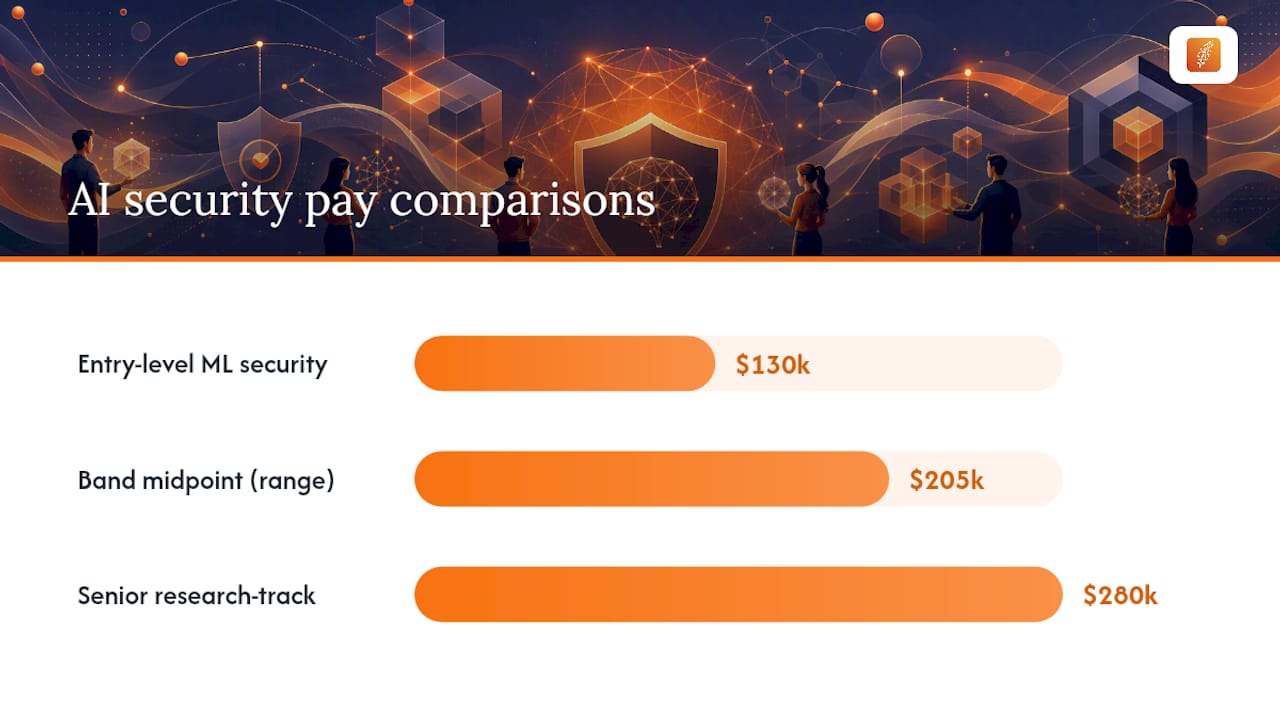
Projected salary bands for these roles land roughly between $130,000 and $280,000 or more, with the wide spread reflecting the difference between an entry-level ML security engineer and a senior AI security researcher at a frontier lab. Research-track roles tend to sit at the top of that band because they demand original contributions rather than applied implementation of existing controls, a distinction NVIDIA's own senior AI security researcher postings make explicit by requiring published work and benchmark development.
Demand is concentrated in a few employer categories:
- Cloud and AI platform providers building the infrastructure other companies' models run on, where a single vulnerability affects thousands of downstream customers.
- Frontier AI labs hiring research-track specialists to stay ahead of novel attack techniques before they hit production systems.
- Financial services and other regulated sectors, where AI GRC and compliance-focused roles are growing fastest because regulators are asking pointed questions about model risk.
- Mid-size SaaS companies adding LLM features to existing products, who need generalist AI/ML security engineers rather than narrow specialists.
Seniority and specialization compound compensation more than either does alone. A generalist AI/ML security engineer with three years of experience sits well below a specialist adversarial ML researcher with the same tenure, largely because the specialist pool is smaller and the failure cost of getting it wrong is higher.
How Do You Transition Into an AI Security Role?
The path from general cybersecurity into AI security is shorter than most practitioners assume, provided you sequence the learning correctly instead of trying to absorb everything at once.
-
Build ML fundamentals first. You don't need a machine learning degree, but you need to understand how models are trained, how embeddings work, and what a training pipeline actually looks like end to end. Skipping this step is the most common reason experienced security engineers stall in AI security interviews.
-
Study adversarial ML specifically. Learn the standard attack categories: prompt injection, data poisoning, model inversion, and evasion attacks. SANS Institute offers training that covers adversarial testing and secure ML practices directly, and it's a credible line item on a resume for hiring managers screening for this exact gap.
-
Get hands-on with LLM-specific risks. Set up a small RAG pipeline yourself and try to break it. This single exercise teaches more about generative AI security than most courses, because it forces you to think about the attack surface a retrieval system introduces.
-
Pursue vendor-neutral governance and technical certifications where they add credibility. Certifications and structured training around AI governance frameworks like ISO/IEC 42001, alongside secure MLOps and adversarial ML workshops, are consistently recommended across role profiles. Treat certifications as a credibility signal, not a replacement for hands-on work.
-
Build a portfolio project that shows outcomes, not just effort. A documented red team exercise against an open-source model, a write-up of a prompt injection vulnerability you found and fixed, or a small tool that detects model poisoning attempts all demonstrate exactly what hiring managers are screening for.
Reviewing broader cybersecurity career path options can help you see how an AI security specialization fits your longer-term trajectory rather than treating it as an isolated pivot.
Pro Tip: Publish your portfolio project somewhere public, even a simple GitHub repository with a readme. Hiring managers for AI security roles routinely check for evidence of hands-on work before they schedule a phone screen, and a public repo does that screening for you.
How Do You Find and Apply for AI Security Jobs?
Job descriptions for AI security roles often bury the signal under generic security language, so knowing what to scan for saves hours of wasted applications.
- Look for phrases like "adversarial testing," "model robustness," "RAG security," or "prompt injection" in the responsibilities section. Their presence separates a genuine ML-security role from a generalist security posting with an AI buzzword bolted on.
- Match your resume language to the role's specific vocabulary. A resume that says "penetration testing" needs a line that says "adversarial ML testing" or "red teaming for generative AI systems" to pass automated screening.
- Publish visible proof of work: a GitHub repository, a conference talk, or a written case study of a vulnerability you found and fixed carries more weight than a bullet point claiming familiarity with the topic.
- Reach out directly to hiring managers or team leads rather than relying solely on the applicant tracking system, since these teams are still small enough that a direct message often gets read.
A structured interview preparation plan built around these specific hiring signals will get you further than a generic cybersecurity job search strategy applied to AI-specific postings.
Who Do AI Security Teams Work With Every Day?
AI security roles rarely operate in isolation. You'll spend a meaningful share of your week talking to data scientists, ML engineers, product managers, and legal or compliance staff, often within the same week you're also reviewing infrastructure security with a traditional cybersecurity team.

Data science and ML engineering teams own the models you're securing, and they don't always think in security terms. Part of the job is translating a threat model into language a data scientist will actually act on, rather than handing over a compliance checklist they'll ignore. Traditional cybersecurity teams, meanwhile, own the infrastructure layer underneath the model, network segmentation, identity and access management, cloud configuration, and expect AI security specialists to plug into that existing posture rather than build a parallel one.
Legal, privacy, and trust and safety teams get involved whenever a model touches personal data or makes decisions that affect people directly, which in practice is most consumer-facing AI systems. AI GRC specialists spend much of their time as the connective layer between these groups, translating regulatory requirements into technical controls engineers can actually implement.
This cross-functional demand is part of why hiring managers value candidates with broad technical fluency over narrow specialists who can't communicate outside their own discipline. NVIDIA's own research role postings make this explicit, expecting strong software engineering and threat modeling skills alongside applied ML knowledge rather than purely academic credentials.
Where Is AI Security Hiring Headed Next?
Titles are consolidating even as the underlying work keeps expanding. A few patterns are worth tracking if you're planning a multi-year career move rather than a single job change.
Agentic AI systems, models that take autonomous actions rather than just generating text, are creating an entirely new attack surface around tool use and multi-step decision chains. Expect security roles focused specifically on agent security to emerge as a distinct specialization within the next hiring cycle or two, separate from today's LLM security engineer track.
Supply chain security for models themselves is becoming a bigger concern as organizations increasingly fine-tune or build on top of third-party foundation models rather than training from scratch. That shifts part of the AI security engineer's job toward vetting upstream model provenance, similar to how software supply chain security evolved after high-profile dependency attacks.
Regulatory pressure is accelerating demand for AI GRC and trust and safety roles faster than for pure engineering roles, particularly in financial services and healthcare, where new disclosure and risk assessment requirements are landing. Expect this track to keep growing headcount even in years when engineering hiring slows.
Industry commentary consistently flags new specialized titles like AI security architect and AI threat modeling specialist as essential as more critical infrastructure depends on AI systems. The practical takeaway: build skills that transfer across titles, since the specific job name you hold in three years may not exist yet.
What Rules and Ethics Should AI Security Professionals Know?
Regulatory frameworks for AI are still forming, but a few are already shaping how AI security roles get scoped and staffed. The EU AI Act sets risk-tiered obligations for AI systems operating in the European market, and organizations serving EU customers are already building compliance teams around it, which is part of why AI GRC roles are growing fastest in regulated, multinational employers.
ISO/IEC 42001, the AI management system standard, is showing up repeatedly across certification and training recommendations for AI security practitioners, because it gives organizations a structured framework for governance that security teams can map controls against. Expect familiarity with it to become a baseline expectation for AI security architect and GRC roles within a few years, the way ISO 27001 became for traditional security architects.
Beyond formal regulation, ethical considerations shape daily decisions in ways a checklist can't fully capture. An adversarial ML specialist deciding how publicly to disclose a discovered jailbreak, or an AI security researcher weighing whether a new attack technique should be published at all, is making a judgment call with real consequences. These roles increasingly require the same disclosure discipline traditional vulnerability research has developed over two decades, applied to a much newer and less standardized set of systems.
Which Track Should You Actually Chase First?
Applied engineering roles, the AI/ML security engineer and LLM security engineer tracks, are hiring faster right now than research positions, mostly because every company shipping an AI feature needs someone to secure it immediately. Research and architect-level roles pay more at the ceiling but take longer to break into and reward depth over speed.
If you need traction fast, an applied role is the better bet. If you're building a decade-long career, invest early in adversarial ML depth even if it slows your first offer, because that specialization compounds into architect and research-track opportunities later.
— Diego
How Pluckjobs Helps You Land an AI Security Role
Finding these roles is harder than it should be, since many AI security openings get buried under generic "security engineer" titles or never surface in a standard job board search at all. Pluckjobs solves that discovery problem directly with SerpAPI-powered role matching that surfaces AI security postings other search methods miss, then pairs each one with Apollo-sourced hiring manager contact details so you're not cold-applying into an applicant tracking system black hole.
The workflow is straightforward: search for AI security roles matched to your background, get a tailored resume that mirrors the specific ML security vocabulary each posting uses, then reach the actual hiring manager instead of waiting on a recruiter queue. That combination, precision role matching plus direct outreach data, is what separates landing an adversarial ML specialist interview from watching your application disappear into a pile of five hundred others. Pairing this with an AI-driven job matching approach built specifically for IT and cybersecurity backgrounds means you're applying to roles that actually fit what you've built so far.
Start a trial at Pluckjobs and run your first role search today.
Sources
- SANS Institute
- Top 10 Emerging AI Security Roles 2026
- What is an AI Security Engineer - role profile & training
FAQ
Is AI Security a Good Career Right Now?
Yes. Demand is concentrated across cloud providers, frontier AI labs, and regulated industries, and projected salary bands for specialized roles run well above generalist cybersecurity positions.
Can You Make $200,000 a Year in Cybersecurity Through AI Security?
Senior and specialized AI security roles, particularly adversarial ML specialist and AI security architect positions, fall within projected ranges that reach $200,000 and beyond at the senior end.
Can You Make $500,000 a Year in Cybersecurity?
Compensation at that level typically sits with senior leadership, executive, or highly specialized research roles at major AI labs rather than standard individual contributor positions, and it isn't representative of typical AI security salary bands.
What Kind of AI Job Pays Close to $900,000?
Compensation packages near that figure are almost always executive-level or highly senior research leadership positions at major AI companies, often including significant equity, rather than typical AI security engineer or analyst roles.
How Do I Start Transitioning From General Cybersecurity Into AI Security?
Build ML fundamentals, study adversarial ML attack categories, get hands-on with a RAG pipeline, and document a portfolio project such as a red team exercise or vulnerability write-up before applying. Tools like Pluckjobs can then match your existing cybersecurity background to the specific AI security postings that fit it.